
Start with the essentials
China’s four broad tea regions organise a complex landscape into a useful map. Temperature, rainfall, growing seasons and plant resources interact with local manufacturing traditions, making geography more than a location label.
The article moves from regional comparisons to particular origins and explains how environments influence leaves and flavour. A broad frame followed by cultivar, harvest and processing details helps account for diversity within each region.
Three key points
- Regions summarise conditionsThe framework compares climate and resources while leaving room for local differences.
- Environment meets manufactureMaterial, seasons and traditions explain familiar products and their distribution.
- Terroir needs closer scalesRegion, district and garden provide progressively more specific information.
Connect the region with the tea
Locate two teas on the four-region map, then add their specific origins and methods. If teas from one broad region differ, investigate season, cultivar and processing next.
How were the four regions defined?
The division of China into four tea regions is not based on administrative boundaries. It is an ecological suitability zoning for the tea plant, using criteria such as:
China’s four tea regions
Tap a number or a row to match them.
Where the four regions lie
- Jiangnan: south of the Yangtze
- South China: no real winter
- Southwest: plateau, tea origin
- Jiangbei: Yangtze to Qinling–Huai
Blue line: the Yangtze. Dashed: Qinling–Huaihe, the northern limit.
Basis & sources
Mechanisms: Based on CAAS Tea Cultivation Ecology and National Zonation Standards (R-042, R-030). Thermal-water balance dictates polyphenol and amino acid synthesis rates.
Note: Macro-regional figures provide baseline benchmarks; micro-watersheds exhibit distinct terroir due to vertical alpine zonation.
Boundaries approximate; outlines: Natural Earth 1:50m.
- Climate: annual mean temperature, extreme winter lows, accumulated temperature above 10 °C, rainfall, and frost-free period.
- Soil: type, pH, organic matter, and drainage.
- Terrain and elevation: how hills, plateaus, and mountains create local microclimates.
- Cultivar types: the natural distribution of large-, medium-, and small-leaf tea plants.
- Tea-category tradition: the main tea types that long production history has shaped in each region.
This four-region framework is widely accepted in Chinese tea science and underpins cultivar breeding, plantation planning, and tea-category optimisation.
Jiangnan: the productive heartland
Jiangnan lies south of the Yangtze River, roughly north of the Dayong–Lianjiang line, and covers Zhejiang, Hunan, Jiangxi, southern Hubei, southern Anhui, southern Jiangsu, and northern Fujian. It has traditionally been China’s most productive tea region, long cited as roughly two-thirds of national output[1]; that share has fallen markedly as Yunnan, Guizhou and Sichuan expanded.
The climate is mid- to south-subtropical monsoon, with annual mean temperatures of 15–18 °C and rainfall of 1,400–1,600 mm[1][2]. Four distinct seasons and abundant spring rain make it ideal for green tea: tender shoots are high in amino acids and low in polyphenol/amino-acid ratio, yielding fresh, mellow infusions[2].
Famous teas from Jiangnan read like a who’s-who of Chinese green tea: West Lake Longjing, Dongting Biluochun, Huangshan Maofeng, Lushan Yunwu, Taiping Houkui. The region also produces black tea (Keemun), dark tea (Anhua), white tea (Fuding), and scented teas.
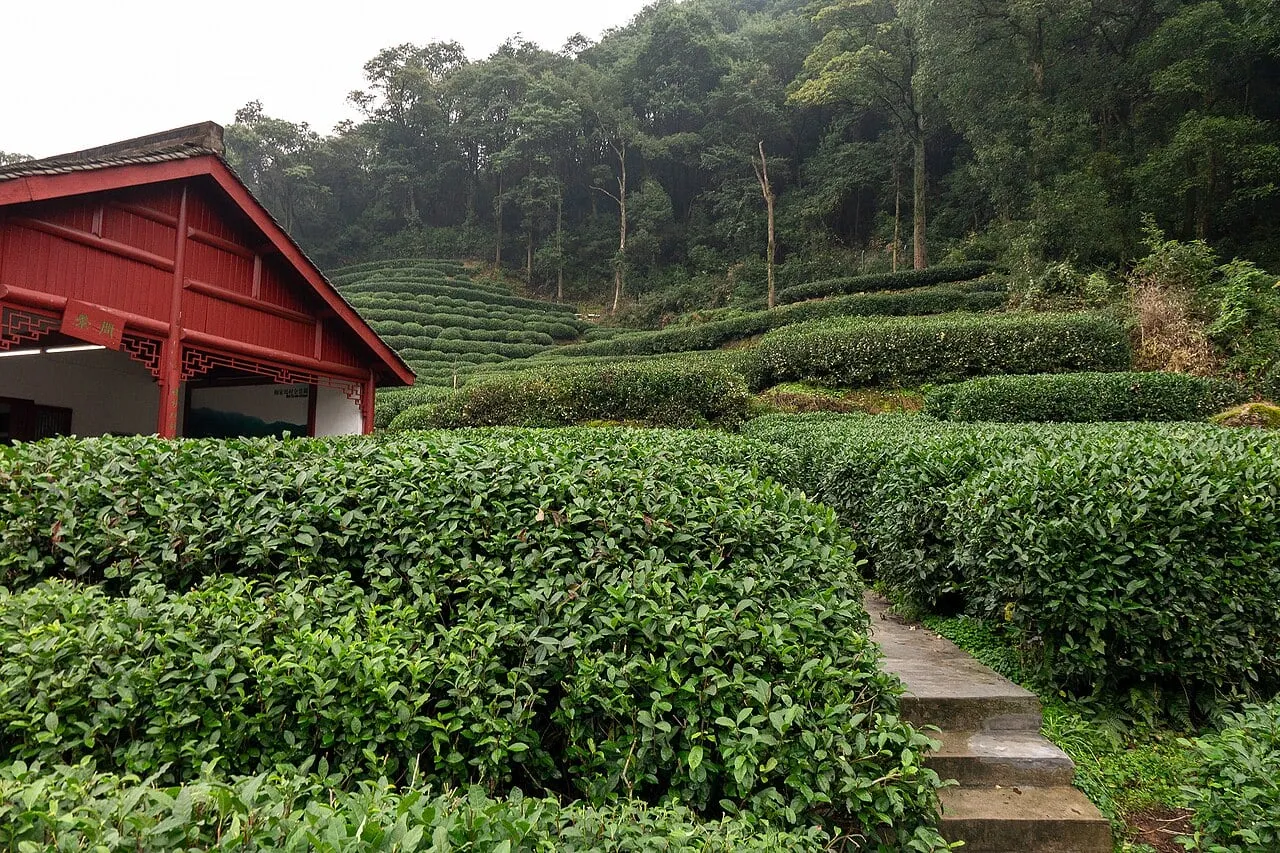
At Meijiawu in Hangzhou, tea rows step up a hillside, a path runs through the bushes, and woodland stands above them. This local view gives the idea of a low-hill tea garden a concrete setting.
South China: the oolong and black-tea greenhouse
South China lies south of the Dayong–Lianjiang line and includes south-eastern Fujian, south-central Guangdong, south-western Guangxi, southern Yunnan, Hainan, and Taiwan. It is classed as the most ecologically suitable tea region in China, with annual means of 19–22 °C and rainfall of 1,200–2,000 mm; the growing season exceeds 10 months[1][2].
High temperatures, heavy rainfall, and deep, fertile lateritic red soils favour large-leaf tea trees and the production of oolong, black, and white teas[2]. Tieguanyin, Fenghuang Dancong, Liubao, Dongding oolong and Oriental Beauty offer useful sample introductions to this region.
Historically, South China has also been China’s most important base for tea exports, especially oolong and congou black teas shipped to South-East Asia and Europe[3]. The broad region contains many local settings; specific gardens and tea samples need to be read alongside the regional description.
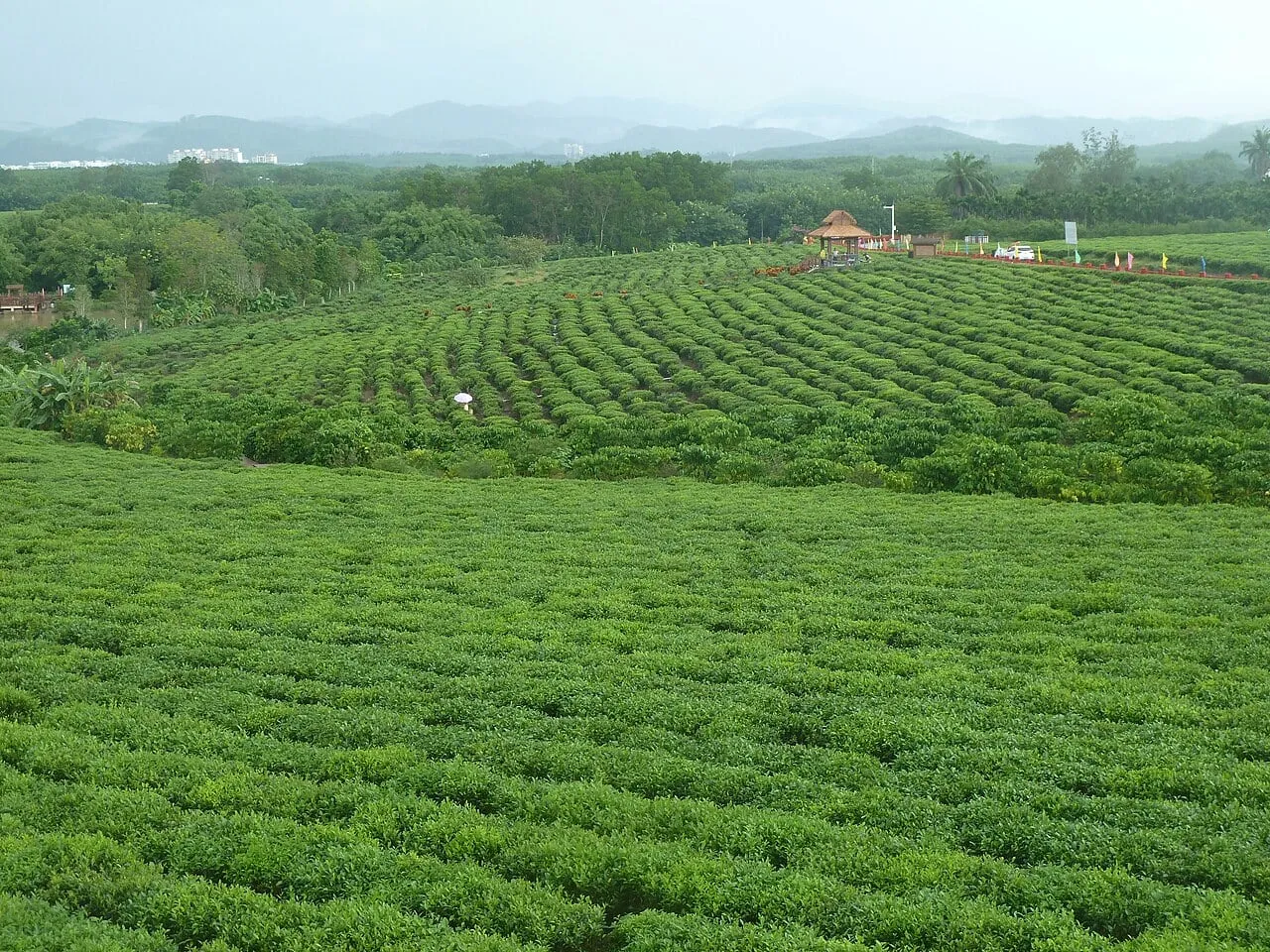
At Baisha in Hainan, rows extend over open slopes alongside roads, trees and hills. This is one South China production setting. Together with the Hangzhou example, it shows why ecological regions should not be expected to share one visual pattern.
Southwest: the origin centre and Pu’er kingdom
The Southwest region covers Yunnan, Guizhou, Sichuan, and south-eastern Tibet. It is China’s oldest tea region and the centre of tea’s origin and domestication[1][2]. Wild, transitional, and cultivated ancient tea-tree communities in Yunnan provide physical evidence for the theory that tea originated in south-west China[4].
The terrain is plateau and mountain, with strong vertical climate zoning. Annual mean temperatures range from 14–18 °C and rainfall from 1,000–1,700 mm[1][2]. Large day–night temperature differences and frequent fog help accumulate flavour compounds. Soils are varied, from red latosol to brown and yellow earth[2].
Cultivar diversity is greatest here: shrub, small-tree, and tree-type tea plants coexist, and large-leaf varieties are abundant[2]. The region is famous for Pu’er tea, Yunnan black tea (Dianhong), and Sichuan–Guizhou teas such as Mengding Ganlu, Duyun Maojian, Sichuan black tea, and Tibetan border tea. Ancient tea tree groves across the Lancang River basin, rooted deep into fertile mountain forest soils, yield unparalleled complexity and wild mountain resonance (shanye qiyun).
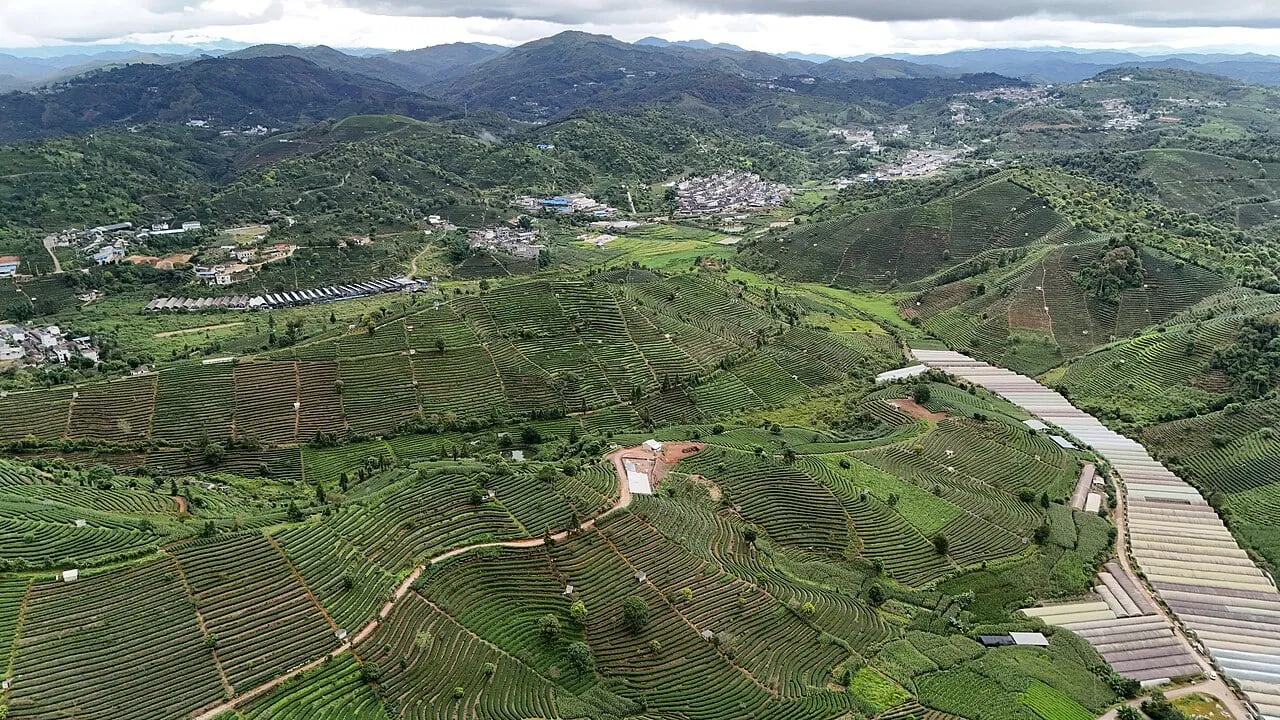
Yixiang in Simao, Pu’er, provides one Yunnan observation point: tea rows turn with the slopes while roads and settlement connect the fields. Province names are an entry to the broad region; closer comparisons need specific sites, and one Yunnan garden cannot stand for every setting across the Southwest.
Jiangbei: the northern frontier
Jiangbei lies north of the Yangtze River and south of the Qinling–Huaihe line, covering southern Henan, southern Shaanxi, southern Gansu, northern Hubei, northern Anhui, northern Jiangsu, and south-eastern Shandong. It is the northern boundary of Chinese tea cultivation.
Conditions are the toughest of the four regions: annual mean temperatures of 15–16 °C, winter extremes around -10 °C, and rainfall of only 700–1,000 mm, unevenly distributed[1][2]. The harvest season lasts only about 180 days[2]. Growers must use cold-resistant, small- and medium-leaf cultivars and employ frost protection and irrigation[2].
Yet hardship produces character. Large day–night temperature differences and a long dormant period help accumulate aromatic substances and amino acids, so Jiangbei green teas are often notably fragrant and brisk[2]. Famous examples include Xinyang Maojian, Lu’an Melon Seed, Ziyang Maojian, and Rizhao green tea.
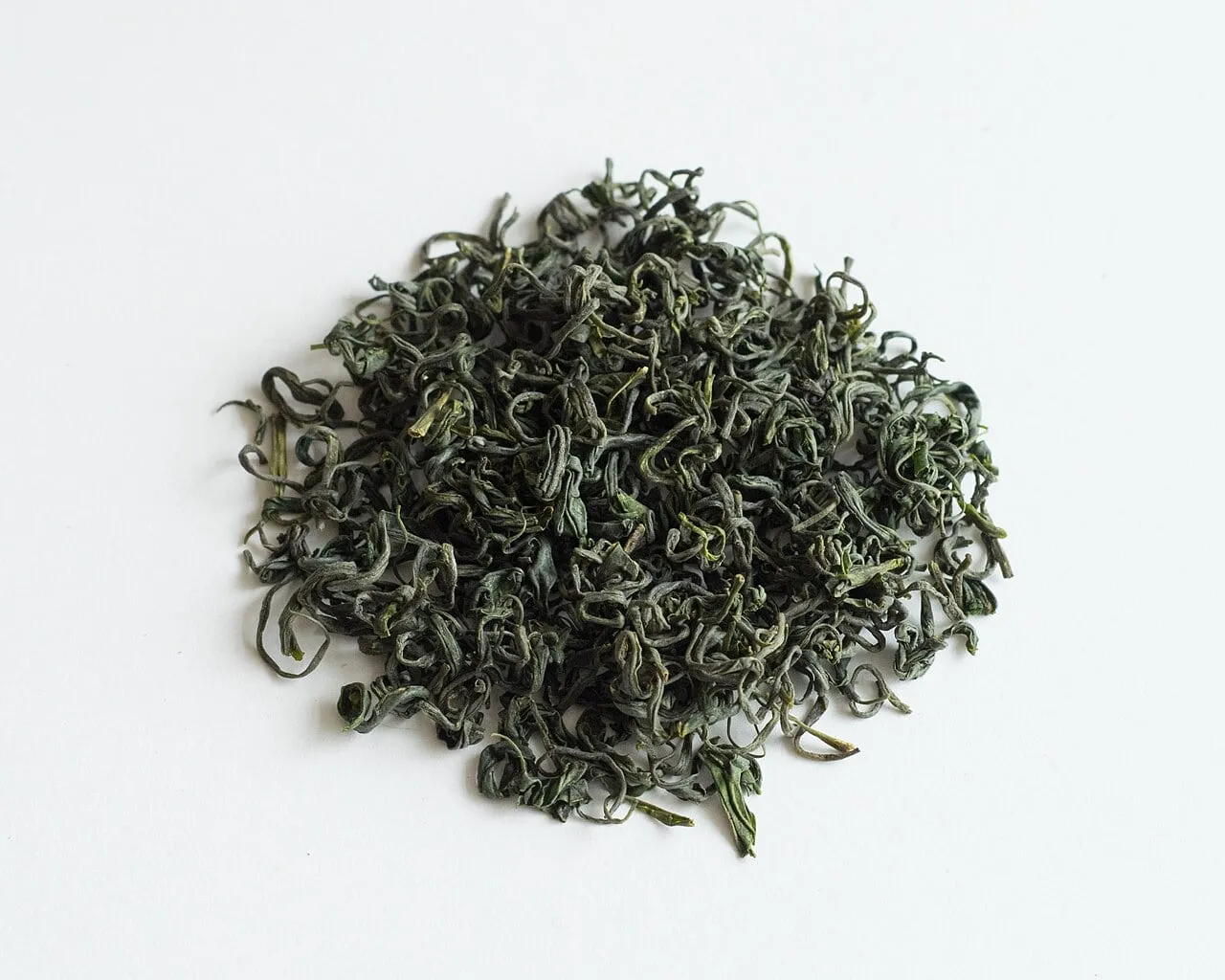
Return from the map to a tea sample. This Laoshan green tea from Shandong provides a Jiangbei dry-leaf example: inspect its curls, tightness and distribution of pieces, then record aroma and taste by brewing. The appearance describes the sample rather than the whole region.
From region to cup: how climate shapes flavour
The differences among the four regions ultimately end up in the cup:
From climate to cup
Switch regions: climate, plant, cup.
Jiangnan: misty, four seasons
- Mean 15–18 °C, short winter rest
- Mist, diffuse light: more amino
- 1,400–1,600 mm rain, wet spring
- Shrub cultivars; famous greens
Mild, wet and misty: fresh, umami-rich green teas.
Basis & sources
- Soil Parent Material & Topography
- Red and yellow earth; acidic pH 4.5–5.5; moderate organic matter
- Signature Historic Teas
- West Lake Longjing, Biluochun, Huangshan Maofeng, Junshan Yinzhen, Keemun Black, Wuyi Rock Tea, Lapsang Souchong, Fuding White
Mechanisms: Based on CAAS Tea Cultivation Ecology and National Zonation Standards (R-042, R-030). Thermal-water balance dictates polyphenol and amino acid synthesis rates.
Note: Macro-regional figures provide baseline benchmarks; micro-watersheds exhibit distinct terroir due to vertical alpine zonation.
Thermometer shows the upper mean temperature; rain lines show relative rainfall only.
- Temperature controls the growing season. Hot, long summers in South China suit polyphenol-rich oolongs and black teas; cool, short seasons in Jiangbei favour fresh, green-tea profiles.
- Rainfall and humidity affect leaf thickness. Misty, humid Jiangnan and the Southwest produce tender leaves with abundant amino acids and less bitterness.
- Day–night temperature range influences aroma. The high plateaus of the Southwest, with large diurnal swings, encourage aromatic compound accumulation.
- Soil contributes minerality. Acidic red and yellow earths are generally favourable for tea, but different parent materials give subtle regional signatures.
These are typical tendencies, not absolute rules. Within each region, elevation, slope orientation, cultivar, and processing all create significant flavour differences.
Common Myths & Scientific Clarifications
Myth 1: “Are China’s four tea regions defined strictly along provincial administrative borders?”
Scientific Clarification: The division is an agro-ecological classification based on botanical suitability rather than political boundaries [1]. Formulated by the Tea Research Institute of CAAS and agricultural botanists, it groups terroirs by annual accumulated thermal units (≥10 °C), precipitation, extreme winter minimums, and soil parent material [1][2]. Because topography varies drastically within single provinces, administrative units often straddle multiple tea regions: northern Fujian belongs to Jiangnan while the south belongs to South China, and Sichuan spans both Southwest and Jiangnan zones [1]. When sourcing Chinese specialty tea, evaluate the local elevation and microclimate rather than generic provincial labels.
Myth 2: “Does the cold winter and high latitude of the Jiangbei region prevent it from producing quality tea?”
Scientific Clarification: Extreme seasonal stress is an asset rather than a defect. Jiangbei represents the cold-tolerant northern limit of tea cultivation, where winter temperatures induce a dormant period lasting 5–6 months [2]. In early spring, wide diurnal temperature swings limit nocturnal respiratory consumption, prompting tender buds to concentrate exceptionally high levels of free amino acids, soluble sugars, and volatile monoterpenes [2][3]. This microclimatic dynamic yields the celebrated briskness, sweet umami, and roasted-chestnut aroma found in Xinyang Maojian, Lu’an Guapian, and Rizhao green teas. Brew these teas at 80–85 °C to highlight their rich, sweet liquor.
Myth 3: “Does Jiangnan produce only green tea, and does the Southwest region produce only Pu’er?”
Scientific Clarification: Both zones are biodiverse hubs producing nearly all six tea categories [1]. While Jiangnan dominates green tea volume through Longjing and Biluochun, its mountainous pockets nurture world-renowned Keemun black tea, Anhua dark tea, and Junshan Yinzhen yellow tea [1][2]. Conversely, the Southwest—the evolutionary cradle of Camellia sinensis—yields not only large-leaf Pu’er and Dianhong black tea, but also historic green teas such as Mengding Ganlu, Duyun Maojian, and Sichuan compressed border dark teas [1]. When assessing terroir, look beyond single category associations and examine cultivar leaf size, elevation, and regional processing tradition.
Myth 4: “Does the hot tropical climate of South China make all its teas overly bitter and astringent?”
Scientific Clarification: High ambient temperatures do accelerate polyphenol synthesis, but topography and craft completely reshape the cup [2]. South China’s celebrated terroirs—such as Anxi, Phoenix Mountain, and Taiwan’s central cordillera—feature steep vertical microclimates where cloud cover and diurnal swings moderate leaf tannins [2][5]. Furthermore, regional artisans mastered complex withering, bruising, and partial oxidation (oolong craftsmanship), converting harsh catechins into fragrant theaflavins, lactones, and nerolidol floral volatiles. Far from coarse, premium South China oolongs and white teas deliver layered floral aromas and resonant mineral aftertastes when brewed with boiling water in porcelain gaiwans.
See Also
- The World Tea Map — where China’s tea regions sit in the global picture
- The Tea Plant — large-leaf vs small-leaf cultivars
- Leaf Chemistry and Flavour — how polyphenols and amino acids shape taste
References
- R-030 — 陈宗懋 主编 (2000).《中国茶叶大辞典》. 中国轻工业出版社. ISBN: 978-7501925094.
- R-042 — 庄晚芳 主编 (1988).《中国茶树栽培学》. 上海科学技术出版社. ISBN: 978-7532304899.
- R-029 — 宛晓春 主编 (2003).《茶叶生物化学》(第3版). 中国农业出版社. ISBN: 978-7109066274.
- R-162 — Ukers, W. H. (1935). All About Tea (Vols. 1–2). The Tea and Coffee Trade Journal Company, New York. https://archive.org/details/AllAboutTeaV1
- R-076 — GB/T 18745-2006.《地理标志产品 武夷岩茶》(Product of geographical indication—Wuyi rock tea). 国家质量监督检验检疫总局、国家标准化管理委员会.
Article Knowledge Network
Explore the connections between the teas, processes and flavours in this article.