
Crafts of Tea
Processing · Six Categories and Artisan Crafts
From the overarching six tea categories to twenty-three detailed monographs covering Longjing, Dongting Biluochun, Xinyang Maojian, Wuyi Rock Tea, Phoenix Dancong, Oriental Beauty, Dong Ding Oolong, Fuding Aged White Tea, Keemun, Yunnan Dianhong, orthodox black tea, CTC, ripe Pu-erh, Anhua Fuzhuan dark tea, and Junshan Silver Needle: dissecting pivotal processing steps.
Tea manufacturing is not about imposing rigid mechanical recipes onto fresh leaf. It is an artful, precise orchestration of heat, moisture, mechanical force, and enzymatic cascades. This chapter first establishes the foundational framework of the six tea categories, then explores twenty-three detailed monographs on iconic teas to observe how identical craft principles adapt to distinct leaves and target flavour profiles[1][2].
From Longjing flat pan-firing, Dongting Biluochun continuous hand-rolling pekoe emergence, and Xinyang Maojian angled-wok broom shaping, to Baihao Yinzhen sun-withering, Fuding Aged White Tea solar phase shifts and cake compression, Junshan Silver Needle 72-hour kraft paper-wrapped slow yellowing, Wuyi Rock tea and Phoenix Dancong single-bush making-up and charcoal roasting, Oriental Beauty (Baihao Oolong) tea green leafhopper herbivory defense, Dong Ding Oolong cloth-bag ball rolling and longan charcoal ember roasting, traditional Keemun and Yunnan Dianhong large-leaf theaflavin polymerization and golden pekoe gilding, the industrial evolution from orthodox Gongfu black tea to CTC, and the microbial post-fermentation of ripe Pu-erh and Anhua Fuzhuan dark tea with Aspergillus cristatus golden flowers—these articles connect raw leaf boundaries, pivotal control points, and drying methods on a rigorous three-tier framework[2][3].
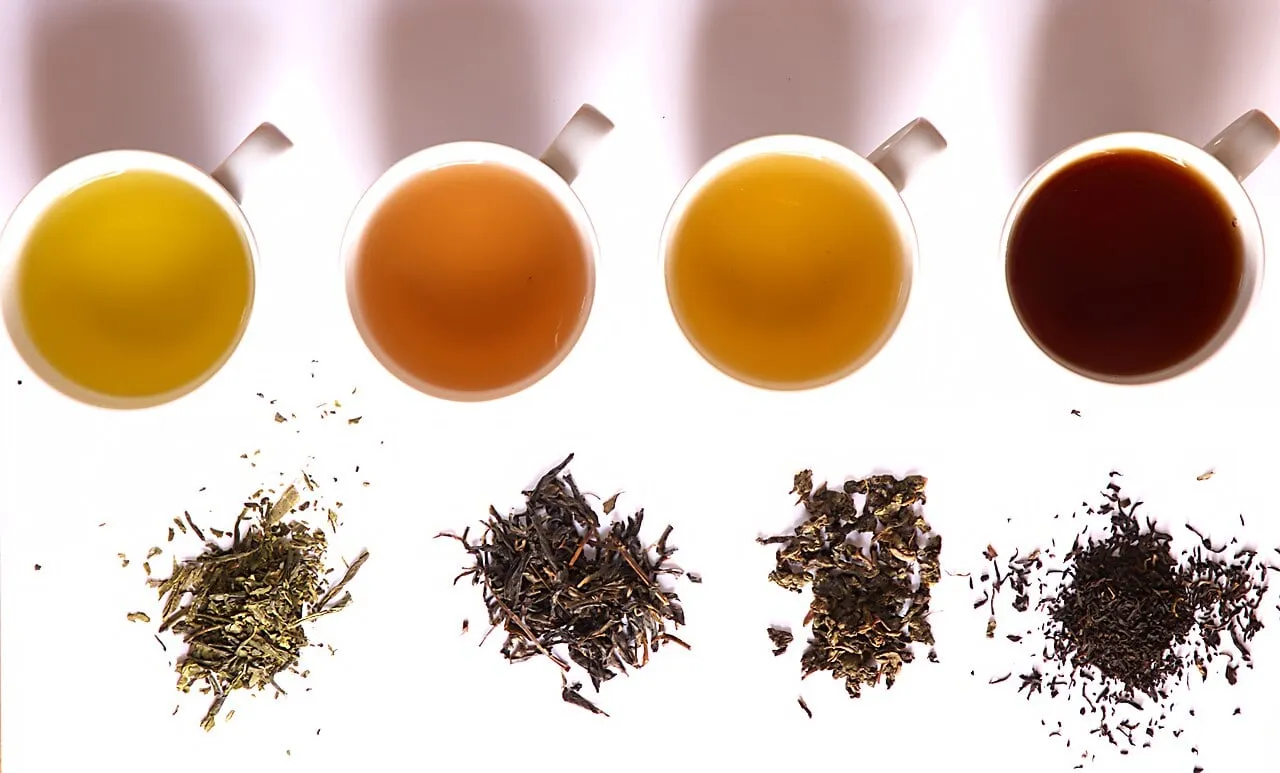
How one fresh leaf branches into six distinct styles
Six Tea Categories & Oxidation Spectrum
Compare green, white, yellow, oolong, black and dark teas along the axis of enzymatic oxidation and thermal control. Visualise pivotal craft sequences and temperature targets.
Chapter articles
29 articlesClassification System of the Six Tea Categories
Green, white, yellow, oolong, black and dark teas are primarily distinguished by key processing changes.
Orthodox Congou vs. Industrial CTC Black Tea
Orthodox Gongfu and CTC both produce black tea, but handle leaves differently.
West Lake Longjing Craft & Flat-Leaf Shaping
Longjing is a green tea associated with flat leaves and pan processing.
Baihao Yinzhen Craft & Silver Needle Morphology
Baihao Yinzhen is a white tea made primarily from buds, with visible down and intact form as familiar clues.
Does Lapsang Souchong always taste smoky?
Lapsang Souchong is a black tea available in smoked and unsmoked styles.
Ripe Pu-erh Craft & Microbial Wet Piling
Ripe pu-erh uses managed moistening, piling and turning so microbes and leaf compounds transform together, developing commonly dark liquor and a mellower style.
Wuyi Rock Tea Craft & "Yanyun" Flavour Foundations
Wuyi rock tea is an oolong shaped by cultivar, place, leaf working and roasting.
Keemun Black Tea Craft & Carotenoid Aroma Chemistry
Keemun's 'Keemun aroma' is often described as floral, honeyed and fruity. It comes from the leaf, withering, oxidation, drying and the final re-firing together, not from a single compound or step.
Huangshan Maofeng Craft & Bird-Tongue Morphology
Huangshan Maofeng is a green tea recognised through its bud-and-leaf form, visible down and fresh style.
Lu'an Guapian Craft & Stemless Single-Leaf Pan-Firing
Liu’an Guapian primarily uses individual leaves, offering a concrete reason to question whether greater tenderness always means better tea.
Taiping Houkui Craft & Large Flat Blade Shaping
Taiping Houkui is immediately recognisable for long, flat shoots.
Mengding Huangya Craft & Multi-Stage Yellowing
Mengding Huangya is a yellow tea made from tender buds.
Anxi Tieguanyin Craft & Semi-Ball Aroma Formation
Anxi Tieguanyin is an oolong, while Tieguanyin also names a cultivar.
Raw Pu-erh Craft & Post-Fermentation Ageing
Raw pu-erh begins with sun-dried base tea and can undergo refining, steaming and pressing.
Phoenix Dancong Craft & Ten Floral Aroma Profiles
Phoenix Dancong is an oolong known for named aroma styles, such as honey-orchid or gardenia associations.
Dongting Biluochun Craft & Spiral Pekoe Morphology
Dongting Biluochun's tight curls and visible down come from tender Dongting small-leaf shoots and from fixation, hot rolling, pelleting and drying done in one wok; its floral-fruity aroma is formed mainly by the leaf itself during pan work.
Anhua Fu Brick Tea: Pressing and Golden-Flower Blooming
Anhua Fuzhuan is a dark tea whose stems, brick structure and familiar “golden flowers” connect with material, pressing and managed fungal development.
Junshan Yinzhen: Yellowing Craft and Bud Movement
Junshan Yinzhen is a bud-focused yellow tea that shares the “silver needle” name with Baihao Yinzhen but follows a different way of making.
Oriental Beauty Craft & Leafhopper Terpene Terroir
Oriental Beauty is a Taiwanese oolong often associated with honeyed and ripe-fruit aromas and a more oxidised style.
Dianhong Black Tea Craft & Bold Briskness Profile
Dianhong Gongfu is a black tea made from Yunnan large-leaf material, often recognised by substantial leaves, golden bud down and a bold taste.
Xinyang Maojian Craft and Chestnut Aroma
Xinyang Maojian is a needle-shaped pan-fired green tea from Xinyang, Henan: fixed in a hot raw pan, shaped with a bamboo broom in a cooler cooked pan into fine, round, straight strips, then charcoal-baked, rested and baked again; its often-mentioned chestnut note is tied most closely to the final drying.
Fuding Aged White Tea: Withering, Pressing and Storage
Fuding aged white tea changes in composition and flavour during storage and is often described with amber liquor and aged or jujube-like notes; the changes depend on material, manufacture and storage conditions.
Dong Ding Oolong Craft & Roasted Fruit Dynamics
Dong Ding Oolong represents the pinnacle of Taiwanese semi-ball rolled oolong craft, famed for dense dragonfly-head pellets, luminous golden liquor, soothing roasted hazelnut bouquets, and profound throat resonance.
Enshi Yulu Craft and Steamed Pine-Needle Shape
Enshi Yulu is fixed with steam rather than an iron wok, then cooled, rolled, rubbed and bundled into tight, straight pine needles; steaming keeps it green and gives it an aroma unlike most pan-fired green teas.
How is jasmine tea scented?
Most of a jasmine tea's aroma comes not from dried petals in the cup but from fresh flowers the leaf absorbed during scenting.
Bai Mudan & Regional White Tea Craft
Harvested as one bud with one or two open leaves, Bai Mudan adds broad leaf transpiration and stem moisture buffering to bud-only withering. Fuding and Zhenghe balance cultivar traits with solar-led vs. shaded rack schedules.
Huoshan Huangya & Graded Yellowing
Huoshan Huangya turns yellow after—not before—enzyme fixation. Holding controlled moisture through a mild pan fixation drives non-enzymatic chlorophyll pheophytinization and catechin mellowing during warm ventilated yellowing, steering delicate buds toward sweet broth rather than high-fire crispy-rice pyrazines.
Taiwan High-Mountain Oolong Craft
Positioned at the light-oxidation edge of Taiwan oolong craft, High-Mountain Oolong pairs cool, slow-maturing mountain shoots (led by Qingxin and Jinxuan cultivars) with timed solar withering, low-temperature gentle bruising, repeated canvas cloth-ball rolling, and a stylistic choice between unroasted floral lift and lightly roasted depth.
Jin Jun Mei Smoke-Free Bud Craft
Developed out of Tongmuguan's Souchong heritage around 2005, Jin Jun Mei trades mature smoke-cured leaves for high-mountain small-leaf single buds, relying on delicate rolling, warm humid oxidation, and clean heat drying; its hallmark honey and roasted-sweet-potato nuances reflect synergistic binary interactions across dozens of volatiles, while well-oxidized traditional small-leaf buds naturally dry gold, amber, and black.
METHODOLOGICAL RIGOR & EVIDENCE BOUNDARIESContext-Dependent Processing Parameters
Processing metrics (withering moisture loss, pan-firing heat, roast duration) are grounded in verified craftsmanship protocols and textbook benchmarks.
Parameters vary dynamically with ambient humidity and shoot maturity; they are operational guides, not rigid formulas.
Primary References
- R-030 — Chen Zongmao, ed. (2000). China Tea Comprehensive Dictionary. China Light Industry Press. ISBN: 978-7501925094.
- R-031 — Shi Zhaopeng & Xia Tao, eds. (2016). Tea Processing Science (3rd ed.). China Agriculture Press. ISBN: 978-7109214347. Standard textbook on manufacturing control points.
- R-029 — Wan Xiaochun, ed. (2003). Tea Biochemistry (3rd ed.). China Agriculture Press. ISBN: 978-7109066274. Biochemical mechanisms governing component transformations during craft steps.