
Start with the essentials
Junshan Yinzhen is a bud-focused yellow tea. Despite sharing “silver needle” in its name with Baihao Yinzhen, its manufacturing approach differs: after fixation, wrapping and baking manage moist heat and change colour and flavour. The rising and sinking buds offer another familiar view.
This article connects origin and material with yellowing, drying and the behaviour of buds during infusion. Separating manufacture from floating helps connect appearance with tasting.
Three key points
- Method identifies yellow teaPost-fixation yellowing distinguishes it from white silver-needle tea.
- Wrapping and baking work togetherMoisture, heat and duration connect successive stages.
- Floating reflects preparation conditionsPouring, temperature and bud condition matter alongside aroma and taste.
What to notice when tasting
Observe infused buds while also smelling and tasting the tea. Record pouring and temperature when comparing floating; upright buds alone do not establish origin or grade.
1. Origin and material
Junshan Yinzhen comes from the area of Junshan Island in Dongting Lake, Yueyang, Hunan, and is a geographical-indication product[2]. The island is surrounded by water, the air is humid and spring mornings are often misty. The national standard divides yellow tea by material into bud, bud-and-leaf and multi-leaf types, among others; Junshan Yinzhen uses single buds and is a bud-type yellow tea (often called yellow bud tea)[1].
The buds come from the local tea population and are picked plump and early in spring.
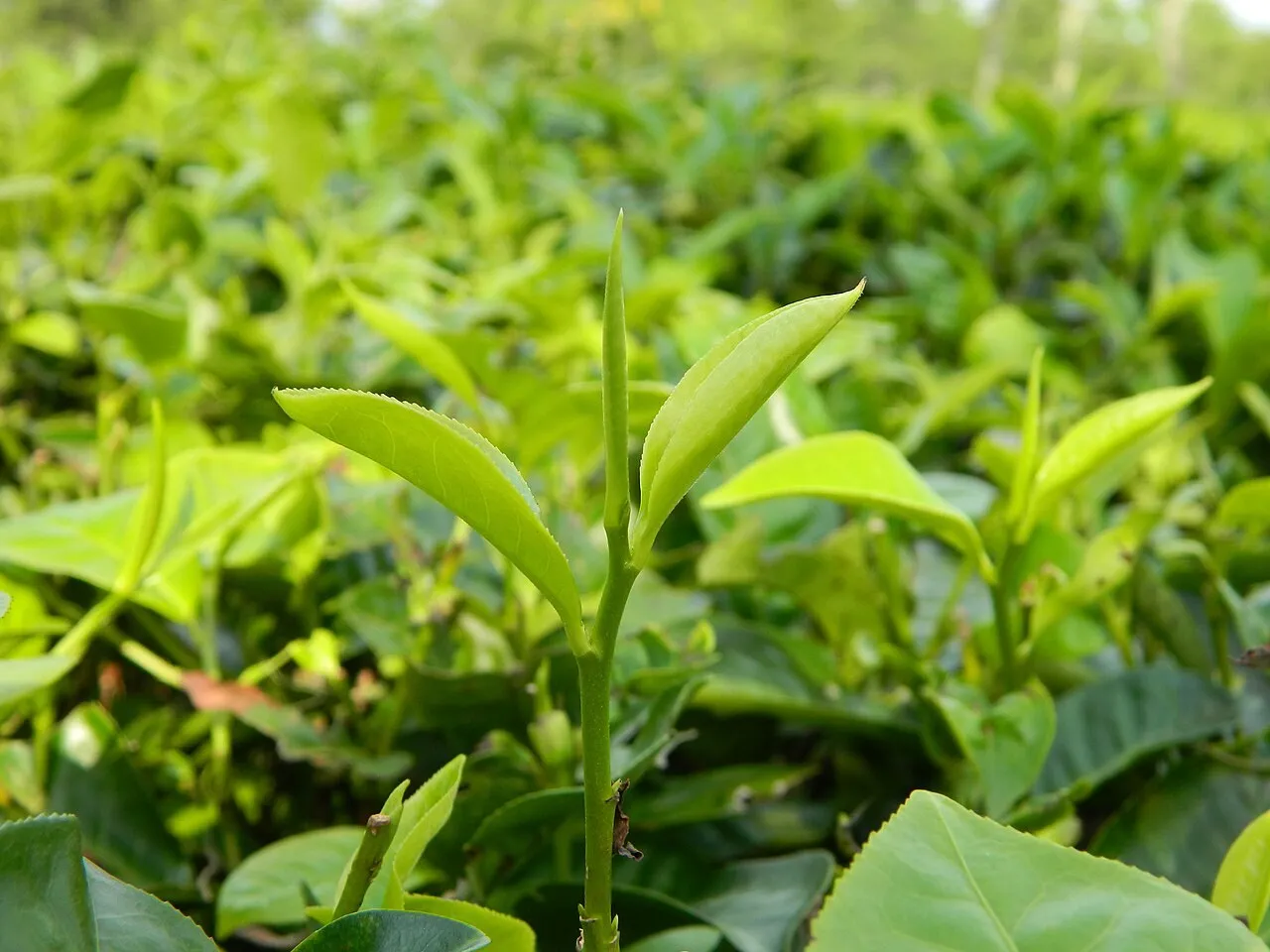
When looking at tea buds, start by locating the bud and the leaves next to it. The image below is an ordinary tea shoot, not confirmed Junshan Yinzhen material.
2. Plucking: the “nine exclusions”
Junshan Yinzhen uses single buds only, and tradition has a list of “nine exclusions” for choosing buds suitable for the tea. The table lists them with the common-sense reasons behind them:
| Do not pick | Meaning | Why |
|---|---|---|
| On rainy days | Buds wet with rain or heavy dew | Surface water makes buds stew and darken during fixation |
| Wind-damaged | Buds bruised or scraped by wind | Damaged spots discolour and spoil the look |
| Opened | Buds whose tips have started to open | Not tight enough to form a straight needle |
| Purple | Buds with a purple tinge | Purple buds tend to taste more bitter and astringent |
| Hollow | Buds that are empty inside | Light and thin when finished |
| Bent | Crooked buds | Cannot be made into a straight needle |
| Insect-damaged | Buds bitten by insects | Damaged appearance and possible off-flavours |
| Thin | Small, weak buds | Thin finished tea and weak liquor |
| Too long or too short | Buds outside the size range | Uneven sizes heat unevenly in processing |
Because picking is so selective, a large number of buds goes into each jin (500 g) of finished tea. Figures such as “tens of thousands” vary between sources, so this article does not quote a number.
3. Process: alternating baking and wrapping
Junshan Yinzhen can be summed up as: fix the buds, bake once and wrap once, bake again and wrap again, then dry fully. “Wrapping” means folding the buds in paper so they yellow slowly while keeping some moisture and warmth. This is the “sealed yellowing” (menhuang) that defines yellow tea[1][8].
The Hunan provincial government’s page on Junshan tea gives one set of process conditions[9], summarised below. It is a description of the craft, not a timetable every batch must follow.
3.1 Fixation
The buds are tossed in a sloping pan that starts at 100–120 °C and is then lowered to about 80 °C[9]. The buds are mostly tossed up and shaken loose so steam escapes, which keeps them from stewing and losing their down. Fixation uses heat to deactivate the leaf enzymes, so the later yellowing does not turn into black-tea-style oxidation[1][8].
3.2 First bake and first wrap
After fixation and cooling, the buds are spread on a baking basket and dried at 50–60 °C for 20–30 minutes to remove part of their water[9]. While still warm they are wrapped in paper and kept warm in a box for 40–48 hours[9], with the packets checked and turned so the change is even. Inside the paper, the moist, warm buds slowly turn yellow; this is the main yellowing stage.
3.3 Second bake and second wrap
The buds are taken out, dried again at about 50 °C for about an hour, then wrapped again for about 20 hours[9]. The second wrapping deepens and evens the yellow colour, leaving golden buds with visible down, traditionally called “gold set in jade”.
3.4 Final drying
Finally the buds are dried at 50–55 °C until fully dry[9]. On site, dryness is judged by feel (crisp, easily crumbled); final moisture should still be measured against the applicable product standard[1][2]. The tea is cooled and then sealed.
The whole process takes about three days, mostly spent in the two wrapping stages. The time needed also varies with the buds, packet size and weather.
Why alternate baking and wrapping?
Basket: water leaves. Wrap: water stays.
After fixation, a first bake
- Charcoal heats from below
- Fixed, cooled buds lie on the tray
- Some water leaves; not dried through
Adjust moisture before wrapping; this is not yellowing completely dry buds.
What to notice, why & sources
What to notice: Blue arrows show outward water loss; warm lines show heat. Fixation has already taken place.
Initial drying affects subsequent colour and aroma development. Suitable leaf condition depends on material and production conditions.
Sources:
Colour is not an oxidation or quality scale. Not to time scale.
4. What happens in the buds during yellowing
The following draws on yellow tea research to describe likely changes. The samples in these studies include other yellow teas such as Pingyang yellow tea. They help explain the principles but are not measurements of any batch of Junshan Yinzhen[3][4][5][6].
4.1 Why the buds turn yellow
Fixation has already stopped the enzymes, so the changes during yellowing come mainly from moist heat rather than enzymatic oxidation[3]. Under moist heat chlorophyll gradually breaks down; some of it loses its central magnesium ion and becomes olive-brown pheophytin. As the green fades, yellow pigments that were masked become visible[3][5].
The “golden” colour of the buds is the combined result of several pigments; bud colour cannot tell how much of any one pigment has broken down.
4.2 Why the taste is mellower
Research shows that heating causes catechins to epimerise (for example EGCG to GCG), degrade and polymerise into new products[6]. Yellow tea processing studies also found that after yellowing, catechins and other constituents differ from those in green tea made from the same material[3][5].
These changes relate to yellow tea’s mellower taste, but they describe structural relationships between compounds and do not yield a fixed figure such as “X% less astringency”. Whether a liquor tastes mellow also depends on how much is extracted, other taste compounds and actual tasting[3][6].
4.3 Aroma
A study that followed aroma during the sealed yellowing of Pingyang yellow tea found clear changes in the kinds and amounts of volatiles: some green-smelling compounds decreased and some sweet, cooked-smelling ones increased[4]. Junshan Yinzhen is often described as sweetly fragrant, with associations such as tender corn or roasted chestnut. These are tasting descriptions; which compounds cause them would need research on Junshan Yinzhen itself, so this article does not list compounds or concentrations.
4.4 About health effects
A review has summarised the effects of tea polyphenols, polysaccharides, caffeine and other constituents in cell and animal experiments[7], and the yellow tea review discusses similar studies[3]. These results come mostly from experimental systems and do not show that drinking Junshan Yinzhen lowers blood sugar or lipids.
Junshan Yinzhen
Yellow · Multi-Stage Bud Yellowing5. Reading the standards and grades
Junshan Yinzhen can be read against two standards: the national standard GB/T 21726-2018 Yellow tea, which sets out yellow tea types and their sensory and physical-chemical requirements[1], and the local standard DB43/T 648-2011 Product of geographical indication — Junshan Yinzhen tea, which sets the protected area, processing requirements and grades[2].
| Grade | Appearance | Liquor colour | Aroma and taste | Items to check in the standards[1][2] |
|---|---|---|---|---|
| Special grade | Plump, straight, even buds fully covered in down; golden bud colour | Bright apricot-yellow | Clean fragrance; sweet, mellow taste | Moisture, water extract, total ash, broken pieces and others |
| First grade | Fairly plump, straight buds with plenty of down | Bright pale yellow | Clean fragrance; mellow taste | Same items; limits as stated in the standard |
For exact figures, check the version and grade in the text of the standard. A recommended standard is something a product may declare it follows, not a legal figure that applies to every product[1][2].
6. Brewing: watching the “three rises and falls”
Brewed in a glass, Junshan Yinzhen buds can be seen floating, standing upright and sinking, traditionally called “three rises and three falls”, with descriptions such as “sparrow’s tongue holding a pearl” for a bud tip carrying a bubble.
6.1 What you actually see
The Hunan provincial government’s page puts it plainly: only some of the buds move like this, a full three rises and falls is uncommon, and other bud teas can do something similar[9]. So it is something to watch, not a way to tell genuine from fake or to grade the tea, and not something every bud will do.
One way to understand it: dry buds hold air inside and on their surface, so they are light at first and tend to float; as they take up water they get heavier and tilt, stand upright or sink; a bubble on the tip can sometimes lift them again. Each bud is different, so each moves differently. This is a general physical explanation; this article does not rest on force measurements of Junshan Yinzhen buds.
Must the buds rise and fall three times?
Switch steps: each bud moves its own way.
Some float, some tilt or sink
- Some buds float flat on the surface
- Some are already tilting
- Some have already sunk
Buds need not move together; a whole cup need not dance in unison.
What to notice, why & sources
What to notice: Look at the surface, middle and bottom rather than just one prominent bud.
Wetting, air, water movement and bud shape may influence posture. This is a general physical interpretation, not measured bud forces.
Sources:
A possible scenario, not measured buoyancy; movement shows no grade. Not to time scale.
6.2 Common brewing practice
| Item | Common practice | Why |
|---|---|---|
| Vessel | Clear straight-sided glass | Easy to watch the buds |
| Pouring | Optionally wet the buds with a little hot water first, then fill along the side of the glass | Avoids pouring straight onto the buds |
| Water temperature | Commonly around 85–90 °C | Delicate buds stew less below boiling; adjust to taste |
| Amount | About 3 g to roughly 150 ml water | Buds are not crowded and are easy to watch |
| Lid | Cover briefly if you like, then uncover | Avoids leaving the buds covered and stewing |
| Drinking | Once most buds have sunk | By then the water has cooled to a comfortable temperature |
7. Common questions
Yellow leaves and yellow liquor: is this badly made green tea or tea that got damp?
No. Yellow leaves and liquor are the defining features of yellow tea, produced by controlled yellowing after fixation[1][3]. Damp, spoiled tea tends to look dull with cloudy liquor and smell sour or musty; normal Junshan Yinzhen has golden buds, bright apricot-yellow liquor and a sweet, clean aroma.
Junshan Yinzhen and Baihao Yinzhen are both “silver needles”. Are they the same tea?
No[1][8].
- Baihao Yinzhen: a white tea made from single buds of cultivars such as Fuding Dabai and Zhenghe Dabai, only withered and dried, never fired or rolled; silvery buds, very pale liquor, with a fresh, downy aroma.
- Junshan Yinzhen: a yellow tea made from single buds of the local Junshan tea plants, fixed, yellowed through alternating baking and wrapping, then dried; golden buds, apricot-yellow liquor, a mellower taste, and some buds rise and fall when brewed.
No “three rises and falls”: did I brew it wrong, or is it fake?
Neither. Only some buds move, and a full three times is uncommon anyway[9]. How buds move depends on the buds themselves, water temperature, glass depth and pouring. Judge the tea by aroma, taste and source information, not by how many times the buds moved.
8. Related Articles
- Mengding Huangya: another yellow bud tea, with a different wrapping rhythm
- Baihao Yinzhen: the white tea that shares the “silver needle” name but is made quite differently
- The six tea categories: where yellow tea sits among the six categories
- Yellow tea sealed yellowing: basics of colour and composition changes during yellowing
- Teaware and water temperature: how glasses and other vessels affect temperature
References
- R-286 — National Technical Committee on Tea of Standardization Administration of China. (2018). Yellow tea (GB/T 21726-2018). Standards Press of China.
- R-323 — Hunan Provincial Bureau of Quality and Technical Supervision. (2011). Product of geographical indication—Junshan Yinzhen tea (DB43/T 648-2011). Hunan Standards Press.
- R-324 — Xu, J., Wang, M., Zhao, J., Wang, Y. H., Tang, Q., & Khan, I. A. (2018). Yellow tea (Camellia sinensis L.), a promising Chinese tea: Processing, chemical constituents and health benefits. Food Research International, 107, 567–577. https://doi.org/10.1016/j.foodres.2018.01.063
- R-325 — Dong, R. J., Sheng, X. H., Xie, Q. T., Huang, X., Yan, F., & Liu, S. (2023). Aroma formation and transformation during sealed yellowing process of Pingyang yellow tea. Food Research International, 165, 112535. https://doi.org/10.1016/j.foodres.2023.112535
- R-326 — Sun, L., He, C., Wang, Y., & Ni, D. (2024). Study on flavor quality formation in green and yellow tea processing by means of UPLC-MS approach. Food Chemistry: X, 22, 101342. https://doi.org/10.1016/j.fochx.2024.101342
- R-327 — Wang, H., Provan, G. J., & Helliwell, K. (2016). Differential behaviors of tea catechins under thermal processing: Formation of non-enzymatic oligomers. Food Chemistry, 196, 689–697. https://doi.org/10.1016/j.foodchem.2015.09.056
- R-328 — Tang, G. Y., Meng, X., Gan, R. Y., & Li, H. B. (2019). Health Functions and Related Molecular Mechanisms of Tea Components: An Update Review. International Journal of Molecular Sciences, 20(24), 6196. https://doi.org/10.3390/ijms20246196
- R-031 — Shi, Z., & Xia, T. (Eds.). (2016). Tea Processing Science (3rd ed.). China Agriculture Press. ISBN: 978-7-109-21434-7.
- R-354 — 湖南省人民政府门户网站 (2017). 茶文化之:君山茶. https://www.hunan.gov.cn/jxxx/hxwh/cwd/201711/t20171111_4685387.html
Article Knowledge Network
Explore the connections between the teas, processes and flavours in this article.