
Start with the essentials
Teaware affects brewing through capacity, walls, shape, material, lids and pouring. Cooling and drainage change how leaves contact water; a material name alone cannot predict the cup.
This article explains heat loss and handling, connects vessel choices with leaf viewing or repeated infusions, and proposes comparisons between similar vessels. Structure, operation and actual temperature together help identify the cause of a difference.
Three key points
- Heat retention combines conditionsCapacity, walls, preheating and lids work alongside material.
- Pouring extends contactSlow or incomplete drainage can change effective steeping time.
- Choose for the taskViewing, cleaning, timing and sharing create different practical needs.
What to notice when comparing teaware
Compare similarly sized vessels with equal water, preheating and lid use. Record cooling and drainage before brewing the same tea; the comparison cannot independently verify every adsorption or mineral claim.
1. Which Brewing Conditions Does a Vessel Change?
A vessel absorbs heat on contact with hot water, then the liquor loses heat through walls, the opening and surrounding air. Vessel mass, wall thickness, geometry, lid position, preheating and actual water volume all matter. A material name alone cannot establish a universal heat-retention ranking.
Preheating changes the starting point. The initial drop depends on the actual vessel and water volume rather than a shared 5–8 °C value. Compare vessels with the same preheating routine, fill volume and timing.
**Lids and pouring change the process.**Opening size affects evaporation and convection; complete, timely decanting controls contact time. Heat capacity and heat transfer both affect temperature; geometry, the opening and the surrounding environment matter as well.
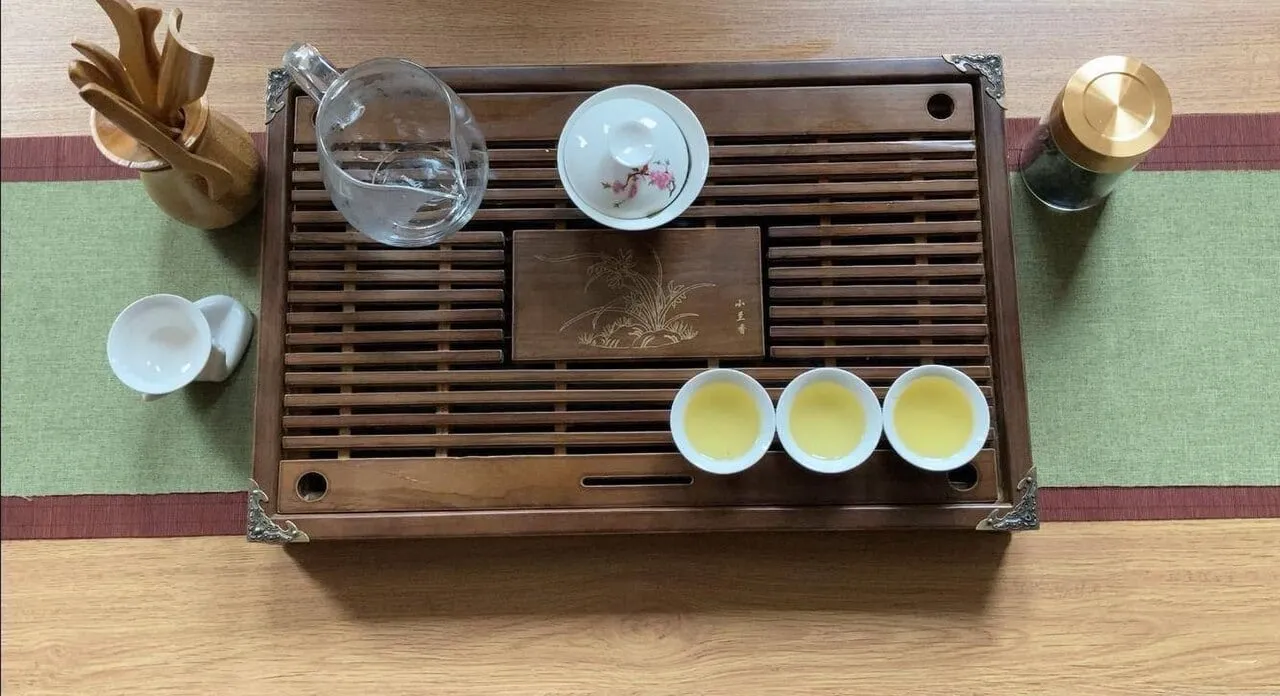
When looking at a real set, note the positions and working volumes of the gaiwan, cups and pitcher before choosing which conditions to control.
2. How to Read the Cooling Illustration
Why tea cools fast or slow
Change one factor; compare two curves.
Up: liquor temperature (no scale) · Right: time
Open tops lose heat faster
- Lid on: heat leaves slowly
- Lid off: evaporation, faster cooling
- The gap widens with time
Lid on or off can matter more than what the vessel is made of.
Conditions & limits
Same vessel, same water and start; only the lid changes.
Capacity, mass, wall thickness, geometry, lid, preheating and environment all affect cooling; this cannot predict a specific pot’s temperature.
Curves show directions, not a real pot’s temperature.
The curves explain scenarios rather than measure your own vessels. A real comparison records dimensions, mass, environment, lid state, fill volume and preheating. Curve order does not rank the quality of the tea liquor.
3. Choose Around an Observation or Task
Inside five teaware walls
Switch material; watch heat cross the wall.
Granular clay with pores
- Sintered clay granules
- Open pores between grains
- Closed micro-pores inside
- Heat crosses the wall slowly
Lidded and preheated, a porous, thicker wall keeps heat steady.
Material notes & common pairings
Zisha bodies form a granular structure with open pores between grains and closed micro-pores. With a lid and preheating, the porous, thicker wall conducts moderately and holds heat steadily.
- Common pairings (indicative)
- Wuyi rock tea, traditional oolong, ripe Pu-erh, aged white tea
Wall slices are schematic; dot speed is a direction, not a measured conductivity.
| Your purpose | A useful starting vessel | Conditions to check |
|---|---|---|
| Inspect liquor and infused leaves | White porcelain gaiwan or heat-resistant clear cup | Capacity, white background and complete decanting |
| Watch leaves unfold | Heat-resistant glass | Temperature, contact time and continuous steeping |
| Compare successive infusions | Appropriately sized gaiwan or pot | Water volume, timing and retained liquor |
| Try simmering | A vessel explicitly suitable for direct heat | Manufacturer instructions, heating method and hygiene |
Transparent vessels make leaves and liquor easier to observe. Check the manufacturer’s instructions for heat suitability before use.
Practical Vessel & Geometry Pairing Across Tea Categories
Combining vessel geometry (wall thickness, rim opening, spout flow) with surface properties (glazed vs. porous) provides a practical starting point for everyday brewing across the six tea categories[1][2]:
| Tea Category & Goal | Recommended Starting Vessel | Physical & Operational Rationale | Handling Details to Watch |
|---|---|---|---|
| Fine Green / Yellow Tea (West Lake Longjing, Junshan Yinzhen) | Open heat-resistant glass or thin-walled white porcelain gaiwan | Wide open rims allow steam and heat to dissipate rapidly, preventing tender buds from cooking; clear walls reveal bud suspension and unfolding | Pour gently along the glass wall; when using a gaiwan, leave the lid tilted ajar between infusions so residual heat does not yellow the leaves |
| White Tea (Baihao Yinzhen, Aged Fuding White Tea) | White porcelain gaiwan (fresh/loose) or direct-heat clay/glass kettle (aged white tea) | Glazed white porcelain preserves delicate downy and floral notes and shows pale apricot-to-amber liquor clearly; aged white tea can be gently simmered after multiple infusions | Confirm the kettle is rated for direct stove use; always evaluate aged white tea in a neutral gaiwan first to verify clean storage |
| High-Aroma Oolong & Black Tea (Anxi Tieguanyin, Oriental Beauty, Keemun) | Standard white porcelain gaiwan or thin-walled Zhuni pot | Non-porous glaze reflects high-key floral and fruity volatiles faithfully; wide gaiwan rims allow fast decanting to prevent over-extraction of rolled leaves | Porous clay pots can carry over aromas if mixed across styles; use glazed porcelain first to establish a sensory baseline |
| Medium- to High-Roast Oolong (Wuyi Rock Tea, Dongding Oolong) | Thick-walled porcelain gaiwan or small Yixing Zisha pot (100–130 ml) | Stronger heat retention supports extraction of high-boiling roast and woody-floral compounds during brief, high-ratio gongfu infusions | Account for spout pouring speed as part of total contact time, and drain every infusion completely |
| Pu-erh & Dark Tea (Raw Pu-erh, Ripe Pu-erh, Anhua Fuzhuan) | White porcelain gaiwan (for evaluation) or thicker Zini/Duanni clay pot (for daily drinking) | Neutral porcelain reveals storage condition and liquor clarity honestly during evaluation; once clean quality is confirmed, thicker clay maintains high temperatures | Never rely on porous clay to “absorb mouldy off-odours”—contaminated tea will taint a porous pot rather than become safe to drink |
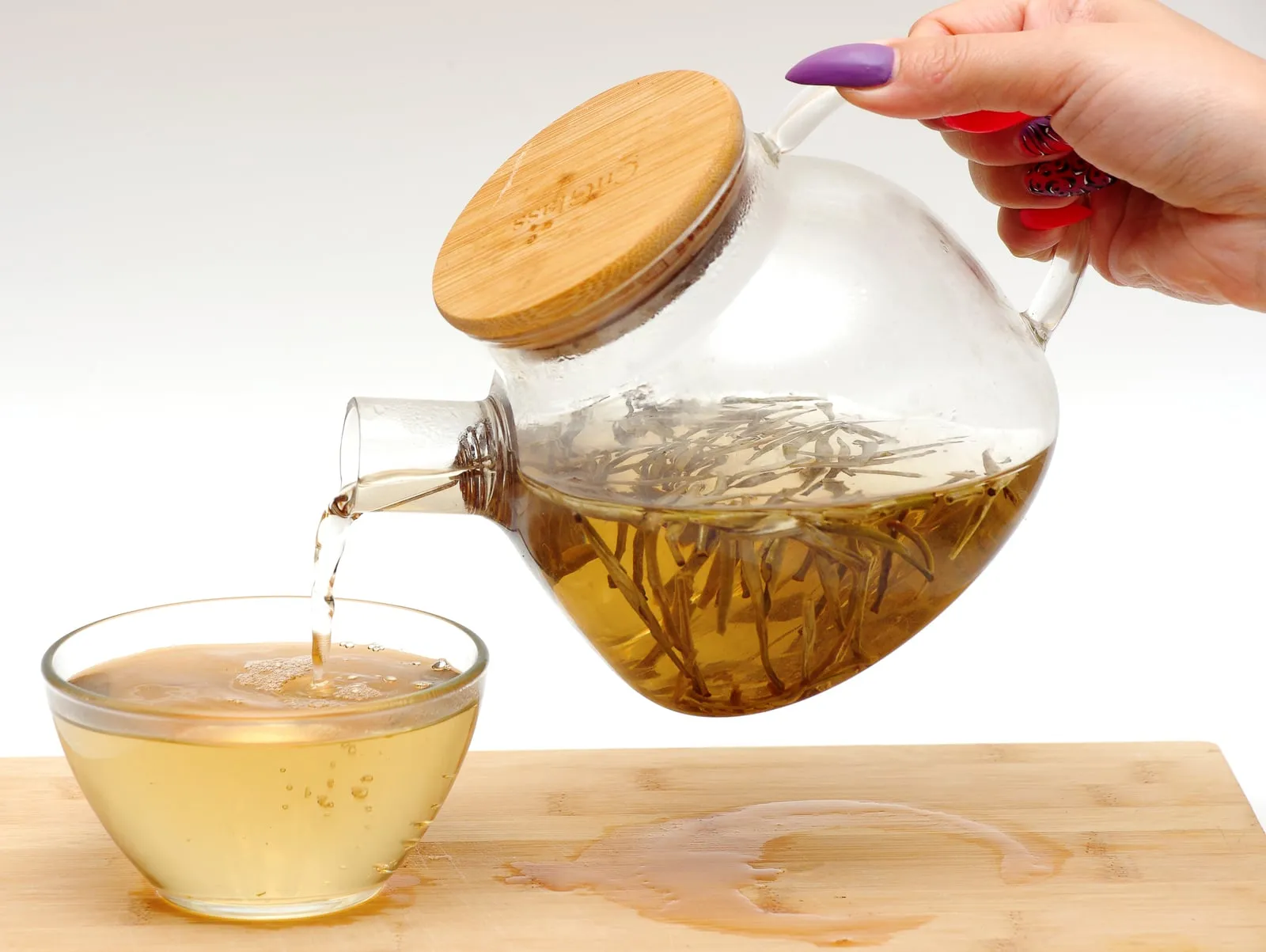
Glazed white porcelain is easy to inspect and clean. ISO 3103 specifies liquor preparation for sensory tests so that comparisons use controlled conditions; it is not a legal ranking of domestic teaware[3]. Ease of cleaning does not imply zero adsorption of every molecule.
Use history, cleaning and firing conditions may affect residual odours in porous or unglazed vessels. Check the actual smell before deciding whether to dedicate a pot to one tea; “absorbing harshness” does not guarantee improvement[2][5].
Liao and colleagues compared oolong infusions prepared in six vessel materials and found differences in some chemical constituents[1]. Those results belong to the experiment’s samples and conditions, not a guarantee of better aroma or health for all teas. They also do not establish the effects of years of seasoning a pot.
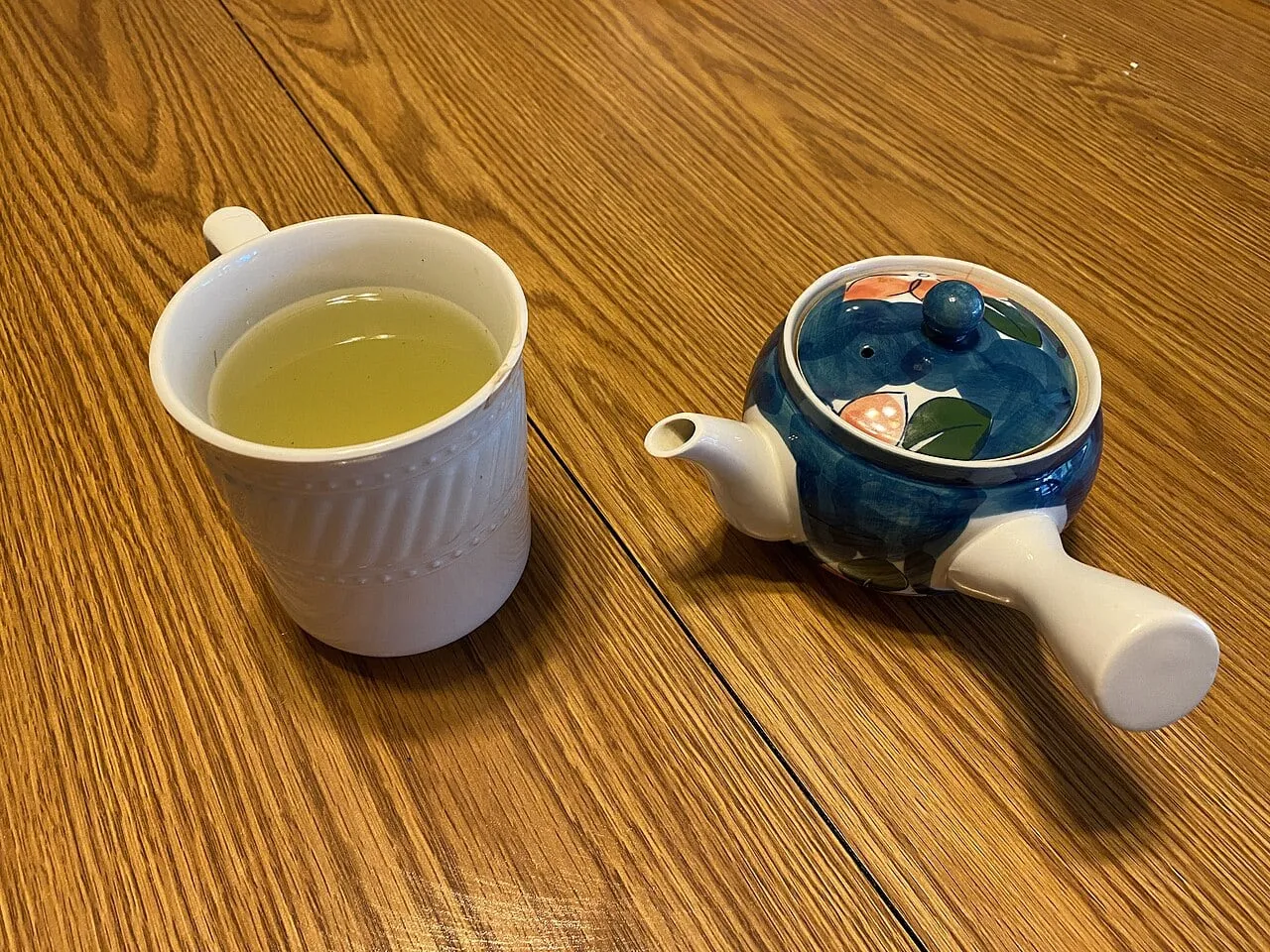
A lidded side-handled pot is another everyday option. Record its actual fill, preheating and lid state when comparing it with another vessel.
4. Try a Two-Vessel Comparison
- Use the same tea, equal leaf masses and two vessels of similar working volume.
- Control water source, preheating, temperature, actual fill volume and time; extraction also depends on time and temperature[4].
- With a suitable thermometer, record temperature after filling, at decanting and after cooling. Without one, compare handling and flavour rather than treating a warm wall as a measurement of the liquor.
- Taste at similar drinking temperatures, then exchange vessels and repeat. Describe results for this tea, these vessels and these conditions.
Keep the vessel fixed for a later water comparison, or use brewing troubleshooting to change one variable when a cup tastes harsh or weak.
Related Articles
- Brewing Basics: Combine actual vessel fill volume and decanting speed with baseline ratios and temperatures across the six tea categories.
- Water Quality & Tea Liquor: Hold teaware and brewing parameters constant to compare how water chemistry alters flavour and colour.
- Brewing Troubleshooting: Diagnose bitterness or cooked notes caused by excessive heat retention, slow spouts, or incomplete drainage.
- Chinese Gongfu Tea Culture: Explore the historical and functional evolution of small pots, gaiwans, fairness pitchers, and tasting cups.
- Song Dynasty Tea Culture: Trace how teaware shifted from Tang cauldrons and Song dark-glazed whisking bowls to Ming loose-leaf pots.
References
- R-296 — Liao, Z. H., Chen, Y. J., Tzen, J. T. C., et al. (2018). Effect of teapot materials on the chemical composition of oolong tea infusions. Journal of the Science of Food and Agriculture, 98(2), 751–757. https://doi.org/10.1002/jsfa.8522
- R-030 — 陈宗懋 主编 (2000).《中国茶叶大辞典》. 中国轻工业出版社. ISBN: 978-7501925094.
- R-294 — ISO 3103:2019. Tea — Preparation of liquor for use in sensory tests. International Organization for Standardization. https://www.iso.org/standard/73224.html
- R-116 — Spiro, M., Jaganyi, D., & Broom, M. C. (1992). Kinetics and equilibria of tea infusion: Part 9. The rates and temperature coefficients of caffeine extraction from green Chun Mee and black Assam Bukial teas. Food Chemistry, 45(5), 333–335. https://doi.org/10.1016/0308-8146(92)90033-x
- R-029 — 宛晓春 主编 (2003).《茶叶生物化学》(第3版). 中国农业出版社. ISBN: 978-7109066274.
Article Knowledge Network
Explore the connections between the teas, processes and flavours in this article.