
Start with the essentials
Ripe pu-erh uses managed moistening, piling and turning so microbes and leaf compounds transform together, developing commonly dark liquor and a mellower style. “Ripe” describes manufacture, while age describes later elapsed time.
This article follows moisture, heat, turning and final drying to explain why piling requires control, then distinguishes it from subsequent storage. Body, smoothness and aroma can be understood within production and preservation conditions.
Three key points
- Moistening establishes conditionsWater needs coordinated management with heat, air and material.
- Turning manages differencesHeat loss, ventilation and redistribution affect conditions within the pile.
- Storage follows manufacturingPackaging and conditions continue influencing flavour and quality control.
What to notice when tasting
Check provenance and condition before describing dry tea, liquor, infused leaves and texture. Stop using tea with suspicious mould or odours rather than treating every off-note as aged aroma.
What makes this tea special
Ripe pu-erh belongs to dark tea (hei cha) — the only category among China’s six tea types whose defining quality is shaped by microbial post-fermentation. Unlike black tea (endogenous aerobic enzymatic oxidation) or green tea (high-heat enzyme arrest), the character of ripe pu-erh is primarily shaped by extracellular enzymes secreted by dominant exogenous microflora (such as tannases, cellulases, pectinases, and polyphenol oxidases) acting in synergy with non-enzymatic hydrothermal reactions.
Its raw material must be the Yunnan large-leaf cultivar (var. assamica). These leaves are rich in polyphenols and thick in texture, providing abundant substrates for microbial metabolism and giving the finished tea a full body and remarkable stamina through multiple infusions. Under China’s GB/T 22111-2008 standard, pu-erh tea must be made from Yunnan large-leaf sun-dried tea and processed within Yunnan province[1].
Finally, wet piling itself is inherently dynamic. The same batch of raw tea will follow slightly different microbial succession paths depending on season, workshop conditions and the tea maker’s judgement, yielding subtly different flavour profiles. This “living process” makes ripe pu-erh a cross-disciplinary art at the intersection of agriculture, food science and microbiology.
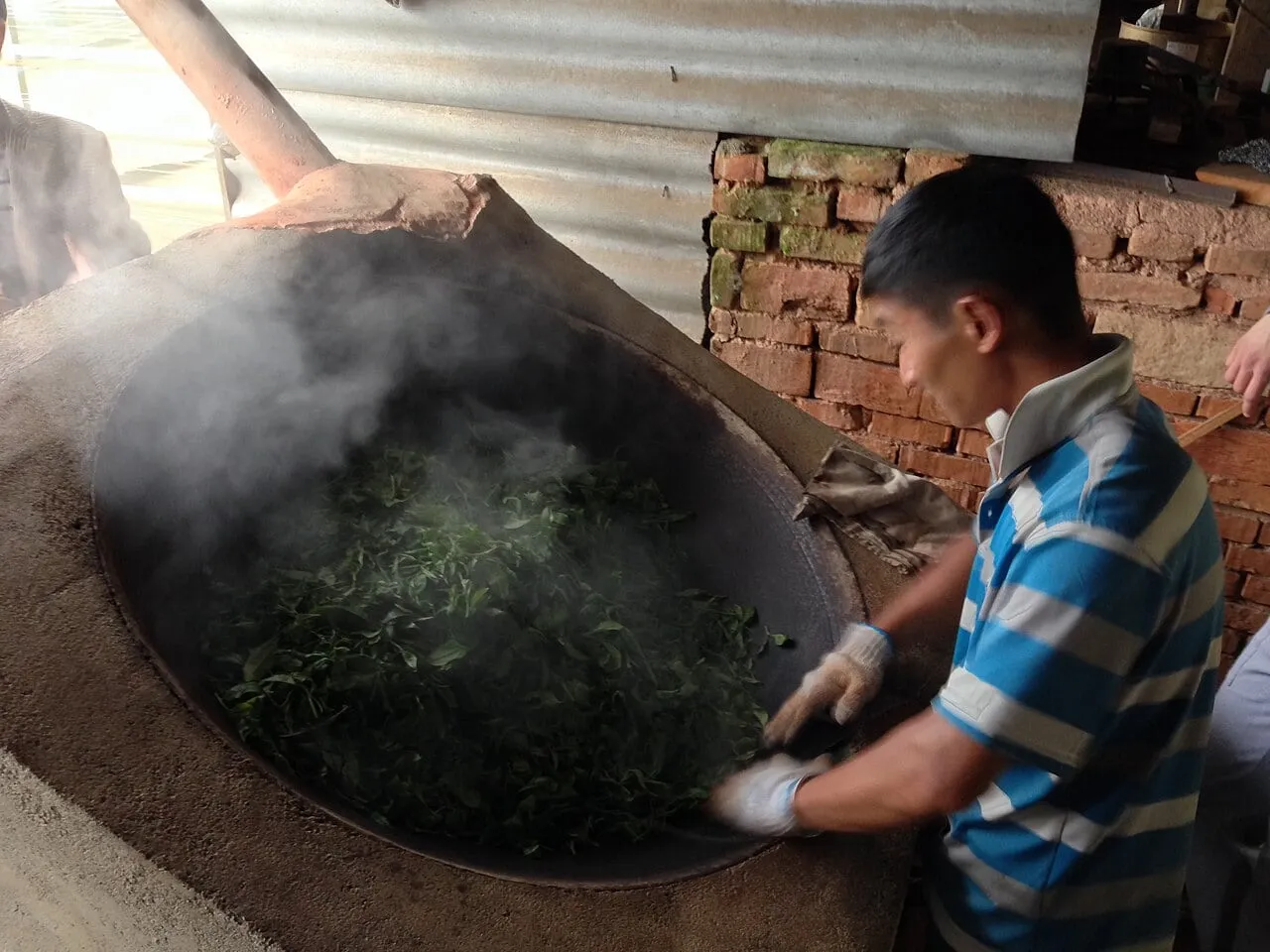
Ripe pu-erh generally starts with sun-dried maocha before wet piling. The photograph below documents a wok operation during pu-erh production and helps show an earlier stage; it is not a wet-piling scene and does not establish whether the tea became raw or ripe.
Full processing flow
Ripe pu-erh production starts with sun-dried raw tea and proceeds through moistening, piling, drying and refining[2]:
Of these, moistening, wet piling and turning are the most quality-critical and are explored in detail below.
Moistening: laying the microbial bed
Before piling, sun-dried raw tea holds only about 10–12% moisture — far too dry for microbial activity. The tea maker sprays clean water (or steam) evenly over the leaves, raising moisture to 25–35%[2][3]. The amount varies with leaf grade: tender leaves absorb water quickly and hold it well, so less is used; older, tougher leaves need more.
Moistened leaves must be piled promptly. The free water on the leaf surface now creates conditions for initial bacterial and yeast proliferation, and the wet-piling curtain rises.
| Parameter | Typical range |
|---|---|
| Water added | 30–50% of raw tea weight (adjusted for leaf grade) |
| Target moisture | 25–35% |
| Water quality | Clean, soft, odour-free |
| Key point | Even distribution; turn while spraying to avoid puddles |
Values are representative; real workshops adjust for raw tea condition, season, equipment and the tea maker’s experience.
Wet piling: the microbial main stage
Wet piling is the soul of ripe pu-erh. Moistened tea is heaped into rectangular piles roughly 1–1.5 m high, covered with damp cloth or sacking to retain heat and humidity. Over 45–60 days the pile core climbs to 50–65 °C, while ambient relative humidity stays at 80–95%[2][3][4].
Inside the pile: three acts of microbes
Three stages; watch the pile core heat up.
Wet the leaf, build the pile, let it warm
- Water sprinkled on the leaf
- A 1 m pile under hemp cloth
- Microbial respiration warms the core
- Loupe: yeasts and moulds grow
Moisture wakes the microbes; they heat the pile from within.
Days, moisture, microbes & sources
- 45-Day Wet Piling Batch Progression
- Days 1–10
- Leaf Bed Moisture
- 30–33% (initial wetting)
- Turning (Fan Dui) Objective
- 1st turning on Day 8–10 (disperses excess surface moisture, breaks clumps)
- Dominant Microbial Flora
- Yeasts, Penicillium, and Rhizopus germinate; Aspergillus niger colonizes
- Tasting Bowl Liquor Tone
- Golden-orange · Mild raw astringency
Sun-dried raw material is stacked into 1-meter high trapezoidal piles (5–10 tons) and sprayed with pure water (28–32% by dry weight). Aerobic microbes multiply rapidly, generating exothermic respiratory heat.
Mechanisms: Synthesised from Tea Processing (R-031) and solid-state microbial fermentation literature (R-029, R-086). Driven by extracellular microbial enzymes combined with hydrothermal oxidation.
Note: Wet piling parameters (38–48 days, 5–10 tons) are fine-tuned by masters based on raw leaf grade, ambient season, and water quality.
Typical directions of change; not fixed microbes, days, temperatures or turning intervals.
Switch stages above to watch temperature, humidity, three classes of microbes and chemical components evolve through the 45-day pile-fermentation journey.
Unlike black-tea “fermentation” (which is actually enzymatic oxidation), wet piling is true microbial fermentation. Microbes secrete amylases, cellulases, pectinases, polyphenol oxidases and peroxidases that break down, transform and reassemble the leaf’s large molecules into new flavour compounds[4].
A three-act microbial drama
The microbial community follows a clear stage-by-stage succession:
Act I: Bacteria open the show (Days 1–10)
At the start, lactic acid bacteria and acetic acid bacteria dominate. They metabolise sugars to produce lactic and acetic acids, lowering the pile’s pH and creating an acidic micro-environment. This not only suppresses some undesirable contaminants but also sets the stage for later fungal growth. During this phase the pile temperature rises rapidly from room temperature to 40–50 °C.
Act II: Aspergillus niger takes centre stage (Days 11–30)
Aspergillus niger achieves overwhelming dominance in the pile, accounting for 60–95% of the fungal community[4][5]. It secretes a rich array of extracellular enzymes: cellulases break down cell walls, pectinases soften leaf texture, and polyphenol oxidases and laccases catalyse the oxidation and polymerisation of catechins. It is during this phase that tea polyphenols are massively converted into thearubigins and then into theabrownins; astringency drops markedly, and the liquor colour shifts toward deep red. The pile core reaches its peak temperature of 50–65 °C.
Act III: Yeasts close the performance (Days 31–45)
As fermentable sugars dwindle and the acidic environment persists, yeasts (such as Saccharomyces, Candida and related genera) increase in relative abundance. They produce esters, alcohols and other volatiles that contribute sweet, fruity and floral undertones. By now polyphenol conversion is largely complete, theabrownin content has stabilised, and the pile enters its finishing phase.
| Stage | Days | Dominant microbes | Core temperature | Key biochemical events |
|---|---|---|---|---|
| Early | 1–10 | Lactic acid bacteria, acetic acid bacteria | 25 → 45 °C | Acidification, metabolism initiated |
| Mid | 11–30 | Aspergillus niger (dominant) | 45 → 65 °C | Polyphenol oxidation and polymerisation; theabrownin formation |
| Late | 31–45 | Yeasts, Bacillus spp. | 50 → 45 °C | Ester production, flavour mellowing |
Values are representative; actual succession varies with raw material, season, workshop environment and the tea maker’s judgement.
Turning the pile: cooling, re-oxygenating and evening out
Wet piling cannot be left unattended. Microbial metabolism generates heat continuously, and if the core exceeds 65 °C the leaves will suffer pile-burning — carbonisation, scorching and off-odours that severely degrade quality[2]. Regular turning is therefore essential.
Why turn the pile?
Switch stages: turning, then spreading to dry.
Turning lets heat out and air in
- Hot leaf from the core is turned to the outside
- Heat and steam escape from the core
- Fresh air brings oxygen into the pile
- Clumps break up so fermentation stays even
Without turning, the core overheats and ferments unevenly.
Days, moisture, microbes & sources
- 45-Day Wet Piling Batch Progression
- Days 11–25
- Leaf Bed Moisture
- 24–28% (water replenishment)
- Turning (Fan Dui) Objective
- Turned on Day 16 & Day 24 (supplies fresh O2, vents internal heat)
- Dominant Microbial Flora
- Aspergillus niger dominant, active Bacillus thermophiles
- Tasting Bowl Liquor Tone
- Chestnut red · Astringency drops sharply
Aspergillus niger secretes abundant extracellular pectinases, cellulases, and polyphenol oxidases. Catechins undergo profound oxidative polymerization, synthesizing deep brown theabrownins (TB).
Mechanisms: Synthesised from Tea Processing (R-031) and solid-state microbial fermentation literature (R-029, R-086). Driven by extracellular microbial enzymes combined with hydrothermal oxidation.
Note: Wet piling parameters (38–48 days, 5–10 tons) are fine-tuned by masters based on raw leaf grade, ambient season, and water quality.
Typical directions of change; not fixed microbes, days, temperatures or turning intervals.
Turning is usually performed 4–6 times at intervals of 7–10 days, adjusted according to pile temperature[2]. Each turn serves three purposes:
- Heat dissipation — hot core leaves are brought to the surface, lowering the overall temperature;
- Re-oxygenation — compacted leaves are loosened, replenishing oxygen for aerobic microbial metabolism;
- Evening out — surface leaves, which are cooler and drier, are folded into the core so the whole pile ferments uniformly.
Turning is also a critical decision point for the tea maker. By observing leaf colour, sniffing the pile aroma and feeling leaf temperature, the maker judges fermentation progress and decides when to turn next and whether to add more water.
| Parameter | Typical range |
|---|---|
| Number of turns | 4–6 |
| Turning interval | 7–10 days (adjusted by core temperature) |
| Core temperature limit | 60–65 °C (exceeding requires immediate turning) |
| Temperature drop after turning | About 10–15 °C |
Drying and refining: halting the reaction and shaping the product
After wet piling, the tea still holds considerable moisture (about 20–30%) and microbial activity must be stopped promptly. Drying methods include warehouse drying and sun drying, with temperatures held at 40–60 °C to avoid destroying the aroma compounds already formed[2]. Finished moisture must fall below the GB/T 22111 limits (12.0% for loose ripe tea, 12.5% for pressed tea). These are pass/fail ceilings, not targets; well-made tea is usually drier[1].
Refining follows: sieving (grading by strip size), hand-picking (removing stems, flakes and dust), and blending (mixing different batches and grades in precise proportions to ensure consistency). Some ripe pu-erh is then steam-pressed into cakes, bricks or tuos — shapes that facilitate storage and transport.
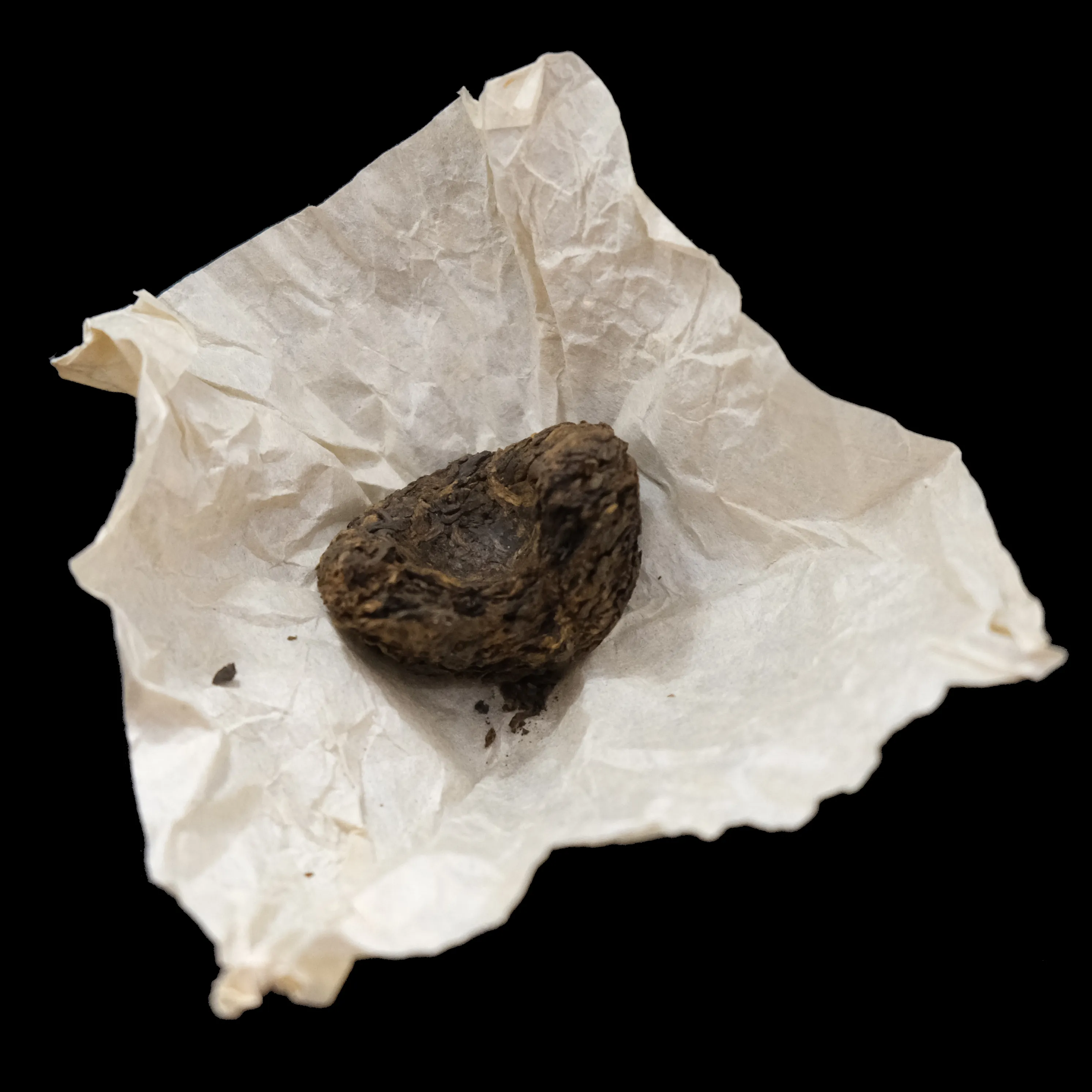
Refined ripe tea may remain loose or be compressed into different shapes. The tuo below is one finished form; its appearance alone cannot establish flavour or storage conditions.
Flavour and quality formation
The typical flavour signatures of ripe pu-erh include:
- Aged / chen xiang: Complex volatiles produced during late-stage microbial metabolism, evoking old wood, damp earth and fungal undertones;
- Woody / medicinal notes: Developed during long-term aging as theabrownins and aromatic substances continue to polymerise and oxidise;
- Sweet mellowness: Polysaccharides are partially broken down into soluble sugars, while bitter polyphenols are transformed, yielding a mellow, sweet taste;
- Silky thickness: Partial degradation of pectin substances gives the liquor a smooth, almost “rice-soup” mouthfeel.
Research shows that tea polyphenols (especially catechins) decline by 50–70% during wet piling, while theabrownins rise from near zero to roughly 10–15% of dry leaf weight[4]. Theabrownins are the main contributors to the deep red liquor colour and are closely linked to the mellow, smooth taste of ripe pu-erh.
Ripe Pu-erh (Shou)
Dark · Pile-Fermented Pu-erhThe silhouette is relative; real cups vary by origin, raw material grade, fermentation depth and aging duration.
Grades and brewing
Ripe pu-erh is graded by raw material tenderness and processing quality. Under GB/T 22111-2008, ripe pu-erh loose tea is classified into six grades based on sensory evaluation: Special, Grade 1, 3, 5, 7 and 9[1]. High-grade lots use mostly buds, with fine, tight strips and visible golden down; lower grades use mature leaves and stems, giving a stronger but less refined taste.
Brewing guide:
| Parameter | Recommendation |
|---|---|
| Water temperature | 95–100 °C (203–212 °F) |
| Leaf-to-water ratio | 5–8 g / 150 ml (gaiwan) or 8–10 g / 200 ml (teapot) |
| Vessel | Yixing clay teapot or gaiwan |
| Pouring | Low, gentle pour down the wall; avoid direct jet on leaves |
| Rinse | 1–2 quick rinses to awaken the leaves |
| Steeping | 1st–3rd infusions 10–20 s; extend gradually |
| Infusions | 8–15, depending on grade |
Wet piling transforms much of the polyphenol content, so ripe pu-erh tastes mellow and far less harsh (caffeine is largely retained). Many drinkers find it gentler on the stomach, though this has not been systematically studied.
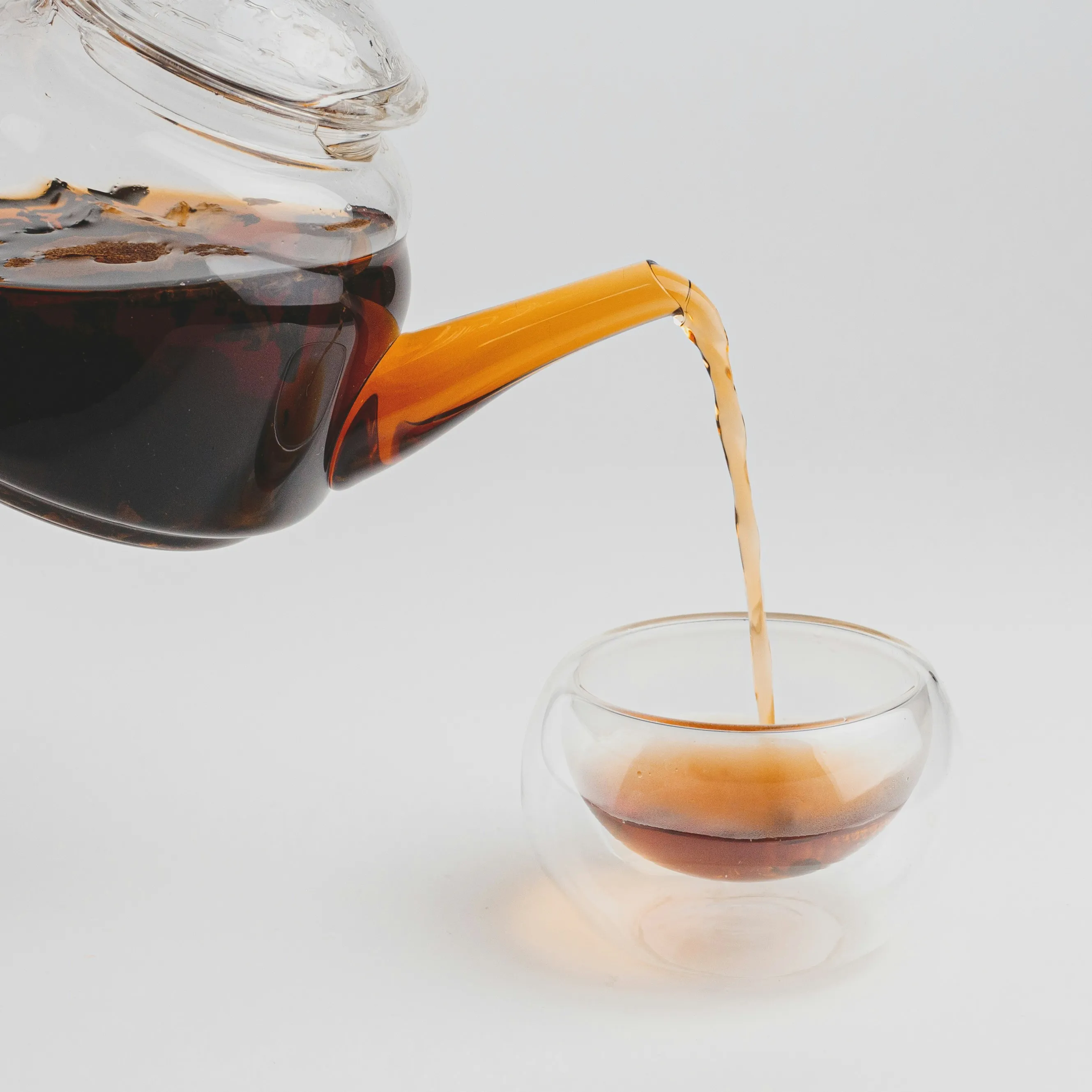
When tasting, notice the colour and strength of the liquor. Dose, steeping time and light also affect its appearance, so colour alone cannot establish whether pu-erh is raw or ripe, or how old it is. The photographer identified the tea below as pu-erh but did not specify its type or batch.
Full process parameters
| Stage | Temperature | Time | Moisture change | Main purpose |
|---|---|---|---|---|
| Raw material prep | Room temp | Hours | 10–12% → 10–12% | Sorting, grading |
| Moistening | Room temp | 1–2 h | 10–12% → 25–35% | Raise moisture for microbial growth |
| Wet piling (early) | Core 25–45 °C | Days 1–10 | 25–35% → 30–40% | Bacterial acidification, metabolism initiated |
| Wet piling (mid) | Core 45–65 °C | Days 11–30 | 30–40% → 25–35% | Aspergillus niger dominant; polyphenols → theabrownins |
| Wet piling (late) | Core 45–50 °C | Days 31–45 | 25–35% → 20–30% | Yeast aroma development, flavour mellowing |
| Turning | — | 4–6 times, 7–10 day intervals | — | Heat dissipation, re-oxygenation, even fermentation |
| Drying | 40–60 °C | Hours to 1–2 days | 20–30% → below 12% | Halt fermentation, stabilise quality |
| Refining | Room temp | Hours to days | Stable | Sieving, picking, blending |
| Pressing (optional) | Steam ~100 °C | Minutes | Brief moistening then re-drying | Shaping for storage and transport |
| Aging | Warehouse 20–30 °C | Months to years | Kept dry, away from damp | Continued mellowing, aged aroma deepening |
Values are representative; real workshops adjust for raw tea condition, weather, equipment and the tea maker’s judgement (drawn from GB/T 22111, wet-piling literature and processing practice)[1][2][3][4].
Common Myths & Scientific Clarifications
Myth 1: ‘Does raw pu-erh naturally turn into ripe pu-erh after decades of storage?’
Scientific Clarification: Although both start from Yunnan large-leaf sun-dried maocha, raw (sheng) and ripe (shu) pu-erh follow fundamentally different biochemical trajectories[1][2]. Raw pu-erh undergoes slow, non-enzymatic auto-oxidation and mild endogenous maturation over decades in dry storage, retaining a distinct phenolic profile and resilient green-brown leaf base. Ripe pu-erh, developed around 1973, uses controlled water moistening (25%–35% moisture) and 45–60 days of thermophilic solid-state wet piling (wodui), where Aspergillus niger and yeasts rapidly convert monomeric catechins into polymeric theabrownins[3][4].
Myth 2: ‘If a newly pressed ripe pu-erh has a damp or earthy ‘pile odor’ (duiwei), is it moldy and spoiled?’
Scientific Clarification: It is important to distinguish normal post-piling odor (duiwei) from mold spoilage. Freshly finished ripe pu-erh often retains trace low-boiling volatile amines, higher alcohols, and organic acids generated during warm, humid microbial fermentation. Resting the tea in clean, ventilated storage for several months to a year allows these transient volatiles to dissipate, revealing clean woody, jujube, and aged aromatics[3][4]. Conversely, visible white/green mold mycelia, pungent musty odors, or sourness in the cup indicate damp storage spoilage or pile-burning defects.
Myth 3: ‘Does a pitch-black, soy-sauce-colored liquor prove superior fermentation and older age?’
Scientific Clarification: The benchmark liquor color for fine ripe pu-erh is ‘deep, luminous ruby-red’ (hong nong ming liang), never opaque, muddy black[1][2]. Over-fermentation (excessive piling duration or core temperatures exceeding 65 °C) carbonizes leaf tissue and degrades pectins, producing a dark, murky first steep followed by a rapid drop-off in flavor and brittle, charred spent leaves[2][3]. Properly fermented ripe pu-erh balances microbial conversion (typically 70%–80% fermentation degree) so the liquor gleams clear crimson-mahogany and the infused leaves remain pliable.
Related Articles
- Microbiology of Dark-Tea Pile-Fermentation (Wodui) — Fungal/bacterial succession and extracellular enzyme cascades in wet piling
- Famous Tea Craft: Raw Pu-erh & Ancient-Tree Tea — Sun-dried maocha fixation and natural dry-warehouse maturation compared
- Famous Tea Craft: Anhua Fuzhuan Brick Tea — Comparing Eurotium cristatum ‘golden flower’ fermentation with pu-erh wet piling
- Aging & Post-Fermentation Chemistry — Post-piling volatile dissipation and long-term theabrownin evolution
- The Science of Tea Storage — Water activity thresholds and clean warehouse protocols for pu-erh
References
- R-086 — GB/T 22111-2008.《地理标志产品 普洱茶》(Product of geographical indication—Pu-erh tea). 国家质量监督检验检疫总局、国家标准化管理委员会.
- R-031 — 施兆鹏, 夏涛 主编 (2016).《茶叶加工学》(第3版). 中国农业出版社. ISBN: 978-7109214347.
- R-267 — 冯超浩, 刘通讯 (2013).《不同潮水量条件下普洱茶渥堆过程化学成分的变化》. 食品科学, 34(7), 135–139. https://doi.org/10.7506/spkx1002-6630-201307028
- R-008 — Zhang, W., et al. (2024). Pile-fermentation mechanism of ripened Pu-erh tea: Omics approach, chemical variation and microbial effect. Trends in Food Science & Technology, 146, 104379. https://doi.org/10.1016/j.tifs.2024.104379
- R-009 — Wang, Y., et al. (2024). Enhanced Fermentation of Pu-Erh Tea with Aspergillus niger: Quality and Microbial Community Analysis. Molecules, 29(23), 5647. https://doi.org/10.3390/molecules29235647
Article Knowledge Network
Explore the connections between the teas, processes and flavours in this article.