
On this page
- What this is
- Why the name 草木间
- Why I made Camellia
- Author and credit
- How I work
- Independence and review boundaries
- Five reading domains, nine chapters
- Know tea (01–03)
- Tea science (04–05)
- Flavour in practice (06–07)
- Tea and culture (08)
- Contemporary issues (09)
- How to read: a layered design
- Interactive visuals
- Bilingual
- Credibility and citation
- Corrections and feedback
- Resources
- References
What this is
Camellia Tea Knowledge Base · 草木间, published by 茶食新知, is an objective, rigorous online tea knowledge base for a global audience. It is not a marketing site or a shop, but a long-term, continuously expanding encyclopedia of tea — from a single leaf to a cup.
Why the name 草木间
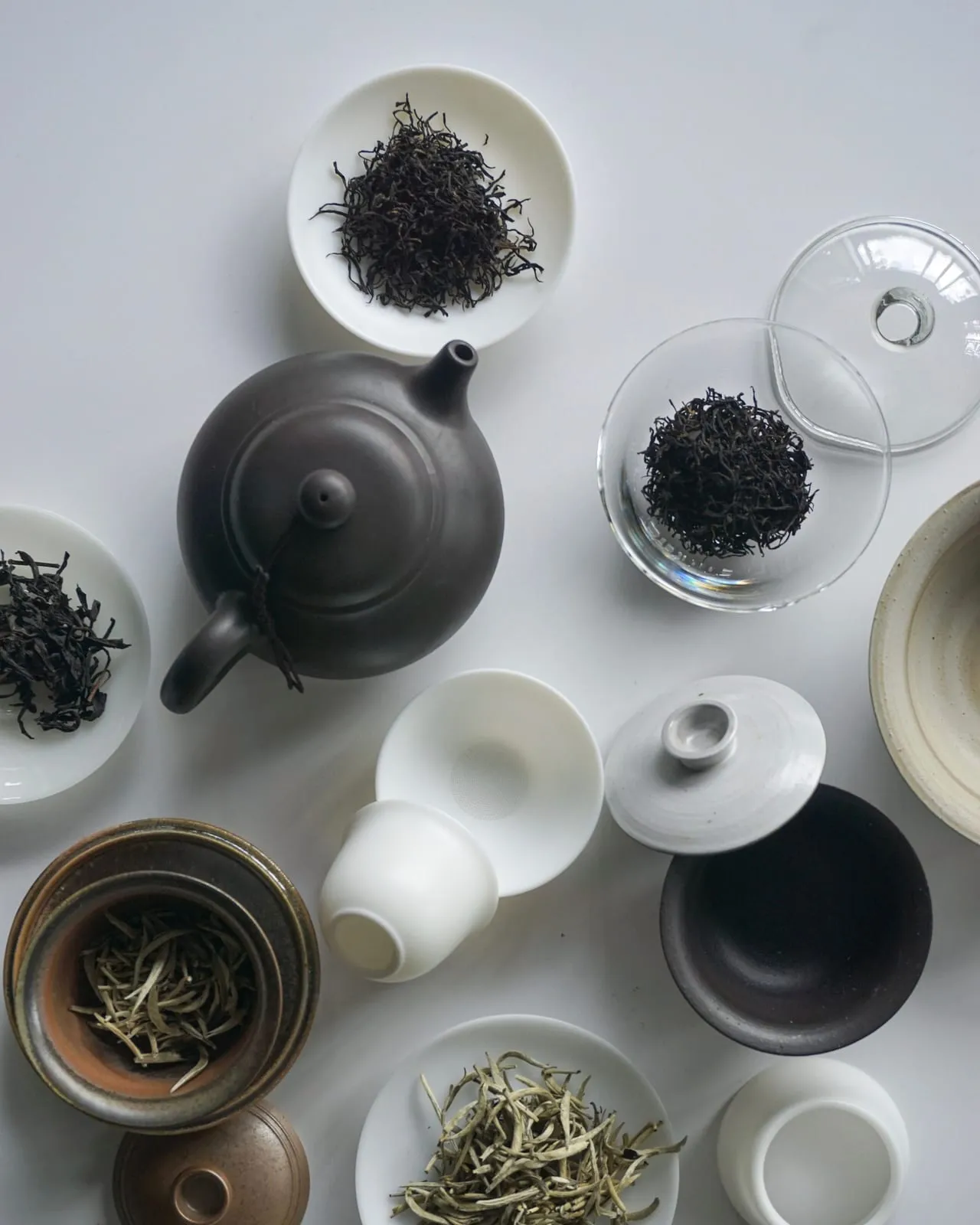
The Chinese character for tea, 茶, has grass (艹) at the top and a tree (木) at the bottom, with a person (人) in between. Tea plants themselves grow wild among grass and trees on the hillsides. The name 草木间, “among grass and trees”, is meant to return a cup of tea to where it came from: a plant, a piece of land, a sequence of processing steps, and the person holding the cup.
The English name, Camellia, is the botanical genus of the tea plant. One Chinese, one Latin — matching the site’s dual nature of culture and science.
Why I made Camellia
I trained in tea science through my bachelor’s, master’s and doctoral degrees, and have studied tea for more than ten years. Over that time I kept noticing that tea knowledge available to the public is scattered: systematic, evidence-based introductions are rare, explanations that go down to the underlying science are rarer still, and there are few practical tools for brewing and keeping tea.
So I decided to build it myself, using AI-assisted programming to turn what I have learned into this knowledge base and an app you can carry with you. I hope it helps more people understand tea and come to love it, and makes a modest contribution to the tea industry.
Author and credit
Most articles on this site are independently researched, written and revised by the principal author under the name 茶食新知. It is the author’s WeChat official-account name and publishing identity, not the name of an invented multi-person editorial team. Camellia Tea Knowledge Base is the project that publishes and maintains the articles and tools.
Reader questions, corrections and specialist review are credited according to the contribution made. Co-authorship is reserved for substantial participation in writing a complete article.
How I work
An article usually starts with a real question: why a process creates a flavour, what a sensory term actually means, or why different sources give different parameters. Sources are then checked in roughly this order: standards and official material; peer-reviewed work and academic books; industry material; and contextual leads. The result is written as an accessible L1 followed by an L2 that preserves mechanisms, data and uncertainty.
Software and AI tools may assist source organisation, language editing, translation, structural discussion or technical implementation, but are not treated as factual sources. Key facts, terminology, citations and final wording are checked and accepted by the principal author. The full approach is described in the editorial and citation policy.
Independence and review boundaries
The site currently focuses on knowledge and interactive tools rather than tea sales or product recommendations. Ordinary articles default to “Author-checked · not externally reviewed”; they are not collectively presented as expert-reviewed. Genuine source checking or specialist review is labelled according to the work done and the reviewer’s preference.
If future content involves commercial support, samples, commissions or another relationship that could influence judgement, that relationship will be disclosed on the relevant article rather than being hidden behind the site’s general reputation.
Five reading domains, nine chapters
Each chapter retains a distinct editorial role, but the site does not treat all nine as equally weighted. The front of the site uses five reading domains to make the learning path clearer.
Know tea (01–03)
- 01 History — origin and global spread
- 02 The tea plant — the tea plant and leaf chemistry
- 03 Regions and cultivation — growing regions, terroir and cultivation
Tea science (04–05)
- 04 Processing — the six categories and world methods
- 05 The science — the science behind decisive processing steps
Flavour in practice (06–07)
- 06 Flavour and evaluation — aroma, taste, mouthfeel and sensory language
- 07 Brewing — using brewing variables to reach a flavour goal
Tea and culture (08)
- 08 Tea culture — ways of drinking tea and their cultural settings
Contemporary issues (09)
- 09 Topics and issues — health, myths, industry and sustainability
How to read: a layered design
Every article comes in two layers, so you can take what you need:
- L1 · Overview — no jargon; what it is and why it’s interesting.
- L2 · Deep Dive — for deeper readers: mechanisms, parameters and research.
Interactive visuals
Each theme has an interactive visual to aid understanding: a history timeline, a world map, an oxidation spectrum, process animations, a flavour wheel, a brewing quick-reference, and a composition ↔ flavour chart. Dragging and clicking often beats reading.
Bilingual
The whole site offers two independent versions in Chinese and English, switchable from the top. Translations follow the glossary.
Credibility and citation
We aim to be scientifically grounded[1]:
- Key claims about mechanisms, data and health cite sources, gathered in References.
- We carefully separate legend from history (e.g. the Shennong tale is myth, not fact) and distinguish “established” from “traditional / unverified.”
- We are cautious about health claims, avoiding absolutes and therapeutic claims.
- Figures are usually common approximate ranges, with their uncertainty noted.
Corrections and feedback
Knowledge is never flawless, and the site may still contain a few errors. You are very welcome to point them out, or to send a private message to the WeChat account 茶食新知; I will check and correct them, and record the change on the corrections and updates pages — continual revision is exactly what this site promises.
Resources
- Glossary: bilingual terms, searchable and filterable
- References: the site-wide library of sources, grouped by chapter
- Editorial and citation policy: source priority, health content, AI assistance and review labels
- Corrections and feedback: prepare an issue and send it through WeChat
- Public update record: material revisions to facts, citations and features
- Content use and reproduction: boundaries for sharing, quotation, republication and reuse of interactive code
Continuously updated. Content here will keep growing and improving.
References
- R-030 — 陈宗懋 主编 (2000).《中国茶叶大辞典》. 中国轻工业出版社. ISBN: 978-7501925094.
- R-051 — Higdon, J. V., & Frei, B. (2003). Tea catechins and polyphenols: health effects, metabolism, and antioxidant functions. Critical Reviews in Food Science and Nutrition, 43(1), 89–143.