
Start with the essentials
A flavour wheel groups related aroma associations into a word map, helping move from “pleasant” to a clearer description. Start with floral, fruity or roasted families; record taste and mouthfeel separately.
This article explains the sources of aroma, taste and texture, why small amounts can smell prominent, and how to practise and calibrate descriptions. Useful notes communicate experience without requiring more words or identical associations from everyone.
Three key points
- Separate sensory dimensionsAroma, taste and texture call for different vocabulary.
- Move from broad to specificA recognisable family is useful even when its exact association remains uncertain.
- Associations need contextConcentration, thresholds and experience affect perception; a floral note does not prove added flowers.
Try it while tasting
Attend to aroma, entry taste and later mouthfeel in three small sips. Choose one or two words each time and mark clear, weak or uncertain impressions so the notes can be discussed and compared.
1. The substances behind taste
Tea’s “taste” (the gustatory part) is mainly set by these water-soluble substances[1][4]:
| Taste | Main substances | Note |
|---|---|---|
| Bitter | caffeine, some catechins | caffeine is the main bitter source, and adds lift |
| Astringent | catechins (esp. galloylated) | bind mouth proteins to give a drying grip |
| Umami | theanine and other amino acids | core of freshness and returning sweetness; softens bitterness |
| Sweet | soluble sugars, some amino acids | mellow sweetness and “hui gan” |
| Body | theaflavins, thearubigins, theabrownins, pectin | oxidation/oxidation products that build body |
Many green teas retain substantial catechins and amino acids, often giving freshness alongside bitterness/astringency. During black-tea processing, some catechins transform into theaflavins, thearubigins and other products, changing taste and colour; dark-tea oxidation brings further polyphenol transformation. Exact levels and perception vary strongly with material and craft, so “highest” and “lowest” should not be inferred from category alone. (See leaf chemistry.)
Synergy and masking: flavour is not simple addition
In the same cup, taste substances interact:
- Amino acids soften bitterness and astringency. Theanine, glutamic acid and others can form complexes with caffeine and catechins, reducing their harsh impact.
- Sugar rounds the mouthfeel. Soluble sugars moderate astringency and make the liquor feel smoother.
- Caffeine amplifies bitterness. Caffeine is bitter on its own, but it produces a clear synergistic bitterness effect when present with catechins [4].
- Returning sweetness (hui gan) is a time effect. After bitter/astringent sensations fade quickly, sweet receptors are relatively activated, producing the subjective impression of sweetness.
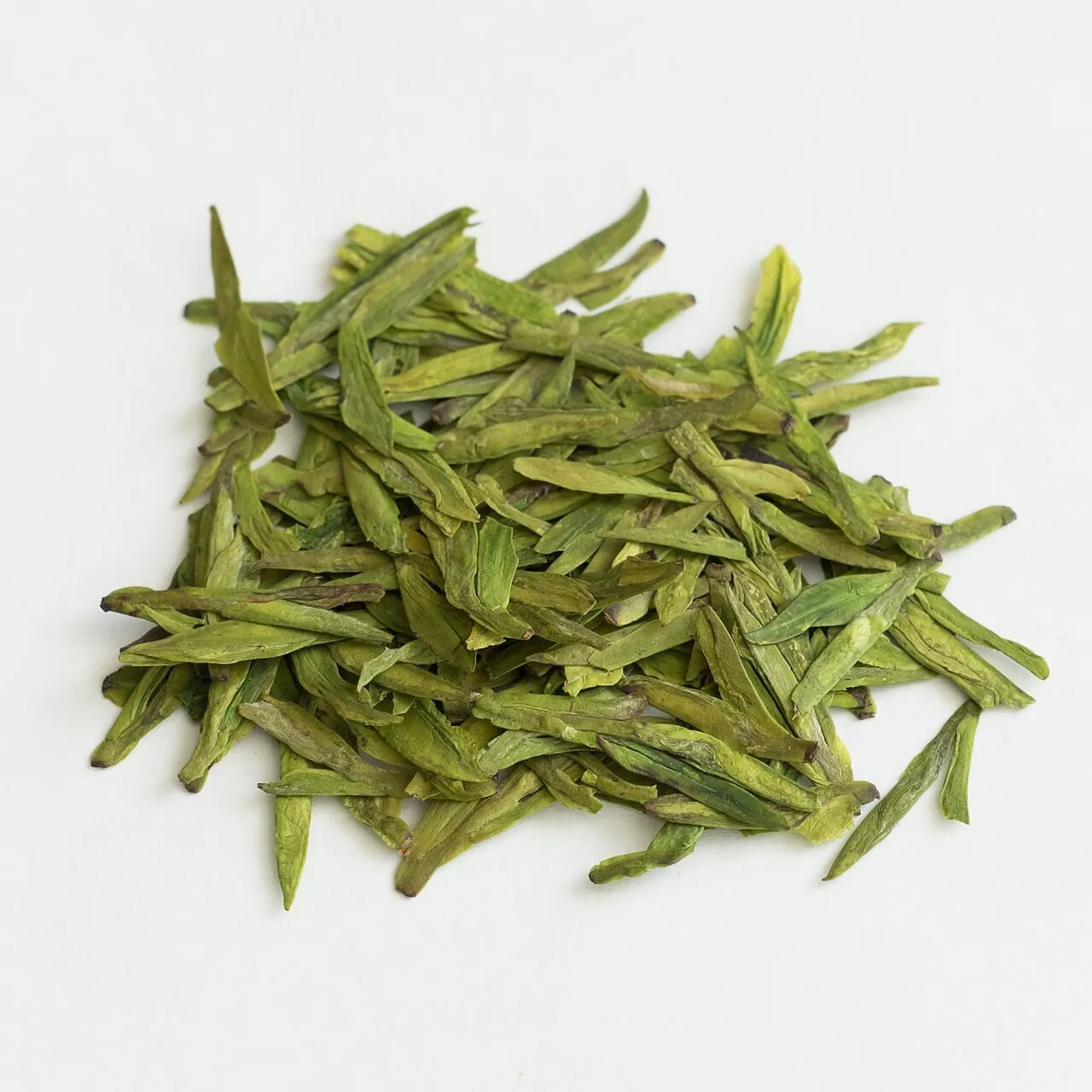
Begin with a dry sample: record its shape, colour and any dry aroma. A photograph can show its appearance; the aroma must be smelled and described.
2. The substances behind aroma
Tea aroma comes from trace volatile compounds — hundreds identified so far[2]. They arise by three broad routes:
- Native to the leaf (terpenes): e.g. linalool (sweet floral) and geraniol (rose), the mainstays of floral aroma[2].
- Enzymatic / stress-induced: wounding and enzymatic release during bruising and rolling generate floral-fruity compounds like cis-jasmone, nerolidol, indole and methyl jasmonate (see oolong zuoqing)[3].
- Heat-formed: Maillard reactions and pyrolysis during fixation, roasting and drying create pyrazines (chestnut, roasty) and other baked notes[2].
Aroma thresholds and odour activity value (OAV)
Whether an aroma compound is perceived depends not only on its concentration but also on its odour threshold — the lower the threshold, the easier a tiny amount is to smell. Scientists use odour activity value (OAV) = concentration ÷ threshold to estimate a compound’s real contribution to aroma[2].
For example, β-damascenone in black tea is present at very low levels, but its threshold is also extremely low (around 0.002 μg/L), so its OAV is high and its contribution to sweet-floral notes is significant [5].
| Representative compound | Aroma type | Common in |
|---|---|---|
| Linalool / geraniol | sweet floral / rose | black, oolong, white |
| cis-Jasmone / indole / jasmine lactone | heady floral (jasmine) | oolong, scented tea |
| β-ionone | violet / fruity | oolong, black |
| Nerolidol | woody floral | oolong, dark |
| (Z)-3-hexenol | grassy / fresh | green, white |
| Dimethyl sulfide | seaweed / shaded | steamed green, gyokuro |
| Pyrazines | chestnut / roasty | pan-fired green, roasted oolong |
Breaking down the aroma families
A tea flavour wheel usually divides aroma into eight families. Understanding their chemical background helps describe a cup more accurately:
- Green / fresh: from C6 aldehydes and alcohols such as leaf aldehyde and leaf alcohol, common in green and white teas.
- Floral: mainly from terpenes and phenylpropanoids such as linalool, geraniol, nerolidol, jasmone and indole; especially rich in oolong and black tea.
- Fruity: β-ionone, β-damascenone, dihydroactinidiolide and other carotenoid-degradation products give apple, grape, peach and other fruit notes.
- Sweet / honey: phenylacetaldehyde, benzyl alcohol, pyrones and pyrroles, often found in black tea and roasted oolong.
- Roasted / chestnut: pyrazines, pyrroles and furans from Maillard and sugar-amino-acid reactions, prominent in pan-fired green tea and roasted oolong.
- Woody / aged: nerolidol, cedrol and microbial transformation products accumulate in aged dark tea and old white tea.
- Seaweed / shaded: dimethyl sulfide (DMS) and its precursors are the signature note of steamed green tea, gyokuro and matcha.
- Off-notes / defects: green-grassy, stale, burnt, mouldy or over-aged notes usually signal under-fixation, excessive piling, over-firing or poor storage.
A single note usually arises from several compounds; the table gives the main correspondence for understanding, not the only source.
3. The science of mouthfeel
Mouthfeel is an oral-tactile experience independent of taste and smell. It mainly includes:
- Astringency. Polyphenols (especially galloylated catechins) bind salivary proteins, reducing lubrication and creating a tightening sensation in the mucosa. Moderate astringency gives the liquor a “backbone”; excess is unpleasant [4].
- Body / thickness. Colloids, pectin and polysaccharides create viscosity and weight. More heavily oxidised or oxidized teas are usually fuller-bodied.
- Smoothness. Low astringency, low particulate roughness and easy flow across the tongue. Roasting, ageing or pectin-rich teas often feel smoother.
- Returning sweetness (hui gan). A subjective sweet impression after bitterness/astringency fades; linked to soluble sugars and taste adaptation.
Mouthfeel vocabulary quick-reference
| Descriptor | Meaning | Common cause |
|---|---|---|
| Astringent | Mouth tightens, lubrication drops | Polyphenols bind salivary proteins |
| Full-bodied | Liquor has weight and roundness | Pectin, polysaccharides, oxidation products |
| Smooth | Soft entry, no roughness | Low astringency, rich colloids, roasting or ageing |
| Thin | Shallow taste, little thickness | Low extractives or under-extraction |
| Rough | Grainy, irritant | Coarse processing or mature raw material |
| Hui gan / returning sweetness | Sweetness appears after swallowing | Contrast effect as bitterness/astringency fades |
4. How to “taste” a tea: sensory evaluation
Professional evaluation looks at five points: appearance, liquor colour, aroma, taste, infused leaf[6]. For everyday drinking, three steps: first smell (dry leaf, lid, liquor, empty-cup aromas); then taste (let the liquor coat the mouth and feel the layers and balance of bitter/astringent/umami/sweet); finally sense the returning sweetness and throat feel. The value of the flavour wheel is to give these elusive impressions a shared, comparable vocabulary.
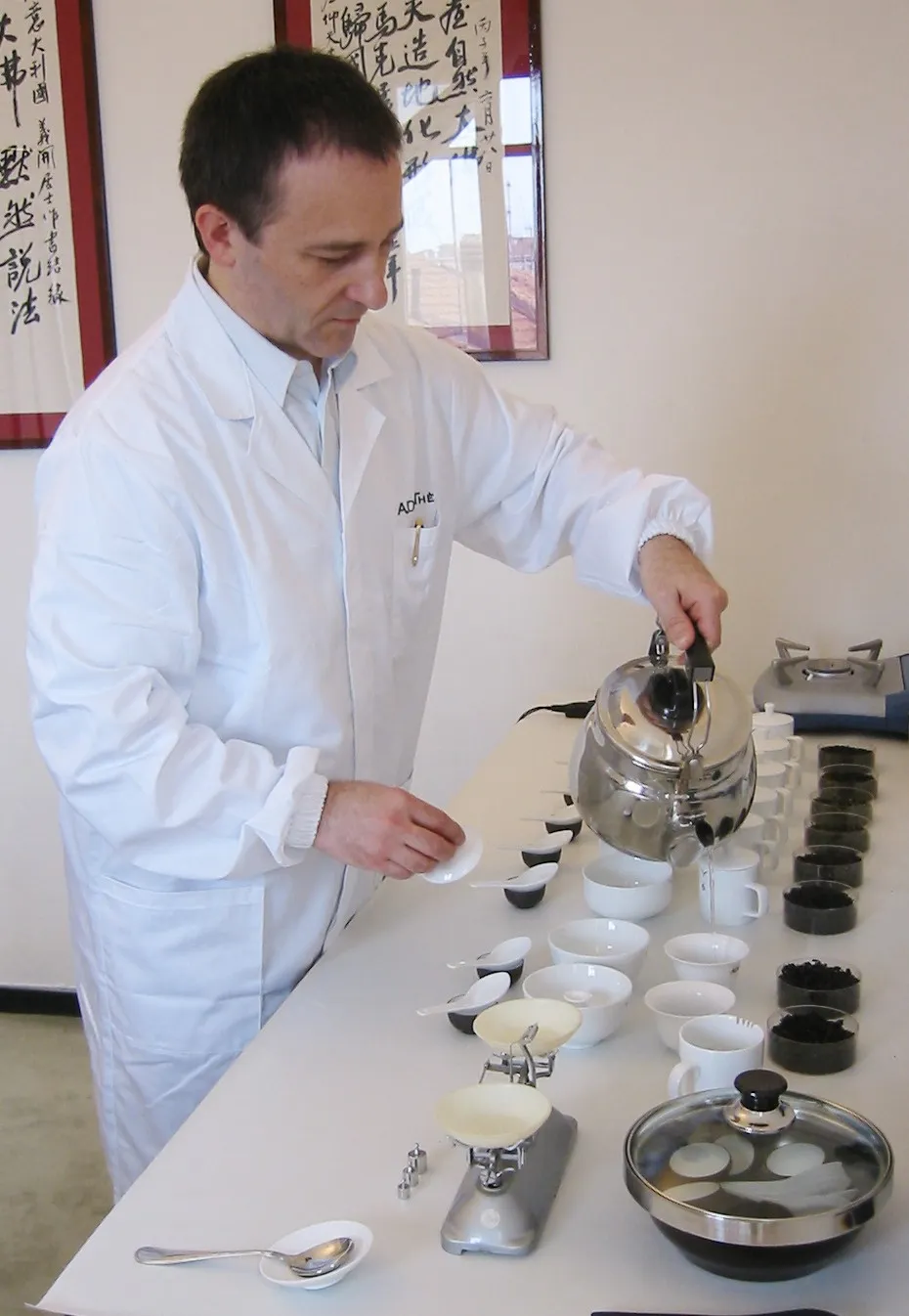
The national standard GB/T 23776-2018 Methodology of sensory evaluation of tea fixes the conditions at 1:50 leaf-to-water ratio, boiling water, a steeping time set by tea type (mostly 4–5 minutes; consult the standard text), using standard evaluation cups and bowls[6]. These conditions are deliberately fixed to remove brewing variables and assess only the tea. You need not copy them at home, but understanding that boundary matters.
The terminology system can be referenced in GB/T 14487-2017 Terms for tea sensory evaluation[7]. The wheel’s value lies in giving these fuzzy sensations a comparable, communicable language.
Move from dry leaf to liquor by observing preparation, then record aroma and taste separately. The image shows a taster pouring water; leaf quantity, temperature and time are not documented.
5. Flavour character of the six tea types
| Tea category | Core flavour character | Key taste/aroma markers |
|---|---|---|
| Green | Fresh and brisk with returning sweetness, slight green bitterness | Catechins, amino acids, leaf alcohol, pyrazines (pan-fired) |
| White | Delicate, sweet and downy, soft with little astringency | Amino acids, sugars, linalool, geraniol |
| Yellow | Mellow-sweet and gentle, low astringency, often “toasty” | Pheophytin, soluble sugars, pyrazines |
| Oolong | Richly floral-fruity, full and smooth with long sweet finish | Terpenes, jasmone, indole, theaflavins |
| Black | Sweet-floral, fruity, malty; bold and brisk | Theaflavins, thearubigins, linalool, β-damascenone |
| Dark (ripe pu-erh) | Mellow and smooth, aged and woody, low astringency | Theabrownins, soluble sugars, microbial metabolites |
Even within a single category, cultivar, roast level and aging shift the sensory balance across a range. The dual-radar explorer below separates aroma (left 6 axes) from taste and mouthfeel (right 6 axes) across 23 representative teas:
Aroma and taste of classic teas
Pick a tea; switch between aroma and taste.
Aroma
Taste & mouthfeel
Oolong · Northern Fujian Charcoal-Roasted
- Medium-full roast Shuixian (orchid & charcoal body)
- Light-medium roast Rougui (spicy cassia & fruity)
What the six axes mean
- Fresh · Tender
- Green · Pekoe
- Floral
- Orchid · Rose
- Fruity · Honey
- Peach · Muscatel
- Sweet · Caramel
- Malt · Cooked
- Roast · Fire
- Chestnut · Charcoal
- Woody · Aged
- Wood · Fungal
- Umami · Brisk
- Theanine · Lively
- Sweetness
- Clean · Honeyed
- Body · Richness
- Full · Smooth
- Bitterness
- Pleasant bitter
- Astringency
- Structure · Grip
- Aftertaste
- Lingering sweet
Outer ring: dominant; middle: distinct; inner: subtle. Solid line is the benchmark; dashed is a cultivar, roast or age variant; the shaded band is the typical category range.
Edited sensory descriptions, not measurements.
6. Flavour-description training
The wheel is a tool; real tasting skill comes from practice. One effective exercise: fix the brewing, write your impressions first, then check the wheel for words. For example:
Find the words in your cup
Pick a family, then a word; or start from a tea.
Segments are families; dots are descriptors
Floral
Aromaindole, cis-jasmone, jasmine lactone
Typical tea associationsUse & creditsView profile
Taste components
Aroma components
Highlights show typical associations, not intensity. Cultivar, craft, brewing and interacting compounds all matter.
Camellia Tea Knowledge Base · by 茶食新知 | Updated 2026-08
A vocabulary, not a score or intensity.
- This green tea is bitter first, then fresh, with fast bitterness fade → “fresh, lightly bitter, returning sweetness”.
- This oolong shows clear orchid and ripe-fruit notes in the third infusion → “orchid floral, ripe fruit, full-bodied”.
- This black tea’s liquor turns cloudy after cooling → suggests rich theaflavins; note “creaming evident, brisk”.
A simple daily log template:
| Item | Record |
|---|---|
| Dry aroma | fresh / chestnut / floral / aged |
| Liquor aroma | lifted / subdued / stale |
| Taste | balance of fresh, sweet, bitter, astringent, mellow |
| Mouthfeel | smooth, astringent, thick, thin |
| Hui gan | long / short / none |
| Overall | summarise in 2–3 words |
Calibrating descriptions with the wheel
When you meet an elusive smell or taste, use the wheel in this order:
- Decide the domain: is it aroma, taste or mouthfeel?
- Pick the family: within aroma, is it floral, fruity or roasted? Within taste, is it bitter, umami, astringent or sweet?
- Find a specific word: choose the closest descriptor under that family. Precision is not required — discrimination is.
- Check the chemical cue: the representative compound linked by the wheel can help verify whether the description is plausible.
For example, a Wuyi rock tea with “roasted nuts plus faint floral-fruit” can be mapped first to “roasted” and “floral-fruity”, then refined to “caramel” and “peach”, building your own descriptive vocabulary.
Taste sensitivity is also affected by temperature, oral condition, mood and even the previous meal, so the same person may describe the same tea slightly differently on different days. The wheel provides direction, not a single standard answer.
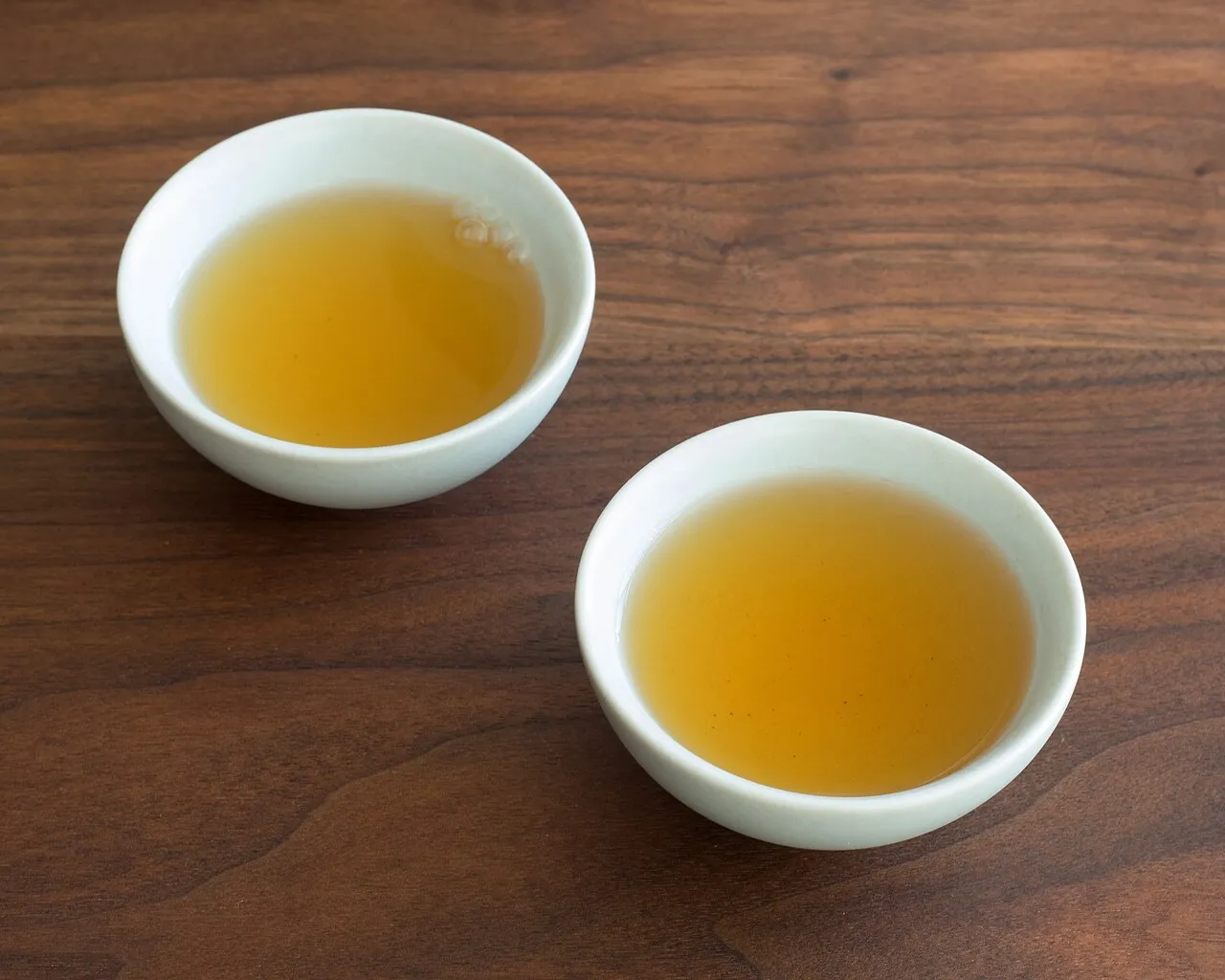
For description practice, write separate notes for each cup: distinguish aroma, bitterness, astringency and finish rather than using only “strong”. The image shows two cups, not a documented controlled comparison.
7. Common Myths & Scientific Clarifications
Myth 1: “Does an exceptionally intense and lingering aroma mean that artificial flavorings were added?”
Scientific Clarification: Not necessarily. High-grade tea naturally encompasses hundreds of volatile aromatic compounds synthesized through endogenous glycoside enzymatic hydrolysis, carotenoid oxidative degradation, and Maillard roasting reactions[2][5]. Genuine tea aroma presents a progressive, evolving release spectrum—subtle in dry leaves, multidimensional in the liquor, and long-lasting on the empty cup base. Synthetic aroma chemicals lack adsorption within the tea leaf colloid matrix, typically presenting an aggressive, pungent fragrance in dry leaf and the first steep, followed by a precipitous drop and disconnected “water-flavor dissociation” by the second or third infusion[1][2].
Myth 2: “Does any noticeable astringency indicate inferior leaf plucking or defective processing?”
Scientific Clarification: A misconception regarding tea mouthfeel architecture. Balanced astringency provides structural backbone and textural vitality, especially in fine oolong and orthodox black teas[1][4]. Astringency arises when galloylated catechins (EGCG, ECG) cross-link reversibly with salivary proline-rich proteins (PRPs), causing transient oral de-lubrication[4]. Quality evaluation hinges not on the complete absence of astringency, but on its resolution kinetics: premier teas demonstrate astringency that dissolves within seconds, triggering salivation and soothing sweetness (hui gan), whereas defective or scorch-fixed teas leave persistent, throat-gripping coarseness[4][6].
Myth 3: “Is the lingering ‘returning sweetness’ (hui gan) caused directly by high sugar levels in tea leaves?”
Scientific Clarification: Distinct physiological mechanisms are at play. Immediate upfront sweetness on the tongue stems from soluble monosaccharides, disaccharides, and specific free amino acids engaging sweet taste receptors[1]. Conversely, the post-swallowing sensation of hui gan is primarily a sensory contrast phenomenon: bitter and astringent polyphenols dissociate from mucosal receptors, though the exact mechanism of hui gan remains unsettled[1][4]. Hui gan is an evolving temporal contrast reflex, fundamentally different from static syrup sweetness.
Myth 4: “Is the primary objective of a sensory tea flavor wheel to assign absolute quality scores?”
Scientific Clarification: No. A flavor wheel functions as a standardized sensory lexicon and diagnostic compass rather than a one-dimensional scoring leaderboard[6][7]. Its purpose is to deconstruct volatile and gustatory profiles into objective sensory attributes—spanning floral, fruity, nutty, roasted, and off-odor tiers. By mapping specific flavor notes to fresh leaf maturity, enzymatic oxidation thresholds, and thermal drying regimes, the wheel enables cross-cultural sensory calibration and technical root-cause attribution, rather than ranking teas on subjective hierarchy[2][6].
The flavour code: how composition becomes “taste”
Connecting compounds to the senses — why each tea tastes the way it does:
Why is green tea brisk?
high amino acids (umami) + high catechins (grip)
= fresh and brisk, clear returning sweetness
Key compoundstheanine, EGCG
Why is white tea delicate-sweet?
high amino acids & sugars + very light oxidation
= soft sweetness, downy aroma
Key compoundstheanine, soluble sugars
Why is yellow tea mellow, not grassy?
men-huang tempers harshness + builds sweet notes
= mellow-sweet with a toasty note
Key compoundssoluble sugars, pheophytin
Why is oolong so aromatic yet smooth?
zuoqing creates hundreds of aromatics + partial oxidation cuts astringency
= "fragrant for seven steeps"
Key compoundslinalool, nerolidol, indole, jasmine lactone
Why is black tea full and sweet?
thearubigins (body) + lower catechins (less astringent) + Maillard (sweet)
= smooth and sweet, bright red liquor
Key compoundstheaflavins, thearubigins
Why is dark tea aged and smooth?
theabrownins + microbial aged aroma + caffeine binding cuts astringency
= mellow and smooth, growing aged aroma
Key compoundstheabrownins, gallic acid
See also
- The Science of each craft — how flavour is generated during processing
- Leaf chemistry · Brewing — how composition and brewing shape flavour
References
- R-029 — 宛晓春 主编 (2003).《茶叶生物化学》(第3版). 中国农业出版社. ISBN: 978-7109066274.
- R-235 — Ho, C.-T., Zheng, X., & Li, S. (2015). Tea aroma formation. Food Science and Human Wellness, 4(1), 9–27. https://doi.org/10.1016/j.fshw.2015.04.001
- R-025 — Zheng, X.-Q., Li, Q.-S., Xiang, L.-P., & Liang, Y.-R. (2016). Recent Advances in Volatiles of Teas. Molecules, 21(3), 338. https://doi.org/10.3390/molecules21030338
- R-253 — Xu, Y.-Q., et al. (2018). Quantitative analyses of the bitterness and astringency of catechins from green tea. Food Chemistry, 258, 16–24. https://doi.org/10.1016/j.foodchem.2018.03.042
- R-272 — Ravichandran, R., & Parthiban, R. (2002). Carotenoid composition, distribution and degradation to flavour volatiles during black tea manufacture and the effect of carotenoid supplementation on tea quality and aroma. Food Chemistry, 78(1), 23–28. https://doi.org/10.1016/s0308-8146(01)00303-x
- R-161 — GB/T 23776-2018.《茶叶感官审评方法》(Methodology for sensory evaluation of tea). 全国茶叶标准化技术委员会(SAC/TC339).
- R-236 — GB/T 14487-2017.《茶叶感官审评术语》(Terminology of tea sensory evaluation). 全国茶叶标准化技术委员会(SAC/TC339). 2018-05-01 实施,代替 GB/T 14487-2008.
Article Knowledge Network
Explore the connections between the teas, processes and flavours in this article.