
Start with the essentials
Oolong leaf working alternates movement and rest. Movement causes controlled damage; moisture loss, reactions and aroma changes continue during rest and inform the next decision. The visible rhythm manages changing conditions.
This article connects water movement, local oxidation and plant responses with floral and fruity aromas, then follows fixation and roasting. Cultivar, weather and intended style explain why observation matters more than a universal timetable.
Three key points
- Movement and rest have complementary jobsDamage and contact interact with moisture loss and reactions.
- Aroma follows several pathwaysMaterial, release of compounds and plant responses contribute together.
- Judgement guides the next stageLeaf condition and aroma inform handling before fixation and roasting.
Connect the process with the tea
Record floral, fruity and roasted notes separately, then inspect infused surfaces and edges. These observations offer processing clues without yielding a universal oxidation percentage.
The oolong process
Biochemistry
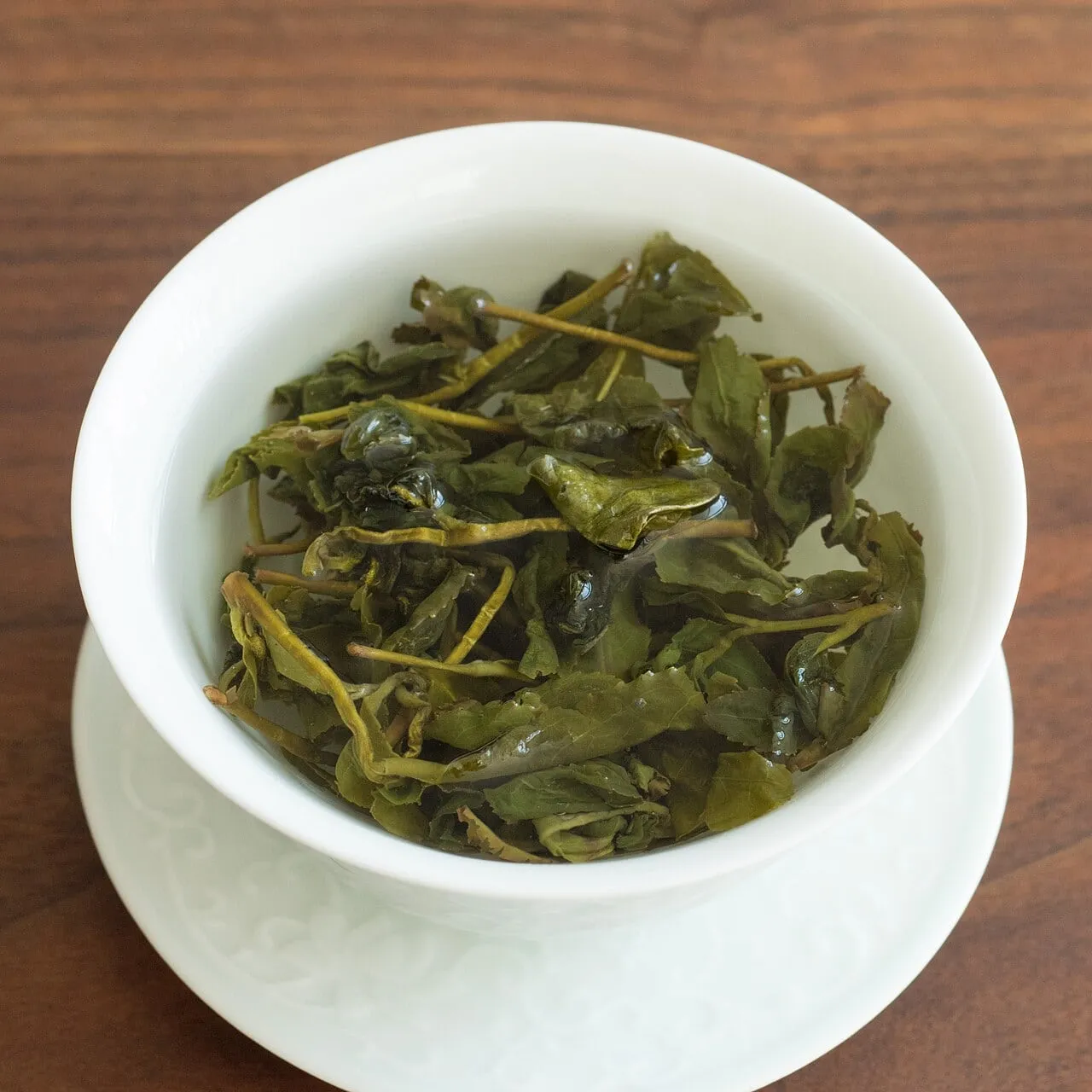
During zuoqing, shaking makes the leaves collide and rub, bruising mainly the edges. The damaged cells open up, oxygen enters, and polyphenol oxidase can more readily meet catechins and drive enzymatic oxidation. Changes are usually more visible at the edge than at the centre, producing the classic lǜ yè hóng xiāng biān [1][2]. Theaflavins and other oxidation products can form during this process; their amounts and sensory contributions vary with the material and manufacture.
Shaking bruises, resting rehydrates
Switch steps: bruising, then water return.
Shaking bruises the edges
- The bamboo drum turns; leaves tumble and collide
- Serrated leaf edges are bruised first
- Loupe: margin cell walls rupture
- Orange PPO meets catechins; local oxidation starts
Shaking bruises only the edge: green leaf, red rim.
Round parameters & sources
- Round 1: Gentle Shaking · Respiration Activation: Speed 18–20 rpm, gentle 2–3 min; Resting 1.5–2.0 h (Room temp 22–24 °C, RH 75%)
- Round 2: Transpiration · Turgidity Recovery: Speed 22–24 rpm, gentle 5–8 min; Resting 2.0–2.5 h (Thickness 2–3 cm)
- Round 3: Moderate Tumbling · Red Rim Emergence: Speed 26–28 rpm, moderate 10–15 min; Resting 2.5–3.0 h (Thickness 3–4 cm)
- Round 4: Robust Shaking · Intense Aroma Bloom: Speed 28–30 rpm, robust 18–22 min; Piled resting 2.5–3.5 h (Thickness 4–6 cm)
- Round 5: Peak Aroma · "Green Leaf with Red Edge": Speed 30–32 rpm, brisk 20–25 min; Final resting 1.5–2.0 h (Ready for fixation)
Mechanisms: Synthesised from Tea Processing (R-031) and oolong aroma research (R-013, R-029). Zuoqing controls gradual dehydration while utilizing mechanical bruising to trigger marginal enzymatic oxidation and glycosidic aroma cleavage.
Note: Masters dynamically fine-tune drum speeds, tossing duration, and resting thickness based on leaf flush tenderness, ambient temperature, humidity, and atmospheric pressure.
Schematic only; shaking strength and rest intervals vary with leaf maturity and weather.
Oolong’s floral-fruity aroma is also linked to secondary metabolism affected by stress. Repeated shaking, water loss during withering and cool resting temperatures can act as multiple stresses on the leaf. Research suggests that the following pathways participate:
-
The LOX / HPL pathway. When cell membranes are damaged, unsaturated fatty acids can be converted through lipoxygenase, hydroperoxide lyase and related reactions into C6 and C9 volatiles and their precursors; these may participate in subsequent aroma transformations.
-
Terpenoid synthesis. Under some experimental conditions, mechanical wounding and low temperature can affect expression of terpene-synthesis genes and coincide with changes in α-farnesene, jasmine lactone and nerolidol, volatiles associated with floral and fruity aroma [3][7].
-
Hydrolysis of glycosidically bound aroma precursors. A large pool of aromatic compounds in the fresh leaf is stored as odourless glycosides. Cell damage and enzyme changes during zuoqing promote β-glucosidase activity, releasing linalool, geraniol, benzyl alcohol, leaf alcohol and other free aroma molecules [2][8].
-
Indole and methyl-jasmonate pathways. Zeng et al. (2016) found that mechanical wounding and low temperature synergistically induce volatile indole, which at low concentrations contributes an elegant floral note and at high concentrations can turn green or animalic [4].
Zeng et al. (2019) linked multiple stresses with enrichment of volatile terpenes, esters and indoles, describing zuoqing as “controlled adversity” — the maker uses the rhythm of shaking and resting to guide the leaf into generating abundant aroma compounds while it tries to repair itself [10].
Gene regulatory networks
Recent omics work has pushed the mechanism of zuoqing down to the gene-regulation level. A 2021 Frontiers in Plant Science study built a shaking-induced gene regulatory network (GRN) and found that mechanical damage rapidly activates transcription factors such as WRKY, MYB and ERF family members; these in turn up-regulate LOX, HPL, terpene synthase and phenylpropanoid-pathway genes involved in aroma synthesis [1].
Green leaf, red edge, round by round
Switch rounds: rim and aroma.
Gentle shake: grassy notes leave first
- Leaf edges barely redden
- Loupe: margin cells mostly intact
- Low-boiling grassy volatiles escape
- Leaves soften; stomata open slightly
First shake: slow and brief, so tender stems are not bruised.
Round parameters & sources
- Shaking drum speed & time
- Speed 18–20 rpm, gentle 2–3 min
- Resting aeration duration
- Resting 1.5–2.0 h (Room temp 22–24 °C, RH 75%)
- Aroma volatile evolution phase
- Fresh green · grassy vapor dispersal
- Dominant aroma volatile profile
- cis-3-hexenol, trans-2-hexenal (low-boiling volatiles evaporate)
Surface water evaporates, leaves soften, stomata open slightly, fresh vegetative notes dissipate
The bamboo drum rotates slowly. Softened leaves gently tumble and slide across the drum walls, shedding surface moisture and activating margin cell respiration.
- Round 1: Gentle Shaking · Respiration Activation: Speed 18–20 rpm, gentle 2–3 min; Resting 1.5–2.0 h (Room temp 22–24 °C, RH 75%)
- Round 2: Transpiration · Turgidity Recovery: Speed 22–24 rpm, gentle 5–8 min; Resting 2.0–2.5 h (Thickness 2–3 cm)
- Round 3: Moderate Tumbling · Red Rim Emergence: Speed 26–28 rpm, moderate 10–15 min; Resting 2.5–3.0 h (Thickness 3–4 cm)
- Round 4: Robust Shaking · Intense Aroma Bloom: Speed 28–30 rpm, robust 18–22 min; Piled resting 2.5–3.5 h (Thickness 4–6 cm)
- Round 5: Peak Aroma · "Green Leaf with Red Edge": Speed 30–32 rpm, brisk 20–25 min; Final resting 1.5–2.0 h (Ready for fixation)
Mechanisms: Synthesised from Tea Processing (R-031) and oolong aroma research (R-013, R-029). Zuoqing controls gradual dehydration while utilizing mechanical bruising to trigger marginal enzymatic oxidation and glycosidic aroma cleavage.
Note: Masters dynamically fine-tune drum speeds, tossing duration, and resting thickness based on leaf flush tenderness, ambient temperature, humidity, and atmospheric pressure.
Schematic only; shaking strength and rest intervals vary with leaf maturity and weather.
Hormone signalling also participates. Jasmonic acid (JA) and ethylene are classic wound-response hormones; both rise during zuoqing and form a cascade with transcription factors, amplifying secondary metabolism toward defence and aroma production. Different cultivars (Tieguanyin, Shui Xian, Rou Gui) show different expression patterns, which may be one molecular basis for their different aroma styles [4][7].
These expression changes are strongly time-dependent: stress-response genes activate within minutes of shaking, then enter a recovery phase, and the next round of shaking triggers them again. This “damage–recover–damage” pulse is more effective at sustaining aroma accumulation than a single severe injury, which is why zuoqing needs multiple cycles rather than one heavy shake [3][4].
Zuoqing and roasting: a relay
After zuoqing, high-heat fixation must immediately stop enzymatic oxidation. Fixation temperature is usually 200–280 °C in a drum or wok, raising leaf temperature rapidly above 80 °C and inactivating PPO/POD. But fixation is only the first step in flavour setting; for Wuyi rock tea and heavily roasted Tieguanyin, the tea then goes through repeated roasting [5][9].
Roasting:
- Stabilises aroma by driving off low-boiling green notes and fixing higher-boiling floral and caramel aromas;
- Reduces moisture to 3–5%, helping long-term storage;
- Develops caramel and baked notes through Maillard and caramelisation reactions, producing pyrazines, pyrroles and furans;
- Improves smoothness as some polyphenols transform further, reducing astringency and rounding the mouthfeel.
Rock-tea roasting usually proceeds through several stages — rough firing (~100–120 °C), final firing (~80–100 °C) and finally a long, gentle “stewing” fire at lower temperature. Lightly roasted teas are aromatic and yellow-green in the cup, best consumed young; fully fired teas are more subdued and mellow, storing well; very high-fired teas show obvious caramel and fire notes and need to “rest” before drinking. Zuoqing sets the aroma “skeleton”; roasting decides the “complexion” and the thickness of the body [5][9].
Common Myths & Scientific Clarifications
Myth 1: “Does the stated ‘20%–70% oxidation’ on oolong tea reflect a precise chemical measurement?”
Scientific Clarification: Stated oxidation percentages represent traditional sensory scales rather than reproducible chemical metrics. In oolong processing, enzymatic oxidation occurs primarily at bruised leaf margins; whole-leaf catechin consumption rates rarely correspond to advertised figures [2][4]. Descriptors like “15%–20% oxidized” for light Tieguanyin or “60%–70%” for Oriental Beauty denote empirical benchmarks for edge-reddening, aroma maturity, and infusion redness rather than stoichiometric conversion rates of tea polyphenols. When evaluating an oolong, assess the physical edge coloration and balance of briskness against sweet finish rather than taking commercial percentage labels literally.
Myth 2: “Is shaking during zuoqing simply bruising the leaves to speed up oxidation?”
Scientific Clarification: Zuoqing shaking differs fundamentally from full-leaf maceration or rolling. Rotary shaking delivers controlled micro-wounds strictly to leaf edges, triggering jasmonic acid defence cascades that activate terpene synthases [1][4]. Crucially, during subsequent resting phases, stems pump moisture, sugars, and amino acids toward leaf margins (“water walking”), driving steady glycosidic precursor cleavage [6][8]. Full cell maceration would completely bypass this regulated stress-response relay, halting stem transport, creating harsh grassy liquor, and turning the entire leaf prematurely dull brown.
Myth 3: “Does heavier zuoqing and a wider red margin always produce better aroma?”
Scientific Clarification: Zuoqing requires delicate physiological equilibrium; aggressive mechanical handling causes quality collapse. When shaking is excessive or resting fails to evaporate stem water, leaves become waterlogged (“dead green” or “water accumulation”), prompting irregular polyphenol degradation that yields muddy liquor and stewed, sour taints [3][9]. Conversely, under-shaking leaves grassy cis-3-hexenol intact, causing excessive bitterness and astringency. Ideal zuoqing balances vermilion leaf margins with a lively green centre, producing a pure, soaring orchid or fruit aroma upon hot infusion.
Myth 4: “Do oolong’s orchid and honey-fruit notes come entirely from final charcoal roasting?”
Scientific Clarification: Roasting cannot fabricate floral volatiles from void; the core aromatic skeleton is forged during zuoqing. Mechanical wounding and moisture stress induce enzymes to synthesise α-farnesene, nerolidol, indole, and jasmine lactone directly in living tissues [1][4][7]. Subsequent charcoal roasting dehydrates the leaf, drives off residual green volatiles, and layers pyrazines and furans via Maillard reactions to add toasted warmth [9]. Without a well-developed floral core from zuoqing, roasting produces merely flat, burnt charcoal aromas.
See also
- Black-tea oxidation — full enzymatic oxidation, for contrast
- Green-tea fixation — how heat switches enzymes off
- The flavour wheel — sensory vocabulary for oolong’s floral-fruity notes
Key compound dynamics
| Compound | Dynamic during zuoqing | Flavour contribution | Ref. |
|---|---|---|---|
| Catechins | May decline; the extent varies by leaf region and process | Associated with changes in astringency | [1][2] |
| Theaflavins | May form and change dynamically | May affect liquor colour and taste | [1][2] |
| α-Farnesene | Increases in some studies | Associated with floral and fruity notes | [3][7] |
| Jasmine lactone | Increases in some studies | Associated with jasmine-like aroma | [3][7] |
| Nerolidol | May change | Associated with floral-fruity aroma | [3] |
| Volatile indole | May fluctuate with stress and processing stage | Associated with floral / orchid-like notes | [4] |
| Glycosidically bound aroma precursors | May undergo hydrolysis | Releases free aroma molecules | [2][8] |
Parameters and quality defects
The ranges below represent selected production practices, not universal specifications for every oolong. Actual control depends on cultivar, plucking maturity, weather and equipment.
| Parameter | Typical range / practice | Too low risk | Too high risk |
|---|---|---|---|
| Shaking intensity | Light to heavy, increasing each round | Under-oxidation, green off-notes | Excessive bruising, uncontrolled reddening |
| Number of shakes | Traditionally 3–6 rounds, adjusted to leaf state | Thin aroma, poor water movement | High leaf temperature, over-oxidation |
| Resting time | 0.5–2 h per round; total zuoqing 6–12 h | Oxidation stalls, greenness remains | Too-fast water loss, stems soften |
| Ambient temperature | 18–26 °C (cooler nights common) | Slow enzyme activity, weak aroma | Rapid oxidation, sour notes |
| Relative humidity | 70–85% | Dry edges, fast water loss | Waterlogging, stale off-notes |
| Leaf moisture after withering | About 65–70% | Hard to move water, stiff leaf | Too wet, prone to stewing, aroma trapped |
Under-oxidation. If shaking is too light, resting too short or the temperature too low, the leaf edges oxidise only weakly. The result is persistent greenness, obvious astringency, thin aroma and too much green in the infused leaf — the tea tastes unfinished.
Over-oxidation. If shaking is too heavy, leaf temperature rises too high or resting runs too long, the red margin spreads toward the centre and polyphenols oxidise excessively. The tea then shows cooked, flat notes, sourness, faded florals and a dull reddish liquor, losing the lively layers that define oolong.
Representative styles
| Style | Relative processing direction | Zuoqing character | Common aroma descriptions | Ref. |
|---|---|---|---|---|
| Fragrant Tieguanyin | Lighter, retaining a fresh profile | Lighter shaking, fewer rounds, often temperature-controlled | Orchid, fresh and lifted | [7][9] |
| Wuyi rock tea | Medium to relatively heavy; later roasting also matters | Heavier shaking; roasting contributes to the final profile | Floral-fruity and roasted notes | [5][9] |
| Fenghuang Dancong | Medium to relatively heavy | Relatively heavy zuoqing, single-bush picking, often night processing | Honey orchid, gardenia, ginger flower | [9] |
| Taiwan oolong (qingxiang / semi-ball) | Light to medium | Light shaking, cloth-wrapped rolling, often cooler conditions | Floral and fruity notes | [9] |
Flavour sketch
Oolong Tea (Bruising & Roasting)
Semi-Oxidized · Stress-Induced VolatilesTea Science · core comparison
| Feature | Oolong | Black tea | Green tea |
|---|---|---|---|
| Oxidation pattern | Localised, partial enzymatic oxidation; its extent varies by style and process and cannot be captured by one universal percentage | Usually more extensive enzymatic oxidation | Fixation usually occurs early, leaving relatively limited oxidation |
| Main driver | Zuoqing: mechanical wounding + dehydration + low-temperature stress | Rolling followed by continuous enzymatic oxidation | High-heat fixation rapidly deactivates enzymes |
| Key products | Catechins partly retained; small theaflavins; abundant terpene floral volatiles | Theaflavins, thearubigins, theabrownins | Catechins, chlorophyll, amino acids largely preserved |
| Liquor colour | Golden to orange (light oxidation) or orange-red (heavy oxidation) | Bright red | Pale green to yellow-green |
References
- R-004 — Zhu, X., et al. (2021). Architecture and Dynamics of the Wounding-Induced Gene Regulatory Network During the Oolong Tea Manufacturing Process (Camellia sinensis). Frontiers in Plant Science, 12, 788469. https://doi.org/10.3389/fpls.2021.788469
- R-029 — 宛晓春 主编 (2003).《茶叶生物化学》(第3版). 中国农业出版社. ISBN: 978-7109066274.
- R-206 — Lin, J., et al. (2021). Study of aroma compound formations and transformations during Jinxuan and Qingxin oolong tea processing. International Journal of Food Science & Technology, 57(3), 1629–1638. https://doi.org/10.1111/ijfs.15205
- R-207 — Zeng, L., et al. (2016). Formation of Volatile Tea Constituent Indole During the Oolong Tea Manufacturing Process. Journal of Agricultural and Food Chemistry, 64(24), 5011–5019. https://doi.org/10.1021/acs.jafc.6b01742
- R-076 — GB/T 18745-2006.《地理标志产品 武夷岩茶》(Product of geographical indication—Wuyi rock tea). 国家质量监督检验检疫总局、国家标准化管理委员会.
- R-208 — Cao, Q., et al. (2026). UV-B and mechanical wounding synergistically induce α-farnesene biosynthesis via CsHY5-CsMYC2 cooperation during oolong tea processing. Horticultural Plant Journal, 12(1), 101–112. https://doi.org/10.1016/j.hpj.2025.01.015
- R-006 Wu, Liangyu, Chen, Xiaolan, Lin, Jiaqi, Lin, Hongzheng, Liao, Ningkai, Li, Chenxue, Hu, Yunfei, Sun, Yun (2024). Study on dynamic alterations of volatile organic compounds reveals aroma development over enzymatic-catalyzed process of Tieguanyin oolong tea production. Food Chemistry: Molecular Sciences, 9, 100227. https://doi.org/10.1016/j.fochms.2024.100227
- R-005 Wang, Dongmei, Kubota, Kikue, Kobayashi, Akio, Juan, I-Ming (2001). Analysis of Glycosidically Bound Aroma Precursors in Tea Leaves. 3. Change in the Glycoside Content of Tea Leaves during the Oolong Tea Manufacturing Process. Journal of Agricultural and Food Chemistry, 49(11), 5391-5396. https://doi.org/10.1021/jf010235+
- R-077 — 刘宝顺、刘仕章等.《武夷岩茶的品质及加工技术研究进展》. 《中国茶叶》, 2021. https://www.puercn.com/zhishi/jishu/153721.html
- R-333 — 系统评述茶树香气化合物生物合成网络、植食性昆虫与环境胁迫下茉莉酸(JA)信号激活与萜烯类化合物大量诱导合成的前沿综述。
Article Knowledge Network
Explore the connections between the teas, processes and flavours in this article.