
Start with the essentials
Lapsang Souchong is a black tea available in smoked and unsmoked styles. Smoking adds particular aromas to a tea that still depends on withering, rolling, oxidation and drying. Recognising it involves more than finding smoke.
This article places smoking within manufacture, fuel and heating conditions, then connects traditional and newer approaches with sweetness, smoke, taste and provenance. It also helps distinguish a smoked style from burnt notes.
Three key points
- Smoking builds on black-tea manufactureEarlier stages provide the base.
- The name includes different stylesProduct information and tasting identify the treatment.
- Describe smoke separately from burningType, clarity and balance communicate more than intensity alone.
What to notice when tasting
Compare clearly labelled smoked and unsmoked samples at similar strength. Record smoke, sweetness and intensity separately, then consult the manufacturing description.
What makes this tea special
Lapsang Souchong’s identity begins with geography and history. Tongmu Pass sits within the Wuyishan National Nature Reserve, at 1,000–1,500 m elevation, with an annual mean temperature of about 14–18 °C, persistent mist, high humidity and wide day–night temperature swings[1]. The dominant local cultivar is Wuyi Caicha — a seed-propagated population of small, tender leaves well suited to black tea production.
Local legend traces the tea’s origin to the late Ming or early Qing dynasty, when an army passed through Tongmu Pass. Tea workers, unable to process the fresh leaf as green tea in time, found it had naturally oxidised and turned red. To salvage the crop, they hastily dried the leaves over pine fires — and accidentally created a new tea with a smoky aroma and bright red liquor[2]. Whether or not the story is historically accurate, it captures the essence of the craft: Lapsang Souchong is a “happy accident” that revealed the path to fully oxidised tea, and the pine-wood roasting was a pragmatic use of abundant local Masson pine, whose resin-rich wood made smoke roasting almost cost-free.
From the late 17th century, Lapsang Souchong was shipped to Europe by Dutch and British traders. As one of the earliest black teas to reach Europe, it shaped European taste for black tea and served as a model for the later black-tea industries of India, Sri Lanka and elsewhere[3]. A thread of pine smoke from Tongmu Pass changed the global tea map.
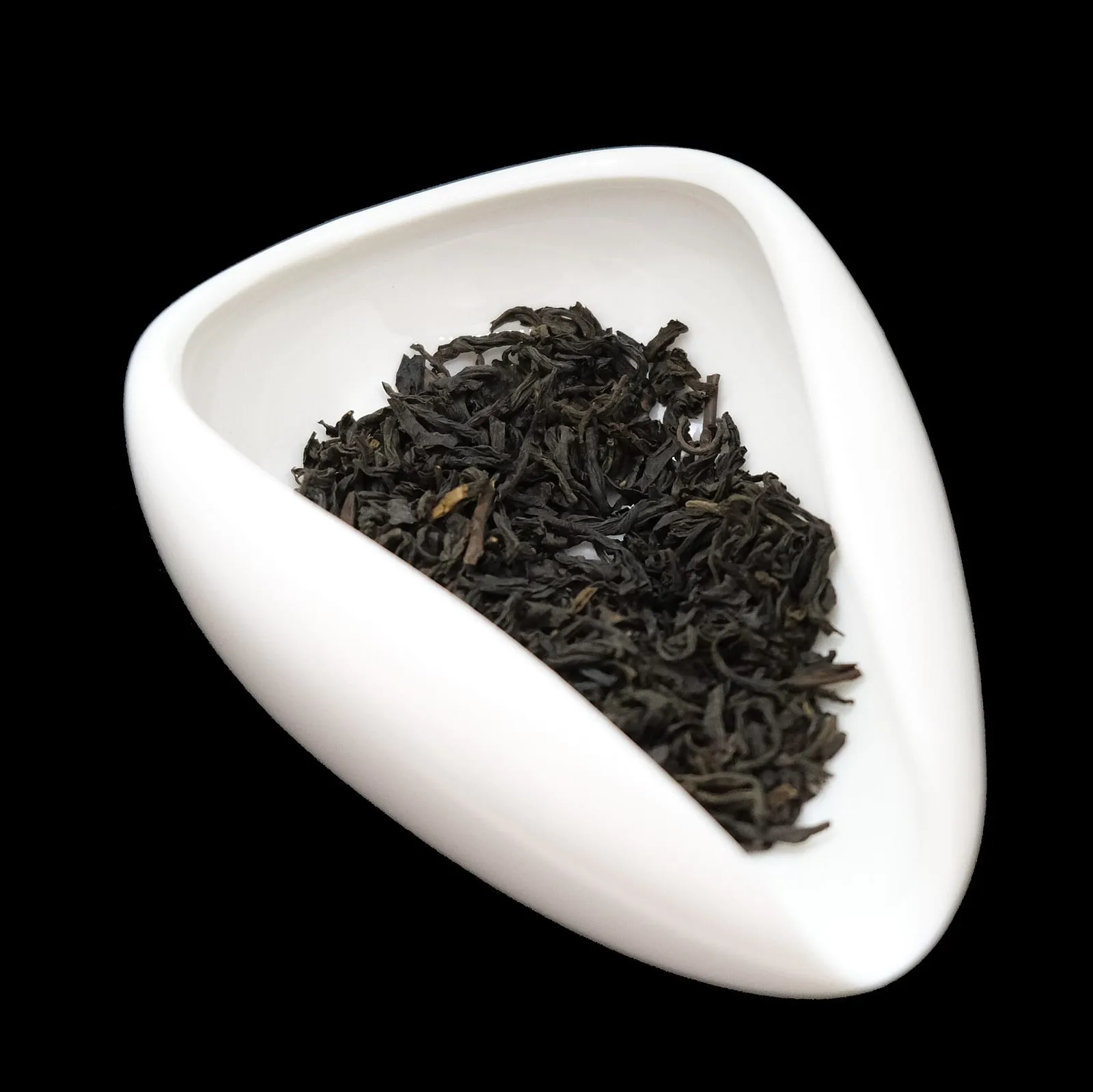
Start with the finished leaves, then follow how withering, rolling and drying contribute to their form. The amount of smoke cannot be judged from the dry-leaf image alone.
Full processing flow
Traditional Lapsang Souchong passes through roughly twelve stages[1][4]:
Of these, withering, rolling, oxidation and smoke-roasting are the most quality-critical and are explored in detail below.
Withering: moisture loss and enzyme awakening
Withering is where Lapsang Souchong flavour begins. Fresh leaves are spread in thin layers on bamboo mats or withering troughs, 3–5 cm deep, for 8–18 hours depending on weather and equipment, reducing moisture from about 75% to 60–65%[1][4].
Traditionally, Tongmu Pass producers rely on natural indoor withering (locally called “liang qing”), exploiting the mountain’s cool, humid, well-ventilated climate for slow moisture loss. Modern factories also use warm-air withering troughs at 30–35 °C, cutting the time to 6–10 hours, though the resulting aroma is slightly less delicate than the natural method[4].
During withering, leaf cells gradually lose water, cell-membrane permeability increases, and the previously separated polyphenol oxidase (PPO) and catechins begin to meet. Proteins hydrolyse into amino acids and starch converts to soluble sugars, laying the groundwork for the sweet, mellow taste that follows. Under-withered leaf retains too much grassiness and astringency; over-withered leaf loses fragrance and ferments unevenly.
| Parameter | Natural withering | Warm-air withering |
|---|---|---|
| Temperature | Room temp, 18–25 °C | 30–35 °C |
| Time | 12–18 h | 6–10 h |
| Spread thickness | 3–5 cm | 5–8 cm |
| Final moisture | 60–65% | 60–65% |
| Aroma character | Delicate, subtle floral notes | Fresh, efficient |
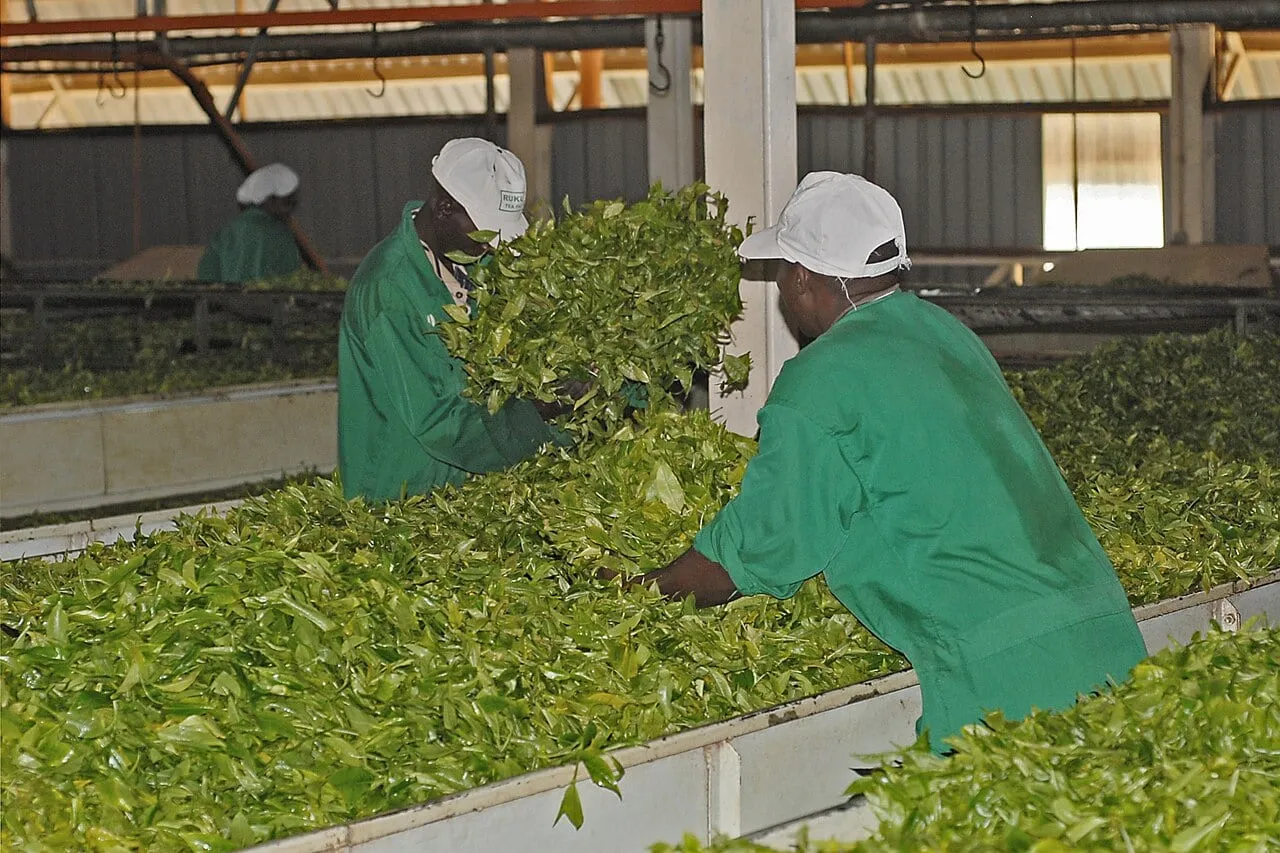
The photograph below shows workers turning withering leaves at a different factory in Kenya. It illustrates spreading and turning, not the withering or pine-smoking process at Tongmu.
Rolling: breaking cells and shaping
Withered leaves move to a rolling machine, following a light–heavy–light pressure pattern for 60–90 minutes[4]. Because Lapsang Souchong uses relatively tender leaf, rolling must not be too aggressive — excessive juice extrusion and broken strips lead to uncontrolled, overly rapid oxidation.
Rolling serves three purposes:
- Cell breakage: releases cell sap so PPO and substrate can meet, creating the oxidation interface;
- Strip formation: the leaf is twisted and curled into tight, rope-like strips that hold their shape through drying;
- Uniform mixing: enzymes, substrates and oxygen are evenly distributed, leading to consistent oxidation.
The sign of proper rolling: cell breakage rate around 70–85%, strips tight and slightly sticky with juice but not dripping, leaf colour shifting from dull green to dark red.
Oxidation: from green leaf to red liquor
Oxidation (in tea terminology, enzymatic oxidation) is the heart of black tea’s “reddening”. Rolled leaves are spread in bamboo baskets or oxidation rooms, 8–12 cm deep, at 22–28 °C and 90–95% relative humidity, for 3–6 hours[1][4].
Here, PPO catalyses the oxidation of catechins into o-quinones, which couple and polymerise into theaflavins and thearubigins — the former giving brightness and briskness to the liquor, the latter contributing the red, rich colour and mellow body[5]. Under-oxidation yields a yellowish liquor and lingering green notes; over-oxidation produces a dull brown colour, flat aroma and thin taste.
Because Tongmu Pass leaf is tender and chemically rich, oxidation time is usually slightly shorter than for large-leaf congou black teas. The tea maker watches the leaf colour and aroma closely: green → yellow-red → red-brown, with grassiness fading into floral and ripe-fruit notes, signals the right moment to stop[5].
| Parameter | Typical range |
|---|---|
| Temperature | 22–28 °C |
| Relative humidity | 90–95% |
| Spread thickness | 8–12 cm |
| Time | 3–6 h |
| Leaf colour | Dull green → yellow-red → red-brown |
| Aroma | Grassy → floral → ripe fruit |
Values are representative; real workshops adjust for leaf condition, weather, equipment and the tea maker’s judgement (drawn from GB/T 13738.3-2012 and Tongmu Pass processing practice)[1][4].
Smoke-roasting: where the pine aroma is born
Smoke-roasting is the single most distinctive step separating Lapsang Souchong from every other black tea — and the reason the “qing lou” exists.
A three-storey smokehouse: what happens on each floor?
Four stages; follow the smoke upwards.
Warm, smoky air rises
- Pine fire in the ground-floor stove
- Smoke rises through the floor
- Leaves wither on top-floor mats
- Leaves soften, pick up resin
Gentle heat and light smoke wither the leaf evenly.
Conditions, chemistry & sources
- Operating Temperature
- 30–40 °C (3rd Floor ambient heat)
- Qinglou Workspace Level
- 3rd Floor (Thin layer on bamboo mats)
- Leaf Moisture Content
- 75% ➔ 58%
Hearth fires on the ground floor generate rising thermal drafts that pass through floor slats to the 3rd floor, withering leaves evenly while initiating floral aroma synthesis.
Withering Rule: Keep leaf layers thin to promote convection; turn gently every 20–30 min to ensure uniform moisture transpiration.
Mechanisms: Based on GB/T 13738.1 and Tongmuguan heritage standards (R-031). Three-story vertical convection; Masson pine pyrolysis generates guaiacol and longifolene that bind tightly to moist fermented leaves, converting into classic dried-longan notes.
Note: "Qinglou pine smoke, red pan locks fragrance". Seasoned Pinus massoniana logs are burned in hearths; Guo Hong Guo requires nimble tossing in a 200 °C pan within 2–3 minutes to avoid scorching.
Smoke and aroma symbols are schematic; smoke volume varies with flue and firewood.
Step through the 4 stages above to see how rising Masson pine smoke inside the three-story Qinglou drives moisture decay and guaiacol aroma adsorption.
The qing lou is a traditional three-storey wooden building unique to Tongmu Pass. A fire pit on the ground floor burns Masson pine firewood; the middle floor acts as a smoke buffer and heat diffuser; the top floor holds the oxidized leaves. Smoke rises through flues, and the temperature in the smoking chamber is held at 100–120 °C for 6–10 hours, slowly drying the leaf while it adsorbs volatile compounds from the pine smoke[1][4].
The main contributors to pine-smoke aroma are pyrolysis products of pine resin, especially guaiacol, 4-methylguaiacol and 4-ethylguaiacol, along with small amounts of terpenes[6]. At 100–120 °C these compounds are adsorbed onto the leaf surface and released gradually during brewing, creating the signature “pine-smoke aroma, longan-sweet liquor” profile.
| Parameter | Traditional pine-wood smoke roasting |
|---|---|
| Fuel source | Masson pine (Pinus massoniana) firewood |
| Smoke-chamber temperature | 100–120 °C |
| Time | 6–10 h |
| Moisture change | 60–65% → 8–10% (re-fired to full dryness afterwards) |
| Main purpose | Adsorb smoke aroma, dry, terminate enzyme activity |
Too low a temperature (below 90 °C) and the smoke aroma is weak, drying is slow and the leaf risks mould. Too high (above 130 °C) and burnt off-notes appear, theaflavins are damaged, the liquor turns dull and the taste becomes harsh. The fuel matters too: fresh pine gives dense, aggressive smoke; air-dried pine gives soft, lingering smoke. Traditionally, Tongmu Pass farmers harvest pine in autumn and let it dry for a year before use[4].
Traditional vs new-style: keeping or losing the smoke
From the late 20th century, as nature-reserve logging restrictions limited Masson pine supplies and some consumers found the smoke too intense, new-style Lapsang Souchong emerged[4].
New-style follows the same withering, rolling and oxidation steps, but eliminates or greatly reduces pine-wood smoke roasting, replacing it with smoke-free hot-air drying or light smoke baking. The finished tea shows floral, honey and sweet notes, with a bright red liquor and a mellow, clean taste closer to standard congou black tea — but it loses the signature pine-smoke aroma that defines traditional Lapsang Souchong.
| Aspect | Traditional Lapsang Souchong | New-style Lapsang Souchong |
|---|---|---|
| Roasting method | Pine-wood smoke (qing lou) | Smoke-free drying or light smoke |
| Typical aroma | Pine-smoke, dried longan | Floral, honey, sweet |
| Liquor colour | Bright red, slightly deep | Bright red, vivid |
| Taste | Mellow, pronounced smoke note | Sweet, mellow, clean |
| Audience | Traditional black-tea lovers, export markets | Domestic drinkers, younger consumers |
| Fuel restriction | Constrained by reserve policy | Unrestricted |
Smoked or unsmoked, and how to brew
Compare two styles, then the golden ring.
Classic: smoke and longan
- Glossy black dry strips
- Pine smoke from guaiacol
- Deep ruby liquor
- Rinse; drink from the 2nd
Smoke notes ease over infusions into longan sweetness.
Conditions, chemistry & sources
- Method
- Qinglou Masson pine smoke (6–10h)
- Key compounds
- Guaiacol, 4-methylguaiacol
- Relative profile
- Pine smoke 88 · Floral-fruity 55 · Longan body 90
Pyrolysis of Masson pine resin generates guaiacol, 4-methylguaiacol, and 4-ethylguaiacol, which adsorb onto moist fermented leaves at 100–120 °C and release steadily across infusions.
Mechanisms: Based on GB/T 13738.1 and Tongmuguan heritage standards (R-031). Three-story vertical convection; Masson pine pyrolysis generates guaiacol and longifolene that bind tightly to moist fermented leaves, converting into classic dried-longan notes.
Note: "Qinglou pine smoke, red pan locks fragrance". Seasoned Pinus massoniana logs are burned in hearths; Guo Hong Guo requires nimble tossing in a 200 °C pan within 2–3 minutes to avoid scorching.
Smoke and aroma symbols are schematic; smoke volume varies with flue and firewood.
Neither style is objectively better; they serve different flavour preferences and market segments. Traditionalists insist “without pine smoke, it is not Lapsang Souchong”; innovators counter that “tea aroma is diverse, why be bound to one thread of smoke?” Today, Tongmu Pass hosts both old factories that still fire the qing lou and younger workshops that have fully embraced the new style[4].
Flavour and quality formation
Lapsang Souchong’s flavour rests on three pillars:
- Theaflavins and thearubigins: formed during oxidation, governing liquor brightness and body;
- Amino acids and soluble sugars: accumulated during withering and oxidation, delivering sweetness and aftertaste;
- Smoke-aroma compounds: guaiacol and related phenols adsorbed during smoke-roasting, creating the distinctive smoky note.
Research shows that traditional Lapsang Souchong contains significantly higher guaiacol levels than smoke-free black teas, and this correlates strongly with sensory scores for “pine-smoke aroma”[6]. Meanwhile, Tongmu Pass’s high altitude, cool temperatures and humid, misty environment slow tea-plant growth, allowing richer accumulation of amino acids and aromatic substances — a key source of the “longan-sweet” character[1][7].
Lapsang Souchong
Black · Wuyi Souchong Black TeaThe silhouette is relative; real cups vary by origin, craft (traditional vs new-style), season and storage. New-style Lapsang Souchong would score near 0–20 on pine-smoke.
Grades and brewing
Under GH/T 1118-2015 Lapsang Souchong tea and GB/T 13738.3-2012 Black tea—Part 3: Souchong black tea, the tea is divided into three grades: Special, Grade 1 and Grade 2[1][7]. Special grade demands tight strips, glossy black colour, bright red liquor, and either a high, long-lasting pine-smoke aroma (traditional) or prominent floral-honey fragrance (new-style), with a mellow, sweet taste.
Brewing guide:
| Parameter | Recommendation |
|---|---|
| Water temperature | 90–95 °C (194–203 °F) |
| Leaf-to-water ratio | 3–5 g / 150 ml |
| Vessel | White porcelain gaiwan or Yixing teapot |
| Pouring | Pour gently down the wall, avoid direct jet |
| First steep | 10–15 s |
| Infusions | 5–8, adding 5–10 s each time |
Because traditional Lapsang Souchong carries an intense pine-smoke note, some drinkers rinse the first infusion quickly and discard it, beginning formal tasting from the second steep — the smoke and longan sweetness will be more harmonious. New-style Lapsang Souchong needs no rinse; the first steep is ready to drink.
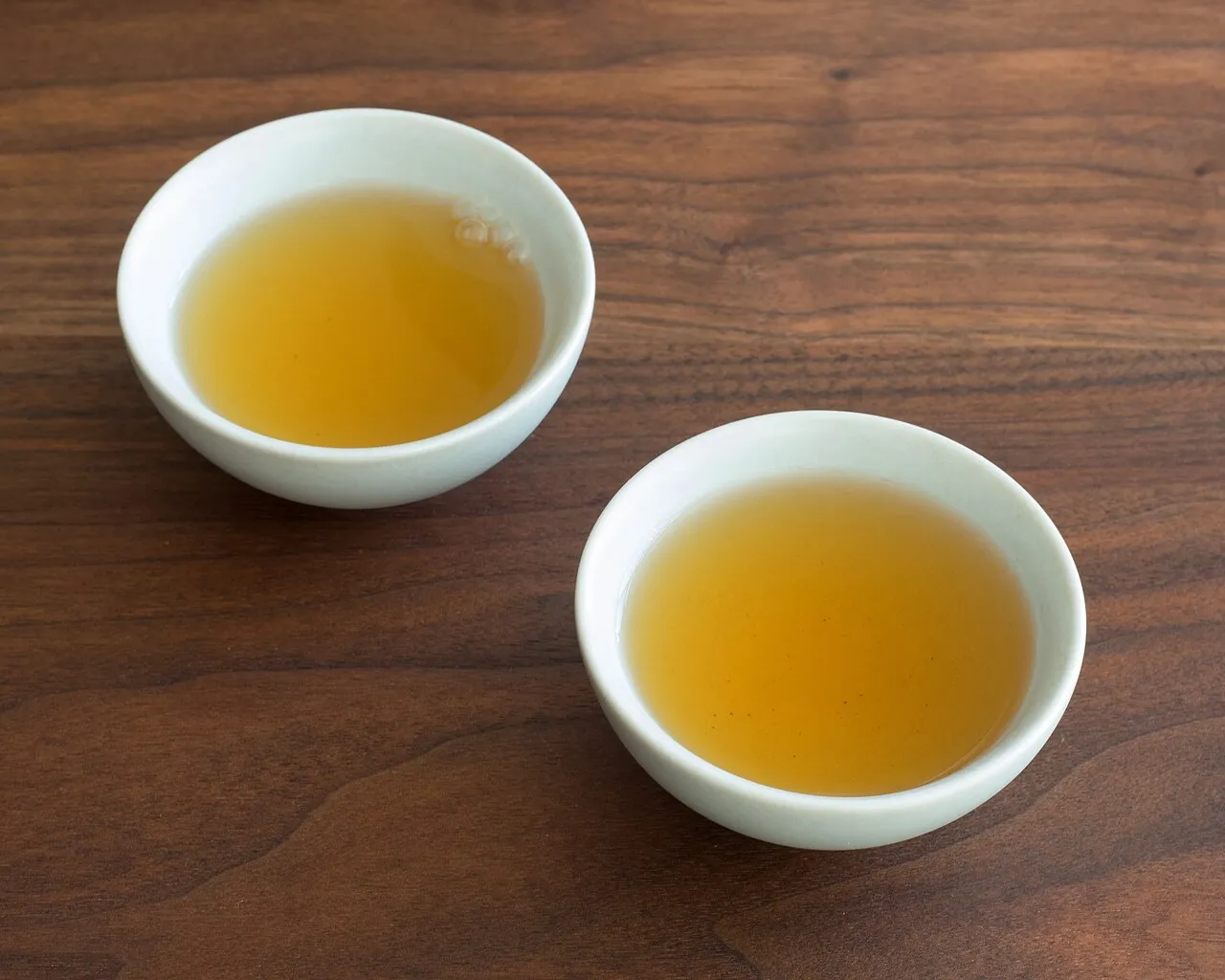
While tasting, note liquor strength and perceived smoke, then compare successive infusions of the same tea. The image shows two cups, but the dose, steep number and comparison conditions were not recorded.
Full process parameters
| Stage | Temperature | Time | Moisture change | Main purpose |
|---|---|---|---|---|
| Withering | Room 18–25 °C or warm-air 30–35 °C | Natural 12–18 h / warm-air 6–10 h | ≈75% → 60–65% | Soften leaf, awaken enzymes, begin conversion |
| Rolling | — | 60–90 min | 60–65% → 55–60% | Break cells, shape, create oxidation interface |
| Oxidation | 22–28 °C, RH 90–95% | 3–6 h | 55–60% → 55–60% | Enzymatic oxidation to form theaflavins/thearubigins |
| Red-pass firing | 200–220 °C (pan temp) | 2–3 min | — | Stop oxidation, fix colour |
| Smoke-roasting (traditional) | Smoke-chamber 100–120 °C | 6–10 h | 55–60% → 8–10% | Adsorb pine-smoke aroma, dry, stop enzymes |
| Re-firing | 80–100 °C | 1–2 h | 8–10% → fully dry | Stabilise quality, lift aroma, final drying |
| Refining | — | Hours to days | Stable | Grade, sort, blend and pack |
Values are representative; real workshops adjust for leaf condition, weather, equipment and the tea maker’s judgement (drawn from GB/T 13738.3-2012, GH/T 1118-2015 and Tongmu Pass processing practice)[1][4].
Common Myths & Scientific Clarifications
Myth 1: ‘If a Lapsang Souchong has no pine-smoke flavor, is it fake?’
Scientific Clarification: Authentic Lapsang Souchong does not have to be smoky. Since the late 20th century—and especially following logging restrictions on Masson pine in the Wuyishan National Nature Reserve and the 2005 creation of Jin Jun Mei—Tongmu Pass producers developed unsmoked (new-style) Lapsang Souchong[1][4]. Using the same high-elevation Caicha shoots and traditional withering, rolling, and oxidation, it replaces pine-smoke drying with clean heat to highlight floral, fruity, and honey notes. Both smoked and unsmoked styles are recognized under national standards GB/T 13738.3-2012 and GH/T 1118-2015[1][7].
Myth 2: ‘Does a harsh, tar-like campfire smell indicate traditional Tongmu pine smoking?’
Scientific Clarification: Traditional Qinglou smoking uses air-seasoned Masson pine aged for over a year, allowing warm, diffused smoke (100–120 °C) to rise through a three-story wooden structure so that guaiacol phenols integrate gently into the leaf over 6–10 hours, yielding a subtle pine-resin aroma that melts into dried-longan sweetness in the liquor[4][6]. Pungent, acrid tar odors that vanish after one or two steeps while leaving a harsh, astringent liquor typically indicate hasty smoking over green, resin-heavy wood or post-processing adulteration with synthetic liquid smoke.
Myth 3: ‘Is any golden-yellow all-bud black tea authentic Jin Jun Mei?’
Scientific Clarification: Authentic Jin Jun Mei, created in Tongmu Pass in 2005 as an unsmoked offshoot of Lapsang Souchong craft, is plucked exclusively from early-spring single buds of high-elevation indigenous Wuyi Caicha (sexual population landrace) bushes. Because small-leaf Caicha buds have fine, sparse down and undergo thorough oxidation, authentic Jin Jun Mei dry buds appear interwoven black and gold (‘gold emerging from jet-black’) with high density[1][4]. Bright, uniformly golden, fuzzy buds on the general market are usually made from lowland clonal cultivars (such as Fuyun No. 6 or Meizhan) and differ markedly in aroma complexity and liquor stamina.
Related Articles
- Biochemistry of Black Tea Oxidation — Polyphenol oxidase (PPO) kinetics and theaflavin/thearubigin formation
- Famous Tea Craft: Keemun Black Tea — How Souchong craft evolved into ten-stage refined Congou black tea
- Orthodox Gongfu vs. CTC Black Tea — Whole-leaf orthodox black tea versus crush-tear-curl global trade styles
- Afternoon Tea & the British Empire — How 17th-century Bohea and Lapsang Souchong sparked Europe’s black tea culture
References
- R-081 — GH/T 1118-2015.《正山小种茶》(Lapsang Souchong tea). 中华全国供销合作总社.
- R-030 — 陈宗懋 主编 (2000).《中国茶叶大辞典》. 中国轻工业出版社. ISBN: 978-7501925094.
- R-045 — 威廉·乌克斯(William H. Ukers).《茶叶全书》(All About Tea). 1935.
- R-031 — 施兆鹏, 夏涛 主编 (2016).《茶叶加工学》(第3版). 中国农业出版社. ISBN: 978-7109214347.
- R-001 Subramanian, N., Venkatesh, Purna, Ganguli, Shovan, Sinkar, Vilas P. (1999). Role of Polyphenol Oxidase and Peroxidase in the Generation of Black Tea Theaflavins. Journal of Agricultural and Food Chemistry, 47(7), 2571-2578. https://doi.org/10.1021/jf981042y
- R-029 — 宛晓春 主编 (2003).《茶叶生物化学》(第3版). 中国农业出版社. ISBN: 978-7109066274.
- R-082 — GB/T 13738.3-2012.《红茶 第3部分:小种红茶》(Black tea—Part 3: Souchong black tea). 全国茶叶标准化技术委员会(SAC/TC339).
Article Knowledge Network
Explore the connections between the teas, processes and flavours in this article.