
Start with the essentials
Qimen black tea develops through withering, rolling, oxidation and drying. Its characteristic aroma is a combined impression: floral and sweet notes have foundations in the material and earlier stages, as well as final heating.
This article follows moisture loss, tissue disruption, oxidation and staged drying. Connecting those processes with leaf form, taste and a particular product helps reveal differences between Qimen samples.
Three key points
- Withering prepares the leavesMoisture change and internal reactions affect later handling.
- Rolling creates contactDisrupted tissue brings enzymes and compounds together for oxidation.
- Drying continues earlier developmentInitial heating, cooling and final drying work with material and batch differences.
What to notice when tasting
Inspect form and compare dry-leaf, hot-liquor and cooler-liquor aromas. Describe the floral, sweet or roasted notes you find alongside strength and taste, without forcing a prescribed Qimen aroma.
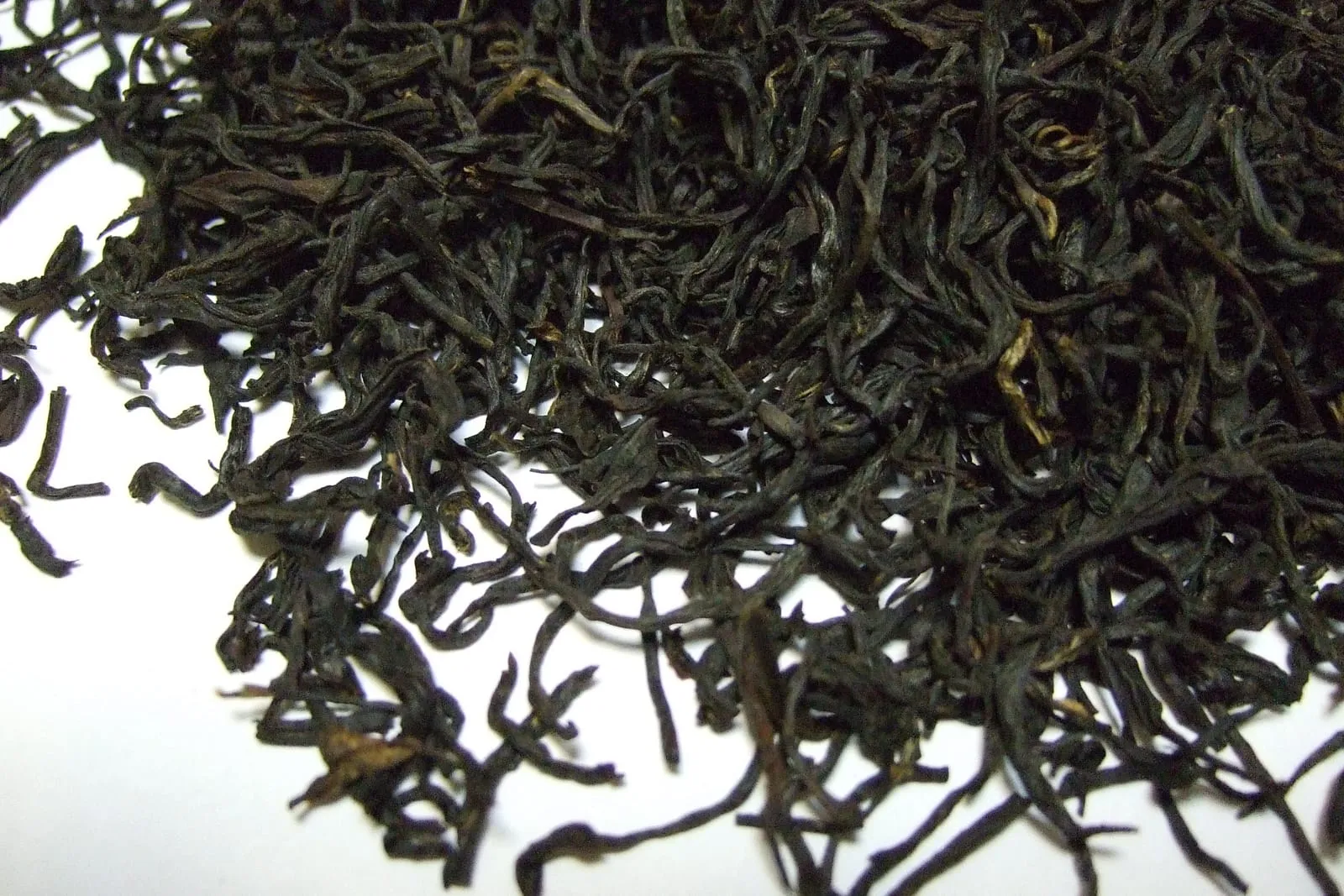
Keemun (Qimen) black tea comes from southern Anhui. It is generally said to have been created in the Guangxu reign of the Qing dynasty and is a strip-style Congou (gongfu) black tea[1][2]. Its best-known trait is “Keemun aroma”: floral, honeyed and fruity at once. This article follows the order leaf, primary processing, refining, aroma, and says what each step does and which claims are supported by research rather than tradition.
1. Growing area and the Zhuye cultivar
1.1 Growing area
The regional geographical-indication standard DB34/T 1086-2009 defines the protected area, centred on Qimen County and including some neighbouring townships[2]. The land is low hills with a mild, misty climate. Such conditions are often thought to keep young shoots tender, but the sources cited here do not quantify how much diffuse light produces how much aroma, so this article does not.
1.2 The Zhuye cultivar
Keemun is traditionally made mainly from the local Zhuye population, a shrub-type, medium-leaf cultivar[2][4]. Its shoots stay tender for a relatively long time and suit fine, tight strips.
It is often said that Zhuye is rich in aroma precursors and well suited to Keemun aroma. Research does find that geraniol and linalool are important aroma compounds in Keemun black tea[5][6]; exact ratios between cultivars depend on the particular study and samples, so this article does not give a single figure.
2. Primary processing: withering, rolling, oxidation, drying
Keemun follows the same four primary steps as other Congou teas: withering → rolling → oxidation (“fermentation”) → drying, with drying split into a first and a second firing[1][4]. Temperatures and times below are rough ranges from common practice; real settings change with the leaf, weather, equipment and the tea maker.
2.1 Withering: softening the leaf
Fresh leaf is spread thinly on bamboo mats or in withering troughs and loses water slowly. In common practice, natural indoor withering takes most of a day; ventilated, warmed troughs are faster. Well-withered leaf is soft, its stems bend without snapping, and the grassy smell fades.
Withering is not only drying. Many aroma compounds are stored as glycosides (bound to sugars and not volatile). During withering and later steps, enzymes release part of them as compounds we can smell, such as geraniol and linalool[3]. One study found that water loss during withering raises expression of the CsCCD1 gene, whose enzyme cleaves carotenoids into violet-like β-ionone[7]. A study of Keemun found that the withering method changes the make-up of key aroma compounds[6].
2.2 Rolling: breaking cells and shaping strips
Withered leaf goes into a rolling machine, usually with a light, firm, light pressure pattern. Rolling does two things: it twists the leaf into tight strips, and it breaks some cells so that catechins meet polyphenol oxidase (PPO), which starts oxidation[3][4]. Too little pressure gives uneven oxidation and a thin taste; too much breaks the leaf.
2.3 Oxidation: the leaf turns red and the aroma changes
“Fermentation” in black tea is mainly the leaf’s own enzymatic oxidation, not microbial fermentation[3]. Rolled leaf is spread on trays or sieves in a warm, humid, ventilated place. PPO oxidises catechins; some form theaflavins (orange-yellow, giving briskness), and further oxidation and condensation produce darker thearubigins and related products[3].
Tea makers judge the end point by sight and smell: the leaf turns from green to copper, the grassy smell goes and a sweet floral-fruity aroma appears. Under-oxidised leaf gives a pale, green-tasting liquor; over-oxidised leaf looks dull and smells flat. How much theaflavin and thearubigin forms, and when, depends on temperature, oxygen and leaf, so there is no universal “peak time”.
Wither, roll, oxidise: where Keemun aroma starts
Three stages; watch the leaf colour in 03.
Slow, cool withering softens the leaf
- Thin layer, no direct sun
- Water slowly leaves the leaf surface
- Loupe: brittle leaf turns soft
- Grassy fades, floral appears
Softens the leaf and starts the changes behind Keemun aroma.
Conditions, techniques & sources
- Temperature
- Room temperature with airflow; troughs may be slightly warmed
- Duration
- Slower on mats, faster in troughs
- Moisture
- Falls gradually until the leaf is soft
Spread thinly on mats or in troughs, out of direct sun, so water leaves slowly.
The leaf softens for rolling. Enzymes release some bound aroma compounds; water loss also raises CsCCD1, which cuts carotenoids into compounds such as β-ionone.
Under-withered leaf loses juice and stays grassy when rolled; over-withered leaf breaks and oxidises unevenly.
Sources: GB/T 13738.2-2017 (Congou black tea), DB34/T 1086-2009 (Keemun geographical indication), Tea Processing, Tea Biochemistry, and a study of CsCCD1 during withering (J. Agric. Food Chem., 2020).
Note: the conditions shown describe common practice; real loads, temperatures and times depend on the leaf, weather and the tea maker.
2.4 First and second firing: stop oxidation, then dry slowly
Once oxidation is right, the leaf is dried promptly, usually in two stages[4]:
- First firing: higher heat, a thin layer and a short time, so the leaf heats quickly, the oxidising enzymes stop working and most of the water goes.
- Cooling: the leaf is spread out to cool for a while so that water left in the stems evens out, avoiding leaf that is dry outside and damp inside.
- Second firing: lower heat for longer, until fully dry. Heating drives Maillard-type reactions between amino acids and sugars, adding roasted, sweet notes[3].
The national standard sets a maximum moisture content for finished Congou tea; see the standard for the figure[1].
3. What “Keemun aroma” is
“Keemun aroma” is a sensory description of floral, honeyed and fruity notes together, not a single compound. Instrumental studies of Keemun usually detect dozens to more than a hundred volatile compounds, of which only some contribute much to what we smell.
3.1 What the research shows
- A study comparing Keemun grades, using gas chromatography–mass spectrometry with sensory evaluation, found geraniol, linalool and phenylacetaldehyde among the compounds most closely linked to aroma scores[5].
- A study of Keemun withering methods found that the method changes the make-up and relative contribution of key aroma compounds[6].
- A study found that water loss in withering raises CsCCD1 expression and promotes β-ionone formation[7].
- A study comparing processing styles found clear differences in volatile composition between traditionally processed Keemun Congou and other styles[8].
Each study used particular samples and conditions. Together they show that Keemun aroma depends on cultivar, withering, oxidation and firing, but they do not support rules like “a tea with X% of a compound is a good tea”.
3.2 Using this when tasting
Smell the dry leaf, the hot liquor and the cooling cup, and note how strong the floral, honey and roasted notes are. Clear florals with light firing often go with full withering and gentle drying; strong honey and roast often go with fuller oxidation and heavier firing. These are common tendencies only, and batches vary a lot.
Rose, honey or orchid: which leads in Keemun?
Pick a style; compare the three plumes (relative, not measured).
Floral and honey together, bright red liquor
- Rose-like floral: Fairly high
- Honey-sweet: Fairly high
- Light floral-woody: Medium
- Liquor colour in the tasting bowl
Moderate settings keep rose-like floral, fruit and honey in balance.
Process settings, compounds & sources
Classic (floral, fruit and honey balanced)
- Withering
- Medium
- Rolling
- Medium
- Oxidation
- Medium
- Firing
- Medium
Process intensities and aroma levels are qualitative, relative descriptions, not measurements or scores.
Every step is moderate: medium withering and rolling, oxidation to a copper leaf, and a moderate two-stage firing. Rose-like floral, ripe fruit and honey are balanced.
- Rose-like floral (geraniol)
- Honey-sweet (phenylacetaldehyde etc.)
- Light floral-woody (linalool and its oxides)
Sources: a study of key aroma compounds across Keemun grades (R-092), a study of withering method and aroma (R-376), a study of CsCCD1 and β-ionone during withering (R-377), a comparison of processing styles (R-378), and processing background from Tea Processing (R-031). The three styles summarise the direction of these findings; they are not measured results from any one study.
Note: real aroma also depends on cultivar, season, batch and the tea maker, and the same method can give different results.
Plumes show sensory tendencies, not compound concentrations.
4. Refining and re-firing
Crude tea varies in length and thickness. Keemun Congou is then refined, traditionally described as “ten steps”, which sort it into grades, remove impurities, re-fire and blend it[2][4].
4.1 Sifting and cutting
Sieves of different mesh sort the crude tea by length and thickness into fractions; over-long or thick strips are cut and sieved again[4]. Cutting makes each grade even in shape so it infuses evenly, and should cut without crushing. Keemun Congou’s short, fine, even strips are the result of refining, not “broken tea”.
4.2 Re-firing
Re-firing is the last bake in refining. Traditionally it uses ash-covered charcoal under bamboo baskets at low heat, without flame or smoke; dryers are common today[2][4]. It lowers moisture further, drives off damp picked up during refining and steadies the aroma. Tea makers set heat and time by grade and condition; too much heat gives a burnt note and masks the florals.
Two firings, then refining
Drying first; then sieve and charcoal basket.
Hot first firing, low second
- First firing: hot air dries a thin layer fast
- Cool and rest: inner water moves outwards
- Second firing: low heat dries fully
- Strips turn black and glossy, honey aroma
High heat stops the enzymes; slow drying adds roasted sweetness.
Conditions, techniques & sources
- Temperature
- First firing hotter, second cooler
- Duration
- First short; second longer after cooling
- Moisture
- First removes most water; second dries fully
First firing in a thin layer, quickly; cool so inner water moves out; second firing slow and low.
The first firing heats the leaf fast, stopping the oxidising enzymes; in the second, Maillard-type reactions between amino acids and sugars add roasted sweetness.
If the first firing is too cool, oxidation continues; if the second is too hot, the leaf scorches and florals are masked.
Sources: GB/T 13738.2-2017 (Congou black tea), DB34/T 1086-2009 (Keemun geographical indication), Tea Processing, Tea Biochemistry, and a study of CsCCD1 during withering (J. Agric. Food Chem., 2020).
Note: the conditions shown describe common practice; real loads, temperatures and times depend on the leaf, weather and the tea maker.
Keemun Black Tea
Black · Keemun Congou5. Steps side by side
| Step | What is done | How the leaf changes | Why it matters |
|---|---|---|---|
| Withering | Spread to lose water | Leaf softens, grassy smell fades | Ready for rolling; aroma precursors start to change[3][7] |
| Rolling | Light, firm, light pressure | Strips form, juice seeps out | Enzymes meet catechins; oxidation starts[3] |
| Oxidation | Rest in warm, humid air | Leaf turns copper, floral-fruity notes appear | Theaflavins, thearubigins and main aromas form[3] |
| First firing | Higher heat, quick | Leaf dries and turns brittle | Stops enzymatic oxidation[4] |
| Second firing | Lower heat, slow | Strips dark and glossy, dry aroma shows | Fully dry; adds roasted sweetness[3][4] |
| Sifting and cutting | Sieve, grade, shorten | Even length and thickness | Even appearance and infusion[4] |
| Re-firing | Low, slow heat | Drier, steadier aroma | Removes damp, settles aroma; too hot burns[2][4] |
6. Brewing
These are common starting points; adjust to taste.
| Item | Starting point | Notes |
|---|---|---|
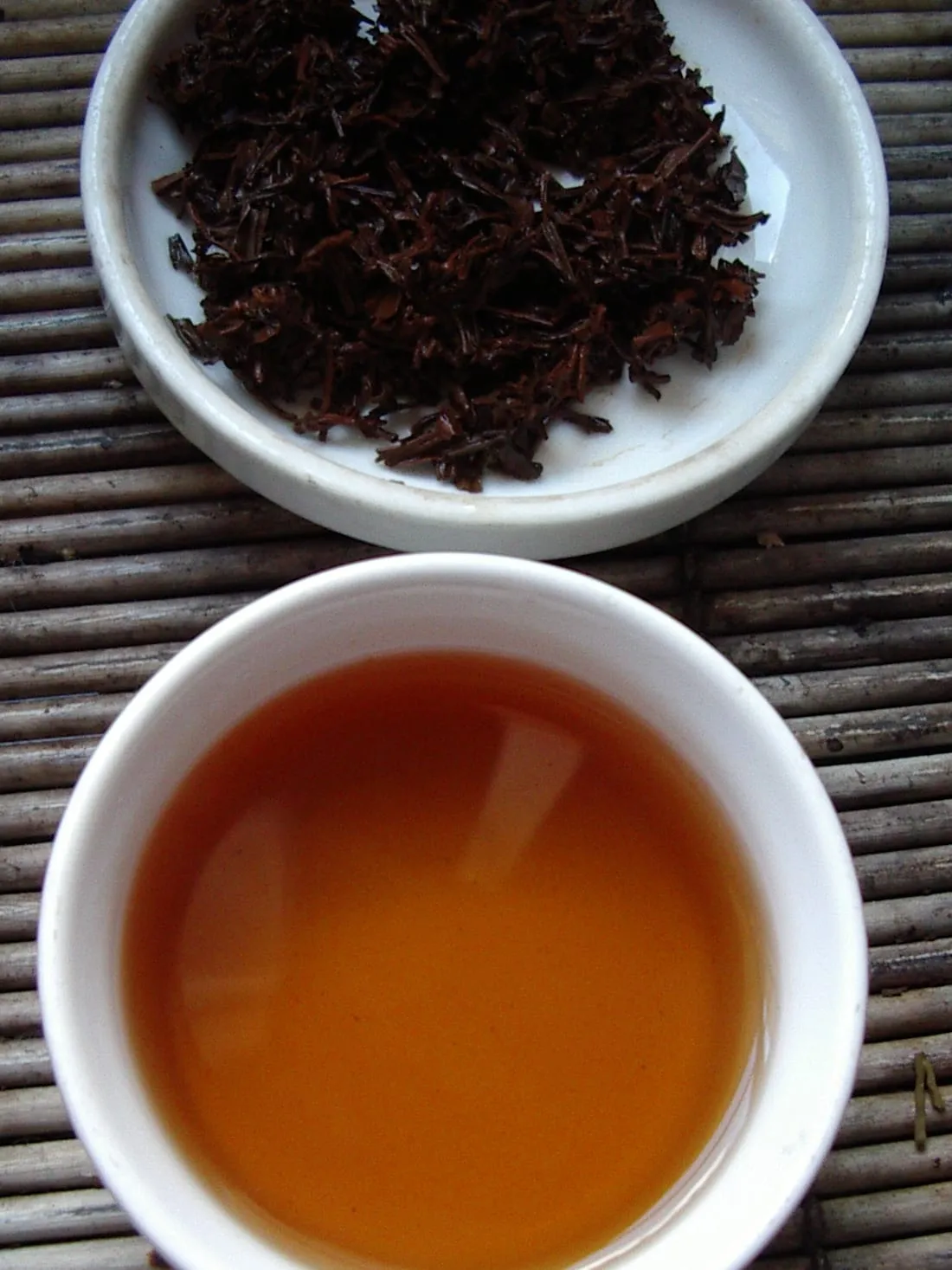
| Vessel | White porcelain gaiwan or tasting cup | Porcelain does not hold aroma and shows the colour well |
| Leaf | About 3 g to 150 mL water | Add leaf or time for a stronger cup |
| Water temperature | Around 90–95 °C | Hotter can bring bitterness; cooler can mute aroma |
| Time | First infusions ten-odd seconds to half a minute, then longer | Judge by colour and taste rather than exact seconds |
Water hardness matters: very hard water tends to darken black tea and leave a film on the surface. Softer water shows a brighter liquor and clearer aroma. See teaware materials and brewing basics.
7. Common misconceptions
Myth 1: Is Keemun aroma added flavouring or flower scenting?
Traditional Keemun Congou is not scented with flowers and has no added flavouring. Its aroma comes from the leaf’s own components changing during withering, oxidation and firing: bound aromas are released, carotenoids are cleaved and heat reactions add more[3][5][7]. Products with added flowers or flavour are scented or flavoured teas and should say so on the label.
Myth 2: Keemun’s short, fine strips are machine-broken leftovers?
No. Congou tea is refined by sifting and cutting; cutting makes strips in one grade the same length and should not crush them[1][4]. Broken grades and fannings are separate grades.
Myth 3: Are “Keemun Xiangluo”, “Keemun Maofeng” and traditional Keemun Congou the same?
They can all use leaf from the Keemun area, but processing and shape differ. Traditional Keemun Congou is refined, cut and re-fired into fine strips; Xiangluo is curled into spirals and Maofeng keeps more intact buds and leaves without heavy cutting[8]. Check the product name and the standard it follows when comparing.
Related Articles
- Biochemistry of Black Tea Oxidation — Polyphenol oxidase, theaflavins and thearubigins
- The Craft of Dianhong Gongfu — Congou tea from large-leaf cultivars, and golden tips
- Orthodox Gongfu vs CTC Black Tea — Refined strips versus crush-tear-curl processing
- The Craft of Lapsang Souchong — Pine-smoked black tea and its link to Congou tea
- Teaware Materials — How porcelain, clay and glass affect brewing
References
- R-065 — Standardization Administration of China (SAC/TC339). (2017). Black tea—Part 2: Congou black tea (Standard No. GB/T 13738.2-2017). Standards Press of China. https://openstd.samr.gov.cn/bzgk/gb/newGbInfo?hcno=9F5C5B054D69B222EC2FAACCD8CFBDDF
- R-095 — DB34/T 1086-2009.《地理标志产品 祁门红茶》(Product of geographical indication—Keemun black tea). 安徽省质量技术监督局.
- R-029 — Wan, X. (Ed.). (2003). Tea Biochemistry (3rd ed.). China Agriculture Press. ISBN: 978-7109066274.
- R-031 — Shi, Z., & Xia, T. (Eds.). (2016). Tea Processing (3rd ed.). China Agriculture Press. ISBN: 978-7109214347.
- R-092 — Su, E., et al. (2022). Aroma effects of key volatile compounds in Keemun black tea at different grades: HS-SPME-GC-MS, sensory evaluation, and chemometrics. Food Chemistry, 373, 131587. https://doi.org/10.1016/j.foodchem.2021.131587
- R-376 — Huang, W.-Q., et al. (2022). Sensomics analysis of the effect of the withering method on the aroma components of Keemun black tea. Food Chemistry, 395, 133549. https://doi.org/10.1016/j.foodchem.2022.133549
- R-377 — Wang, J., et al. (2020). Dehydration-induced carotenoid cleavage dioxygenase 1 reveals a novel route for β-ionone formation during tea (Camellia sinensis) withering. Journal of Agricultural and Food Chemistry, 68(40), 11256–11266. https://doi.org/10.1021/acs.jafc.0c04208
- R-378 — Xu, Y., et al. (2023). Manufacturing process differences give Keemun black teas their distinctive aromas. Food Chemistry: X, 19, 100865. https://doi.org/10.1016/j.fochx.2023.100865
Article Knowledge Network
Explore the connections between the teas, processes and flavours in this article.