
Start with the essentials
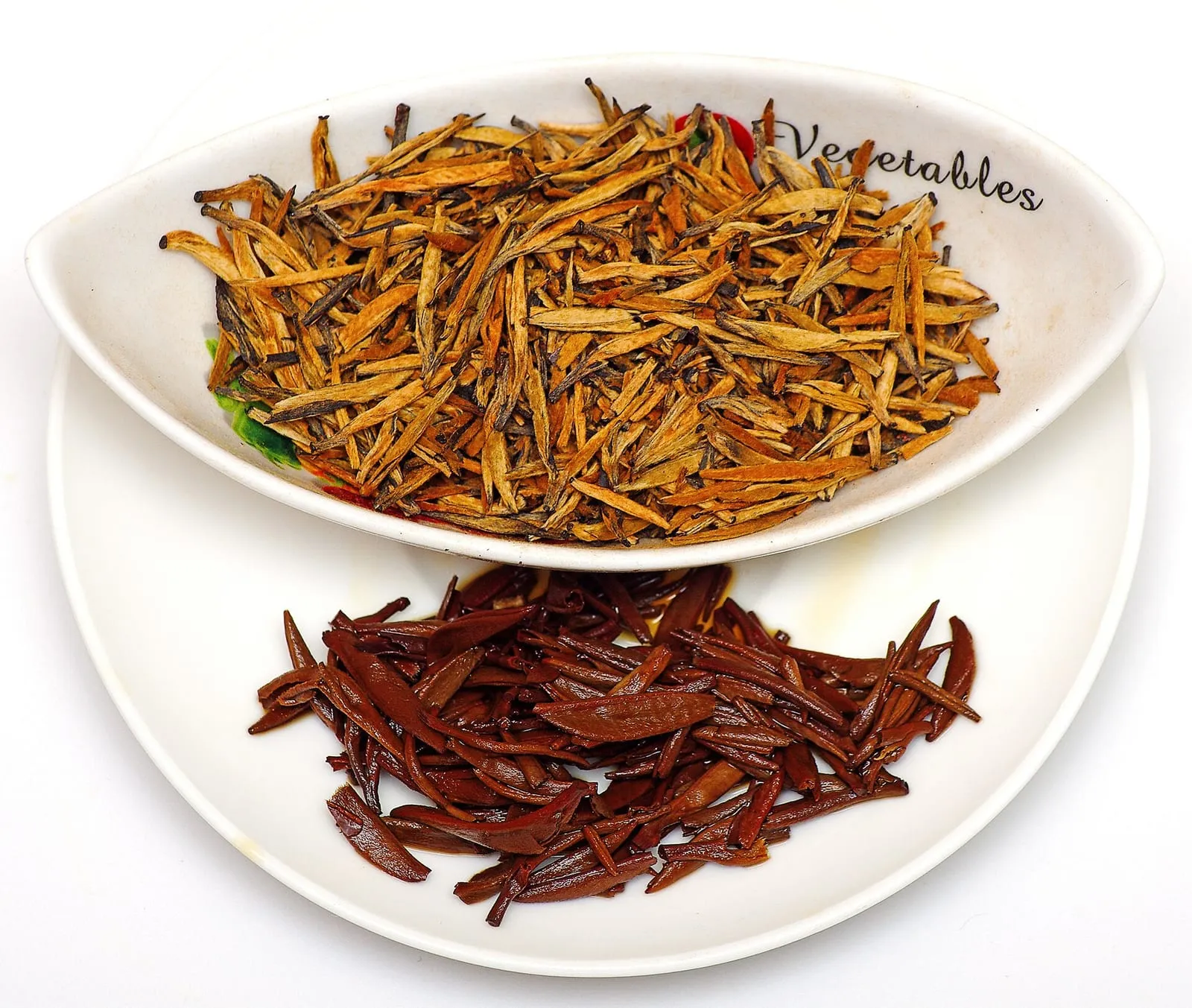
Dianhong Gongfu is a black tea made from Yunnan large-leaf material, often recognised by substantial leaves, golden bud down and a bold taste. How do golden tips develop, and why can the liquor cloud as it cools? Both observations lead back to material and manufacture.
This article connects the growing setting with withering, rolling, oxidation and staged drying, then explains brewing strength and tea cream. These relationships offer more insight than tip count or colour alone.
Three key points
- Material provides the foundationLeaf traits and compounds work with harvesting and manufacture.
- Rolling and oxidation connect leaf and liquorTissue changes enable reactions whose products contribute colour and taste.
- Golden tips and tea cream are different cluesOne concerns bud down and processing, the other the cooling liquor.
What to notice when tasting
Compare dry-leaf form with hot and cooled liquor for colour, clarity and texture. Record leaf quantity and duration to interpret strength alongside tea cream; investigate unusual odours separately.
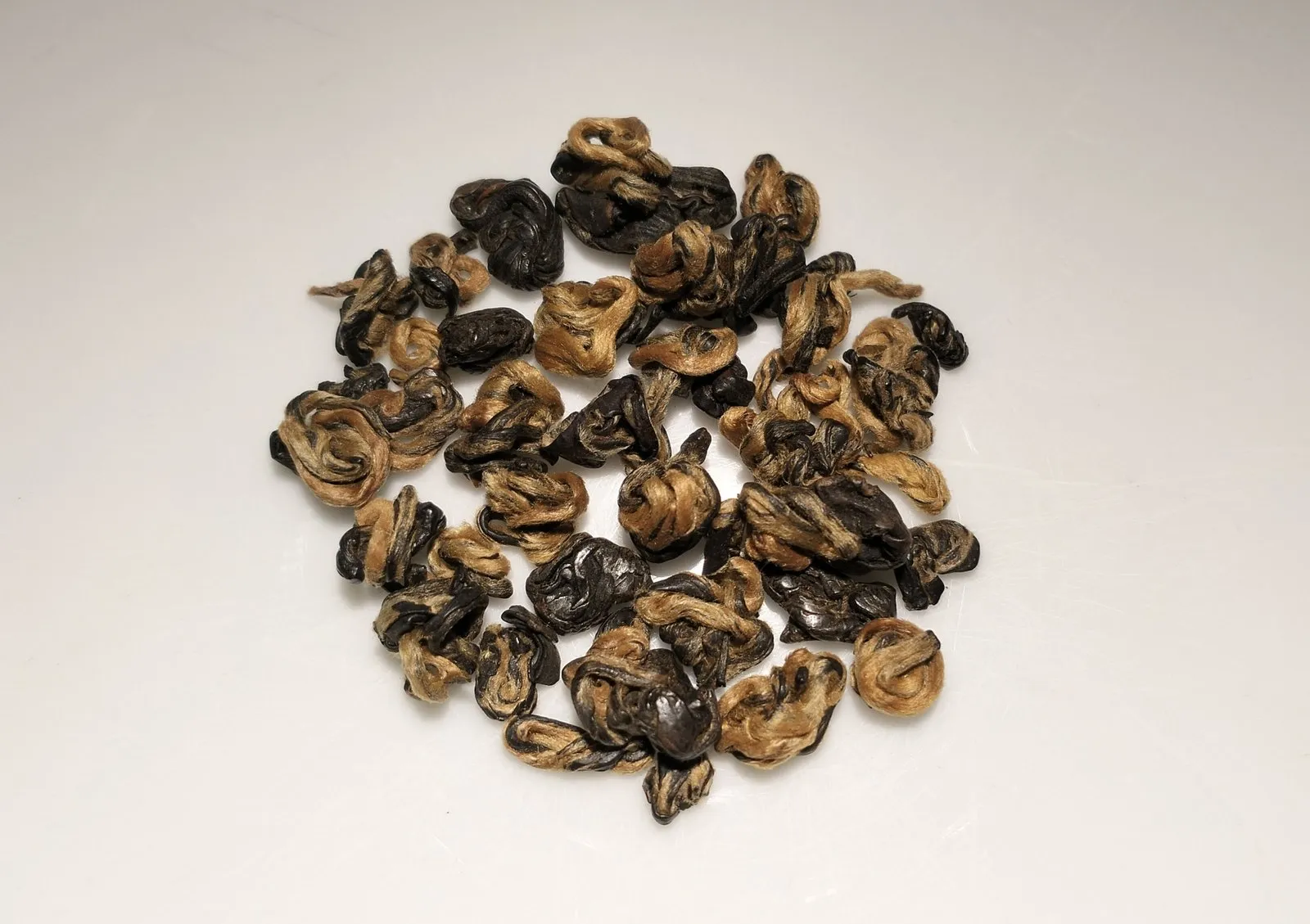
Dianhong Gongfu was first made in 1938–1939 in Shunning (today Fengqing, Lincang, Yunnan), linked to trial production by the tea maker Feng Shaoqiu[2]. It uses buds and leaves of Yunnan large-leaf cultivars (see large-leaf and small-leaf cultivars) and is processed as a Congou (gongfu) black tea[1][3]. Its strong taste, red liquor and golden tips come from the leaf together with withering, rolling, oxidation and drying. Below, each step is described with what it does, which observations research supports and which are only clues.
1. Growing area and leaf
1.1 Growing area
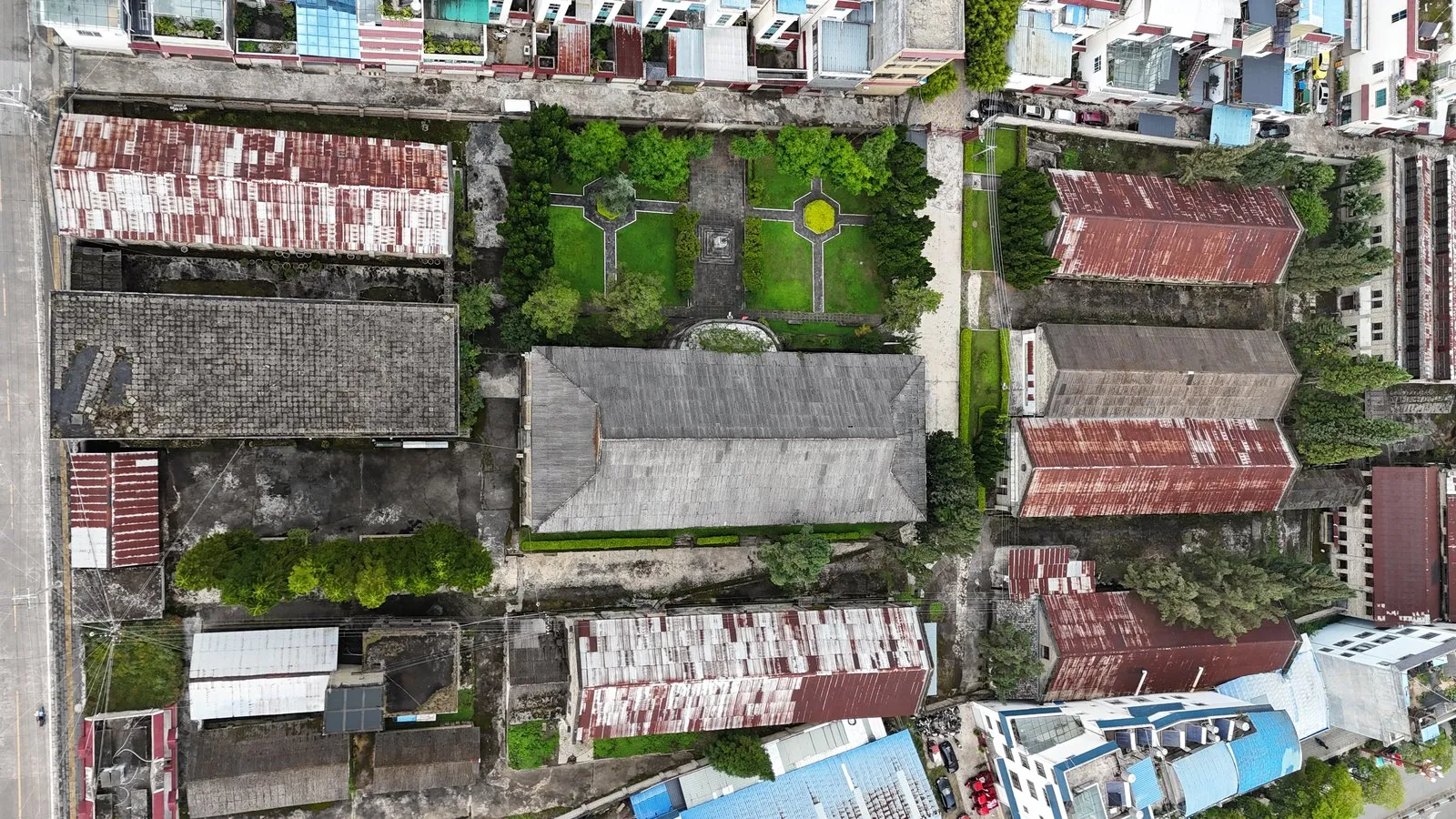
Dianhong originated around Fengqing in Lincang, and is grown along the middle and lower Lancang (Mekong) in Lincang, Baoshan, Pu’er, Xishuangbanna and nearby areas[2]. These are low-latitude, fairly high mountain gardens. The environment affects leaf composition, but the sources cited here do not give rules like “this altitude or temperature range produces this much of a compound”, so this article does not quantify it.
1.2 Yunnan large-leaf cultivars
Dianhong commonly uses large-leaf tree or small-tree cultivars such as Fengqing Dayezhong and Mengku Dayezhong[2]. Compared with small- and medium-leaf cultivars, they have bigger, thicker leaves, plump and hairy buds, and generally more polyphenols, which suits a strong black tea[2][4]. Actual amounts vary with cultivar, season, tenderness and test method, so “large leaf” does not imply a fixed figure.
The white down on the bud (tea hairs) consists of single-celled epidermal hairs. One study found that the transcription factor CsMYB1 helps regulate both hair development and catechin synthesis[11]; another compared tea plants with more and fewer hairs and identified genes and pathways involved in hair development[12]. These studies explain how the hairs grow, which is a different question from why they turn golden in finished tea.
2. Withering and rolling
The basic sequence is fresh leaf → withering → rolling → oxidation (“fermentation”) → drying (first firing, cooling, final drying) → refining[1][3].
2.1 Withering
Fresh leaf is spread in troughs or on racks with airflow until it is soft enough to roll without breaking[3]. During withering some protein breaks down into amino acids, the grassy smell fades and aroma compounds change; terpene aromas such as linalool and the green notes from lipid oxidation come from different routes[4][10].
A study of Dianhong Gongfu compared withering degrees and found that the degree affects taste, aroma and pigment composition in the finished tea[7]. Lighter or heavier withering leaves a mark in the cup; the right degree depends on the leaf and the target style.
Does rolling only curl the leaf?
Three jobs: lose water, shape, break tissue.
Water loss makes leaf pliable
- Warm air rises through the mesh
- Some water leaves the leaf
- Upright shoots soften and droop
Withering readies leaves for rolling and shifts aroma.
What to notice, why & sources
What to notice: Water moves outward as the leaf softens. Withering is not final drying.
Raw material and the uniformity of leaf condition matter as well as elapsed time.
Sources:
Enlarged schematic; symbols do not show damage rates or amounts. Not to time scale.
2.2 Rolling
Withered leaf goes into a rolling machine, usually with light, firm, then light pressure[3]. Large leaves are thick: too little pressure leaves tissue intact and oxidation weak; too much breaks the leaf and loses juice. Rolling twists the leaf into strips and breaks some cells so polyphenol oxidase meets catechins and oxidation starts[3][4].
Juice coats the strips and the bud hairs. After rolling, clumps are usually broken up to release heat before oxidation[3].
3. Oxidation: theaflavins and thearubigins
“Fermentation” in black tea is mainly the leaf’s own enzymatic oxidation, not microbial fermentation[4].
What can a redder leaf tell us?
Illustrated change is not measured data.
Oxygen joins enzyme and catechin
- Rolled leaf spread in a layer of some depth
- Air enters the layer from above
- Temperature and humidity matter too
Tissue damage, air and leaf-layer conditions all influence oxidation.
What to notice, why & sources
What to notice: Arrows show air entering the leaf layer, not red pigment being added.
Temperature, humidity, layer thickness and raw material affect the process. One duration cannot describe every batch.
Sources:
Enzymatic oxidation, not microbes; no TF or quality prediction. Not to time scale.
3.1 What happens
Polyphenol oxidase and related enzymes oxidise catechins to reactive quinones; some pair up to form theaflavins (TF), both the free form and several galloylated forms[4]. Theaflavins are orange-yellow and relate to a bright liquor and brisk taste.
As oxidation continues, theaflavins and other products react further into darker, mixed thearubigins (TR) and related products[4]. One study found that theaflavins can condense with EGCG and be used up this way, one route by which theaflavin falls[9].
Catechins + polyphenol oxidase etc. + oxygen
                 ↓
        Reactive quinone intermediates
          ↙              ↘
  Theaflavins (TF)    Other oxidation products
          ↘              ↙
  Further reactions build up mixed pigments
  (the parts measured as thearubigins, theabrownins)
The diagram summarises relationships; it is not a fixed one-way line. Formation and loss happen at the same time, and thearubigins and theabrownins are not single molecules[4][9].
3.2 How the degree of oxidation shows up
- A study oxidised Yunnan Congou at different temperatures and times and found clear changes in liquor colour and in theaflavin, thearubigin and other pigments[5].
- A metabolomics study of large-leaf black tea found that oxidation time changes components linked to taste and aroma[6].
- A study following black tea oxidation found that many aroma compounds form or change during this stage[10].
These used particular samples and conditions; their best times and temperatures do not transfer directly to every Dianhong batch. In practice tea makers look and smell: an even copper colour, no grassy smell and sweet, fruity notes mean it is ready; a dull dark leaf with a flat, sour smell means it has gone too far[3].
4. Drying and golden tips
After oxidation the leaf is dried, usually in stages: first firing, cooling, final drying[1][3].
Why rest between two drying stages?
Water leaves, evens out, then dries fully.
Heat stops enzymes, dries leaf
- Hot air rises through the mesh belts
- Strips travel and heat on the belts
- Vapour leaves through the top
First drying halts oxidation; tissues lose water unevenly.
What to notice, why & sources
What to notice: Warm lines represent heat, blue arrows water loss. Air temperature is not leaf temperature.
Heating and water loss reduce conditions for enzymatic reactions. They do not instantly freeze every chemical change.
Sources: ;
Simplified; water symbols and colours are not measured. Not to time scale.
4.1 First firing
Higher heat, a thin layer and a short time. Heat stops polyphenol oxidase and related enzymes and removes most water[3]. How far the enzymes are stopped depends on actual leaf temperature and time; the dryer’s air temperature is not the leaf temperature. Non-enzymatic heat reactions continue afterwards, so drying does not “freeze” the tea.
4.2 Cooling
The leaf is spread to cool. The first firing dries the surface first while stems and midribs stay wetter; cooling lets water even out so the final drying does not leave leaf burnt outside and damp inside[3].
4.3 Final drying
Lower heat for longer, until fully dry. Maillard-type reactions between amino acids and sugars add roasted, sweet notes. A study found that baking conditions change Dianhong’s aroma composition[8]. Finished moisture is set by the product standard[1].
4.4 Where golden tips come from
Golden tips are the bud’s existing hairs, not new growth during drying and not crystals[11][12]. A common explanation is that rolling juice coats the white hairs and turns golden or orange after oxidation and drying. This fits what we see, but the cited sources do not measure the colouring directly, so treat it as an explanation, not proof that “more gold, heavier rolling, better tea”. When looking, note bud wholeness, amount of down and colour separately[1].
Dianhong (Yunnan Black Tea)
Black · Yunnan Large-Leaf Congou5. Steps side by side
What each step does and what to look for. Temperatures and times depend on equipment, load and leaf, so only directions are given here, not a single recipe.
| Step | What is done | How the leaf changes | What to judge by |
|---|---|---|---|
| Withering | Spread with airflow, lose water | Softens, grassy smell fades | Rolls without breaking; degree affects flavour[7] |
| Rolling | Light, firm, light pressure, then break up | Strips form, juice coats leaf and buds | Tight strips, not too broken[3] |
| Oxidation | Rest in warm, humid air with airflow | Copper colour, sweet fruity notes | Colour and smell; conditions affect pigments[5][6] |
| First firing | Higher heat, quick | Dry, no longer sticky | Enzymes stopped, oxidation largely halted[3] |
| Cooling | Spread to cool | Moisture evens out | Strips soften again, not dry outside and damp inside[3] |
| Final drying | Lower heat, slow | Dark glossy strips, golden tips, clear dry aroma | Fully dry; baking shapes aroma[8] |
6. Brewing and tea cream
6.1 Starting points
Common starting points; adjust to taste:
- Vessel: a white porcelain gaiwan shows colour and aroma well; clay pots are also common.
- Leaf: about 3 g to 150 mL water. Dianhong infuses fast and strong, so start a little lighter.
- Water: around 90–95 °C; a bit cooler for tender golden-bud teas, a bit hotter for bold strips.
- Time: pour off the first infusions quickly (around ten seconds), then lengthen. Judge by colour and taste.
Pour gently down the side of the vessel rather than straight onto the leaf for a more even infusion. See brewing basics.
6.2 Tea cream
Black tea can turn cloudy or milky as it cools, called creaming or tea cream[4][13]. A study using scattering and NMR found that complexes between caffeine and polyphenols, including theaflavins, are a major cause of the cloudiness[13].
- Reheating can redissolve these complexes and clear the liquor.
- Whether and how much it happens depends on strength, composition, water and temperature.
- Creaming shows the liquor contains plenty of these components, but cannot by itself judge grade, authenticity or safety.
7. Common misconceptions
Myth 1: Golden tips grow during drying, or show how hard the tea was rolled?
No. The hairs are already on the fresh bud[11][12]. Processing changes how visible they are and their colour. The amount of gold mainly reflects tenderness and the share of buds; it does not reveal rolling pressure or replace a full assessment[1].
Myth 2: The golden ring at the cup rim tells you the theaflavin content?
No. Theaflavins do contribute to a bright orange liquor[4][5], but cup shape, light, strength and water all change how the ring looks. It is one tasting observation, not a measurement.
Myth 3: All-bud Dianhong is always richer and lasts more infusions?
Not necessarily. All-bud “golden needle” teas look striking and are sweet in the first infusions; a bud with one or two leaves has more leaf tissue and often gives a fuller taste that lasts longer[3]. Choose by preference; more buds is not automatically better.
Related Articles
- Large-Leaf vs. Small-Leaf Cultivars — Form and suitability of Yunnan large-leaf tea
- Biochemistry of Black Tea Oxidation — Polyphenol oxidase, theaflavins and thearubigins
- Famous Tea Craft: Keemun Black Tea — A refined medium-leaf Congou and “Keemun aroma”
- Orthodox Gongfu vs. CTC Black Tea — Strips versus crush-tear-curl particles
- Botanical Anatomy of a Tea Shoot — The structure of bud hairs
References
- R-065 — GB/T 13738.2-2017.《红茶 第2部分:工夫红茶》(Black tea—Part 2: Congou black tea). 全国茶叶标准化技术委员会(SAC/TC339).
- R-030 — Chen, Z. (Ed.). (2000). China Tea Dictionary. China Light Industry Press. ISBN: 978-7501925094.
- R-031 — Shi, Z., & Xia, T. (Eds.). (2016). Tea Processing (3rd ed.). China Agriculture Press. ISBN: 978-7109214347.
- R-029 — Wan, X. (Ed.). (2003). Tea Biochemistry (3rd ed.). China Agriculture Press. ISBN: 978-7109066274.
- R-002 Zhu, Jiayi, Wang, Jinjin, Yuan, Haibo, Ouyang, Wen, Li, Jia, Hua, Jinjie, Jiang, Yongwen (2022). Effects of Fermentation Temperature and Time on the Color Attributes and Tea Pigments of Yunnan Congou Black Tea. Foods, 11(13), 1845. https://doi.org/10.3390/foods11131845
- R-345 — Dong, H., Li, Y., Lai, X., Hao, M., Sun, L., Li, Q., Chen, R., Li, Q., Sun, S., Wang, B., Zhang, Z., & Liu, X. (2024). Effects of fermentation duration on the flavour quality of large leaf black tea based on metabolomics. Food Chemistry, 444, 138680. https://doi.org/10.1016/j.foodchem.2024.138680
- R-346 — Wang, H., Wang, J., Yuan, H., Shen, S., Li, J., Hua, J., & Jiang, Y. (2022). Novel insights into the effect of withering degree on Dianhong Congou black tea quality. International Journal of Food Science & Technology, 57(6), 3713–3726. https://doi.org/10.1111/ijfs.15697
- R-347 — Qiu, X., Wang, J., Yu, X., Lv, S., Wu, Y., Wang, C., Gao, X., Li, J., Zhang, W., Zhao, P., & Meng, Q. (2017). Aroma formation in Dianhong black tea: Effects of baking. International Journal of Food Properties, 20(11), 2724–2735. https://doi.org/10.1080/10942912.2016.1249797
- R-348 — Tanaka, T., Yasumatsu, M., Hirotani, M., Matsuo, Y., Li, N., Zhu, H.-T., Saito, Y., Ishimaru, K., & Zhang, Y.-J. (2022). New degradation mechanism of black tea pigment theaflavin involving condensation with epigallocatechin-3-O-gallate. Food Chemistry, 370, 131326. https://doi.org/10.1016/j.foodchem.2021.131326
- R-349 — Chen, Q., Zhu, Y., Liu, Y., Liu, Y., Dong, C., Lin, Z., & Teng, J. (2022). Black tea aroma formation during the fermentation period. Food Chemistry, 374, 131640. https://doi.org/10.1016/j.foodchem.2021.131640
- R-350 — Li, P., Fu, J., Xu, Y., Shen, Y., Zhang, Y., Ye, Z., Tong, W., Zeng, X., Yang, J., Tang, D., Li, P., Zuo, H., Wu, Q., Xia, E., Wang, S., & Zhao, J. (2022). CsMYB1 integrates the regulation of trichome development and catechins biosynthesis in tea plant domestication. New Phytologist, 234(3), 902–917. https://doi.org/10.1111/nph.18026
- R-351 — Lan Chen, Na Tian, Mengqing Hu, Devinder Sandhu, Qifang Jin, Meiyi Gu, Xiangqin Zhang, Ying Peng, Jiali Zhang, Zhenyan Chen, Guizhi Liu, Mengdi Huang, Jianan Huang, Zhonghua Liu, Shuoqian Liu (2022). Comparative transcriptome analysis reveals key pathways and genes involved in trichome development in tea plant (Camellia sinensis). Frontiers in Plant Science, 13, 997778. https://doi.org/10.3389/fpls.2022.997778
- R-255 — Jöbstl, E., et al. (2005). Creaming in black tea. Journal of Agricultural and Food Chemistry, 53(20), 7997–8002. https://doi.org/10.1021/jf0506479
Article Knowledge Network
Explore the connections between the teas, processes and flavours in this article.