
Start with the essentials
Xinyang Maojian, from the northern foothills of the Dabie Mountains in Xinyang, Henan, is a needle-shaped pan-fired green tea of the Jiangbei region: fine, round, tight, straight and downy, often described as chestnut-scented.
This article covers origin and standard, then what raw-pan fixation, cooked-pan broom shaping, first baking, resting and second baking each do, what processing studies show about aroma and composition, and a brewing starting point.
Three key points
- Two pans share the workthe hotter raw pan fixes the leaf; in the cooler cooked pan a bamboo broom pushes and pulls it into fine, round, straight needles.
- Drying comes in stagesthe first bake fixes the shape, a rest evens out moisture, and a slow second bake dries the tea fully.
- Chestnut notes are tied to dryingresearch shows roasted-type compounds form during drying, while the tea's key odorants are mainly floral and fresh.
What to notice when tasting
Brew in a clear glass at about 80–85 °C using middle- or top-drop, and watch the strips sink and the down spread. Note fresh, chestnut and savoury notes separately; a sharp burnt smell usually means the heat was too high.
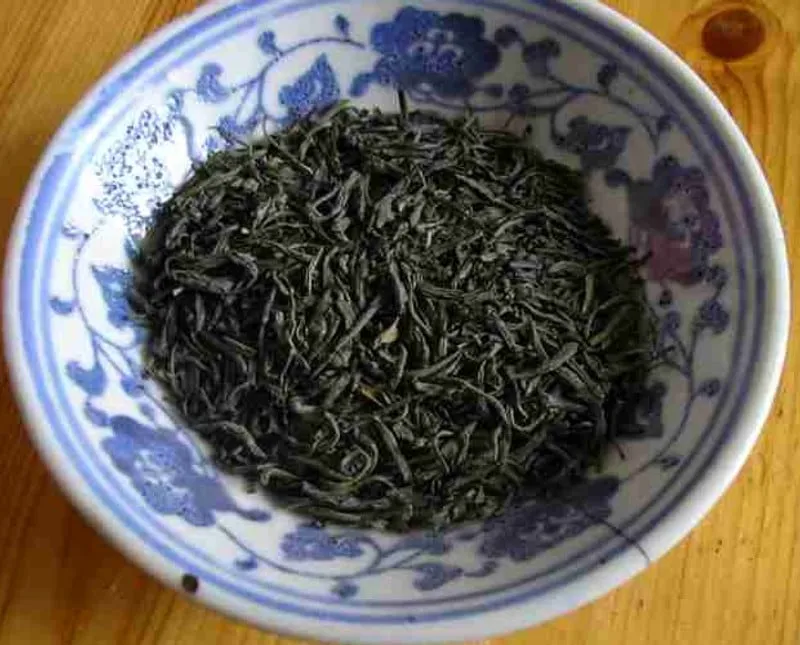
Xinyang Maojian comes from the northern foothills of the Dabie Mountains around Xinyang, Henan, and is a needle-shaped pan-fired green tea[1]. Its hand-made method has a few distinctive features: two tilted pans, one hotter and one cooler (the raw pan and cooked pan), share fixation and shaping; a tea broom made of bundled bamboo twigs pushes and pulls the shoots into fine, round, tight, straight, downy needles; and the tea is dried over charcoal in two stages[1]. The sections below cover the origin, each stage, what research shows about aroma and compound changes, and how to brew it.
1. Origin
1.1 The protected area
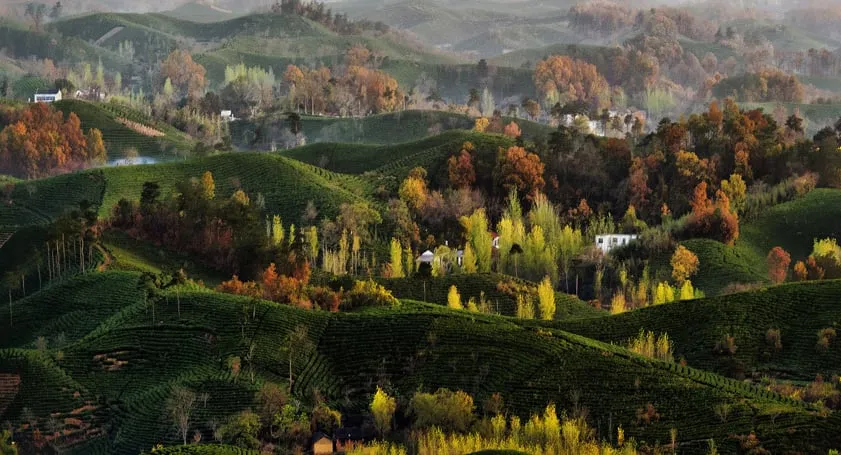
The national standard GB/T 22737-2008, Product of Geographical Indication – Xinyang Maojian Tea, defines the protected area as Shihe and Pingqiao districts and Luoshan, Guangshan, Xin, Shangcheng, Gushi and Huangchuan counties in Xinyang[1]. The traditional famous gardens are often summed up as “five clouds, two pools and one stockade” (Cheyun, Jiyun, Lianyun, Tianyun and Yunwu mountains, Heilongtan and Bailongtan, and Hejiazhai), all around Shihe District.
1.2 A northern tea region
Xinyang lies near 32°N, in the transition from subtropical to warm-temperate climate, one of the more northerly parts of China’s tea country, known as the Jiangbei (north of the Yangtze) region. Compared with tea areas further south, winters are colder and spring buds appear later. Gardens are mostly on hills and low mountains backed by the Dabie range.
A common view is that the cool climate and wide day–night temperature range give Xinyang Maojian more amino acids and less bitterness. A study comparing Xinyang Maojian across cultivars, elevations and processing found that all three affect the tea’s composition[4]. But the amino acid and polyphenol levels and ratios of any one tea vary widely with raw leaf, season and grade, so no figures are given here.
2. The stages: two pans and two bakes
Traditional hand-made Xinyang Maojian uses a double-pan stove: two tilted iron pans set side by side, a hotter “raw pan” for fixation and a cooler “cooked pan” for shaping. The maker’s tool is the tea broom, a bundle of fine bamboo twigs with a springy, splayed end[1].
The temperatures below are common ranges in traditional hand-making, given to show how the stages compare; real heat is adjusted to batch size, weather and the maker’s hand, and these are not standard parameters.
2.1 Spreading
Picked leaf is not panned straight away but spread thinly on bamboo mats in a cool, airy room. It loses some water and softens, and the grassy smell fades, so it is less likely to scorch or stew in the pan. Spread too long, the tips scorch and break.
2.2 Raw-pan fixation
The raw pan is hot. Holding the broom in one hand and working with the other, the maker scoops the leaf from the pan bottom and shakes it loose so steam and grassy notes escape: “more tossing, less covering”. The heat inactivates polyphenol oxidase and related enzymes so the leaf does not oxidise and redden, and softens it for shaping (see The Science of Fixation). When the leaf is soft but not sticky, it is swept into the cooked pan.
2.3 Cooked-pan shaping
This is where the needle shape is made. The cooked pan is cooler and is eased down further as shaping goes on. Holding the broom in both hands, the maker traps the leaf between the twigs and the pan wall and pushes, pulls and rubs it along the wall in repeated passes. The leaf rolls tight into fine, round needles; some juice reaches the surface and the down lies flat along the strips, giving the smooth, straight, downy look[1].
Raw pan, cooked pan
Toss first, then rub along the wall.
Push, pull and rub into needles
- Lower heat, eased down as shaping goes on
- Hands push, pull and rub the broom along the wall
- Leaves roll into tight, straight needles
- Magnified: down lies flat along the needle
Most of the round, tight, straight shape forms here.
Conditions, technique & sources
- Pan / baking heat
- Commonly about 80–100 °C, then lower (pan)
- Duration
- Around ten minutes
- Leaf moisture
- Still drying
Hold the broom with both hands and push, pull and rub along the pan wall, straightening the strips in several passes.
Before the raw pan, leaves are spread thinly for a few hours until slightly soft.
Stage names follow GB/T 22737-2008 (Geographical Indication Xinyang Maojian Tea); temperatures and times are common ranges for hand-making, and makers differ.
Batch size, weather and charcoal heat are judged by the maker; figures here are common ranges, not standard parameters.
2.4 Staged charcoal drying
Strips leaving the cooked pan are mostly shaped but still damp, drier outside than inside. Drying is therefore done in stages[1]:
- First bake: spread thinly over a charcoal basket and dried quickly to remove surface water and fix the shape;
- Rest: tipped into a bamboo tray to cool for a while, so water from the stems and core moves outward and the whole leaf evens out, avoiding a scorched outside over a damp inside;
- Second bake: the charcoal is banked with ash for a low fire, the tea spread a little thicker and dried slowly with light turning until it crumbles. This makes the tea dry enough to keep and is when roasted and chestnut-like notes form[3].
Bake, rest, bake again
Follow the water in the needle.
Thin layer, fast drying
- Charcoal basket, commonly about 90–100 °C
- Thin layer, quick drying
- Magnified: surface water leaves first
Fast drying fixes the shape while the core stays damp, so a rest follows.
Conditions, technique & sources
- Pan / baking heat
- Commonly about 90–100 °C (baking)
- Duration
- Over ten minutes, then a rest
- Leaf moisture
- Damp → half dry
Spread thinly over a charcoal basket and dry quickly; then tip into a bamboo tray to cool so moisture evens out.
Stage names follow GB/T 22737-2008 (Geographical Indication Xinyang Maojian Tea); temperatures and times are common ranges for hand-making, and makers differ.
Batch size, weather and charcoal heat are judged by the maker; figures here are common ranges, not standard parameters.
3. What research shows
3.1 Key aroma compounds
A study using gas chromatography–olfactometry and related methods on Xinyang Maojian infusions identified nine key odorants, including nonanal, β-ionone, octanal, nerolidol, linalool, geraniol and decanal[2]. It also followed them from fresh leaf through fixation, rolling, shaping and drying: most key odorants decreased after fixation[2]. Another study following Xinyang Maojian on an industrial line likewise showed the volatile profile changing at every stage[6].
3.2 Chestnut notes and drying
Xinyang Maojian is often described as smelling of roasted chestnut. A study following a chestnut-type green tea through manufacture found that drying had the largest effect on volatiles; pyrroles, methylpyrazine, furfural and similar compounds formed during drying, heterocyclic and sulfur compounds usually linked to Maillard reactions in roasting[3]. Those samples were chestnut-type green tea in general, not specifically Xinyang Maojian, but the finding fits the practical view that the second bake brings out the aroma.
Note that the key odorants identified in Xinyang Maojian were mainly floral and fresh compounds[2]; the chestnut impression comes from many compounds together and cannot be pinned on a single molecule.
3.3 Non-volatile compounds
An analysis of non-volatile compounds across the whole Xinyang Maojian process identified about 1,000 non-volatile metabolites and selected 53 that changed markedly during processing[5]. These changes relate to taste, but which change corresponds to which sensation needs more research. In general, amino acids such as theanine give savoury freshness, while catechins give bitterness and astringency[7].
Xinyang Maojian
Green · Rolled Pan-Fired4. The stages at a glance
The table summarises methods and signs at each stage. Temperatures are common ranges for traditional hand-making, not standard parameters.
| Stage | Equipment and heat | Main handling | Signs it is done |
|---|---|---|---|
| Spreading | Bamboo mats, room temperature | Thin layer, little turning | Leaves soft, grassy smell fading |
| Raw-pan fixation | Raw pan, hot (commonly about 140–160 °C) | Broom and palm scoop and shake, more tossing than covering | Soft, deeper green, grassy smell gone, not sticky |
| Cooked-pan shaping | Cooked pan, cooler (commonly about 80–100 °C), eased lower | Broom pushes, pulls and rubs along the wall in passes | Fine, round, tight, straight strips; down lies flat |
| First bake | Charcoal basket, fairly hot (commonly about 90–100 °C) | Thin layer, quick drying | Shape fixed, firm but still flexible |
| Rest | Bamboo tray, room temperature | Spread and left | Strips soften slightly, moisture even |
| Second bake | Ash-banked charcoal, low fire (commonly about 60–70 °C) | Slightly thicker layer, slow drying, light turning | Crumbles between fingers, aroma shows |
5. Brewing
Xinyang Maojian is tender, tightly rolled and downy, and brews much like other tender green teas. These are common practice; adjust to taste.
5.1 Temperature and adding the tea
- About 80–85 °C: boiling water poured straight on tends to yellow the leaves, increase bitterness and give a stewed note; slightly cooler water slows the release of bitter compounds. For a stronger cup, add more tea or time.
- Middle-drop: pour about a third of the water into a glass, add about 3 g of tea, wait a moment for it to take up water, then top up along the side to 70–80% full.
- Top-drop: fill with water first, then scatter the tea on the surface and watch the strips sink; suits very tender, downy teas.
5.2 Ratio and time
- About 3 g of tea to 150 mL of water;
- Start tasting the first infusion at about 1 minute, leave about a third in the glass before topping up;
- Lengthen later infusions. The first is usually the freshest; later ones grow lighter and softer.
6. Common misconceptions
Misconception 1: “The white fuzz floating on the liquor is dust or mould.”
It is tea down, the fine hairs on young buds and leaves[1]. The younger the shoot, the more down; shaping presses it onto the strips and some spreads into the cup. It is normal for tender raw material (see Botanical Anatomy of a Tea Shoot).
Misconception 2: “The stronger the chestnut note the better; a little burnt fire is the real old style.”
The chestnut note forms mainly during drying and is linked to reactions under heat[3], but it should sit in balance with the tea’s own fresh and floral aroma[2]. A sharp burnt smell or obvious harsh “fire” usually means the pan or baking was too hot, a processing fault rather than a mark of tradition.
Misconception 3: “The tighter the strips, the more they need boiling water and a long steep.”
Xinyang Maojian is made from tender shoots; tight as the strips are, they open readily in water at about 80–85 °C. A long steep in boiling water tends to yellow the leaves, darken the liquor and add bitterness.
Related Articles
- Famous Tea Craft: West Lake Longjing — handling techniques for a flat pan-fired green tea
- Famous Tea Craft: Dongting Biluochun — the one-wok method for a curled pan-fired green tea
- The Science of Fixation — why heat keeps green tea green
- Composition and Flavour — where roasted and other aroma compounds come from
- China’s Four Great Tea Regions — where the Jiangbei region is and what it is like
References
- R-361 General Administration of Quality Supervision, Inspection and Quarantine of the People’s Republic of China, & Standardization Administration of China (2008). Product of geographical indication - Xinyang Maojian tea (GB/T 22737-2008). Standards Press of China. https://std.samr.gov.cn/gb/search/gbDetailed?id=71F74333E8947FB9E05397BE0A0A5A82
- R-362 Cui, J., Zhai, X., Guo, D., Du, W., Gao, T., Zhou, J., Schwab, W. G., & Song, C. (2022). Characterization of Key Odorants in Xinyang Maojian Green Tea and Their Changes During the Manufacturing Process. Journal of Agricultural and Food Chemistry, 70(1), 279–288. https://doi.org/10.1021/acs.jafc.1c06473
- R-363 Yang, Y., Qian, M. C., Deng, Y., Yuan, H., & Jiang, Y. (2022). Insight into aroma dynamic changes during the whole manufacturing process of chestnut-like aroma green tea by combining GC-E-Nose, GC-IMS, and GC × GC-TOFMS. Food Chemistry, 387, 132813. https://doi.org/10.1016/j.foodchem.2022.132813
- R-364 Wang, H., Cao, X., Yuan, Z., & Guo, G. (2021). Untargeted metabolomics coupled with chemometrics approach for Xinyang Maojian green tea with cultivar, elevation and processing variations. Food Chemistry, 352, 129359. https://doi.org/10.1016/j.foodchem.2021.129359
- R-365 Kong, Y., Chen, L., Cheng, E., Zhu, Y., Wang, J., Wang, X., Wang, Z., Chen, Y., Yin, P., & Guo, G. (2024). Analysis of Non-Volatile Metabolic Profiles during Xinyang Maojian Tea Processing Based on Untargeted Metabolomics. Food Science, 45(5), 102–110. https://doi.org/10.7506/spkx1002-6630-20230824-188
- R-366 Yin, P., Wang, J.-J., Kong, Y.-S., Zhu, Y., Zhang, J.-W., Liu, H., Wang, X., Guo, G.-Y., Wang, G.-M., & Liu, Z.-H. (2022). Dynamic Changes of Volatile Compounds during the Xinyang Maojian Green Tea Manufacturing at an Industrial Scale. Foods, 11(17), 2682. https://doi.org/10.3390/foods11172682
- R-029 Wan, X. (Ed.) (2003). Tea Biochemistry (3rd ed.). China Agriculture Press. ISBN: 978-7109066274.
Article Knowledge Network
Explore the connections between the teas, processes and flavours in this article.