
Start with the essentials
White tea develops through withering and drying. Both loose and compressed tea can change during suitable storage. Age must be considered alongside material, manufacture, packaging and conditions; traditional sayings about tea becoming medicine do not establish health benefits.
This article follows manufacture and storage, then considers catechins, flavonoid composition, potential storage markers and aroma. An increase in one total measurement does not mean every flavonoid or glycoside increases.
Three key points
- Withering and drying establish the starting characterMoisture loss and internal reactions depend on leaves and conditions.
- Compression changes physical conditionsShape, moisture and packaging matter; age or cake form cannot predict quality alone.
- Distinguish research measuresSome total assays rise while individual flavonoids decline or transform; EPSF compounds are potential markers, not standalone proof of age.
What to notice when tasting
Record colour, aroma, strength and astringency across infusions; try gentle decoction if preferred. Medicinal or jujube aroma is a sensory description rather than evidence of therapeutic effects, flavonoid content or authentic age.
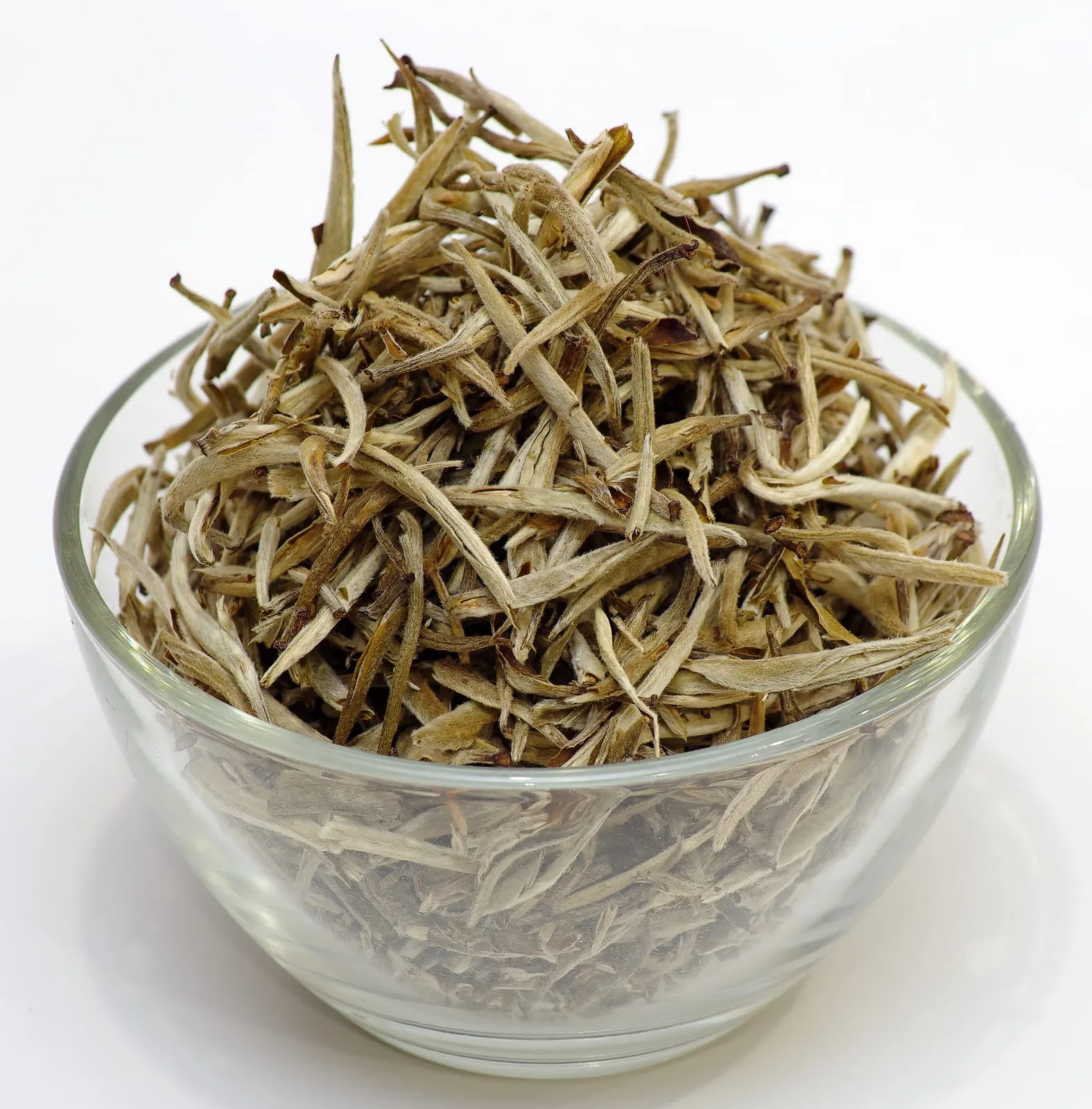
Fuding white tea is made by withering and drying. It can be stored loose or steamed and pressed into cakes[1][2]. During storage, catechins, flavonoids and aroma compounds all change (see White tea withering and aging and Tea storage at home). But different studies measure different things, and their results do not always point the same way, so this cannot be summed up as “flavonoids multiply with age”[3][4]. “One year tea, three years medicine, seven years treasure” is a folk saying, not evidence of any medicinal effect.
1. Origin and cultivars
The geographical-indication area for Fuding white tea lies within Fuding City, Fujian[8]. Fuding sits between mountains and the sea, with a warm, humid climate, and is a traditional white tea area.
The cultivars most used here are Fuding Dabai and Fuding Dahao. Their buds are plump and covered in down (baihao), which suits bud-focused white teas such as Silver Needle and White Peony. The national white tea standard divides products by tenderness of material into Baihao Yinzhen (Silver Needle), Bai Mudan (White Peony), Gongmei and Shoumei[1].
2. Withering, drying and pressing
The basic method for white tea is “no firing, no rolling”: fresh leaves are spread out to lose water slowly (withering) and then dried[1][7]. Aged white tea is mostly sold as cakes or bricks, which adds a step of steaming and pressing[2].
2.1 Withering
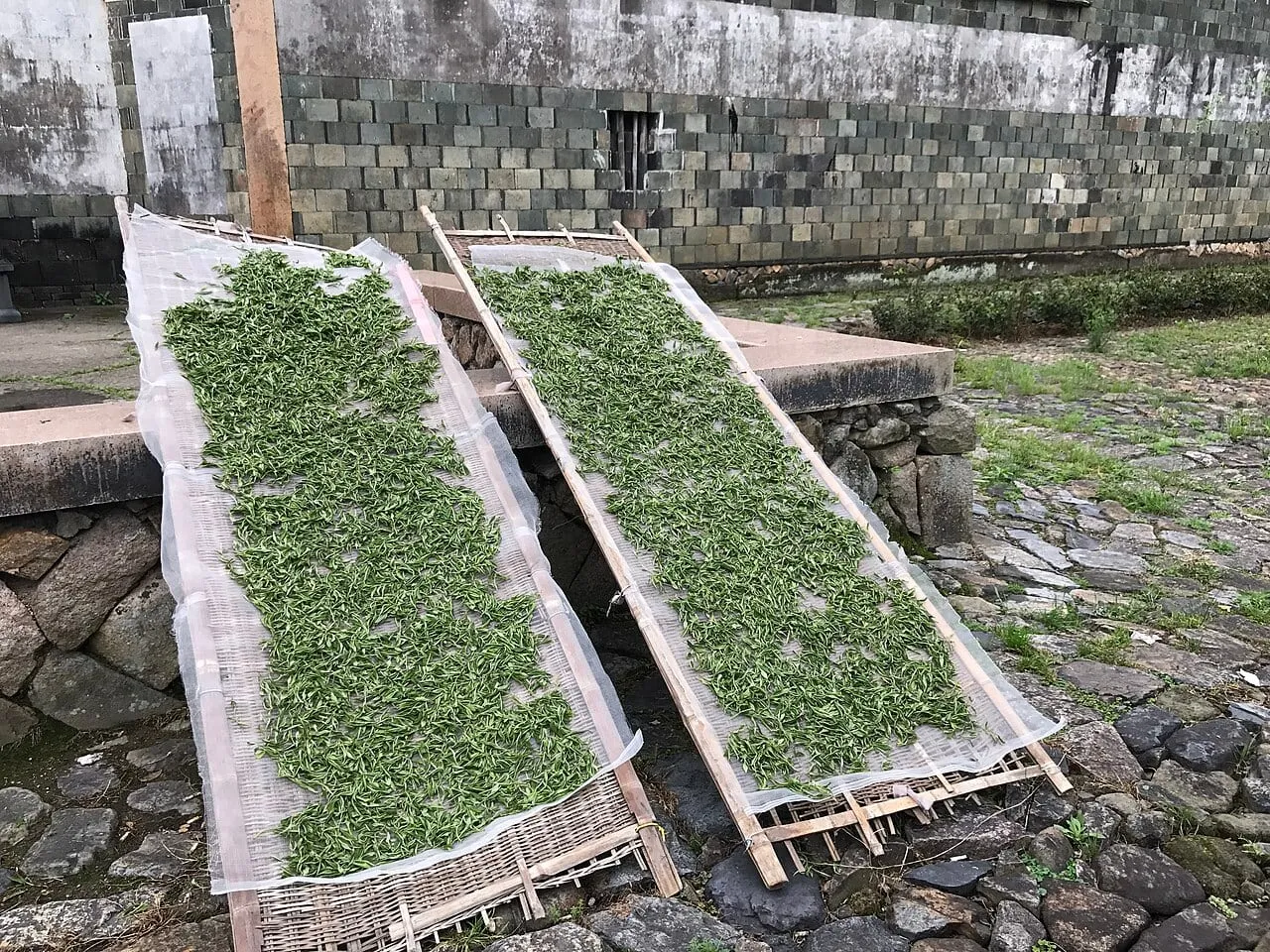
Withering is the key step in white tea. Fresh leaves are spread thinly on bamboo sieves outdoors or in a ventilated room and left to lose water slowly, commonly for two to three days. When the sun is too strong they are moved into shade; in poor weather they are withered indoors or with gentle added heat[1].
Because the leaves are never heated to stop enzyme activity, their enzymes stay active during withering: some proteins break down to amino acids, some polysaccharides to sugars, catechins oxidise slightly and grassy notes fade[7]. These changes give white tea its sweetness and downy aroma.
2.2 Drying
Once withered enough, the leaves are dried at low heat. Drying brings their water content very low, largely stops enzyme activity and keeps the tea from spoiling in storage[1][7]. Temperature and time depend on the degree of withering, the equipment and the producer’s practice; charcoal drying is also used traditionally.
Wither, dry, press: making a white tea cake
Three stages; the buds are never rolled.
Gentle light on tilted sieves, no turning
- Soft, slanting light
- Thin layers on tilted sieves
- Loupe: straight, silvery buds
- Water leaves over two to three days
Slow water loss lets the leaf change gently, unrolled and unfired.
Conditions, evidence & sources
- Conditions
- Gentle sun or a ventilated room; avoid harsh sun
- Duration
- Commonly two to three days, by weather
- Moisture
- Progressive moisture loss; observe and measure
Leaves are spread thinly on sieves, moved into shade when the sun is too strong and withered indoors in poor weather. They are generally not tossed, to avoid bruising.
Without a firing step the leaf enzymes stay active: some proteins and polysaccharides break down to amino acids and sugars, catechins oxidise slightly and grassy notes fade.
Strong sun can scorch and redden leaves, so the usual practice is to avoid the midday sun.
Standards address product requirements; studies address their sampled changes. Total assays and individual compounds must be distinguished.
Qualitative, not measured levels or a universal aging curve.
2.3 Steaming and pressing
Compressed white tea follows GB/T 31751-2015 Compressed white tea[2]. Typically the dry tea is steamed briefly to soften it, pressed into a cake or brick in a cloth bag or mould, then dried below the moisture limit set by the standard.
Pressing changes the tea’s shape, and air and moisture move more slowly through a cake than through loose tea. It is often said that cakes “age better”, but the standards and studies cited here did not measure this; the actual effect also depends on how tightly the tea is pressed, its moisture and the packaging.
3. How composition changes in storage
Storage studies have recorded changes in white tea composition and sensory character. Oxidation, polymerisation and hydrolysis are reasonable directions for explanation, but age is not a single chemical timetable, and folk sayings are not experimental findings[3][4][5].
3.1 Keep totals, glycosides and individual compounds apart
Storage studies do not show every compositional measure moving in the same direction. When reading them, first ask what was measured and which samples were compared[3][4]:
- Total measurements: Zhao et al. measured the main components of ten white tea sets stored for 1–13 years and applied untargeted metabolomics to selected ages. They reported increasing total-flavonoid measurements and decreasing total polyphenols in those samples[3]. This describes a trend in that set of samples, not a rule that every aged white tea multiplies steadily with age.
- Individual compounds: Fan et al. studied White Peony stored for 1–13 years. Declining or transforming flavonoids, tannins and amino acids were associated with changes in astringency, umami and liquor colour[4]. A rising total flavonoid measurement therefore does not mean every flavonoid glycoside increased.
- Like with like: a “total flavonoid” figure depends on the assay method, units and basis of calculation. Individual chromatographic quantities, metabolomic peak signals and total assays are not interchangeable. Teas from different years may also differ in material, season and manufacture, so comparing age groups alone cannot show that every difference comes from storage.
- Health claims need other evidence: in-vitro assays, human absorption and the effects of drinking tea are separate questions; a “medicinal” aroma or a proverb cannot stand in for them.
3.2 Catechins and EPSF
- Catechins: in the studies, some catechins declined or transformed in storage, which may relate to reduced astringency; the size of the change depends on material and storage and cannot be given as one fixed percentage[3][4].
- EPSF: a 2018 study identified several 8-C N-ethyl-2-pyrrolidinone-substituted flavan-3-ols (EPSF) as potential markers in its stored white tea samples[5]. Detection alone cannot establish an authentic year: levels have to be read alongside material, processing and storage records; there is no universal three-year onset, and no medicinal effect follows from them.
What can storage change, and what can it not?
Switch years; watch the leaf in the loupe.
Stored dry, dark and odour-free
- Sealed, away from light, damp and odours
- Steady room temperature, dry air
- Loupe: in some samples the leaf darkens
- Some samples develop an aged aroma
Some catechins and flavonoids transform, not all in one direction.
Conditions, evidence & sources
- Conditions
- Room temperature, dry, dark, odour-free
- Duration
- About three years (example)
- Moisture
- Confirm by measurement
Keep sealed, dry, protected from light and odours; inspect packaging and moisture exposure.
Some catechins, flavonoids and other constituents transform. Total assays and individual compounds can move differently; three years is not a universal chemical milestone.
“Three years as medicine” is a traditional saying rather than evidence of increased human benefit.
Standards address product requirements; studies address their sampled changes. Total assays and individual compounds must be distinguished.
Qualitative, not measured levels or a universal aging curve.
3.3 Aroma
A 2018 study used gas chromatography–mass spectrometry with chemometrics to compare fresh white tea, naturally stored white tea and white tea treated with a rapid-aging technique, and found clear differences in aroma composition among the three[6]. Fresh, slightly green notes decline with storage, and stored tea has a different profile that tasters often describe as aged, jujube-like, medicinal or woody. Studies do not fully agree on which compounds are responsible, so this article does not list them; “rapidly aged” tea should not be equated with naturally stored tea.
Aged Fuding White Tea
White · Aged Shoumei / Peony4. From making to storage: a comparison table
The table lists what is done at each stage and what to watch for. It does not give single temperatures, durations or moisture figures because these vary with the tea and conditions; for exact limits, use the standard the product follows[1][2].
| Stage | What is done | What to watch | What standards or studies support |
|---|---|---|---|
| Plucking | Buds or shoots picked to the product | Avoid rain-wet leaves and crushing | The standard grades Silver Needle, White Peony, Gongmei and Shoumei by tenderness[1] |
| Withering | Spread thinly on sieves; slow water loss | Move to shade in strong sun; do not toss | Leaf enzymes stay active and change some constituents[7] |
| Drying | Low-heat drying | Avoid scorching | Lowers moisture for storage[1] |
| Pressing | Steam, press, then dry again | Dry thoroughly after pressing | Compressed white tea has its own product standard[2] |
| Several years’ storage | Sealed, dark, dry, odour-free | Check packaging for damp | Some catechins and flavonoids change, by an amount that depends on the sample[3][4] |
| Longer storage | Keep dry and odour-free | No need to keep opening it to “air” the tea | Totals and individual compounds need separate testing; EPSF are only potential markers[3][5] |
5. Brewing and boiling
Aged white tea changes in composition and flavour during storage, but by how much depends on the tea and conditions. It can be brewed in a gaiwan or simmered to taste; suitability for simmering does not mean more total flavonoids or polysaccharides, and more of a compound is not automatically better. The following are common practice.
5.1 Gaiwan brewing
- Amount: about 5 g in a 120–150 mL gaiwan or pot.
- Water: aged white tea is usually brewed with boiling water; loosen pieces of cake first.
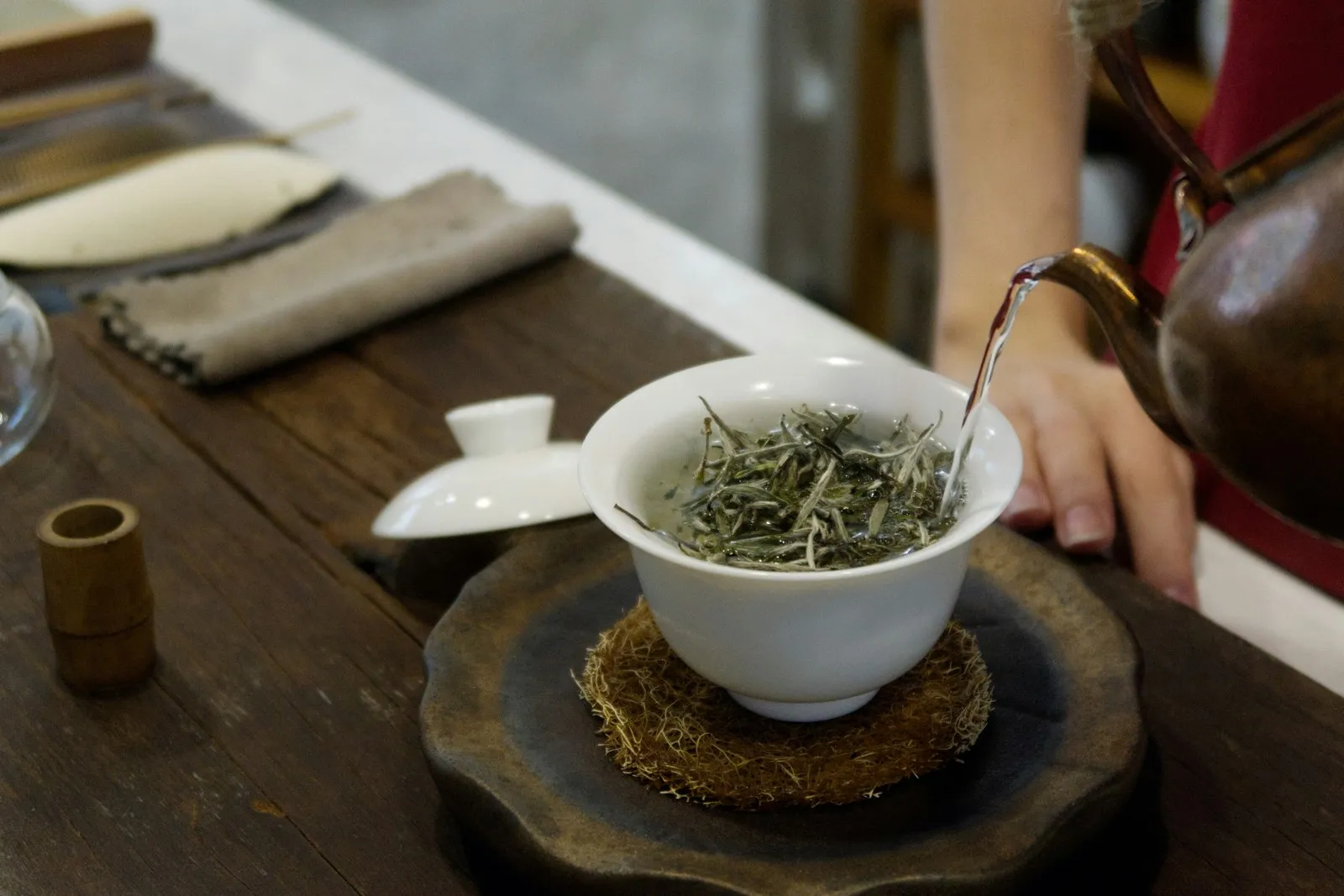
- Rhythm: a quick first rinse, discarded; pour the first few infusions quickly, then lengthen them. Notice how the liquor deepens from pale orange-yellow and how aroma and astringency change.
The image below records water being poured into a gaiwan of Silver Needle and shows how water meets the leaves. The photographer gave no age, origin or water temperature for this sample, so it should not be read as an aged white tea or a standard parameter.
5.2 Simmering
One way to drink aged white tea is to simmer it gently. Simmering makes the liquor stronger and may make it more bitter; it does not show that particular “bound flavonoids” are released or that the tea becomes healthier:
- Amount: commonly about 4–5 g per 500 mL water, or leaves already infused a few times.
- Method: add the tea once the water boils, simmer gently for a few minutes, rest briefly off the heat, then pour; adjust strength to taste.
6. Common questions
Aged white tea “gets better with age”: will it improve however it is stored?
No. Store it sealed, dark, dry and away from odours. GB/T 31751-2015 Compressed white tea sets a maximum finished moisture of 8.5%[2]; that is a pass/fail ceiling, not an ideal, and well-made tea is usually drier. Tea that takes up moisture can go mouldy or develop sour or musty smells; that is spoilage, not aging.
Does a redder liquor or stronger medicinal or jujube aroma prove greater age?
No. Neither liquor colour nor an aroma impression proves storage age; hot, humid “accelerated aging” or roasting can darken leaf and liquor quickly. The potential marker EPSF is also affected by material and heat treatment, so no single measure can certify age[5]. Verifying age requires batch, packaging and storage records.
Does “three years medicine, seven years treasure” mean flavonoids double and the tea has special health effects?
The saying sums up experience that stored white tea becomes less bitter and softer; it is not medical evidence. One study found rising total flavonoid measurements in stored samples, while another found many individual flavonoids and glycosides declining or transforming during storage[3][4]. This cannot be reduced to “flavonoids generally double”, and tea is no substitute for medical care.
Related Articles
- Baihao Yinzhen: how single-bud new white tea is withered and where its downy aroma comes from
- White tea withering and aging: chemical changes in withering and storage
- Tea storage at home: keeping tea dry, dark and free of odours
- Raw Pu-erh: another compressed tea often kept for years
- Tea & Health: telling compound measurements apart from evidence in people
References
- R-071 — GB/T 22291-2017.《白茶》(White tea). 全国茶叶标准化技术委员会(SAC/TC339).
- R-367 General Administration of Quality Supervision, Inspection and Quarantine of the People’s Republic of China, & Standardization Administration of China (2015). Compressed white tea (GB/T 31751-2015). Standards Press of China. https://std.samr.gov.cn/gb/search/gbDetailed?id=71F74333CF797FB9E05397BE0A0A5A82
- R-368 Zhao, F., Chen, M., Jin, S., Wang, S., Yue, W., Zhang, L., & Ye, N. (2022). Macro-composition quantification combined with metabolomics analysis uncovered key dynamic chemical changes of aging white tea. Food Chemistry, 366, 130593. https://doi.org/10.1016/j.foodchem.2021.130593
- R-369 Fan, F.-Y., Huang, C.-S., Tong, Y.-L., Guo, H.-W., Zhou, S.-J., Ye, J.-H., & Gong, S.-Y. (2021). Widely targeted metabolomics analysis of white peony teas with different storage time and association with sensory attributes. Food Chemistry, 362, 130257. https://doi.org/10.1016/j.foodchem.2021.130257
- R-370 Dai, W.-D., Xie, D., Lu, M.-L., Li, P., Lv, H.-L., Yang, C.-Y., Peng, Q.-F., Zhu, Y.-J., Guo, L.-P., & Zhang, Z.-H. (2018). Metabolomics Investigation Reveals That 8-C N-Ethyl-2-pyrrolidinone-Substituted Flavan-3-ols Are Potential Marker Compounds of Stored White Teas. Journal of Agricultural and Food Chemistry, 66(27), 7209–7218. https://doi.org/10.1021/acs.jafc.8b02038
- R-371 Qi, D., Miao, A., Cao, J., Wang, W., Chen, W., Pang, S., He, X., & Ma, C. (2018). Study on the effects of rapid aging technology on the aroma quality of white tea using GC–MS combined with chemometrics: In comparison with natural aged and fresh white tea. Food Chemistry, 265, 189–199. https://doi.org/10.1016/j.foodchem.2018.05.080
- R-029 Wan, X. (Ed.) (2003). Tea Biochemistry (3rd ed.). China Agriculture Press. ISBN: 978-7109066274.
- R-072 — DB35/T 1076-2010.《地理标志产品 福鼎白茶》(Product of geographical indication—Fuding white tea). 福建省质量技术监督局.
Article Knowledge Network
Explore the connections between the teas, processes and flavours in this article.