
Start with the essentials
Baihao Yinzhen is a white tea made primarily from buds, with visible down and intact form as familiar clues. If its main stages are withering and drying, why do weather, spreading and moisture still require such close attention? Internal changes continue as water is lost.
This article follows withering approaches, leaf consolidation and drying, connecting the adjustments with aroma, taste and storage. A short process can contain substantial judgement.
Three key points
- Buds provide a distinctive materialSize, integrity and down work with the manufacturing approach.
- Withering manages continuing changeWater loss, airflow and internal reactions require responsive handling.
- Drying links flavour with storageFinal moisture condition and packaging matter alongside appearance.
What to notice when tasting
Inspect buds and liquor clarity, then smell dry tea, hot liquor and cooler liquor separately. Adjust duration while holding other conditions steady rather than relying on a universal new- or aged-white-tea recipe.
What makes Silver Needle special
Silver Needle’s identity begins with raw material and place. Under China’s GB/T 22291-2017 standard, Baihao Yinzhen must be made from the single buds of the Fuding Dabaicha (Fuding large-white tea) or Shuixian cultivars[1]. In Fuding itself, the preferred cultivars are Fuding Dahaocha and Fuding Dabaicha, whose buds are unusually fat, densely covered in white trichomes and rich in soluble compounds.
Place matters just as much. Fuding, in north-eastern Fujian, enjoys a subtropical maritime climate with an annual mean temperature of about 18–19 °C and 1 500–1 800 mm of rainfall. Frequent mist and diffused light keep the buds tender and the down (baihao) abundant. Under the local standard DB35/T 1076-2010, only tea grown and processed within Fuding’s administrative area by the traditional method may be sold as “Fuding white tea”[2].
Plucking is ruthlessly selective: only spring single buds are taken, and local custom lists “ten do-not-pluck” rules — no rain, no dew, no thin buds, no purple buds, no insect-damaged buds, and so on. This draconian selection is why genuine Fuding Silver Needle is always scarce and expensive.
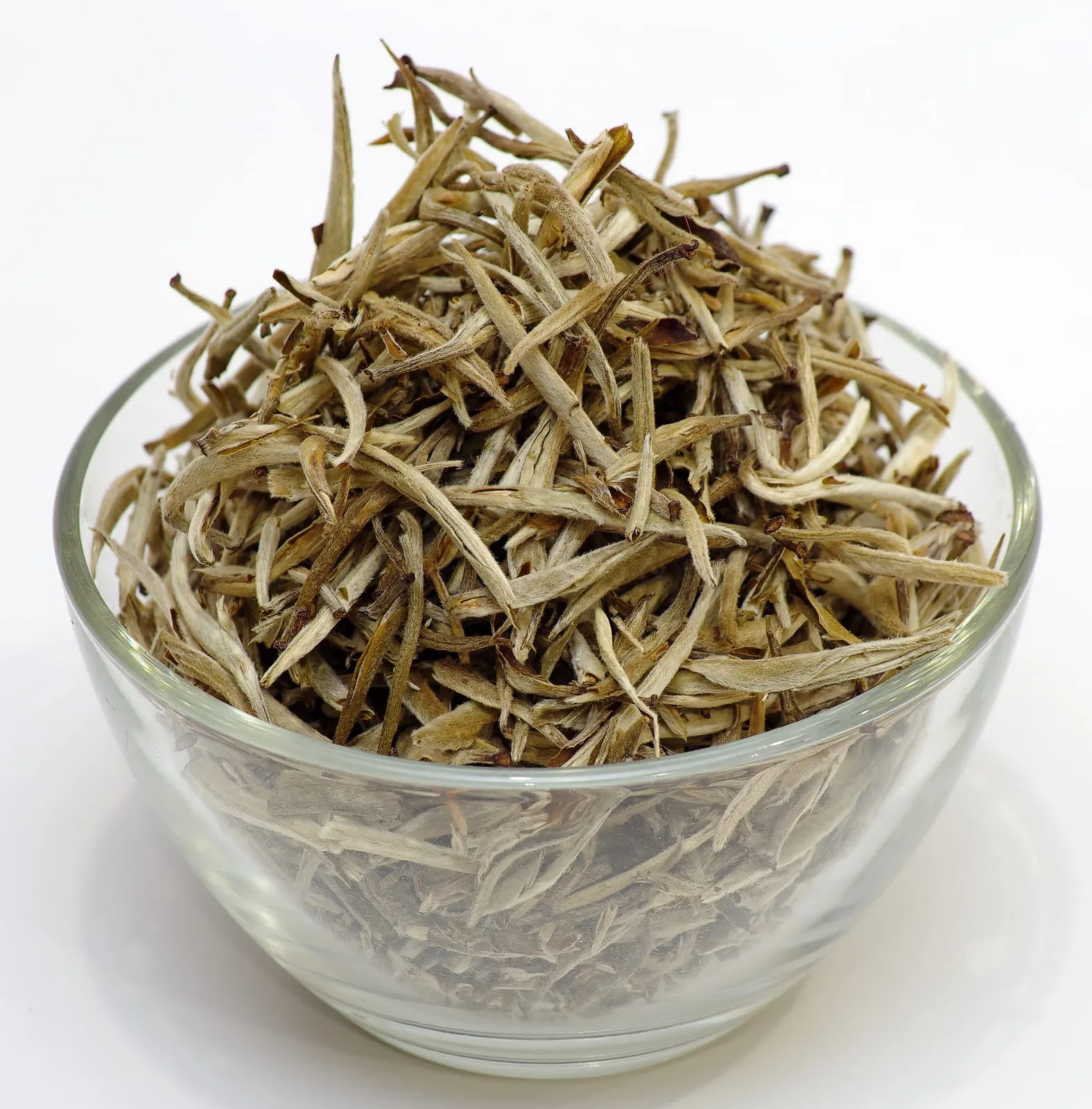
Full processing flow
Traditional Fuding Silver Needle passes through roughly six steps[2][3]:
Of these, withering is the most quality-critical and is explored in detail below.
Withering: time as the sculptor
Withering is the soul of Silver Needle. Freshly picked buds are spread thin on bamboo sieves or withering racks and left in ambient or controlled conditions. GB/T 32743-2016 recommends a withering temperature of 15–35 °C and relative humidity of 60–80%, with duration varying by method[3].
Do white hairs appear during withering?
Do hairs increase, or does the bud change?
Hairs already cover the bud
- A plump bud spread on a bamboo tray
- Loupe: hairs already on the epidermis
- Blue dots: water inside the bud
Pekoe starts on the plant, not on the withering tray.
What to notice, why & sources
What to notice: Short lines represent original hairs from the first step; they are not vapour or crystals.
Hair density and morphology depend on cultivar, development and other conditions.
Sources: ;
Enlarged schematic; sizes do not show moisture or hair density. Not to time scale.
Step through the 5 withering stages above to see how moisture, aroma precursors, and bud colour evolve across 48–72 hours on bamboo sieves. What begins as a bright green, water-rich shoot ends as a silvery, down-covered needle.
Three withering methods
| Method | Temperature | Duration | Character | Best for |
|---|---|---|---|---|
| Natural (sun) withering | Ambient, 15–30 °C | 48–72 h | High aroma, prominent downy scent; weather-dependent | Sunny, dry days |
| Indoor natural withering | Room temp, 20–25 °C | 48–72 h | Stable quality, softer aroma | Overcast or humid weather |
| Combined withering | Sun + indoor alternating | 40–60 h | Balances aroma and stability | Changeable seasons |
Values are representative; real workshops adjust for leaf condition, weather, equipment and the tea maker’s judgement[3].
Because Silver Needle buds are fat and their waxy cuticle slows water loss, they typically need longer withering than White Peony (Bai Mudan) — 48–72 hours or more. The Fuding local standard targets a post-withering moisture of 18–26%[2].
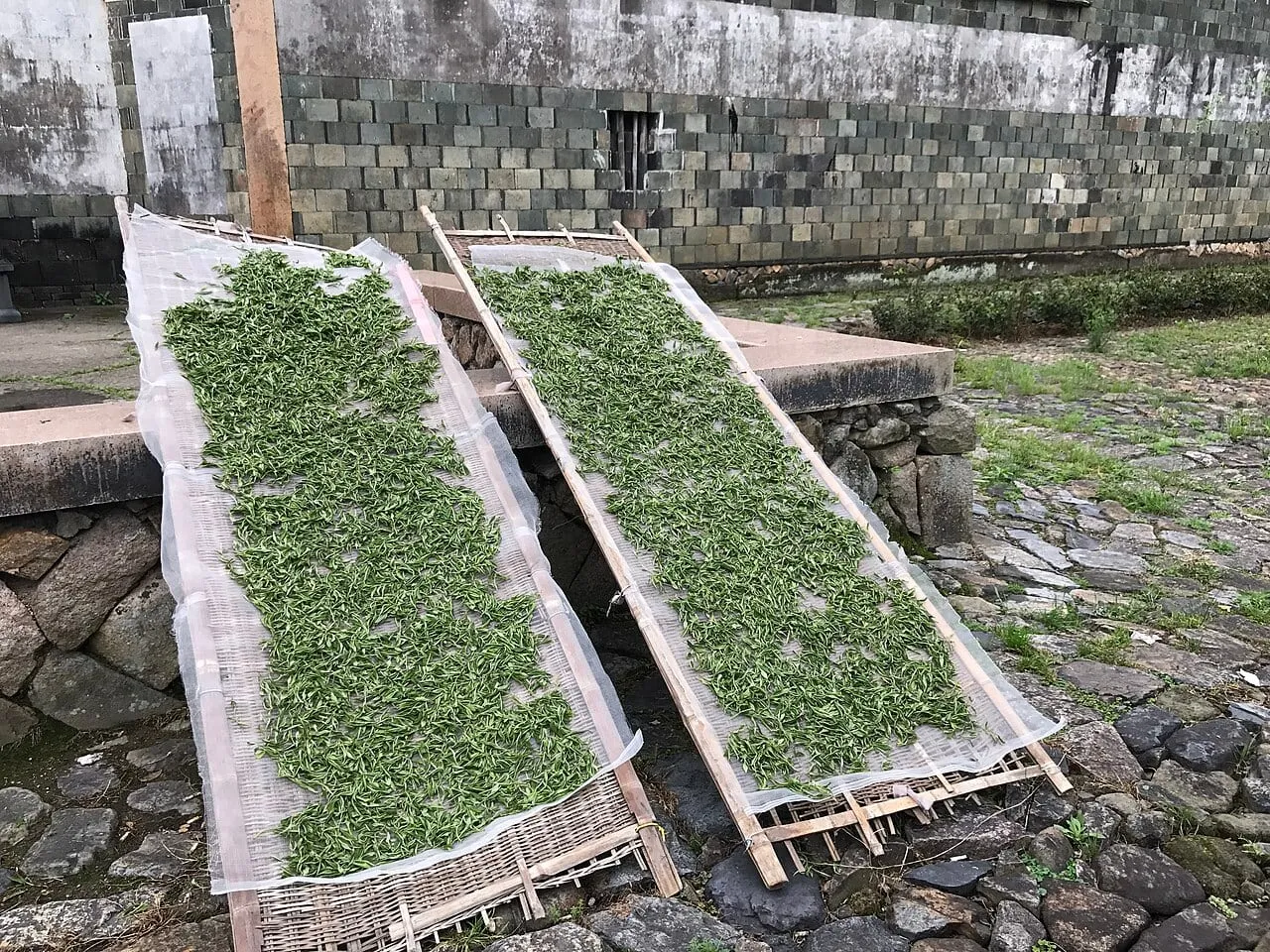
Thin spreading becomes clearer when looking at the trays: the white tea lies in an open layer on bamboo supports raised off the ground, rather than in a dense heap. Silver Needle uses buds, so loading and withering decisions still depend on bud condition and the surrounding environment.
Biochemical changes during withering
Withering is far more than “drying in the sun”. It is a complex interplay of enzymatic and non-enzymatic reactions:
-
Water loss and enzyme activation: Fresh leaf is about 75% water. As this falls to roughly 20%, cell-membrane permeability increases, raising the activity of polyphenol oxidase (PPO) and peroxidase (POD) and driving light oxidation of catechins[4]. Unlike black tea, white tea is not rolled, so cell walls remain largely intact; oxidation is therefore mild and slow, creating the characteristic “micro-oxidation” profile.
-
Protein hydrolysis and amino-acid accumulation: Protease activity rises during withering, breaking proteins into free amino acids. Theanine and glutamic acid increase, contributing to the brisk, umami-rich taste[4].
-
Aroma-precursor release: Glycosidically bound volatile precursors (GBVs) are hydrolysed by β-glucosidase, releasing floral compounds such as linalool and geraniol. Meanwhile, low-boiling grassy volatiles (cis-3-hexenol, hexanal) escape, and the distinctive downy, honeyed aroma emerges[5].
-
Pigments and hair visibility: Water loss and processing can alter chlorophyll and the underlying green tone, while pre-existing bud hairs become more visible. This is not growth of new white hairs or conversion of green tissue into hairs. Trichome studies describe their plant origin; the airflow experiment also records changes in moisture, tissue and colour under its specific withering conditions[4][6][7].
Merging sieves: the art of even water loss
During withering, the maker periodically merges sieves — combining two or three trays into one, or adjusting spread thickness. This slows water loss, equalises temperature and humidity among the leaves, and promotes uniform conversion. Timing is weather-dependent: warm, humid “south-wind” days call for earlier merging; cool, dry “north-wind” days allow later merging. The buds are usually merged when moisture is around 30–40%, while the leaf is still soft and the colour has just begun to darken.
Drying: low-heat fixation and aroma locking
When withered buds reach about 20% moisture (roughly 80–90% dry), they move to drying to stop enzyme activity, fix quality, and reduce moisture to a safe storage level.
Drying methods and parameters
| Method | Temperature | Time | Best for |
|---|---|---|---|
| Gentle charcoal baking (traditional) | 30–45 °C | 30–60 min | 80–90% dry buds; traditional craft |
| Basket roasting | 45–50 °C | Until fully dry | 60–70% dry buds |
| Low-temperature dryer | 40–60 °C | Until fully dry | Modern, scaled production |
Values are representative; real workshops adjust for equipment and bud moisture[2][3].
Traditional Fuding Silver Needle favours “gentle fire, slow baking” — low temperature over a longer time, using charcoal or electric baskets lined with paper to prevent scorching. Each basket holds roughly 0.25 kg of leaf. Final moisture must not exceed the national standard’s 8.5% ceiling[1][2]; that is a pass/fail limit, not a target, and well-made tea is usually drier.
Hand vs. machine
Silver Needle’s process is simple, but simple is not easy.
- Hand / traditional method: Relies on weather and the maker’s intuition. Sun-withered Silver Needle often carries a brighter, more lifted downy aroma, but output is small and weather-dependent.
- Machine / controlled withering: Modern withering troughs and climate-controlled rooms allow precise regulation of temperature, humidity and airflow. Quality is consistent and throughput is high. Some artisans argue that overly strong mechanical airflow can harden the bud surface and block even internal conversion, but well-designed equipment largely avoids this.
Top-grade Silver Needle is still mostly made by natural withering and gentle charcoal baking; machine methods dominate the mid-tier market.
Flavour and quality formation
Silver Needle’s typical aroma spectrum includes:
- Downy aroma (haoxiang): The clean, slightly milky scent of the dense white trichomes; the tea’s most recognisable signature;
- Honeyed sweetness: From glycoside hydrolysis and amino-acid–sugar reactions during withering;
- Floral notes: Delicate, elusive flower hints in high-grade lots, linked to terpenes such as linalool;
- Aged / medicinal scent: After several years of careful storage, slow internal conversion yields jujube and woody-medicinal notes prized by collectors.
In the cup, Silver Needle is defined by briskness, mellow body and a very low polyphenol/amino-acid ratio, which means almost no bitterness or astringency and a long, sweet aftertaste. Research shows that white tea contains higher free amino acids than green tea, while its catechins are slightly reduced by the mild oxidation, creating a softer, more rounded sweetness[4][5].
Baihao Yinzhen (Silver Needle)
White · Single-Bud WitheredThe silhouette is relative; real cups vary by origin, cultivar, grade, year and storage conditions.
Grades and brewing
GB/T 22291-2017 divides Baihao Yinzhen into two grades: Special and Grade 1[1]:
| Grade | Appearance | Aroma | Taste | Liquor | Infused leaf |
|---|---|---|---|---|---|
| Special | Fat buds, dense white down, silver-grey, glossy | Pure, prominent downy aroma | Brisk, mellow, strong downy note | Apricot-yellow, bright and clear | Fat, tender, bright |
| Grade 1 | Slender buds, visible down, silver-grey | Pure, distinct downy aroma | Brisk and mellow, distinct downy note | Apricot-yellow, clear | Tender, bright |
Brewing guide:
| Parameter | Recommendation |
|---|---|
| Water temperature | 85–90 °C (185–194 °F) |
| Leaf-to-water ratio | 3–5 g / 150 ml |
| Vessel | White porcelain gaiwan or glass cup |
| Pouring | Pour gently down the wall; avoid direct jet on the buds |
| Steeping | First infusion 20–30 s; increase gradually |
| Refills | 6–8 infusions; downy aroma lingers well |
Water that is too cool will not release the downy aroma and briskness; water that is too hot or too long a steep will bring out unwanted bitterness and mask the delicate fragrance.
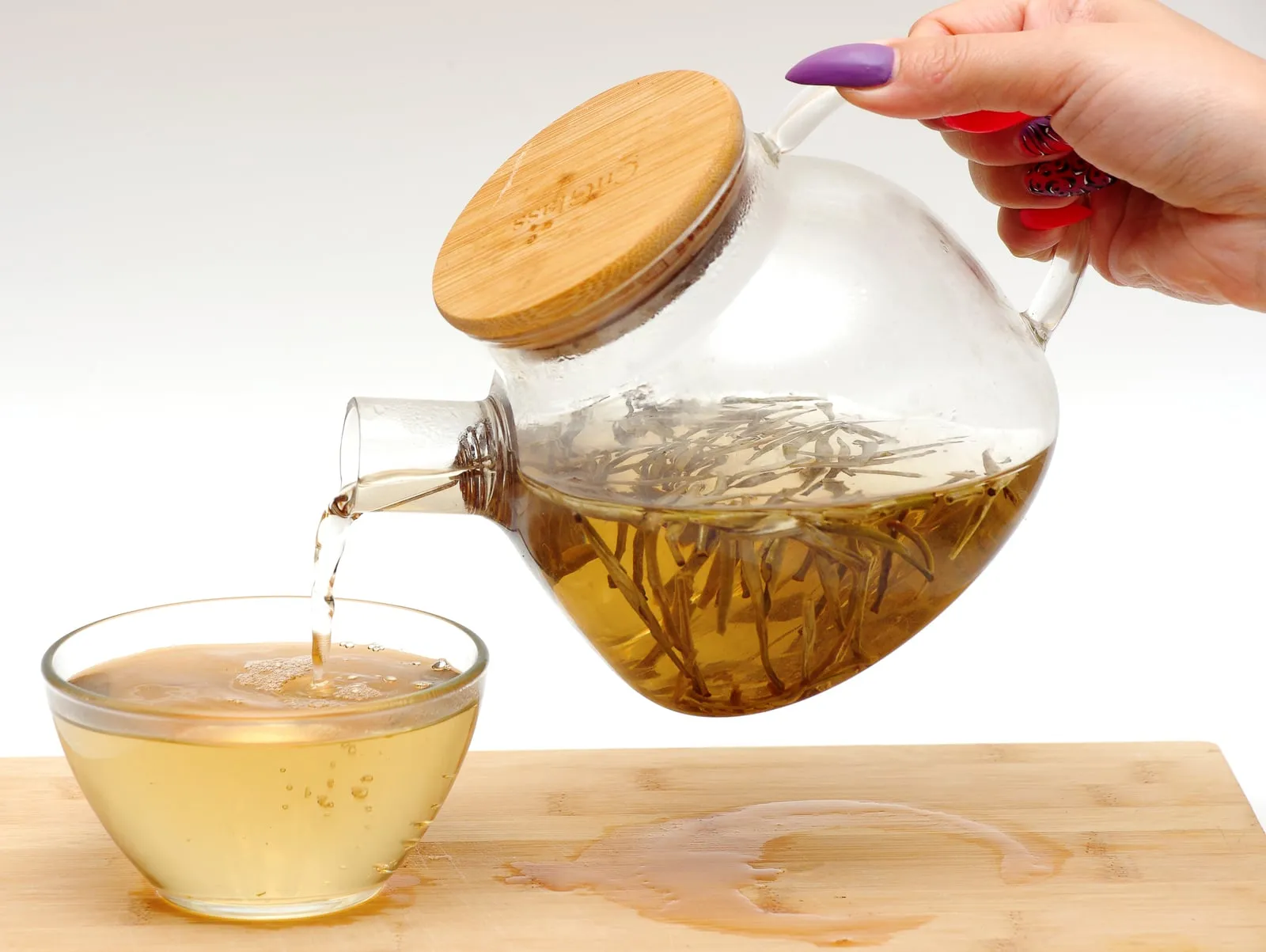
Does a sinking bud mean the tea is ready?
Bud posture and taste are separate cues.
Some dry buds may float temporarily
- Some dry buds float on the surface
- Some tilt into the water
- Some have already sunk
Buds need not move together. Their posture is not a quality score.
What to notice, why & sources
What to notice: Watch different buds rather than waiting for perfect upright rows.
Wetting, air, water movement and differences between buds may affect posture. This is a possible scenario.
Sources:
A plausible wetting sequence, not measured extraction. Not to time scale.
Common Myths & Scientific Clarifications
Myth 1: “Since white tea is not pan-fired or rolled, is it just sun-dried leaf without technical skill?”
Scientific Clarification: White tea processing is deceptively nuanced. The 48–72 hour natural or combined withering requires strict atmospheric control (15–25 °C, 60–80% RH) to achieve gradual moisture loss[3]. Within intact cells, endogenous hydrolases hydrolyze proteins into savory amino acids while glycosidases liberate linalool and other fresh floral aroma volatiles[4][5]. Sudden scorching under intense sun or wet pile-stewing causes enzymatic runaway, reddening buds and producing sour taints. The craft’s true mastery lies in fine-tuning moisture release rates without mechanical cell disruption.
Myth 2: “Is Silver Needle better if the dried buds appear completely pale white without a hint of green?”
Scientific Clarification: Extreme paleness does not indicate superior quality. Standard authentic Fuding Silver Needle is characterized by “silver down concealing jade green”[1][2]. While dense unicellular trichomes scatter light to create a silvery sheen, the underlying leaf tissue and bud core should retain vibrant tender green or olive tones. Chalky, dead white buds often signal unshaded solar sun-scorching that photodegraded chlorophyll unnaturally, or high-temperature forced drying that truncated proper withering. Look for plump, erect buds with lustrous silvery down rather than lifeless, desiccated white shoots.
Myth 3: “Is young Silver Needle intrinsically inferior to aged white tea?”
Scientific Clarification: Young and aged Silver Needle represent two distinct biochemical and sensory profiles. Spring fresh Silver Needle boasts maximum theanine content and volatile terpene alcohols, delivering an ethereal, brisk liquor rich in sweet downy aroma. In contrast, aged Silver Needle undergoes slow, non-enzymatic catechin condensation during dry storage, converting flavone glycosides into smooth, mellow herbal and dried-jujube profiles. Neither is objectively superior: fresh teas prioritize crisp, vibrant vitality, while aged teas offer rounded, comforting depth. Select according to personal taste rather than commercial age hype.
Myth 4: “Can Silver Needle be stored indefinitely at ambient temperature without strict humidity control?”
Scientific Clarification: Aging white tea requires strict moisture boundaries. National standard GB/T 22291 caps moisture at 8.5%[1]; that is a pass/fail ceiling, and tea meant for long storage should be thoroughly dry and sealed against damp. The dense trichomes absorb ambient moisture and odors aggressively. If storage relative humidity exceeds 65% or the leaf takes up moisture, favorable conversion degrades into musty mold contamination and sour hydrolysis. Safe domestic aging requires triple packaging—sealed heat-seal aluminum foil, an airtight polyethylene bag, and an intact corrugated carton—stored in a cool, dark, dry, odor-free room.
Related entries
- The science of white-tea withering — the enzymology, water-loss kinetics and aroma chemistry behind withering
- China’s six tea categories — where white tea sits in the broader landscape
- The craft of Longjing — another representative tea craft deep dive
- Congou vs. CTC black tea — another representative tea craft deep dive
Full process parameters
| Stage | Temperature | Time | Moisture change | Main purpose |
|---|---|---|---|---|
| Plucking | — | — | Fresh leaf ≈ 75% | Select single, fat buds |
| Withering (natural) | Ambient, 15–30 °C | 48–72 h | ≈ 75% → 18–26% | Water loss, enzymatic oxidation, conversion, aroma development |
| Withering (combined) | Sun + indoor 20–25 °C | 40–60 h | ≈ 75% → 18–26% | Balance aroma and stability |
| Merging sieves | — | 1–3 times as needed | Regulate water-loss rate | Even water movement, prevent surface hardening |
| Drying (gentle bake) | 30–45 °C | 30–60 min | 18–26% → ≤ 8.5% | Stop enzymes, fix shape and aroma, safe storage moisture |
| Drying (low-temp machine) | 40–60 °C | Until fully dry | 18–26% → ≤ 8.5% | Same as above, suited to scale |
| Re-firing | 40–50 °C | 15–30 min | Stabilise to 5–8% | Final drying, quality stabilisation |
Values are representative; real workshops adjust for leaf condition, weather, equipment and the tea maker’s judgement (drawn from GB/T 22291-2017, GB/T 32743-2016, DB35/T 1076-2010 and processing literature)[1][2][3].
References
- R-071 — GB/T 22291-2017.《白茶》(White tea). 全国茶叶标准化技术委员会(SAC/TC339).
- R-072 — DB35/T 1076-2010.《地理标志产品 福鼎白茶》(Product of geographical indication—Fuding white tea). 福建省质量技术监督局.
- R-073 — GB/T 32743-2016.《白茶加工技术规范》(Technical specification for white tea processing). 国家质量监督检验检疫总局、国家标准化管理委员会.
- R-014 — Tan, J., et al. (2020). Changes of chemical contents during the withering process of white tea. IOP Conference Series: Earth and Environmental Science, 443, 012023. https://doi.org/10.1088/1755-1315/443/1/012023
- R-015 Wu, Huiting, Chen, Yuyu, Feng, Wanzhen, Shen, Shanshan, Wei, Yuming, Jia, Huiyan, Wang, Yujie, Deng, Weiwei, Ning, Jingming (2022). Effects of Three Different Withering Treatments on the Aroma of White Tea. Foods, 11(16), 2502. https://doi.org/10.3390/foods11162502
- R-351 — Lan Chen, Na Tian, Mengqing Hu, Devinder Sandhu, Qifang Jin, Meiyi Gu, Xiangqin Zhang, Ying Peng, Jiali Zhang, Zhenyan Chen, Guizhi Liu, Mengdi Huang, Jianan Huang, Zhonghua Liu, Shuoqian Liu (2022). Comparative transcriptome analysis reveals key pathways and genes involved in trichome development in tea plant (Camellia sinensis). Frontiers in Plant Science, 13, 997778. https://doi.org/10.3389/fpls.2022.997778
- R-352 — Jinyuan Wang, Dongchun Lin, Jiao Feng, Shuping Ye, Weisu Tian, Weiyi Kong, Wenfeng Zhang, Qiang Chu, Bugui Yu, Hongzheng Lin, Zhilong Hao (2025). Airflow: A double-edged sword in shaping white tea quality. Food Chemistry: X, 28, 102558. https://doi.org/10.1016/j.fochx.2025.102558
Article Knowledge Network
Explore the connections between the teas, processes and flavours in this article.