
Start with the essentials
Longjing is a green tea associated with flat leaves and pan processing. Heating removes moisture while handling shapes the leaves; initial pan work, moisture equalisation and final pan work connect oxidation control, water distribution and shaping.
Following a leaf through manufacture, this article explains the stages, shaping movements and their relationship with aroma, taste, grading and brewing. Flatness is the beginning of recognising a sample, with material and workmanship adding detail.
Three key points
- Initial pan work has several jobsHeat controls oxidation while handling begins moisture loss and shaping.
- Resting connects the stagesMoisture redistribution prepares leaves for further pan work.
- Final work brings the result togetherHeat and movement affect drying, flatness and aroma according to material condition.
What to notice when tasting
Observe flatness, integrity and colour, then identify buds and leaves after infusion. Record dry-leaf aroma, liquor aroma and taste separately to understand more than shape alone.
Origin, cultivar and fresh leaf
Longjing is first of all a place name. China’s GB/T 18650-2008 standard for Longjing as a geographical-indication product divides production into three zones[1]:
- West Lake zone: the West Lake scenic area and surroundings in Hangzhou, source of West Lake Longjing;
- Qiantang zone: Xiaoshan, Yuhang, Fuyang, Lin’an and other parts of Hangzhou;
- Yuezhou zone: Shaoxing, Xinchang, Shengzhou, Zhuji and nearby areas.
Only Longjing made by the traditional method within the West Lake zone may be called “West Lake Longjing”; tea from the Qiantang and Yuezhou zones is sold as “Longjing tea”[1][2].
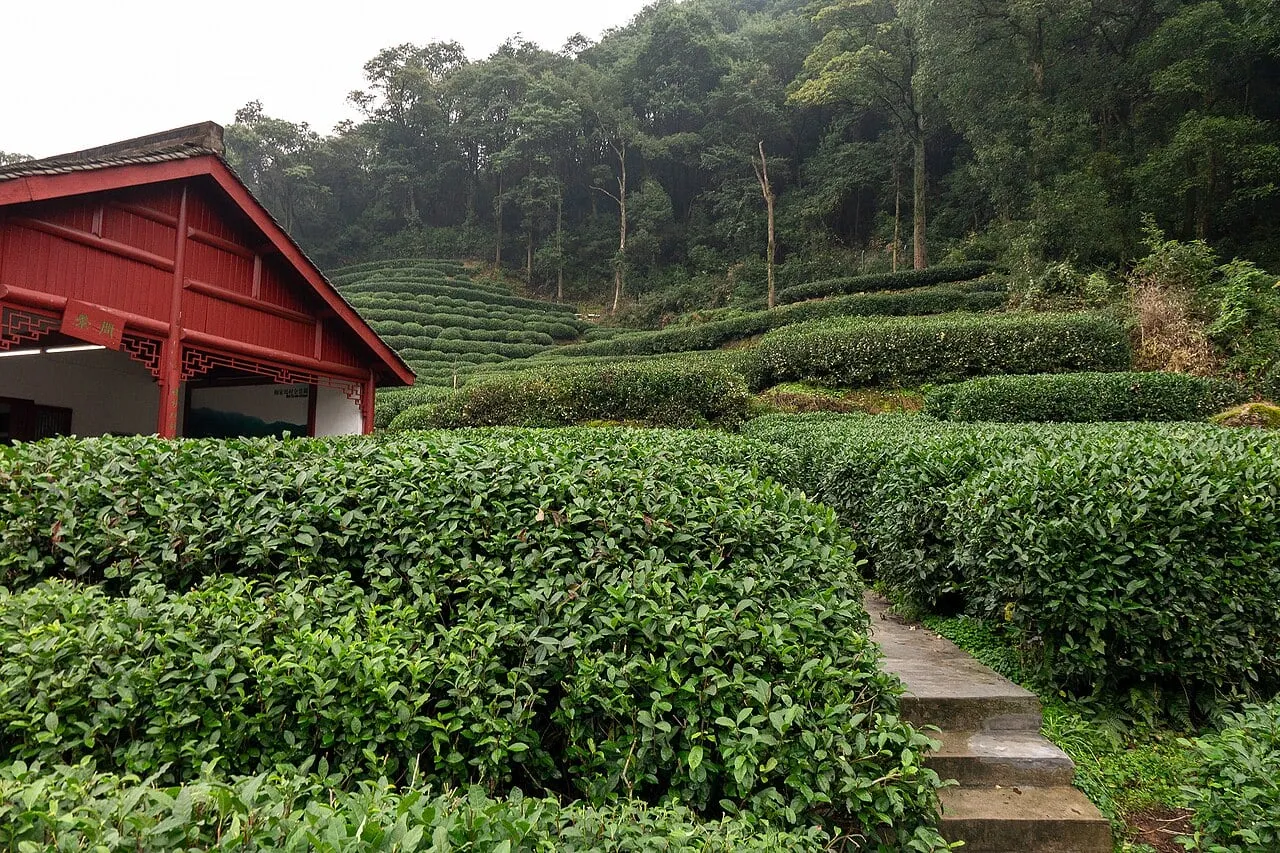
Hand pan-firing of West Lake Longjing is listed as national intangible cultural heritage in China. The traditional rule is to “work the tea as you find it”: pan heat and movements are adjusted to the tenderness and moisture of the leaf and to the day’s weather, so the temperatures and times below are only typical ranges.
Cultivar shapes the finished style. The traditional Longjing population is grown from seed, buds at uneven times and gives a more complex aroma; the widely planted Longjing 43 is a clonal cultivar selected from that population, which buds early and gives uniform shoots. Cultivar, tenderness and harvest season all change the composition of the fresh leaf. Wang and Ruan compared chemical composition with sensory quality in Longjing teas and found a relationship between them, though composition explained only part of the quality differences[4].
For plucking, high-grade West Lake Longjing commonly uses one bud with one just-unfolding leaf. Older leaves are hard to make into a fine shape and a fresh taste; very young shoots give low yields and small finished leaves. Pre-Qingming tea grows slowly and is tender, so it is often treated as premium material, but “pre-Qingming” describes the picking date and does not guarantee better quality.
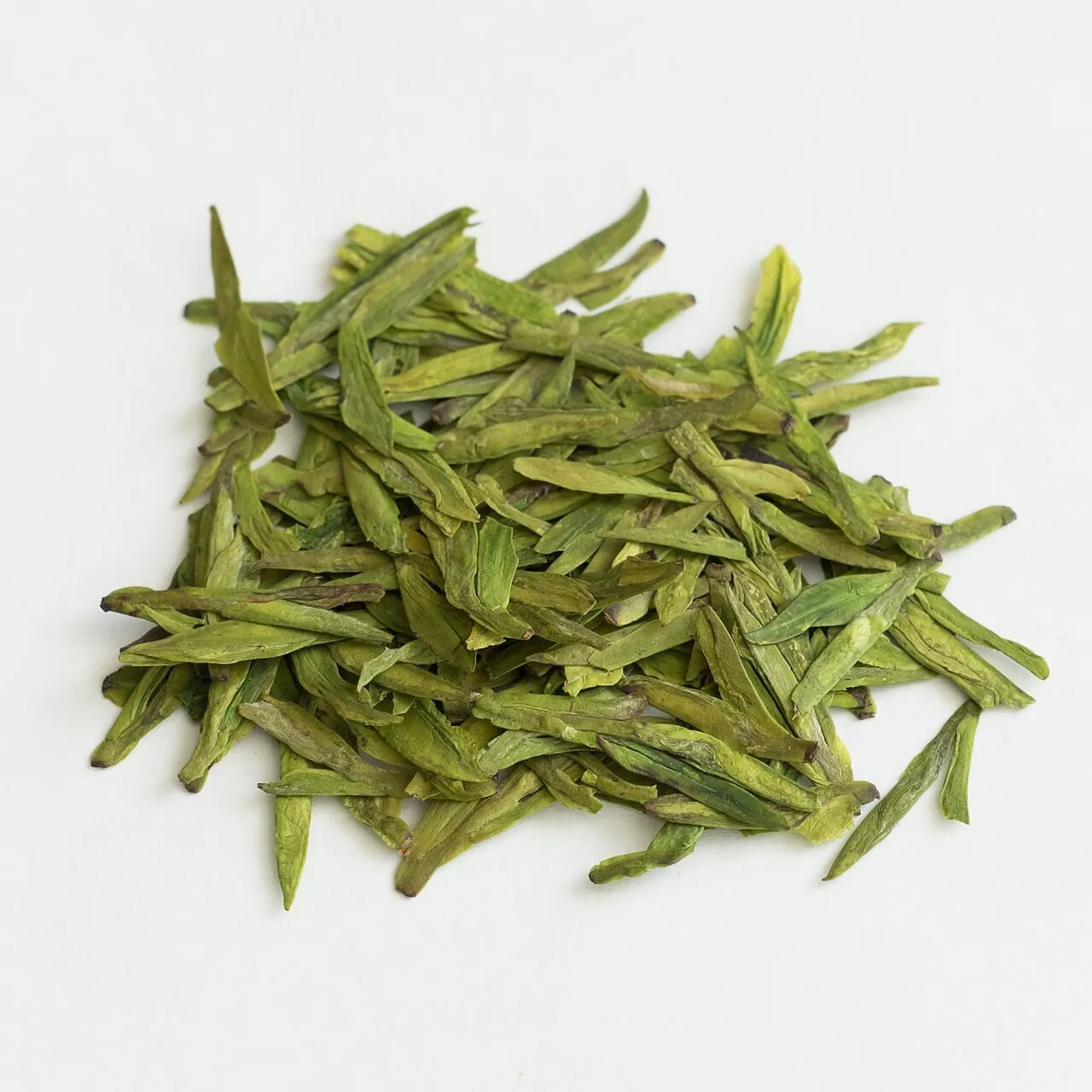
Full processing flow
Traditional West Lake Longjing passes through roughly ten steps[2]:
Of these, spreading, qing guo and hui guo matter most for quality and are covered in detail below. The later steps tidy and protect the tea: larger, longer leaves are fired once more to straighten them, and “resting with lime” is a traditional storage method in which the dry tea is kept in a closed container with quicklime that absorbs the last moisture.
Spreading: let the fresh leaf lose some water
Freshly picked leaves are not fired straight away. They are spread thinly on bamboo trays for a while; a common practice is from a few hours to about half a day, until the leaf turns from crisp to soft, depending on its moisture and the weather.
Spreading does three things:
- Softens the leaf: it bends instead of snapping, which makes shaping easier;
- Lets grassy notes escape: some green-smelling volatiles evaporate;
- Allows some change in composition: enzymes are still working, so some protein can break down into amino acids and sugars also change[7].
Too little spreading leaves strong grassy notes and edges that scorch in the pan; too much gives a weak aroma and yellowing leaves.
Qing guo: fixation and first shaping
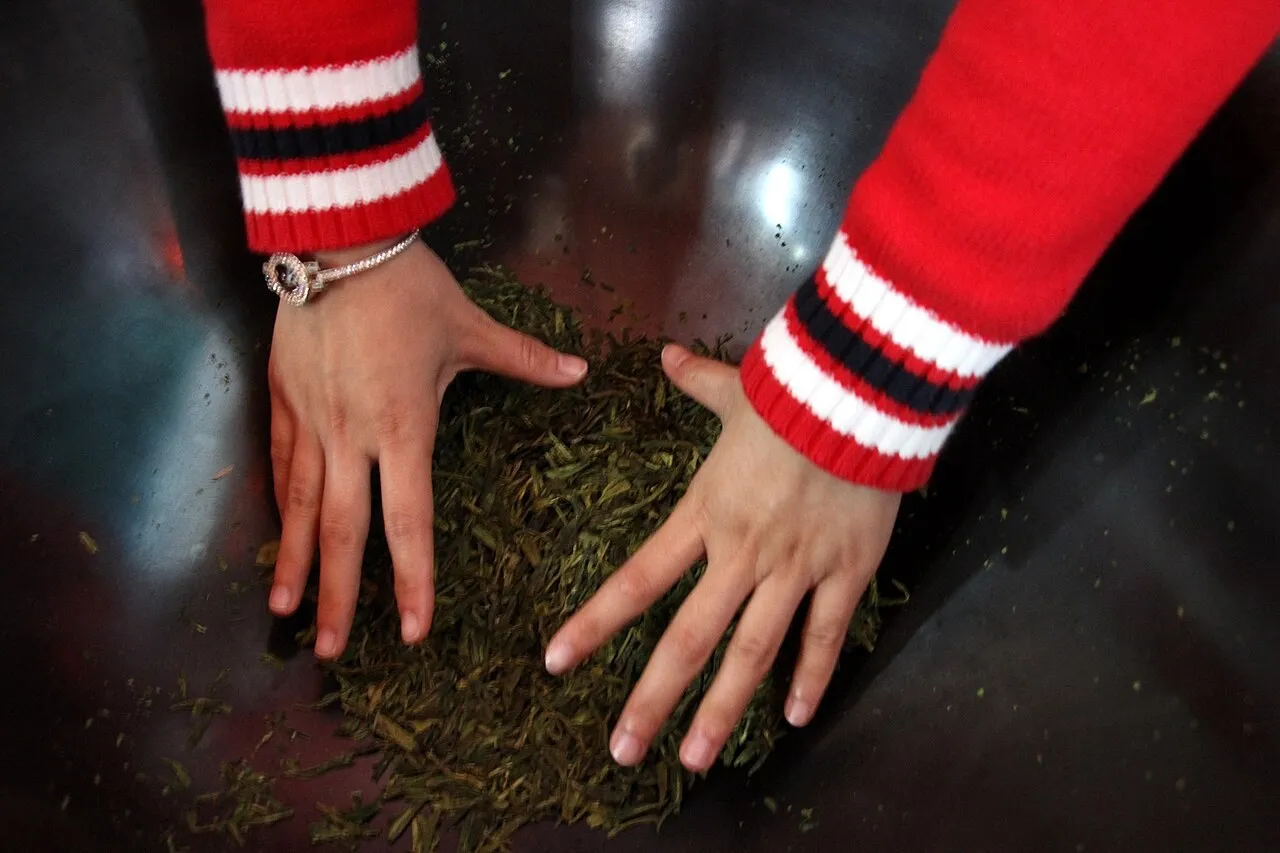
Qing guo is the first firing. In hand work the pan is typically around two hundred degrees Celsius, a batch is a little over a hundred grams of leaf, and firing takes around ten minutes, with the leaf kept moving by grabbing, shaking, laying, pressing and smoothing. Machine temperatures and times vary by model.
In hand firing, the leaves, hands and pan surface come into contact. This scene records pan work at a Hangzhou tea garden; its particular firing stage was not documented.
Compare the two firing stages: qing guo emphasises fixation and first shaping; hui guo emphasises pressing, polishing and final drying. Switch stages to connect each movement with its purpose.
One pan, why two different tasks?
Watch the leaf: tossed first, then pressed.
Toss to vent steam, shape
- Heat passes from the pan into the leaf
- Grab, shake, toss off the metal
- Steam escapes as leaves turn
- Leaves soften and flatten
Hot pan, moving leaf: enzymes stop, then a flat shape begins.
Conditions, techniques & sources
- Pan / room
- Pan around 200 °C
- Duration
- About ten minutes by hand; machines vary
- Leaf state
- Fired to 70–80% dry
Grab, shake, lay, press, smooth: tossing releases steam and begins flattening
Temperatures and times are common hand-firing ranges from the article, not values set by a standard; only the finished-moisture limit comes from the Longjing standard [1]. They are not measured batch data. Makers adjust to cultivar, tenderness, equipment and weather.
Pan temperature is not leaf temperature; the hand shows direction only. Not to time scale.
Heat lowers the activity of polyphenol oxidase (PPO) and peroxidase, so the leaf no longer reddens through enzymatic oxidation and keeps its green-tea colour and style. The two enzymes differ in heat resistance: a study of Turkish green tea found PPO more heat-resistant than peroxidase, with some activity left after steaming until the later drying stage; that result cannot be applied directly to every batch of Longjing[6]. Heat also drives off some grassy volatiles, and Maillard and other heat reactions between sugars and amino acids produce roasted aroma compounds[7].
Pan temperature is not leaf temperature. Leaves take up heat while touching the pan and lose heat and water when tossed; shaking and flicking spread the leaves out and let steam escape so that heating is even. Too much leaf, uneven movement or covering the leaf for too long can leave it under-fixed, scorched at the edges or stewed in smell.
Qing guo ends when the leaf is clearly soft, partly flat and roughly seventy to eighty per cent dry.
Resting: even out the moisture
After qing guo the leaf is dry outside but moist inside. It is spread thinly to cool before hui guo, commonly for up to about an hour. During this time water moves towards the drier parts of the leaf, the leaf softens again, and it breaks less and flattens more evenly in the next firing.
Both involve spreading leaves, but their main tasks differ. The simplified cross section below contrasts outward water loss with internal redistribution.
Water loss or water redistribution?
Follow the blue dots: out of the leaf, or within it?
Water leaves into the air
- Fresh leaves spread thinly on a bamboo tray
- Blue dots: water inside the leaf
- Water leaves through the surface into the air
Losing some water makes brittle leaf pliable before firing.
Conditions, techniques & sources
- Pan / room
- Room temperature
- Duration
- A few hours to half a day (thin layer)
- Leaf state
- Loses some water and softens
Spread thinly on bamboo trays, turned gently, not rolled or pressed
Temperatures and times are common hand-firing ranges from the article, not values set by a standard; only the finished-moisture limit comes from the Longjing standard [1]. They are not measured batch data. Makers adjust to cultivar, tenderness, equipment and weather.
Simplified; blue dots are not measured moisture.
Too short a rest leaves the leaf stiff and hard to flatten; too long makes it soft, sticky in the pan and dull in colour. Makers usually judge it by squeezing a few leaves.
Hui guo: flatten, polish, dry
Hui guo sets the final shape and continues to develop aroma. The pan is much cooler than in qing guo, usually low at first, a little higher in the middle and lower again at the end; the batch is larger and the firing usually lasts longer than qing guo. Machine settings again depend on the equipment.
Grabbing, folding, rubbing, pressing and pushing press the strips against the pan wall again and again until they are flat, smooth and straight. The gentle heat drives out the remaining water slowly. Low heat at the start avoids burnt hands and broken leaves; slightly higher heat in the middle helps fix the shape and develop aroma; lowering it at the end avoids scorching and dull colour. The tea is fired until fully dry and a strip snaps when bent. The Longjing standard sets a maximum moisture of 6.5% for the finished tea[1].
The “parched-rice” colour has no single cause. With heat and acidity, chlorophyll can lose its magnesium and become olive-brown pheophytin; the leaf’s own pigments and other processing changes also affect colour[7]. Some traditional-style Longjing is yellowish green or parched-rice coloured, but colour alone does not prove origin or grade, and an overly yellow, dull leaf should be judged together with aroma, liquor and infused leaf.
The ten hand movements, by hand and by machine
The “ten movements” of hand-fired West Lake Longjing are:
Grab, shake, lay, press, smooth, push, fold, flick, rub and flatten
(Chinese: 抓、抖、搭、拓、捺、推、扣、甩、磨、压)
Different stages favour different movements: qing guo relies more on shaking to release heat and steam and on laying to begin flattening; hui guo relies on rubbing and pressing to fix and polish the shape. The traditional saying is “the hand never leaves the tea, the tea never leaves the pan”: the maker watches the leaf and adjusts heat, pressure and timing throughout.
Machine processing is efficient and gives more consistent batches; hand or combined work allows finer adjustment to the leaf. Cui et al. (2021) compared four methods: fully machine-made, machine first firing then hand finishing, machine first and second firing then hand finishing, and fully handmade. In that trial, machine first firing followed by hand finishing gave aroma and taste comparable to fully handmade tea and better than fully machine-made tea[5]. This shows a combined route can work under the tested conditions; it does not show that all handmade tea beats all machine-made tea. Whatever the method, the essentials are adequate fixation in qing guo and even shaping and full drying in hui guo.
Aroma, taste and colour
Aromas often used to describe Longjing include:
- Fresh, tender notes: the clean smell of young buds;
- Chestnut and bean notes: linked to roasted aroma compounds formed during pan-firing[7], an impression made by many volatiles rather than one compound;
- Floral notes: found in some West Lake Longjing.
Cultivar and season also change the style. Longjing 43 is generally described as clear and high in aroma with uniform leaves, and the population cultivar as more layered but less consistent between batches; pre-Qingming tea is usually described as fresh and delicate and pre-Guyu tea as fuller. These are tasting generalisations; the sample in front of you decides.
Li et al. (2019) found that some glycosidically bound aroma precursors (GBVs) increased at the pan-firing stage of the green tea they studied[3]. More bound precursor does not mean more free aroma: how much is later released depends on enzymes, temperature, water and volatile losses, so the result does not show that all Longjing releases the same aroma when brewed. Amino acids, including theanine, and other taste compounds together affect savouriness, bitterness, astringency and aftertaste, which still need to be judged by actual brewing[4].
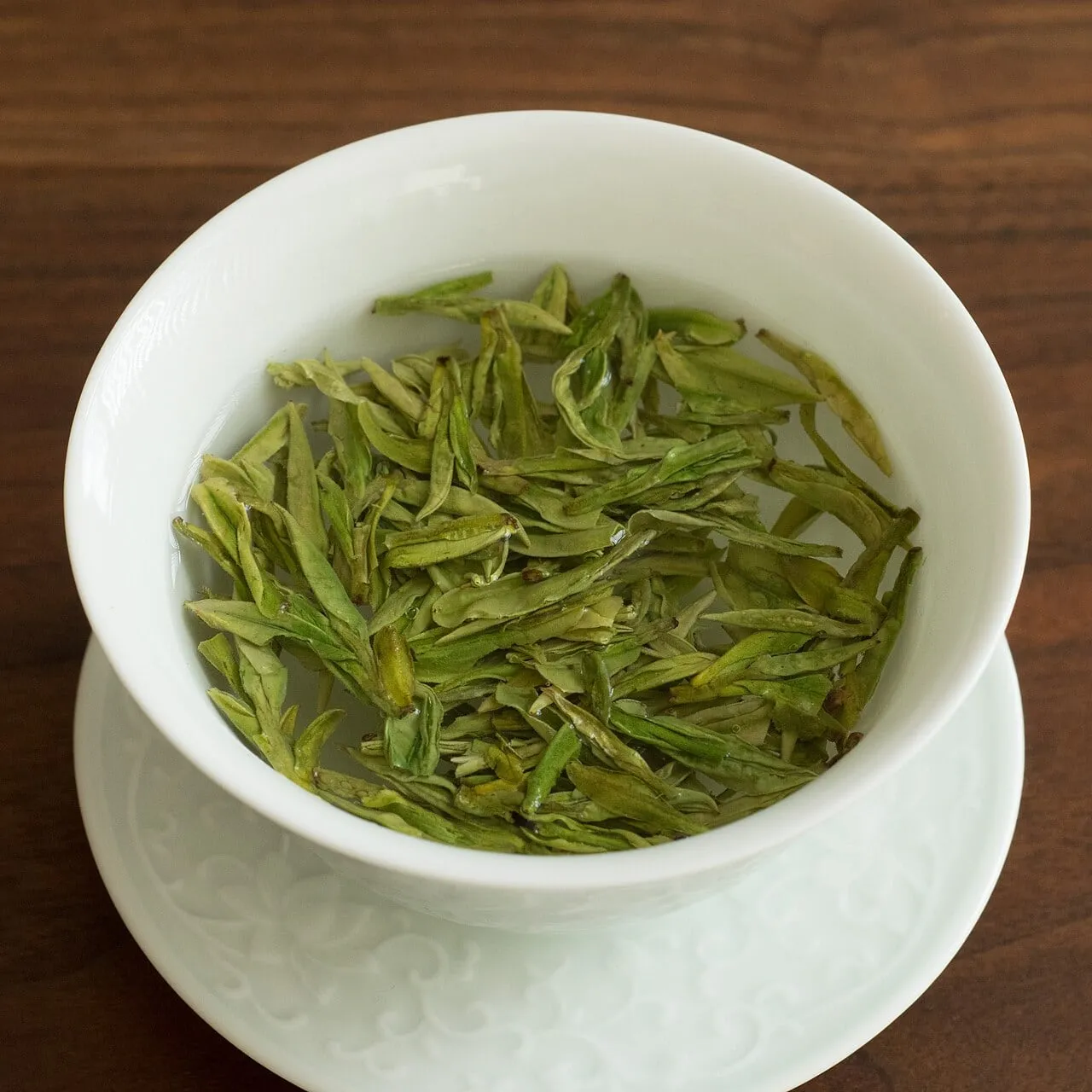
Good dry leaf is even in colour with some sheen, not dead green or mottled. The liquor is usually tender green or pale yellow-green and bright; yellow, dull liquor may come from under-fixation, too hot a hui guo or damp storage.
West Lake Longjing
Green · Flat Pan-FiredThe silhouette is a qualitative illustration, not a measured sensory score; real cups vary by origin, cultivar, grade and season.
Grades, standards and buying
GH/T 1115-2015 divides West Lake Longjing into grades including Premium, Special, Grade 1 and Grade 2[2]. Higher grades call for tender, flat, smooth leaves, a tender green colour, a clear high aroma and a fresh, mellow taste. Tasting panels usually assess appearance, liquor colour, aroma, taste and infused leaf: flatness, colour and evenness; brightness of the liquor; fresh or chestnut aroma and any grassy or stewed notes; whether freshness, sweetness and bitterness are in balance; and the tenderness and colour of the infused leaf[2][4].
When buying, read the name on the pack: “West Lake Longjing” must come from the West Lake zone; “Longjing tea” may come from the Qiantang or Yuezhou zones[1]; a product labelled only “Longjing” may cover a wider range, so check the origin and the standard it claims.
Brewing and storage
Use these common starting points and adjust to taste:
| Parameter | Recommendation |
|---|---|
| Water temperature | 80–85 °C (176–185 °F) |
| Leaf-to-water ratio | 2–3 g / 150 ml |
| Vessel | Clear glass or gaiwan |
| Pouring | Pour gently down the wall, not straight onto the leaves |
| Steeping | 1–2 min; avoid long steeps that turn it yellow |
| Refills | In a glass, leave one-third of the liquor before refilling |
Water that is too hot or a steep that is too long dulls the freshness and brings out bitterness. A glass shows the leaves unfolding; a gaiwan makes temperature and timing easier to control. In a gaiwan you can use more leaf and shorter steeps, for example a first infusion of a dozen or so seconds and slightly longer ones after; in a glass left to steep, use less leaf.
Longjing is best drunk in the year it is made. At home, keep it away from light, damp, heat, air and strong smells: a sealed foil bag is fine for a short time; for longer, refrigerate it and open it as rarely as possible. Let a chilled tin return to room temperature before opening so condensation does not wet the leaves. Even well stored, the fresh aroma fades over time.
Common processing faults and causes
Most Longjing faults start in spreading, qing guo or hui guo:
| Fault | Possible cause | What you notice |
|---|---|---|
| Grassy | Too little spreading; qing guo too cool or short | Raw green aroma and taste |
| Red stems and leaves | Under-fixed qing guo; leaves spread too thick and heating up | Red patches on infused leaf, yellowish liquor |
| Scorched edges | Pan too hot; uneven tossing | Burnt spots, smoky or burnt smell |
| Loose, puffy shape | Hui guo too cool or too short | Poorly flattened, curved leaves |
| Yellowing | Hui guo too hot; packed before fully dry | Dull yellow dry leaf and liquor |
| Dull, stewed aroma | Too much spreading or resting; damp storage | Low, flat aroma with a stale note |
Longjing quality is not decided by one step but by spreading, qing guo and hui guo working together.
Common myths
Myth 1: “The greener the dry Longjing, the better?”
Explanation: Not necessarily. During hui guo some chlorophyll loses its magnesium and the colour shifts towards yellow-green; some traditional-style Longjing is parched-rice coloured for this reason[7]. A very bright green can also come from incomplete fixation or drying. Look for even colour with some sheen and flat, smooth leaves, then a bright liquor and a fresh, mellow taste without rawness, rather than judging by colour alone.
Myth 2: “Can Longjing from Qiantang or Yuezhou be called ‘West Lake Longjing’?”
Explanation: No. GB/T 18650-2008 divides Longjing into the West Lake, Qiantang and Yuezhou zones, and only tea from the West Lake zone may be called “West Lake Longjing”[1]. Longjing from Qiantang and Yuezhou is also protected by the standard, under a different name. Check the zone and the geographical-indication details on the pack.
Myth 3: “Is pre-Qingming tea always better than pre-Guyu tea, and handmade always better than machine-made?”
Explanation: Neither is guaranteed. Pre-Qingming tea is tender and scarce and is often described as fresh and delicate; pre-Guyu shoots are a little larger and tend to give a stronger taste that lasts more infusions. These are differences in style. On processing, a West Lake Longjing trial found that tea fired first by machine and finished by hand matched fully handmade tea in aroma and taste and beat fully machine-made tea[5]. Choose by taste and budget.
Myth 4: “Can Longjing improve with age like Pu-erh or white tea?”
Explanation: Generally not. Longjing is valued for freshness, and the standard limits finished moisture to 6.5%[1]. At room temperature, air, light and damp turn the leaf and liquor yellow and dull, the fresh aroma fades and stale notes appear. Store it sealed, dark and refrigerated, and try to drink it within the year.
Related entries
- The science of green-tea fixation — how enzymes are stopped in Longjing’s qing guo
- China’s six tea categories — where Longjing sits in the bigger picture
- Congou vs. CTC black tea — another representative tea craft deep dive
Process at a glance
| Stage | Typical temperature | Typical time | Leaf state | Main purpose |
|---|---|---|---|---|
| Spreading | Room temperature | A few hours to half a day | Crisp to soft | Lose water, release grassy notes |
| Qing guo | Pan around 200 °C | About ten minutes by hand | 70–80% dry, partly flat | Fixation, first shaping |
| Resting | Room temperature | Up to about an hour | Moisture redistributes | Re-soften for hui guo |
| Hui guo | Pan well below qing guo (low→high→low) | Usually longer than qing guo | Fully dry, moisture ≤ 6.5%[1] | Flatten, polish, dry |
| Refining | — | Hours to days | Stable | Sieve, straighten, blend, rest with lime |
Apart from the finished-moisture limit, these are common ranges for hand firing, not values set by a standard or a measured batch curve. Workshops adjust them to the leaf, weather, equipment and the maker’s experience.
References
- R-066 — GB/T 18650-2008.《地理标志产品 龙井茶》(Product of geographical indication—Longjing tea). 国家质量监督检验检疫总局、国家标准化管理委员会.
- R-067 — GH/T 1115-2015.《西湖龙井茶》(West Lake Longjing tea). 中华全国供销合作总社.
- R-068 — Li, P., Zhu, Y., Lu, M., et al. (2019). Variation patterns in the content of glycosides during green tea manufacturing by a modification-specific metabolomics approach: Enzymatic reaction promoting an increase in the glycosidically bound volatiles at the pan firing stage. Food Chemistry, 279, 80–87. https://doi.org/10.1016/j.foodchem.2018.11.148
- R-069 — Wang, K. B., & Ruan, J. Y. (2009). Analysis of chemical components in green tea in relation with perceived quality, a case study with Longjing teas. International Journal of Food Science & Technology, 44(12), 2476–2484. https://doi.org/10.1111/j.1365-2621.2009.02040.x
- R-070 — 崔宏春, 张建勇, 敖存, 黄海涛, 郑旭霞, 赵芸, 师大亮, 余继忠 (2021). 不同加工工艺西湖龙井茶品质差异特性分析. 食品工业科技, 42(13), 268–273. https://doi.org/10.13386/j.issn1002-0306.2020070165
- R-060 — Öztürk, B., et al. (2016). Change of enzyme activity and quality during the processing of Turkish green tea. LWT-Food Science and Technology, 65, 318–324. https://www.sciencedirect.com/science/article/abs/pii/S0023643815300852
- R-029 — 宛晓春 主编 (2003).《茶叶生物化学》(第3版). 中国农业出版社. ISBN: 978-7109066274.
Article Knowledge Network
Explore the connections between the teas, processes and flavours in this article.