
Start with the essentials
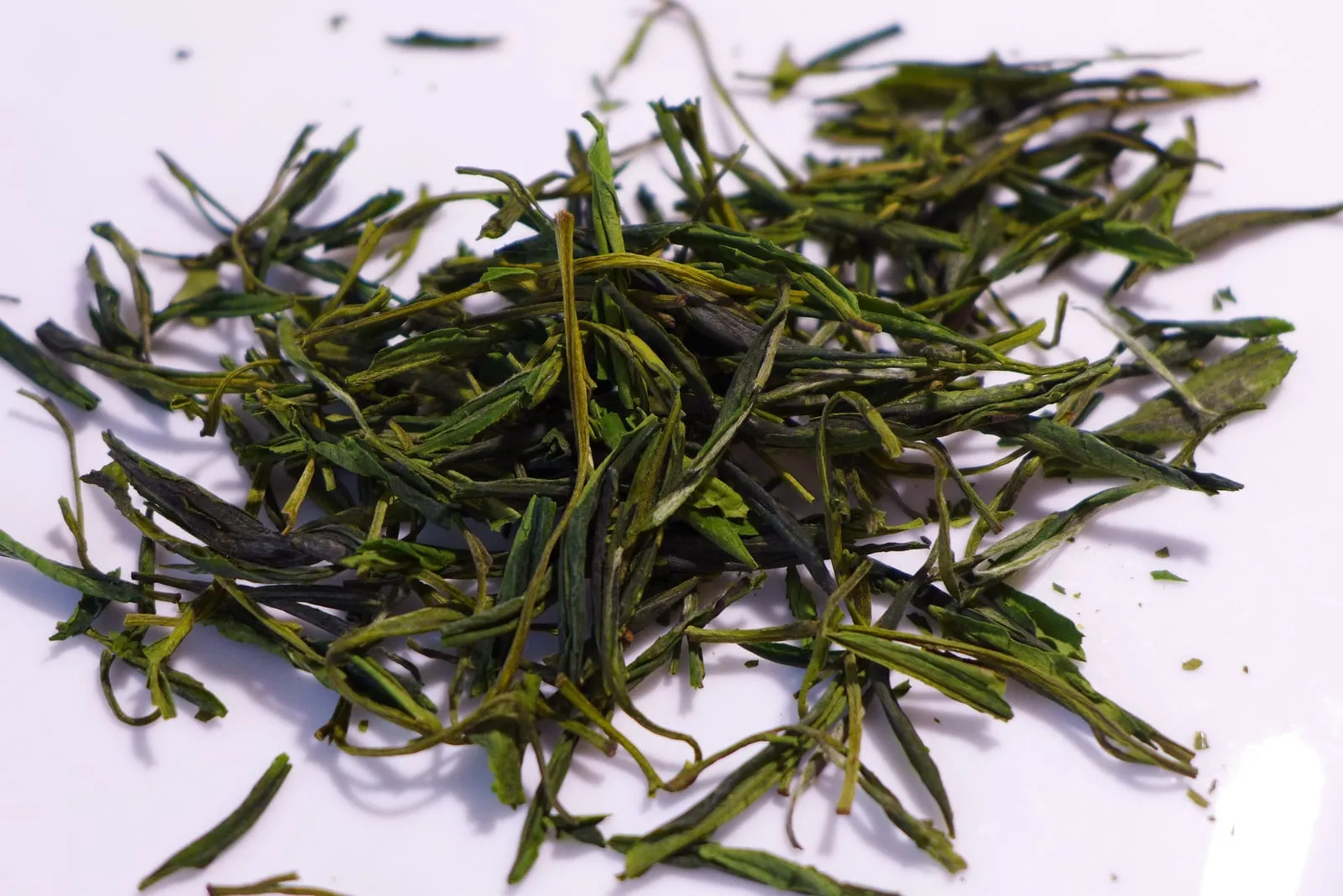
Huangshan Maofeng is a green tea recognised through its bud-and-leaf form, visible down and fresh style. Fixation, gentle rolling and staged baking remove moisture while retaining a relatively intact appearance, rather than forming Longjing-like flat leaves.
This article explains light rolling and the different jobs of initial and final drying, connecting manufacture with appearance, flavour and preparation. It also places hand and machine processing within their practical tasks.
Three key points
- Fixation establishes the green-tea approachHeat controls oxidation and prepares the leaves for later handling.
- Gentle rolling balances structure and formIt changes tissue while retaining recognisable shoots.
- Drying works in stagesInitial and final baking connect moisture removal with aroma development.
What to notice when tasting
Compare Maofeng with a flat green tea before and after infusion. Taste at similar strength and record aroma and texture separately to explore shaping and drying differences.
Origin, cultivar and fresh leaf
Huangshan Maofeng is first of all a place name. China’s GB/T 19460-2008 standard for it as a geographical-indication product limits production to Huangshan City in Anhui Province, including the Yellow Mountain scenic area, Huizhou district, She county and Xiuning county[1]. The area is mountainous and the gardens are often misty, which is the feature local descriptions mention most; the sources cited here do not give measurements linking altitude or mist to leaf composition.
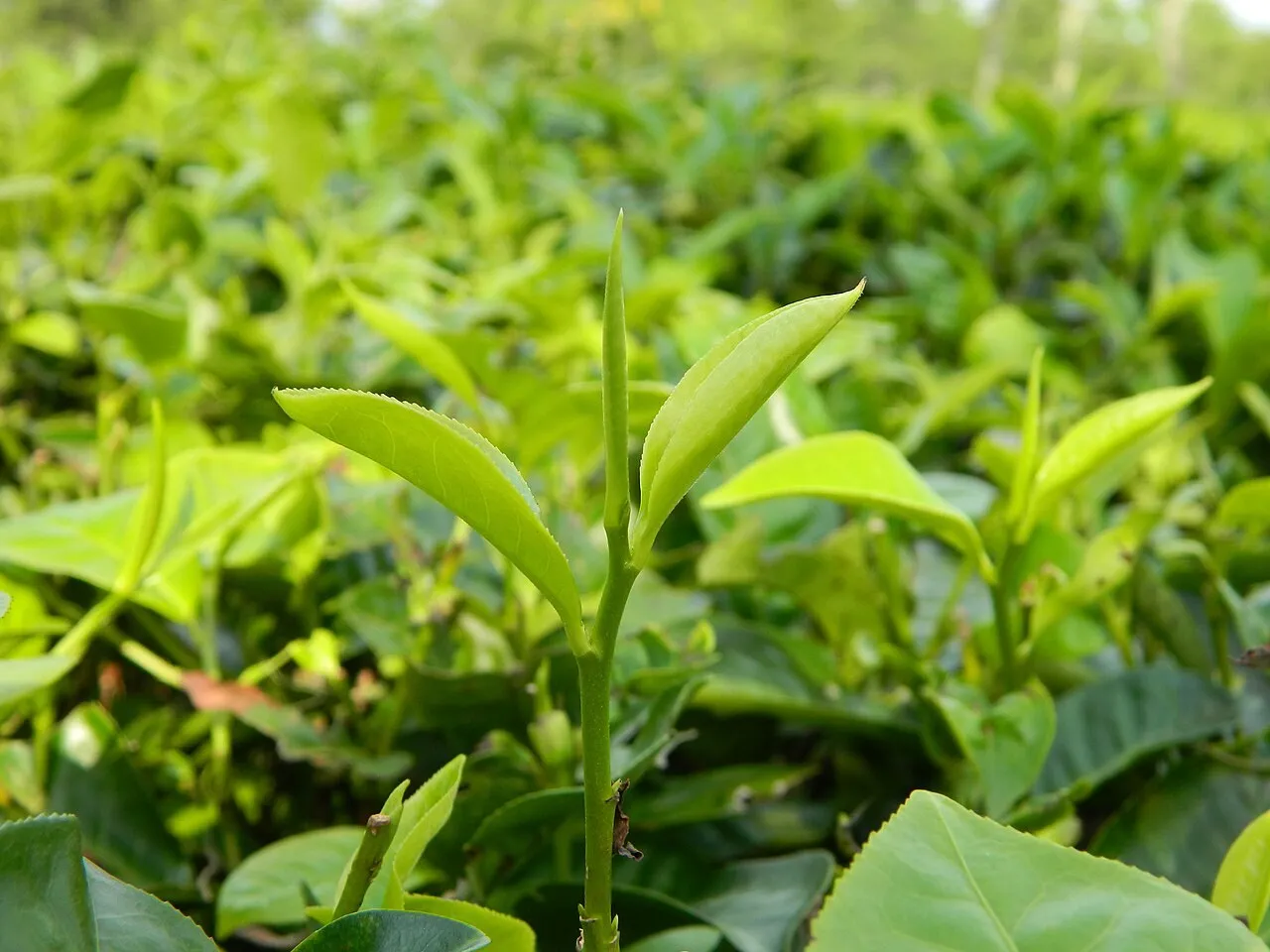
Cultivar and plucking also matter. The traditional Huangshan cultivar (Huangshan zhong) is a seed-grown population with tender, very downy shoots; clonal cultivars such as Longjing 43 are also planted for more even budding and higher yield. High-grade Maofeng is usually picked as one bud with one just-unfolding leaf, with plump buds, visible down and even size.
Full processing flow
Traditional Huangshan Maofeng passes through roughly six steps[1][2]:
Of these, fixation, light rolling, first bake and second bake matter most for quality and are covered in detail below.
Before following the process, distinguish the bud from the leaves on a fresh shoot. This is a general tea-plant example, not confirmed Huangshan Maofeng material.
Fixation: using heat to stop enzymes
Fixation decides whether Maofeng keeps its green-tea colour. The spread leaf goes into a hot pan (or a rotary drum) and is tossed quickly. A common hand practice is a pan of about 150–180 °C, a few hundred grams of leaf per batch and a few minutes of firing; machine temperatures and times vary by model.
Huangshan Maofeng: what does fixation change?
Compare the enzymes in the magnifier.
Before heat: enzymes active
- Raw form: Tender shoot: keep the natural tip
- Magnified: enzymes in the cells are active
- If bruised, polyphenols meet enzymes and darken
This is the starting form, not the finished shape.
Conditions & sources
- Pan temperature
- Room temperature
- Duration
- —
- Leaf load
- A few hundred grams per hand batch
Fixation conditions are the common-practice description from this article’s fixation section, not values set by a standard. Equipment temperature is not leaf temperature.
Leaf and enzyme shapes are schematic; they do not predict residual activity or colour.
Heat lowers the activity of polyphenol oxidase (PPO) and peroxidase, which limits enzymatic oxidation and keeps the leaf green. A study of Turkish green tea found the two enzymes differ in heat resistance, with some activity left after fixation until the later drying stage[3]. Heat also drives off some grassy-smelling compounds.
Fixation ends when the leaf is soft, slightly curled and the grassy smell has clearly faded.
Light rolling: shaping while keeping the bud tip
Maofeng is not pressed flat like Longjing; it keeps the natural “peak” of the bud tip. Rolling is therefore light and short, commonly just a few minutes.
In green-tea making, rolling does three main things[2]:
- Breaks some leaf cells: juice coats the leaf surface, so compounds dissolve more easily when brewed;
- Begins to tighten the strip: preparing the shape for baking;
- Changes the leaf structure: with cells broken, leaf contents meet enzymes more, which also changes what happens during baking.
Rolling too hard breaks the bud tips and rubs off the down, so the dry tea loses its “peak”; rolling too little leaves loose strips and a thin taste.
First bake (mao huo): fast drying to set the shape
Rolled leaves go to the baker promptly. The first bake, mao huo, traditionally uses a charcoal baking basket, and today also machine dryers. A common practice is a fairly hot fire (about 90–120 °C), a thin layer of leaf and a bake of a little over ten minutes.
Fast mao huo, slow zu huo
Compare fire, layer and what rises.
Strong fire, thin layer
- Strong charcoal heat rises to the screen
- Leaves spread in a thin layer
- Steam leaves fast, so the leaf does not stew yellow
- Light turning keeps heating even
Sets the shape fast; cooling afterwards lets moisture even out inside the leaf.
Conditions & sources
- Bake temperature
- About 90–120 °C
- Layer depth
- Thin
- Duration
- A little over ten minutes
- Leaf state
- About 70–80% dry
Baking values are the common-practice ranges given in this article, not values set by a standard; the product grades come from GB/T 19460-2008 [1].
Temperatures and times are common-practice ranges; charcoal must be even and smokeless, and layer depth and timing vary by batch.
The diagram above compares the two bakes. Switch stages to compare the fire, the depth of the leaf layer, and whether steam or aroma rises from the screen.
Mao huo does three things:
- Removes most of the water quickly: so the leaf does not stew and turn yellow in damp heat;
- Sets the shape: the rolled strip holds its form and the bud tip begins to show its “peak”;
- Drives off more grassiness: a baked aroma begins to appear.
After mao huo the leaf is roughly seventy to eighty per cent dry. It is spread to cool for a while (commonly about half an hour) so moisture evens out inside the leaf and the next bake does not leave it dry outside and moist inside.
Second bake (zu huo): slow baking until fully dry
Zu huo dries the tea fully and settles its aroma. A common practice is to lower the fire to about 60–80 °C, use a thicker layer than in mao huo and bake for longer.
Where mao huo is fast, zu huo is slow: gentle heat removes the last water evenly without scorching the surface. At the end the dry leaf crumbles when rubbed, the colour is a glossy green and the down is visible. GB/T 19460-2008 sets moisture and other physical and chemical limits for the finished tea[1].
Glycosidically bound volatiles (GBVs) are aroma compounds attached to sugars, which do not smell in that form. Li et al. (2019) found that some of these precursors increased at the pan-firing stage of the green tea they studied[4]. More bound precursor does not mean more free aroma, and the study was not about Maofeng baking, so it cannot show which step produces a particular Maofeng aroma.
By hand and by machine
Traditional Huangshan Maofeng values hand fixation and charcoal baking. In hand fixation the maker judges by touch how soft and dry the leaf is; charcoal gives a gentler fire that needs constant watching and turning.
Machine processing is efficient and gives more consistent batches, with rotary drums for fixation and chain dryers or ovens for baking, suited to large volumes. High-grade Maofeng is still often made by hand or with hand fixation and charcoal baking, mainly because judging the fire and protecting the bud tips during slow baking is hard to hand over to a machine entirely. This article has no comparative study to cite on whether hand- or machine-made Maofeng is better.
Aroma and taste
Aromas often used to describe Huangshan Maofeng include:
- Orchid-like: the floral note tasters often name in high-grade Maofeng;
- Tender chestnut: a soft baked note;
- Fresh green: the clean smell of early-spring buds.
These are sensory descriptions; each comes from a mix of many volatiles and does not map to one compound or one processing step. In the cup, Maofeng is usually described as fresh and mellow, with little bitterness.
Huangshan Maofeng
Green · Baked Green TeaThe silhouette is relative; real cups vary by origin, cultivar, grade and season.
Grades and brewing
GB/T 19460-2008 divides Huangshan Maofeng into Special, Grade 1, Grade 2 and Grade 3 (the Special grade has further sub-grades; consult the standard text for details)[1]. Special grade calls for tender shoots with upright tips and visible down, a tender green colour, a clear, lasting aroma and a fresh, mellow taste with returning sweetness.
Use these common starting points:
| Parameter | Recommendation |
|---|---|
| Water temperature | 80–85 °C (176–185 °F) |
| Leaf-to-water ratio | 3 g / 150 ml |
| Vessel | Clear glass or white porcelain gaiwan |
| Pouring | Pour gently down the wall, not straight onto the leaves |
| Steeping | 1.5–2 min; avoid long steeps that turn it yellow |
| Refills | In a glass, leave one-third of the liquor before refilling |
Water that is too hot or a steep that is too long dulls the freshness and weakens the floral note.
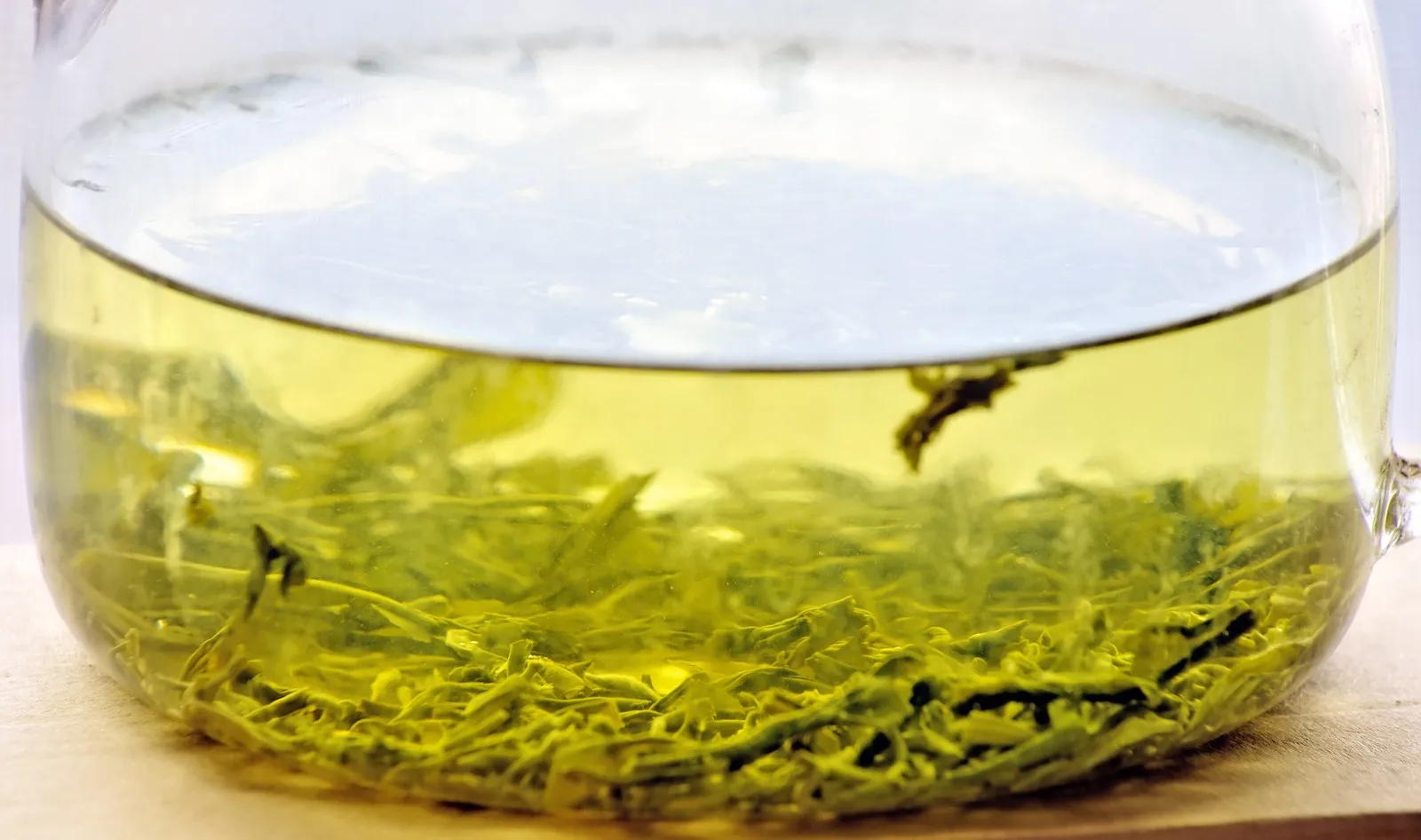
Infused leaves can be observed as they open in water. This is a Maofeng sample documented by the photographer; its growing origin and brewing conditions were not specified.
Brewing Maofeng in a glass
Pour gently, then watch the shoots unfurl.
Pour down the wall, not on buds
- Water at 80–85 °C
- Pour along the glass wall instead of straight onto the buds
- About 3 g of tea per 150 mL
Gentle pouring keeps it fresh; long, hot steeps dull the floral note.
Brewing parameters
- Water
- 80–85 °C
- Ratio
- 3 g / 150 mL
- Steep
- 1.5–2 min
- Vessel & refill
- Clear glass or white porcelain gaiwan
Brewing values follow the article’s brewing table and are starting points, not a fixed recipe.
Liquor colour and leaf position are schematic, not a colour standard.
Common myths
Myth 1: “The greener the dry Maofeng, the better, and yellowish leaves are a defect?”
Explanation: Not necessarily. GB/T 19460-2008 describes Maofeng colour as including a yellowish-green, downy appearance (consult the standard for its exact wording)[1]. Traditionally, special-grade Maofeng often carries a small yellowish first leaf at the base of the shoot, called the “golden flake”. Some chlorophyll also changes during baking, shifting the colour towards yellow-green. Bright green alone does not show quality; look at shape, aroma and taste as well.
Myth 2: “Is the fine white fuzz floating on the liquor dust?”
Explanation: No. It is the down (fine hairs) on young buds, which washes into the liquor when brewed and can make the surface look slightly hazy. Plenty of down usually means tender material, but how much ends up in the cup also depends on rolling and brewing, so it is not a grade test on its own.
Myth 3: “Is baked green tea naturally weaker than pan-fired green tea?”
Explanation: It is a difference in style, not in rank. Pan-fired teas such as Longjing are dried in a hot pan and often have a clear roasted note; baked teas such as Maofeng are dried mainly in baskets or dryers and are often described as cleaner and softer in aroma. Each has its admirers; choose by taste.
Related entries
- The science of green-tea fixation — how enzymes are stopped in Maofeng’s fixation
- China’s six tea categories — where Maofeng sits in the bigger picture
- The Craft of Longjing — a pan-fired green tea for contrast with Maofeng’s baked style
Process at a glance
| Stage | Typical temperature | Typical time | Leaf state | Main purpose |
|---|---|---|---|---|
| Spreading | Room temperature | A few hours | Crisp to soft | Lose water, release grassy notes |
| Fixation | Pan about 150–180 °C | A few minutes by hand | Soft, slightly curled | Stop enzymes, keep green |
| Light rolling | Room temperature | A few minutes | Slightly curled | Shape, break some cells |
| First bake (mao huo) | About 90–120 °C, thin layer | A little over ten minutes | 70–80% dry | Fast drying, set shape |
| Cooling | Room temperature | About half an hour | Moisture redistributes | Avoid dry outside, moist inside |
| Second bake (zu huo) | About 60–80 °C, thicker layer | Longer than mao huo | Fully dry, crumbles | Slow drying, settle aroma |
| Refining | — | Hours to days | Stable | Sorting, grading, resting with lime |
These are rough common-practice ranges, not values set by a standard or a measured batch curve; workshops adjust them to the leaf, weather, equipment and the maker’s experience.
References
- R-096 — GB/T 19460-2008.《地理标志产品 黄山毛峰茶》(Product of geographical indication—Huangshan Maofeng tea). 国家质量监督检验检疫总局、国家标准化管理委员会.
- R-031 — 施兆鹏, 夏涛 主编 (2016).《茶叶加工学》(第3版). 中国农业出版社. ISBN: 978-7109214347.
- R-060 — Öztürk, B., et al. (2016). Change of enzyme activity and quality during the processing of Turkish green tea. LWT-Food Science and Technology, 65, 318–324. https://www.sciencedirect.com/science/article/abs/pii/S0023643815300852
- R-068 — Li, P., Zhu, Y., Lu, M., et al. (2019). Variation patterns in the content of glycosides during green tea manufacturing by a modification-specific metabolomics approach: Enzymatic reaction promoting an increase in the glycosidically bound volatiles at the pan firing stage. Food Chemistry, 279, 80–87. https://doi.org/10.1016/j.foodchem.2018.11.148
Article Knowledge Network
Explore the connections between the teas, processes and flavours in this article.