
Start with the essentials
Liu’an Guapian primarily uses individual leaves, offering a concrete reason to question whether greater tenderness always means better tea. Removing buds and stems, pan shaping and repeated baking work together around that material.
This article follows leaf sorting, pan work and the successive firing stages, including the distinctive final firing. It connects repeated handling with aroma, taste, grading and preparation within Guapian’s own manufacturing logic.
Three key points
- Leaf selection defines the productIt calls for a different frame from bud-focused tea.
- Pan work and baking have distinct tasksOxidation control and shaping lead into staged drying and flavour formation.
- Final firing reveals the craftIntensity and rhythm must suit material and avoid excessive heat defects.
What to notice when tasting
Compare infused Guapian leaves with a bud tea, then consider aroma and texture. Ask how the selected material suits its product rather than using bud count as a universal measure.
What makes this tea special
Origin and terroir
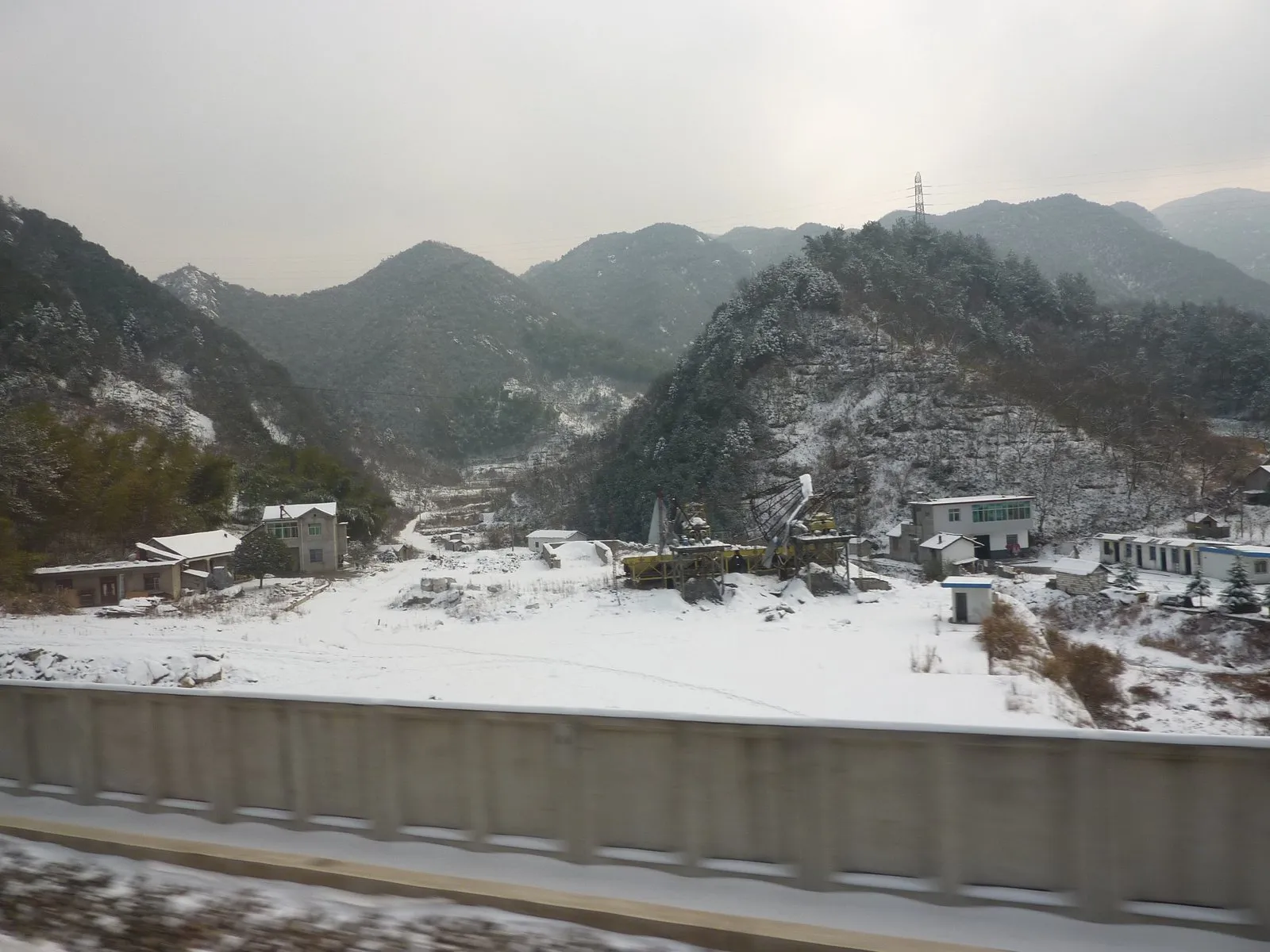
Lu’an Guapian is produced in the Dabie Mountains of Lu’an City, Anhui Province, with core areas in Jinzhai County, Huoshan County and Yu’an District. Under GH/T 1242-2019, the protected geographical indication is limited to specific mountain areas at 300–800 m elevation[1].
The Dabie Mountains are shrouded in mist, with large day-night temperature swings and yellow-brown forest soils rich in organic matter. The slow growth this encourages produces thick, substance-rich leaves — the foundation of Guapian’s famously full-bodied taste. Core micro-terroirs center around Qi Shan (Qitoushan) and Xianghongdian in Jinzhai County, alongside Huangshixi in Yu’an District. Planted across steep slopes and mist-filled valleys at 400–800 meters, dense canopy cover and high humidity nurture succulent mesophyll tissue with soft, pliable cuticles.
Cultivar and plucking standard
Traditional Guapian uses the Lu’an Guapian population cultivar, a small-to-medium-leaf tea with oval, thick leaves. Modern plantings also use clonal varieties such as Lu’an Guapian No.1 for more uniform flushing and higher yield.
The plucking standard is unique: no buds, no stems — only the second and third leaves of an opened shoot (“open-face” plucking). Harvesting usually falls between Qingming and Guyu, with leaves chosen to be tender yet mature enough to carry sufficient extractables[2].
Historical background
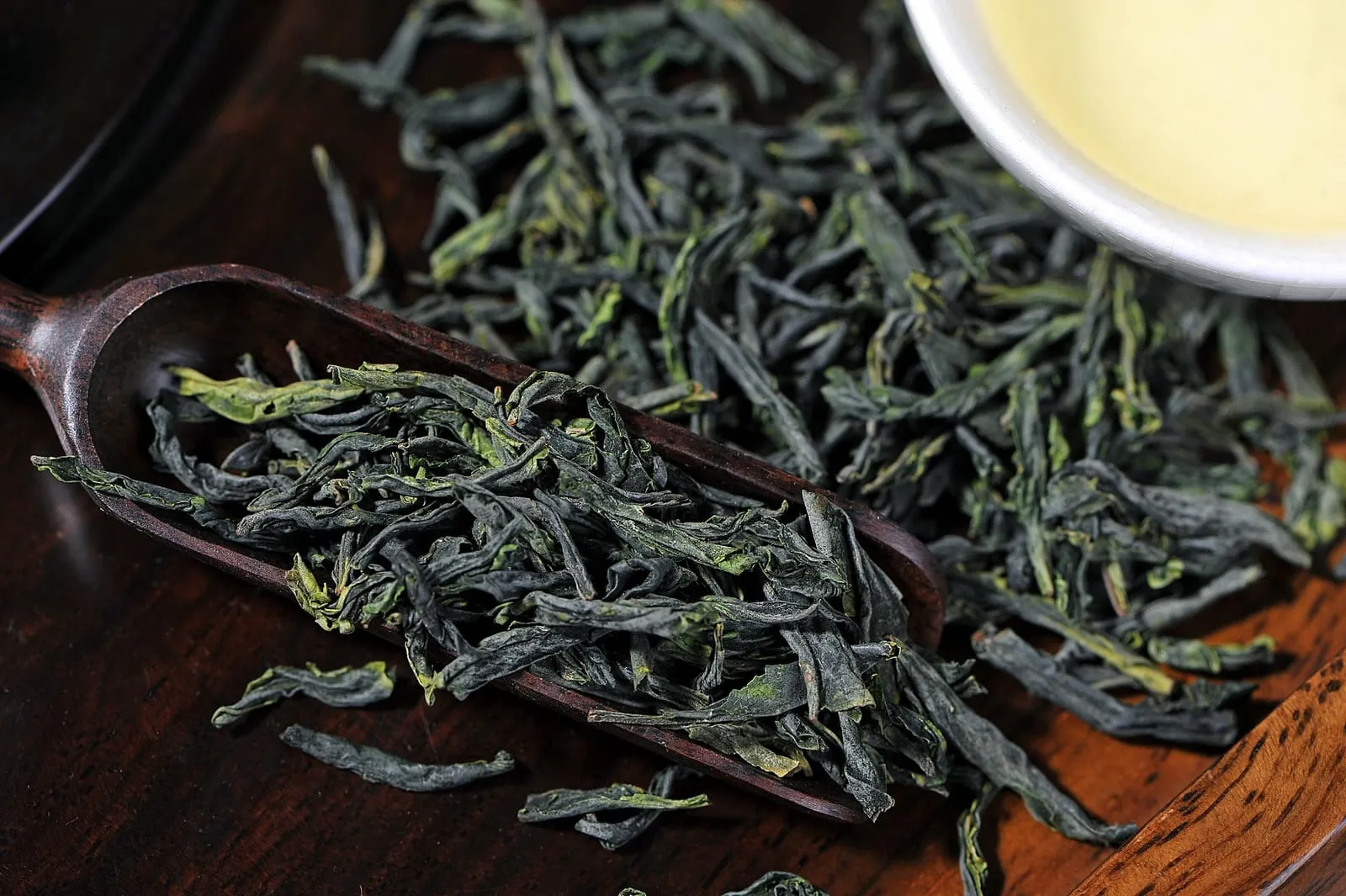
Lu’an tea has a long history; Lu Yu’s The Classic of Tea (Tang Dynasty) already lists tea from Shouzhou, the prefecture that then covered today’s Lu’an; the name “Luzhou Lu’an” appears in tea books from the Ming dynasty onward. The name “Guapian” (melon seed) comes from the finished leaf’s resemblance to pumpkin or sunflower seeds. It was a tribute tea in the Qing Dynasty, and the modern Guapian craft was refined around 1905 by Lu’an tea farmers who adapted the older “Lv Da Cha” process, gradually developing the distinctive bud-free, stem-free, single-leaf method[3].
Full processing flow
Traditional Guapian processing comprises eleven steps[2]:
Of these, ban pian, sheng guo, shou guo, mao huo and la lao huo are the most quality-critical and are expanded below.
Ban pian: the obsession with purity
Ban pian is the first step that sets Guapian apart from every other green tea. Fresh shoots are held in the palm and, with thumb and forefinger, each leaf is plucked from the stem while the bud is removed. One fresh shoot is thus deconstructed into three parts:
Which part becomes Guapian?
See why Guapian uses single leaves.
One shoot: bud, leaves and stem
- The bud at the tip
- Tender second and third leaves
- The stem
- Thumb and index snap each leaf off
Each leaf is judged for tenderness and thickness before it is kept.
Hand sorting in practice
- Method
- Snapped leaf by leaf; bud, leaf and stem separated
- Output
- About 2–3 kg of fresh leaf per person per day
- Selection
- Strict: second and third leaves only
- Effect
- High purity: no bud grassiness, no stem astringency
Machine-assisted sorting can exceed 10 kg a day but is less strict, with occasional bud or stem residue.
Schematic; speed and colour are not measurements.
About this diagram & its limits
Lu'an Guapian Ban Pian and La Lao Huo illustration · Illustrates single-leaf sorting (discarding bud and stem) and two-craftsman charcoal high-heat tossing to develop frost sheen; tossing tempo adapts to leaf dryness and frost formation.
- Bud: set aside for other teas or by-products;
- Tender stem: too coarse, discarded;
- Single leaf: the only part used for Guapian.
Ban pian looks simple but tests eyesight and touch. Overly young leaves lack substance and yield thin taste; over-mature leaves are fibrous and produce flat aroma. Experienced tea makers can judge a leaf’s age, thickness and suitability in seconds.
| Parameter | Traditional hand ban pian | Modern simplified process |
|---|---|---|
| Method | Leaf-by-leaf hand separation | Partly machine-assisted sorting |
| Throughput | ~2–3 kg fresh leaf per person per day | >10 kg with machine aid |
| Selection standard | Strict: only 2nd/3rd leaf single pieces | Relaxed; occasional bud/stem residue |
| Quality impact | High purity, no bud grassiness or stem astringency | Occasional off-notes, lower grade |
Hand ban pian is slow but remains the core competitive edge of premium Guapian. The effective elimination of high bud grassiness and coarse stem astringency is a key craft foundation of the tea’s pure “clear fire aroma.”
Sheng guo: high-heat fixation and first shaping
After ban pian, the single leaves must enter the pan immediately. Sheng guo is Guapian’s fixation step, with pan temperatures reaching 180–220 °C, similar to Longjing’s qing guo[2].
Lu’an Guapian: what does fixation change?
Compare the enzymes in the magnifier.
Before heat: enzymes active
- Raw form: A single leaf, bud and stem removed
- Magnified: enzymes in the cells are active
- If bruised, polyphenols meet enzymes and darken
This is the starting form, not the finished shape.
Conditions & sources
- Pan temperature
- Room temperature
- Duration
- —
- Leaf load
- Single leaves after sorting
Fixation conditions follow this article’s fixation section [4]. Equipment temperature is not leaf temperature.
Leaf and enzyme shapes are schematic; they do not predict residual activity or colour.
Key operating points:
- High-heat fast kill: leaves are tossed into the hot pan and rapidly stirred with a bamboo or palm-fibre brush;
- Toss to prevent scorching: frequent tossing prevents leaves sticking to the pan or yellowing;
- Initial shaping: the leaves soften quickly under heat and are partially flattened by the stirring motion.
Sheng guo lasts 2–3 minutes with a leaf load of about 250–300 g. Moisture drops from ~75% to 35–45%, colour turns dark green, and the leaf becomes pliable with much of the grassy note gone.
At high temperature, polyphenol oxidase (PPO) and peroxidase are rapidly deactivated, oxidation is halted and the green colour is preserved. Meanwhile, low-boiling grassy volatiles evaporate and some Maillard reaction begins, generating pyrazines and other roasted-savoury aroma precursors[4].
| Parameter | Hand sheng guo | Machine sheng guo |
|---|---|---|
| Pan temperature | 180–220 °C | 180–200 °C |
| Leaf load | 250–300 g | machine-dependent |
| Time | 2–3 min | 1.5–2 min |
| Final moisture | 35–45% | 35–45% |
| Key movements | Bamboo brush fast stir, toss | Mechanical tossing |
Shou guo: low-heat shaping and pressing flat
After sheng guo, the leaves move to shou guo. Pan temperature drops to 80–100 °C; the focus is on shaping and pressing flat, lasting 5–7 minutes[2].
Core movements:
- Lay: leaves are lightly laid against the pan wall to soften further;
- Press: palm or brush gently presses the leaf to flatten it;
- Push: leaves are pushed along the pan wall for even heating and consistent shape.
At the end of shou guo, moisture falls to 20–30%, the leaf takes on a preliminary melon-seed shape with slightly curled edges, and the colour shifts to lustrous jade-green.
| Parameter | Hand shou guo | Machine shou guo |
|---|---|---|
| Pan temperature | 80–100 °C | 90–110 °C |
| Time | 5–7 min | 3–5 min |
| Final moisture | 20–30% | 20–30% |
| Key movements | Lay, press, push — shaping and flattening | Mechanical pressing and friction |
Mao huo and xiao huo: gradual moisture removal
After shou guo, the leaves undergo two baking stages to progressively reduce moisture.
Mao huo (first firing):
- Temperature: 100–120 °C
- Time: 10–15 minutes
- Moisture: 20–30% → 10–15%
- Purpose: rapid moisture removal, shape stabilisation, preventing off-flavours
Xiao huo (re-firing):
- Temperature: 80–100 °C
- Time: 15–20 minutes
- Moisture: 10–15% → 7–8%
- Purpose: further drying, preparing for la lao huo
Both stages use charcoal-heated drying baskets, with frequent turning to ensure even heat. After mao huo, leaves are sorted to remove yellow, old and broken pieces for uniformity.
La lao huo: the art of fire
La lao huo is Guapian’s most distinctive and recognisable step, and the source of its “clear fire aroma” and frosted appearance. Such a step is rare among green teas.
La lao huo: heating in short visits
Three steps; heating and turning alternate.
Brief heating over charcoal
- Charcoal: basket at 160–200 °C
- Close to the heat only briefly
- Heat passes through into the leaves
Short heating, then off: the leaves never sit over the fire for long.
Key parameters & sources
- Basket temperature
- 160–200 °C
- Load
- 2–3 kg per basket
- Turns
- 80–100
- Duration
- 30–40 min
- Moisture
- 7–8% → 5–6%
- Charcoal
- Smokeless, even heat
Values follow this article’s la lao huo section [4]. Equipment temperature is not leaf temperature.
Schematic; speed and colour are not measurements.
About this diagram & its limits
Lu'an Guapian Ban Pian and La Lao Huo illustration · Illustrates single-leaf sorting (discarding bud and stem) and two-craftsman charcoal high-heat tossing to develop frost sheen; tossing tempo adapts to leaf dryness and frost formation.
Method
La lao huo uses large, specially made drying baskets 1.2–1.5 m in diameter, fuelled by quality charcoal. Basket temperature reaches 160–200 °C, with 2–3 kg of leaf per basket[2].
Traditionally two tea makers carry the basket between them, hold it over the charcoal for two or three seconds, lift it away to turn the leaves, and swing it back over the fire for even heat exposure. This is repeated 80–100 times per basket over 30–40 minutes.
Key parameters
| Parameter | Range |
|---|---|
| Basket temperature | 160–200 °C |
| Leaf load | 2–3 kg per basket |
| Tossing cycles | 80–100 times |
| Time | 30–40 min |
| Moisture change | 7–8% → 5–6% |
| Charcoal requirement | Smoke-free, even heat |
Biochemical changes
La lao huo’s temperature far exceeds that of most green tea drying. At this heat:
- Maillard and caramelisation reactions accelerate: sugars and amino acids react to form pyrazines, pyrroles, furans and other roasted aroma compounds, creating Guapian’s characteristic “fire aroma” or “clear fire aroma”[4];
- Partial chlorophyll degradation: the jade-green colour is further stabilised, with slight yellowing at the edges;
- Rapid moisture loss: the leaf surface forms fine wrinkles from quick dehydration, creating a visual “frosted” look;
- Aroma sharpening: low-boiling grassy notes are substantially driven off, while higher-boiling aromatics (linalool, geraniol, etc.) are retained and concentrated.
The key to la lao huo is “high heat, short exposure, repeated tossing.” Insufficient heat leaves the aroma flat; excessive heat or uneven tossing scorches the edges and over-dries the leaf. Master tea makers judge the fire by touch and smell, finding the balance between charcoal and leaf.
Hand vs. machine
| Aspect | Traditional hand craft | Modern machine process |
|---|---|---|
| Ban pian | Leaf-by-leaf, high purity | Machine-assisted; occasional bud/stem residue |
| Sheng guo | Bamboo brush, flexible temperature control | Drum fixation, high efficiency |
| Shou guo | Hand shaping, precise pressing | Mechanical pressing, good uniformity |
| La lao huo | Bamboo basket tossing, nuanced fire control | Some use electric baskets, temperature controllable |
| Efficiency | Low: a few kg of finished tea per day | High: suited to bulk production |
| Quality profile | High aroma, mellow body, fully penetrated fire | Uniform appearance, stable quality, slightly lighter fire |
Premium Lu’an Guapian still markets “hand ban pian + hand la lao huo” as its core value. Machine Guapian wins on shape uniformity, but the “dialogue with fire” during la lao huo — the tea maker’s instant response to subtle charcoal changes — remains difficult to fully automate.
Flavour and quality formation
Lu’an Guapian’s typical aroma spectrum includes:
- Clear fire aroma / fire craft aroma: the product of high-heat charcoal baking, a composite of roasted nuts and caramel, and Guapian’s most signature note;
- Fresh / tender notes: the clean, youthful base of early spring single leaves;
- Floral notes: occasionally found in high-grade Guapian, linked to terpenes such as linalool.
In taste, Guapian is celebrated for its “rich mellow” character. With buds and stems removed, the single leaf’s polyphenols and amino acids are in harmonious proportion, giving a thick, full entry without bitterness, and a long sweet aftertaste.
Lu'an Guapian
Green · Single-Leaf High-Fire BakedThe silhouette is relative; real cups vary by origin, cultivar, grade and season.
Grades and brewing
Under GH/T 1242-2019, Lu’an Guapian is divided into four grades: Special, Grade 1, Grade 2 and Grade 3[1]. Special grade requires:
- Appearance: melon-seed shape, flat and even, lustrous jade-green with frost;
- Aroma: clear and high, with pronounced fire aroma;
- Taste: rich mellow, sweet aftertaste;
- Liquor: bright green and clear;
- Infused leaf: tender green and even.
Brewing guide:
| Parameter | Recommendation |
|---|---|
| Water temperature | 85–90 °C (185–194 °F) |
| Leaf-to-water ratio | 3 g / 150 ml |
| Vessel | Tall glass or gaiwan |
| Pouring | Pour gently down the wall |
| Steeping | 1.5–2 min; avoid over-steeping |
| Refills | Leave one-third of the liquor before refilling |
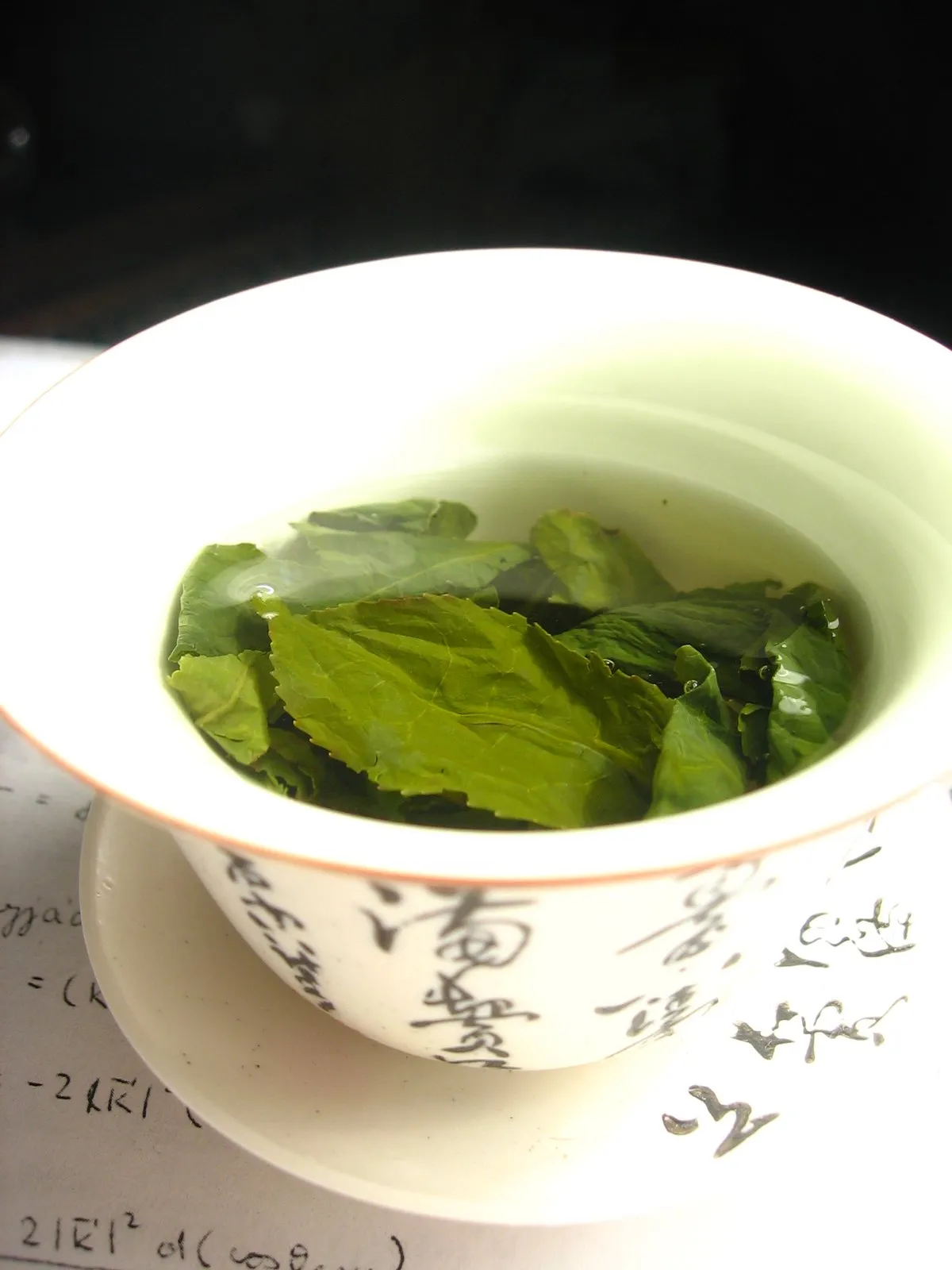
Water that is too cool will not fully release Guapian’s rich body and fire aroma; water that is too hot or too long a steep will bring out bitterness. Because Lu’an Guapian completely excludes tender downy buds and woody stems, its infusion exhibits unique extraction physics: the liquor remains pristinely crystal-clear and devoid of floating downy trichomes, revealing a brilliant luminescent jade-chartreuse glow. Fully hydrated single leaves unfold into flat, uniform seed-shaped laminae with prominent venation.
Common Myths & Scientific Clarifications
Myth 1: “Are Lu’an Guapian’s single leaves and lack of buds evidence of leftover, discarded broken leaf?”
Scientific Clarification: Guapian is an elite, specialized whole-leaf green tea created by deliberate de-budding. In traditional practice, picked shoots undergo the ban pian process to strip away tender apical buds and woody petioles, retaining exclusively the second and third open leaves[1]. Structurally mature foliage contains higher concentrations of water-soluble polysaccharides, pectin, and high-boiling aroma precursors. Eliminating buds removes trichome turbidity and astringency while establishing a rich body capable of withstanding intense charcoal firing. Each piece remains an intact, seed-shaped botanical leaf.
Myth 2: “Does la lao huo firing at 160–200 °C essentially char and burn the tea leaf?”
Scientific Clarification: La lao huo is a precision flash-heat sublimation technique rather than destructive roasting. Suspended over smokeless charcoal embers at 160–200 °C, two masters swing the bamboo basket in rapid, rhythmic sweeps (60–80 times per minute for mere seconds per pass)[1][2]. This intense flash heat dehydrates leaf-surface pectins and soluble sugars into an iconic silvery-white “frost” (Bai Shuang) while triggering Maillard reactions that forge sweet roasted-chestnut aromas without burning the leaf. Premium Guapian emerges jade-green with natural frost, completely free of scorched bitterness.
Myth 3: “Since Guapian is a green tea, must it be brewed with 80 °C low-temperature water?”
Scientific Clarification: Guapian requires higher steeping water (85–90 °C) compared to delicate spring buds. Harvested from mature leaves with thickened cuticles and hardened cell walls from la lao huo, its mass-transfer extraction kinetics are naturally slower. Sub-80 °C water fails to penetrate the dense cellular matrix, leaving high-boiling chestnut aroma volatiles trapped and rendering the liquor flat and watery. Brewing in a white porcelain gaiwan with 85–90 °C water activates rich polysaccharide dissolution, delivering robust body and lingering throat sweetness without bitterness.
Related entries
- The science of green-tea fixation — the enzyme science behind Guapian’s sheng guo
- China’s six tea categories — where Guapian sits in the bigger picture
- The Craft of Longjing — another pan-fired green tea, compare flat-leaf shaping
- The Craft of Taiping Houkui — another Anhui famous tea, compare orchid-aroma baked green tea
Full process parameters
| Stage | Temperature | Time | Moisture change | Main purpose |
|---|---|---|---|---|
| Plucking | — | — | Fresh leaf ≈75% | Open-face 2nd/3rd leaf, no bud, no stem |
| Ban pian | Room temp | Batch-dependent | — | Separate bud, leaf, stem; keep single leaf |
| Sheng guo | 180–220 °C | 2–3 min | ≈75% → 35–45% | Kill enzymes, initial shaping |
| Shou guo | 80–100 °C | 5–7 min | 35–45% → 20–30% | Shaping, pressing flat, drying |
| Mao huo | 100–120 °C | 10–15 min | 20–30% → 10–15% | First drying, stabilise shape |
| Xiao huo | 80–100 °C | 15–20 min | 10–15% → 7–8% | Re-drying, prepare for la lao huo |
| La lao huo | 160–200 °C | 30–40 min (80–100 tosses) | 7–8% → 5–6% | High-heat aroma, frost forming, fire finish |
| Refining | — | Several hours | Stable | Sorting, grading, packing |
Values are representative; real workshops adjust for leaf condition, weather, equipment and the tea maker’s judgement (drawn from GH/T 1242-2019 and processing literature)[1][2].
References
- R-101 — GH/T 1242-2019.《六安瓜片茶》(Lu’an Guapian tea). 中华全国供销合作总社.
- R-031 — 施兆鹏, 夏涛 主编 (2016).《茶叶加工学》(第3版). 中国农业出版社. ISBN: 978-7109214347.
- R-030 — 陈宗懋 主编 (2000).《中国茶叶大辞典》. 中国轻工业出版社. ISBN: 978-7501925094.
- R-029 — 宛晓春 主编 (2003).《茶叶生物化学》(第3版). 中国农业出版社. ISBN: 978-7109066274.
Article Knowledge Network
Explore the connections between the teas, processes and flavours in this article.