
Start with the essentials
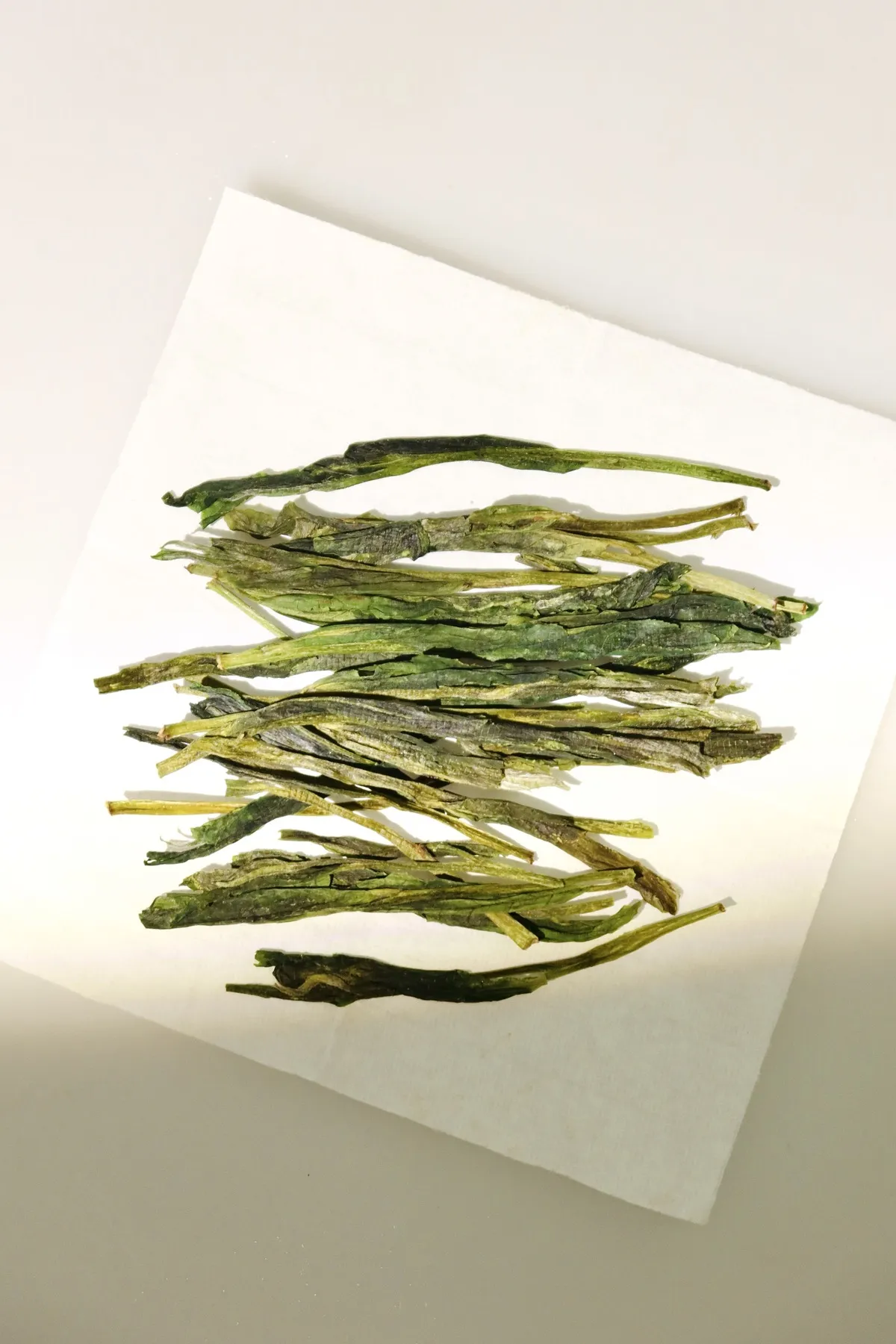
Taiping Houkui is immediately recognisable for long, flat shoots. Size begins with the raw material; selection, alignment, shaping and baking create the organised appearance. Pressing alone does not describe the craft.
This article follows leaf selection and repeated baking, explaining integrity, arrangement and the relationship between moisture, shape and aroma. Hand and machine methods, infused leaves and tasting provide a fuller picture than leaf length.
Three key points
- Material underlies the large formShoot composition, maturity and integrity matter.
- Alignment organises the leavesArrangement and shaping affect both dry and infused appearance.
- Baking continues the shapingStaged moisture removal and heating influence stability and flavour.
What to notice when tasting
Use a clear vessel to watch the leaves unfold, then examine shoot structure, aroma and taste. Length and mesh marks are appearance clues; provenance still requires information beyond those marks.
What makes Houkui special
What you notice first about Taiping Houkui is its size and shape: two leaves holding one bud, pressed flat and straight. That form comes partly from the raw material and partly from hand shaping.
Origin and cultivar
Taiping Houkui comes from Huangshan District of Huangshan City in Anhui (formerly Taiping County), with its traditional core around villages such as Houkeng beside Taiping Lake; the exact production area is set by the standard[1]. The area is hilly and close to the lake, and the gardens are often misty, which is the feature most descriptions mention; the sources cited here do not measure how these conditions relate to leaf composition.
The traditional cultivar is Shida (Shi Da tea / persimmon-large tea), with large, thick leaves and fairly long internodes, the material basis for Houkui’s long, large-leaf form[2].

Plucking standard
Houkui is usually picked around Grain Rain (late April). Pickers take two leaves embracing one bud: one bud with two just-unfolding leaves, still joined, with the bud tip roughly level with the leaf tips, called a “tip”. The shoots are then sorted again to remove single leaves, fish leaves and older leaves. The traditional requirement for high-grade fresh leaf can be summed up as “stout bud, thin leaf, short internode, green colour, visible down”.
Full processing flow
Traditional Taiping Houkui can be divided into roughly ten steps[1][3]. Workshops differ in how many bakes they use and what they call them; this article describes four:
Of these, plucking and sorting, fixation, pinching, the first bake and the final bake matter most for quality.
Fixation: using heat to stop enzymes
Fixation decides whether Houkui stays green. The spread shoots are tossed lightly and quickly in a hot pan for a few minutes, in small batches so they heat evenly; pan temperature is adjusted to the pan and batch size, and machine settings vary by model.
Taiping Houkui: what does fixation change?
Compare the enzymes in the magnifier.
Before heat: enzymes active
- Raw form: Two leaves hugging a bud, still connected
- Magnified: enzymes in the cells are active
- If bruised, polyphenols meet enzymes and darken
This is the starting form, not the finished shape.
Conditions & sources
- Pan temperature
- Room temperature
- Duration
- —
- Leaf load
- Small batches for even tossing
Fixation conditions are the common-practice description from this article’s fixation section, not values set by a standard. Equipment temperature is not leaf temperature.
Leaf and enzyme shapes are schematic; they do not predict residual activity or colour.
Heat lowers the activity of polyphenol oxidase (PPO) and peroxidase, so the leaf no longer reddens through enzymatic oxidation, and some grassy-smelling compounds escape. Fixation should be thorough and even: the leaf is ready when it is soft, bends without breaking and the grassy smell has gone. Too little leaves a dull colour and raw taste; too much scorches the edges and flattens the aroma.
Straightening and pinching: where Houkui gets its shape
The fixed leaf goes straight on to straightening and pinching, the steps that most set Houkui apart from other green teas.
From curled shoot to flat spear
Watch the same three shoots change.
Press and push to straighten
- Shoots are worked while still warm and soft
- Hands press lightly, push and pull
- Shoots straighten along the bud
- Steam escapes as the leaf keeps drying
Straightens the shoots without sticking or scorching, ready for pinching.
Conditions, technique & sources
- Heat
- Warm leaf straight after fixation
- Duration
- Until straight
- Leaf state
- Still soft, losing water
Straightening: stroke gently so “every leaf lies straight, every strip is separate”.
After the first bake come further bakes, each cooler than the last, until the tea is fully dry; the number and names of bakes vary between workshops. Descriptions follow common practice, not values set by a standard.
The traditional saying is that Houkui is “pointed at both ends, not loose, not curled”. Too much mesh pressure crushes the leaf; too little leaves the strips lifting.
Shoot shapes are schematic; playback speed is not processing time.
The diagram follows the same three shoots throughout: straightened in li tiao, wrapped around the bud by pinching, then flattened and set under the mesh during the first bake. The later bakes are described in the next section.
Straightening (li tiao)
While the fixed leaf is still warm and soft, each curved shoot is straightened by hand on a bamboo tray or shaping table so the two leaves lie parallel along the bud without overlapping or folding. Light pressing and pushing in the direction of the shoot keeps the leaves from sticking or scorching[3].
Pinching (nie jian)
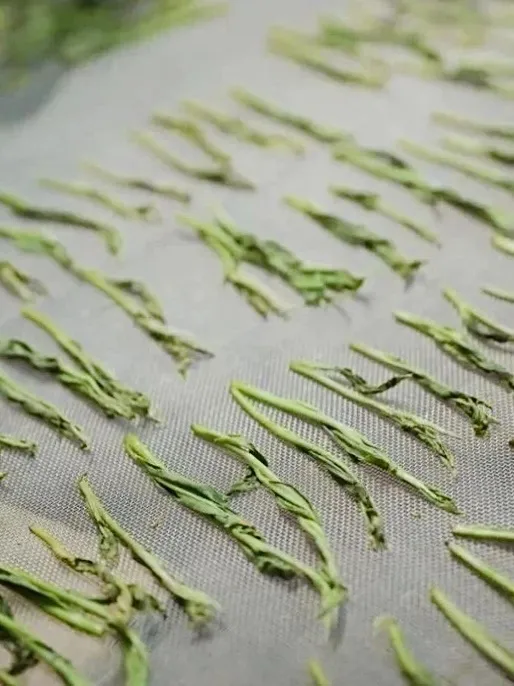
Pinching is Houkui’s own hand-shaping step. The maker picks up each straightened shoot and pinches it gently between thumb and index finger so the two leaves close around the bud, then lays the shoots in neat rows on a mesh. The traditional aim is “leaves wrapped round the bud, flat and straight, not loose, not lifting”, and finished spears are commonly around 5–7 cm long.
Pinching uses no heat and relies on touch. Too light, and the strip stays loose; too hard, and the shoot breaks and loses its down.
Repeated baking: cooler each time
Houkui is not dried in one go but baked several times, each time at a lower heat. This article describes four bakes (first, second, third and final); some workshops use three, or names such as “zi hong, lao hong, da lao huo”.
First bake (mesh pressing)
A second mesh is laid over the arranged shoots and a wooden roller is passed over it before the mesh goes onto a charcoal baking basket. The first bake is the hottest and shortest: it removes most of the water quickly while pressing the shoots flat and setting their shape. Afterwards the strips are mostly flat and straight but still soft and easy to bend.
Second and third bakes
The next bake is cooler, so the strips dry further and stiffen and no longer soften and lose shape; the one after that is cooler and longer again, letting water leave the stems slowly.
Final bake
The last bake is the coolest and dries the tea fully. The finished strips are flat, straight and firm to the touch, with a deep olive-green colour.
The number of bakes, their temperatures and times vary with the leaf, weather, charcoal or electric heat and the maker’s experience; this article does not give a single set of values.
By hand and by machine
Traditional Taiping Houkui is valued most when fully handmade, and pinching in particular is still hard to hand over to machines entirely. There are also flat “tip” teas pressed and dried by machine, which are efficient and uniform. This article has no comparative study to cite on how hand and machine methods differ in aroma and taste; judge by brewing the tea and check its origin and the standard it claims.
Aroma and taste
Tasters often describe Houkui’s aroma as orchid-like (orchid fragrance), with a noticeable scent left in the empty cup. Wang et al. (2022) used gas chromatography–mass spectrometry and odour activity values to compare the volatiles of Dianhong black tea and Taiping Houkui and identified the compounds contributing most to each tea’s smell[4]. Work like this shows that Houkui’s aroma is built from many volatiles together; it does not assign the “orchid” note to one compound or show which processing step produces it.
In the cup, Houkui is usually described as fresh, full and sweet in the aftertaste, without much bitterness. These are sensory descriptions; the sample and the way it is brewed decide.
Taiping Houkui
Green · Flat-Pressed Large LeafThe silhouette is relative; real cups vary by origin, elevation, year and grade.
Grades and brewing
GH/T 1172-2017 divides Taiping Houkui into five grades: Premium (jipin), Special, Grade 1, Grade 2 and Grade 3[1]. Higher grades call for flat, straight shoots with two leaves around one bud, plump buds and leaves, an even deep olive-green colour, a high, clear aroma, a fresh and full taste, and tender, bright infused leaves that stay whole.
Use these common starting points:
| Parameter | Recommendation |
|---|---|
| Water temperature | 85–90 °C (185–194 °F) |
| Leaf-to-water ratio | 3–4 g / 150 ml (a little more for these large strips) |
| Vessel | Clear glass or straight-sided gaiwan, so the strips can stand |
| Pouring | Pour gently down the wall and let the leaves stand up on their own |
| Steeping | 2–3 min; the first infusion can be a little longer |
| Refills | Leave one-third of the liquor before refilling; it usually gives several infusions |
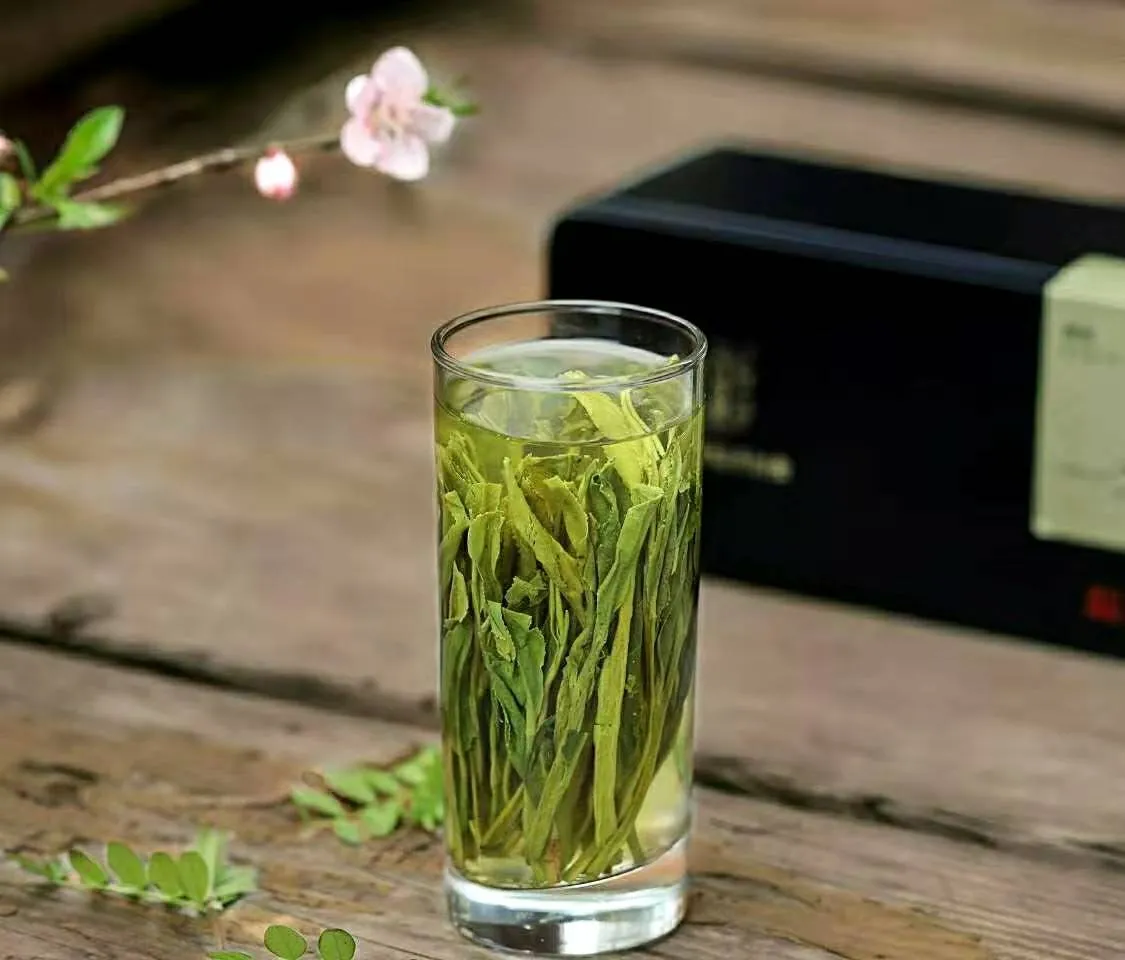
Houkui’s strips are long and large, so in a tall glass they slowly stand upright and open. Water that is too cool keeps the aroma muted; too hot brings out bitterness.
Brewing Houkui in a tall glass
Pour gently, then watch the strips stand.
Pour slowly down the wall
- Water at 85–90 °C
- Pour down the wall, not onto the strips
- 3–4 g per 150 mL; a little more for big strips
Too cool and the aroma stays muted; too hot and bitterness rises.
Brewing parameters
- Water
- 85–90 °C
- Ratio
- 3–4 g / 150 mL
- Steep
- 2–3 min; the first steep can be longer
- Vessel & refill
- Clear glass or straight-sided gaiwan
Values follow the article’s brewing table and are starting points, not a fixed recipe.
Liquor colour and leaf position are schematic, not a colour standard.
Common myths
Myth 1: “The greener the dry Houkui, the better?”
Explanation: Not necessarily. GH/T 1172-2017 describes Houkui’s colour in terms such as an even deep olive green (consult the standard for its exact wording)[1], not bright green. Traditionally, the midrib often shows a faint dark red line, called the “red thread”. A very bright green may point to incomplete fixation or baking. Look for even colour and flat, straight strips, then check the liquor and taste.
Myth 2: “Is the only difference between machine-pressed and hand-pinched Houkui the output?”
Explanation: The methods differ, and the shape often shows it, for example whether the shoots stay whole and whether the leaf carries mesh marks. Mesh marks also appear on hand-pressed tea, though, so they cannot by themselves tell hand from machine work, and this article has no comparative study to cite on aroma and taste. Origin and method are best checked through the seller’s information.
Myth 3: “Houkui is flat too, so can it be brewed any way, like Longjing?”
Explanation: Houkui’s leaves are large and long, so a tall glass or straight-sided gaiwan gives them room to open. A common practice is to pour 85–90 °C water down the side of the glass, rather than boiling water straight onto the leaves or a long covered steep, which tends to bring out bitterness and darken the liquor. Adjust temperature and time to taste.
Related entries
- The science of green-tea fixation — how enzymes are stopped in Houkui’s fixation
- China’s six tea categories — where Houkui sits in the bigger picture
- The Craft of Longjing — another flat green tea, but pan-fired rather than baked
- The Craft of Huangshan Maofeng — a baked green tea from the same mountain range with a different style
Process at a glance
| Stage | Heat | Leaf state | Main purpose |
|---|---|---|---|
| Spreading | Room temperature | Crisp to soft | Lose water, release grassy notes |
| Fixation | Hot pan, a few minutes | Soft, darker | Stop enzymes, keep green |
| Straightening | While still warm after fixation | Shoots straight | Leaves along the bud |
| Pinching | Room temperature, no heat | Leaves wrap the bud | Shape, lay on mesh |
| First bake | Hottest of the bakes | Most water gone, pressed flat | Set shape under mesh |
| Second and third bakes | Cooler each time | Drier, firmer | Hold shape, dry slowly |
| Final bake | Coolest | Fully dry | Dry fully, settle aroma |
The number of bakes, temperatures and times vary with the leaf, weather, heat source and the maker’s experience; the table is a qualitative comparison, not parameters set by a standard.
References
- R-106 — GH/T 1172-2017.《太平猴魁茶》(Taiping Houkui tea). 中华全国供销合作总社.
- R-030 — 陈宗懋 主编 (2000).《中国茶叶大辞典》. 中国轻工业出版社. ISBN: 978-7501925094.
- R-031 — 施兆鹏, 夏涛 主编 (2016).《茶叶加工学》(第3版). 中国农业出版社. ISBN: 978-7109214347.
- R-109 — Wang, C., Zhang, C., Kong, Y., Peng, X., Li, C., Liu, S., Du, L., Xiao, D., & Xu, Y. (2022). A comparative study of volatile components in Dianhong black tea and Taiping Houkui green tea using GC-MS and odor activity value. LWT - Food Science and Technology, 163, 113523. https://doi.org/10.1016/j.lwt.2022.113523
Article Knowledge Network
Explore the connections between the teas, processes and flavours in this article.