
Start with the essentials
British afternoon tea combines a drink, food and time together. Tiered stands, scones and milk are familiar, but household schedules, sociability and class also shape the history. Why do afternoon tea and high tea refer to different settings?
This article follows tea’s place in British life, changing menus and etiquette, hotel services and the trade behind tea, sugar and porcelain. Connecting the table with society gives familiar customs a context.
Three key points
- Names identify different settingsHigh tea is not simply a more prestigious afternoon tea.
- Food and tea organise sociabilityTiming and service connect drinking with hospitality, leisure and meals.
- Forms change with occasionsMilk order, tiered stands and modern packages need their particular context.
Understand afternoon tea through a menu
Read a menu for name, food, tea and timing, then consider the gathering it describes. Check dates and sources when comparing origin stories and etiquette with modern commercial presentations.
From a Portuguese Princess to the Duchess of Bedford: Tea’s Two “Landings” in Britain
Catherine of Braganza and Seventeenth-Century Court Tea (from 1662)
Tea arrived in Britain roughly two centuries before the afternoon-tea tradition. In 1662, Catherine of Braganza (1638–1705), princess of the Portuguese House of Braganza, married King Charles II and brought the Portuguese court’s tea-drinking habit into the English royal household. Catherine’s dowry included tea and trading posts in the East, and she herself entertained with tea, rapidly turning a drink that had been sold in apothecaries as an “exotic Oriental remedy” into a court fashion[2].
The poet Edmund Waller composed verses in her honour: “Venus her Myrtle, Phoebus has his bays; / Tea both excels, which she vouchsafes to praise” — likening tea to the myrtle of Venus, with Catherine as the queen who “vouchsafes to praise” it[2]. Even so, seventeenth-century tea remained an extreme luxury: in the 1690s tea cost roughly 20–30 shillings per pound, equivalent to several weeks’ wages for an ordinary craftsman. Tea’s social role was closer to that of medicine and a status symbol than an everyday drink[3].
The Duchess of Bedford and the “Invention” of Afternoon Tea (c. 1840)
The origin of modern British afternoon tea is usually credited to Anna Maria Russell, 7th Duchess of Bedford (1783–1857). As the story goes, around 1840 the Duchess felt a “sinking feeling” during the long gap between luncheon (around midday) and dinner — which in fashionable society had been pushed back to 8–9 p.m. — and so asked her servants to bring tea, bread, butter, and cake to her boudoir around 4 p.m.[4]
This private habit soon evolved into a social activity: she began inviting friends and relatives to join her, first at Woburn Abbey in Bedfordshire and later among London high society. Because the Duchess was a Lady of the Bedchamber to Queen Victoria, her habit quickly won court approval. By the late 1840s the royal household was holding afternoon tea daily[5].
It should be noted that the Duchess’s contribution is more accurately described as “elevating informal afternoon tea-drinking into a social ritual with clear etiquette” rather than “inventing” tea-drinking itself[4][6].
The Victorian Backdrop: Industrialisation, Gender, and Class
The Reshaping of Time
Nineteenth-century Britain underwent a profound industrial transformation. The factory system drew vast numbers of labourers from countryside to city, lengthened the working day, and steadily pushed dinner later. In aristocratic and upper-middle-class households, dinner moved from the 5–6 p.m. of the eighteenth century to 8–9 p.m., leaving a 6–8 hour gap between luncheon and dinner[6]. Afternoon tea filled precisely this “time crack,” becoming a transitional ritual connecting the working day with evening socialising.
A Social Space for Women
Afternoon tea carried a particular gendered significance in the Victorian era. Public spaces of the day — coffee houses, clubs, Parliament — were almost entirely male-dominated. Afternoon tea, by contrast, offered women a social occasion “free of male supervision”: they gathered in the drawing room to discuss literature, politics, fashion, and household affairs. Some historians have even called it “a mild act of feminism” — securing women a limited measure of autonomy within a strict gendered division of labour[6][7].
A Marker of Class and Material Culture
Afternoon tea soon trickled down from the aristocracy to the middle class, becoming a display of social standing. A complete afternoon-tea service included a silver teapot, bone-china cups and saucers, sugar bowl, milk jug, cake stand, and linen napkins. The tea itself carried class codes: fine Earl Grey, Darjeeling, and Ceylon tea were the drawing room’s first choices, while the working class drank cheap Assam broken tea or reprocessed tea dust[8].
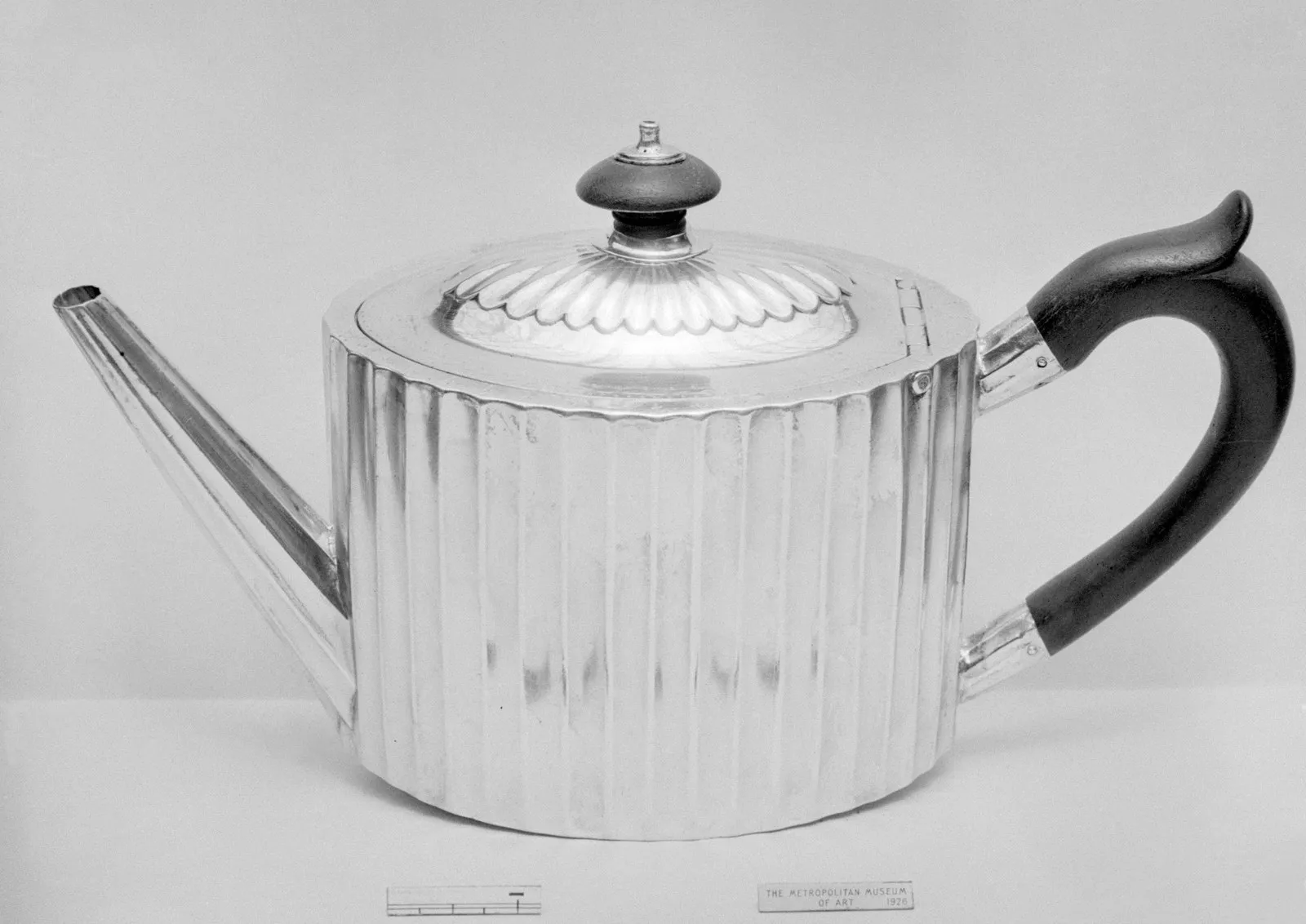
Silver teapots were used in Britain before afternoon tea became fashionable. This London example dates from 1784–1785, so it illustrates an earlier tea object rather than a Victorian afternoon-tea service.
”Afternoon Tea” vs. “High Tea”: A Class Misunderstanding
In modern English, “afternoon tea” and “high tea” are often conflated, and many hotels even advertise their upscale afternoon-tea service as “High Tea.” Historically this is a serious misuse.
| Dimension | Afternoon Tea | High Tea (meat tea) |
|---|---|---|
| Social class | Upper class / middle class | Working class |
| Time | 3:00–5:00 p.m. | 5:00–7:00 p.m. |
| Setting | Drawing room / sitting room (low tables, sofas) | Kitchen / dining room (high table, high-backed chairs) |
| Food | Finger sandwiches, scones, cakes, macarons | Hot main meal: meat pie, fish, potatoes, bread, eggs |
| Function | Socialising / leisure / bridging the meal gap | Main evening meal after work / sustenance |
| Alternative name | ”Low Tea" | "Meat Tea” |
The “high” in “High Tea” refers not to “high-class” but to the “high table” and “high-backed chairs” used while eating, in contrast to the “Low Tea” enjoyed on the low drawing-room furniture[9]. High tea was the working class’s substitute for dinner during the Industrial Revolution: after long hours of physical labour, men needed a filling hot meal of meat and starch, not delicate pastries. Equating “High Tea” with “upscale afternoon tea” is a twentieth-century distortion of historical meaning by commercial marketing[9][10].
The Three-Tier Stand and the Lineage of Treats: From Sandwiches to Scones
The Structural Logic of the Three-Tier Stand
Reading a three-tier stand
Bottom to top, savoury to sweet.
Finger sandwiches
- Cucumber, egg and cress
- Crusts off, cut in fingers
Savoury and filling, so they come first.
About this sketch
Early stands were sometimes arranged the other way, with warm scones on top; menus vary by venue.
Schematic; foods and teaware are illustrative.
The diagram above takes the stand tier by tier, bottom to top: savoury first, sweet last.
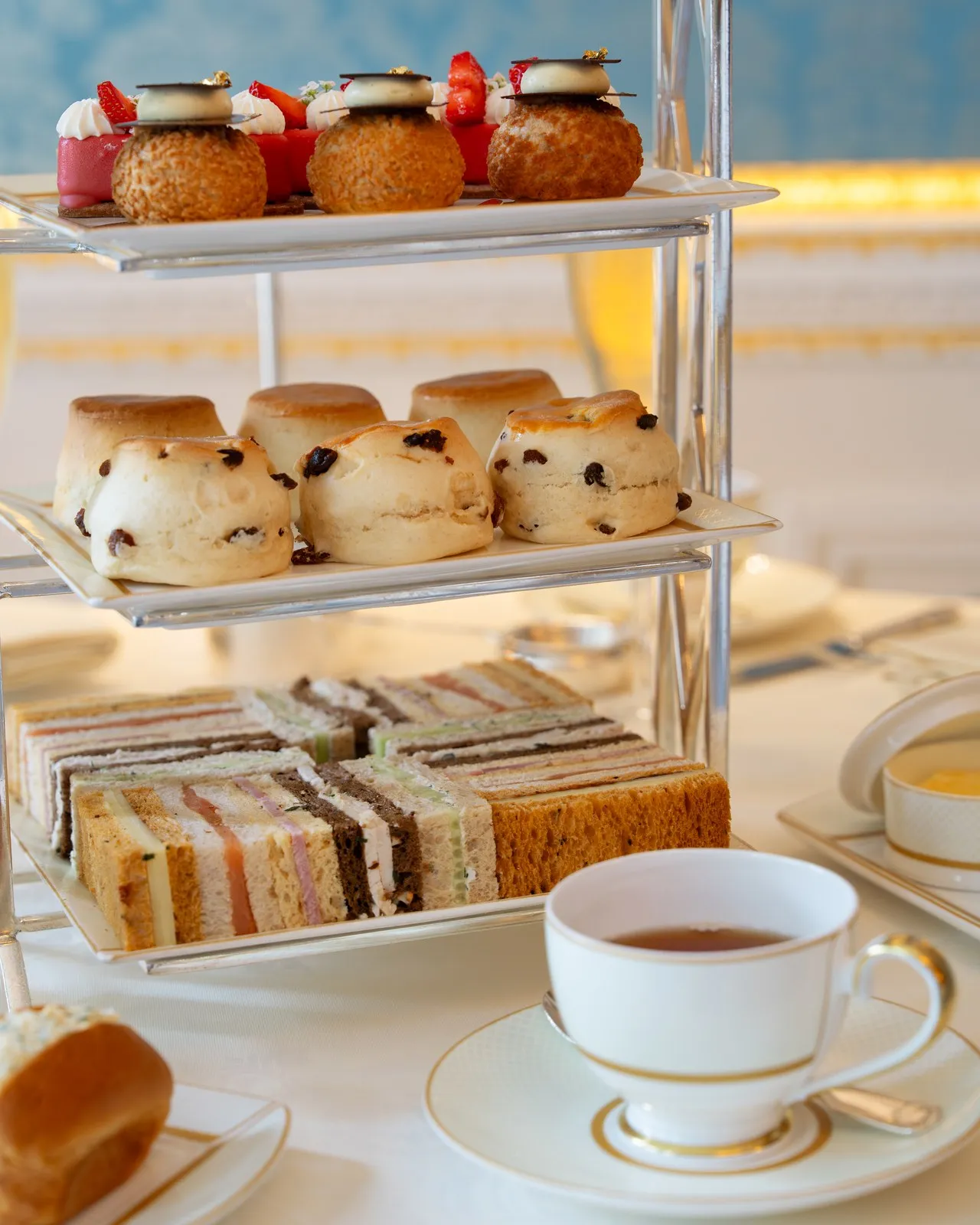
The most recognisable visual symbol of modern afternoon tea is the three-tier cake stand. Its prototype can be traced to the silver cake trays of the late nineteenth century, but its consolidation into a three-tier structure with a clear allocation of food by level dates to roughly the Edwardian era (1901–1910), and by the 1920s it had become the standard configuration[11].
| Tier | Contents | Eating order | Logic |
|---|---|---|---|
| Bottom | Finger sandwiches | First | Savoury to sweet; sandwiches are the most filling |
| Middle | Scones with clotted cream and jam | Second | Transitional layer bridging savoury and sweet |
| Top | Cakes, macarons, miniature pastries & petit fours | Third | Highest sweetness, to finish |
Interestingly, the arrangement and eating order of the three-tier stand was not fixed from the start; today’s “low to high, savoury to sweet” order is simply the prevailing convention[11].
The modern hotel service below places sandwiches, scones and pastries on separate tiers, making the structure easy to see. Actual menus and arrangements vary by venue.
The Lineage of the Finger Sandwich
Finger sandwiches (also called “tea sandwiches”) are required to be de-crusted and cut into strips two or three fingers wide, easy to take with one hand without soiling one’s gloves. Classic fillings include:
- Cucumber sandwiches: traceable to Victorian-era recipes such as Mrs. Beeton’s (1861), with thinly sliced cucumber and cream cheese or butter between white bread — the most representative afternoon-tea sandwich[12].
- Smoked salmon & cream cheese: added in the Edwardian era, reflecting the development of British fisheries and refrigerated transport.
- Egg & cress and ham & mustard: common choices in middle-class households.
Scones and the North–South Dispute of the Cream Tea
The scone is the soul of afternoon tea, but how to eat one has sparked a century-long regional dispute in Britain. Cream Tea refers specifically to the combination of “scone + clotted cream + jam,” originating in the southwest of England in Devon and Cornwall.
| Region | Order | Reasoning |
|---|---|---|
| Devon | Cream first, then jam | Cream, like butter, is the “base”; jam is the topping |
| Cornwall | Jam first, then cream | Jam is the “base,” cream the “cap”; and cream spread first on a hot scone would melt |
According to her former royal chef Darren McGrady, Queen Elizabeth II ate her scones “the Cornish way” (jam first), and the celebrity chef and Cornishman James Strawbridge likewise defends the “jam first” tradition. In 2018, when the National Trust used a “cream-on-top” scone photo in an advertisement for one of its Cornish properties, it triggered fierce local protest, with residents regarding it as a “sacrilege” against Cornish culture[13].
From a food-science perspective, “jam first” does help prevent the cream on a hot scone from melting too quickly; but “cream first” better fits the “light to rich” progression of taste. Both practices have historical basis and today are seen more as personal preference than absolute etiquette[13].
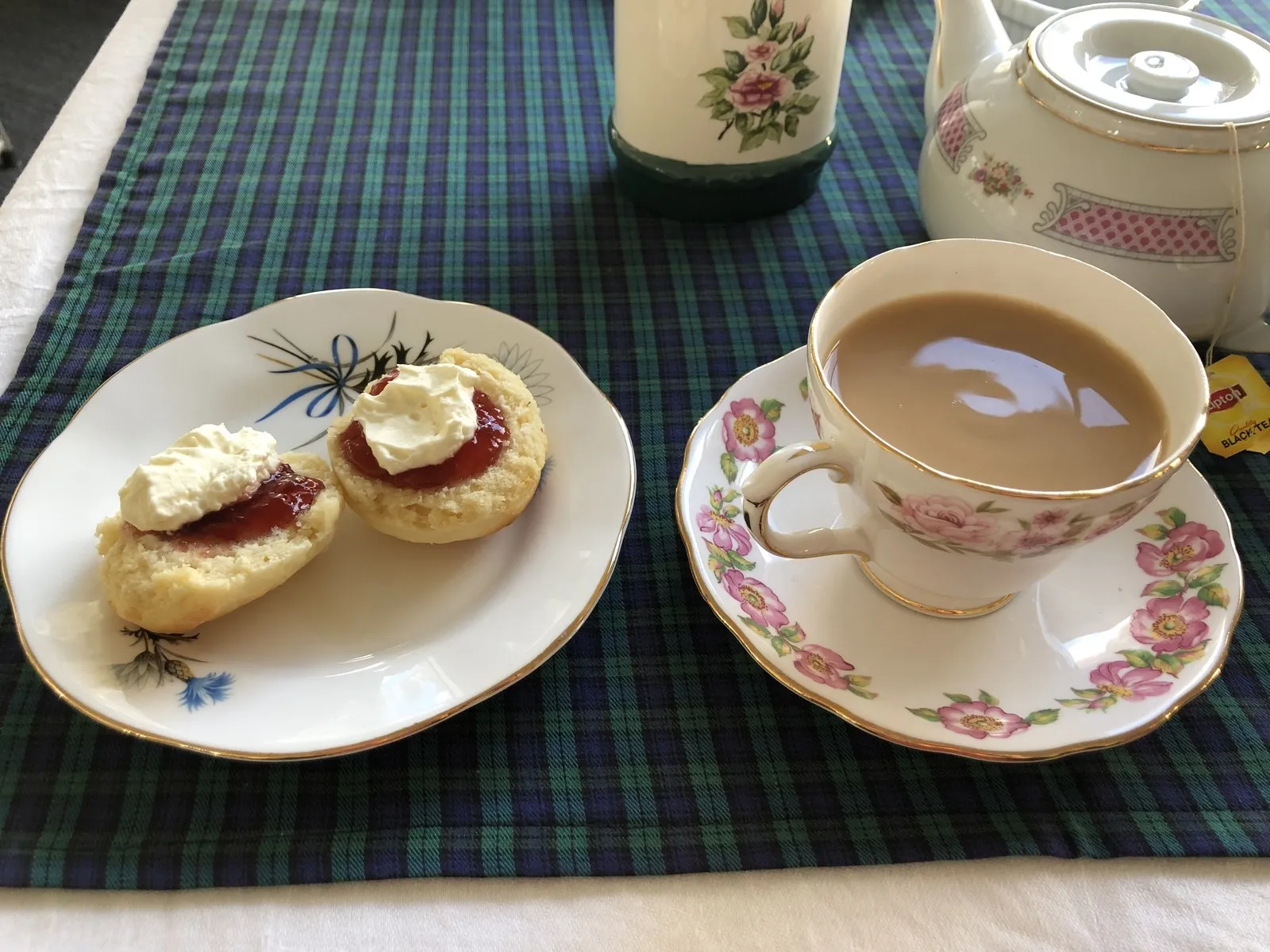
Scones with jam and cream, accompanied by a cup of tea, make a simpler serving. This photograph shows jam beneath cream; it does not establish where the photograph was taken.
Etiquette: Tea First or Milk First?
The etiquette rules of afternoon tea are extremely elaborate, the most contentious being “tea first or milk first” (MIF vs. MIL).
Milk first or tea first?
Compare the order of the two pours.
Cold milk, then hot tea
- Cold milk into the cup
- Hot tea poured on top
- They mix as the tea goes in
Milk first may once have protected fragile cups; this is debated.
About this sketch
Neither order is a test of manners; choose by tea, teaware and taste.
Schematic; foods and teaware are illustrative.
The Tea-and-Milk Order Dispute
Porcelain quality is often offered as one piece of context for the dispute: thin or poorer-quality early cups could crack when hot tea was poured in, so some drinkers added cold milk first as a buffer. The abbreviations should be read literally: MIF (milk in first) means milk first, then tea; MIL (milk in last) means tea first, then milk. As more heat-resistant tea ware became common, tea first also made it easier to see the liquor and adjust the amount of milk. The familiar class-based explanation for these choices, however, remains historically debated[14].
Some contemporary etiquette writing prefers tea first, but adding milk first is also a long-standing practice. The choice can follow the tea, the ware and personal preference; neither order should be treated as a reliable marker of social class or tea quality[14].
Other Core Etiquette
- Holding the cup: pinch the handle with thumb and forefinger, with the middle finger supporting from below; the little finger should curl in naturally — raising the pinkie (pinkie up) is seen as affected and is not elegant[15].
- Stirring: stir gently back and forth (6 o’clock to 12 o’clock), avoiding circular motions or clinking the side of the cup.
- Scones: break them by hand, never cut them with a knife; find the scone’s natural “waistline” and tear gently along the seam. After breaking, spread cream and jam on each half separately (rather than making a “sandwich” to pick up).
- Eating order: a common approach is to begin with savoury sandwiches, followed by scones and sweets; the menu and personal preference can guide the order[15].
- Napkin: unfold it onto your lap once seated; when leaving the table, place it loosely folded on the arm of the chair rather than on the table (signalling that you will return).
From Hotel to the World: Modern Variations of Afternoon Tea
The Origin of Hotel Afternoon Tea: The Langham (1865)
On 10 June 1865, The Langham, London opened on Portland Place, becoming Europe’s first “purpose-built Grand Hotel.” From its opening day the hotel served afternoon tea in the Palm Court, recognised as “the first place in the world to serve afternoon tea in a hotel”[16]. The Palm Court’s afternoon tea has now run for over 160 years, the longest-running afternoon-tea service in the world.
When The Langham opened it had 600 rooms, equipped with Britain’s first hydraulic lifts (“rising rooms”), electric lighting and indoor plumbing, representing the technological pinnacle of the Victorian era. Its afternoon-tea menu, designed with input from food historian Natasha Marks (AVM Curiosities), has featured historical recipes such as Mrs. Beeton’s cucumber sandwich (1859), crayfish-mayonnaise sandwiches (1890), and iced orange cake (1891)[5][16].
Regional Variations
- Cream Tea: a simplified afternoon tea from southwest England (Devon, Cornwall, Somerset), containing only scones, clotted cream, jam, and tea — no sandwiches or sweets. Affordable and a staple of rural tea rooms[13].
- Champagne Afternoon Tea: a late-twentieth-century invention of London hotels, replacing tea with a glass of champagne or serving it as an opener, raising both the sense of occasion and the per-head price.
- Gentleman’s Afternoon Tea: savoury-focused (mini burgers, sausage rolls, scones with gravy), reducing the proportion of sweets to appeal to male customers.
- Vegan / Gluten-free Afternoon Tea: a twenty-first-century variation driven by health and dietary ethics, substituting plant-based cream and gluten-free bread for traditional ingredients.
Global Spread and Reinterpretation
Afternoon tea spread to the colonies and dominions with the expansion of the British Empire in the late nineteenth century: India’s “high tea” (in fact a British supper tea), Hong Kong’s “saam-dim-saam” (3:15 afternoon-tea culture), the afternoon tea at Raffles Hotel in Singapore, and the afternoon tea at The Plaza in New York are all localised variations of the tradition. In Japan, afternoon tea was absorbed into the “yōshoku” (Western food) system, substituting refined French pastries for English cakes; in China’s first-tier cities, hotel afternoon tea has become a social medium for a “light-luxury lifestyle”[17].
The Taste of Empire: The Colonial Economy Behind Tea, Sugar, and Porcelain
Behind the elegance of afternoon tea lay the British Empire’s global trade network. In the eighteenth and nineteenth centuries, almost all the tea Britain consumed came from the East India Company’s monopoly trade with China. After the Company lost its tea-trade monopoly in 1833, tea prices fell sharply and imports surged: in 1800 Britain imported about 23.7 million pounds of tea a year, and by 1900 about 223–224 million pounds — a near-tenfold increase. Per-capita consumption rose from about 1.36 pounds in 1813 to about 3.76 pounds in 1870[3][18].
To break its dependence on Chinese tea, Britain began large-scale tea cultivation in Assam (India), Ceylon (today’s Sri Lanka) and elsewhere from the mid-nineteenth century; Kenya’s tea industry only began in the early twentieth century. In 1866 India’s tea output was only about 6 million pounds; by 1875 it had risen to about 20 million pounds. In 1883, India supplied about 34% of Britain’s total tea imports[18].
Sugar was another key ingredient of afternoon tea. In the eighteenth century, British per-capita sugar consumption was about 4 pounds a year; by the late nineteenth century it had risen to about 80 pounds. The consumption of tea and sugar reinforced one another: adding sugar made bitter black tea palatable, while tea’s hot-drink form became an ideal vehicle for ingesting sugar. The historian Sidney Mintz argued that the sugar-tea combination provided cheap calories and caffeine to the industrial working class — a hallmark product of “the taste of capitalism”[19].
Porcelain was the third pillar of afternoon tea’s material culture. The bone china produced by Wedgwood, Minton, Royal Doulton, and others — achieving a thin, translucent, white quality through bone-ash formulas — became the pride of British manufacturing. Yet the “chinoiserie” and “Indian-style” motifs in porcelain decoration also hinted at the Empire’s appropriation and repackaging of Eastern aesthetics[20].
Classic Afternoon Tea Selections & Three-Tier Pairing Logic
A traditional afternoon-tea menu typically offers both single-origin black teas and classic blends so guests can match their cup to the progression from savoury sandwiches to rich scones and sweet pastries[1][8][11]:
| Classic Tea Selection | Origin & Sensory Profile | Traditional Service (Straight / Milk / Lemon) | Recommended Tier & Food Pairing |
|---|---|---|---|
| Darjeeling | Himalayan foothills of India; First Flush is crisp and floral-green, Second Flush offers classic muscatel grape notes | Best served straight (milk masks its delicate muscatel aromatics) | Bottom-tier cucumber or egg-and-cress finger sandwiches and light citrus tarts |
| Earl Grey | Black-tea base scented with Italian bergamot (Citrus bergamia) peel oil; bright citrus-floral lift | Served straight or with a slice of lemon; fuller-bodied bases can take a splash of milk | Middle-tier scones (bergamot cuts through rich clotted cream) and top-tier fruit tarts or macarons |
| Ceylon Medium / High Grown (Sri Lanka) | Dimbula, Kandy, or Uva districts; bright orange-red liquor with crisp briskness and floral-citrus notes | Versatile: served straight, with a light splash of milk, or with lemon | All-round accompaniment bridging smoked-salmon sandwiches and jam-topped scones |
| Assam & English Breakfast | Low-elevation Assam valley or multi-origin blends of Assam, Ceylon, and Kenyan teas; rich malty body high in theaflavins and thearubigins | Ideal with milk (milk caseins bind astringent polyphenols to create a creamy, rounded cup) | Middle-tier warm scones with clotted cream and top-tier chocolate gateaux or shortbread |
| Keemun (Qimen Black Tea) | Qimen, Anhui, China; celebrated for its rose, honey, and subtle wine-woody bouquet (“Keemun aroma”) | Traditionally best straight, or with a small dash of milk | Bottom-tier ham-and-mustard sandwiches and top-tier caramel or nut petit fours |
| Lapsang Souchong | Tongmuguan, Wuyi Mountains, China; pine-smoke drying imparts resinous smokiness and dried-longan sweetness | Served straight without milk | Savoury smoked-salmon and cream-cheese sandwiches, aged cheddar bites, or dark chocolate pastries |
Related Articles
- Global Tea Trade History — trace the East India Company monopoly, the Opium Wars, and clipper ships that shaped British tea consumption
- Sri Lankan Tea Regions — how Ceylon highland and lowland estates became a cornerstone of British empire tea
- The Art of Tea Blending & Commercial Standardisation — the sensory architecture behind English Breakfast, Earl Grey, and commercial blends
- Congou vs CTC Black Tea — how Orthodox whole-leaf and CTC broken teas serve straight drinking versus milk-tea traditions
- Lapsang Souchong & Keemun Black Tea — the two historic Chinese black teas that captivated Victorian and Edwardian London
- Chinese Gongfu Tea Culture — compare how Eastern and Western societies built contrasting vessel systems and social rituals around tea
References
- R-164 — Twinings. (2024). The History of Afternoon Tea. Twinings UK. https://twinings.co.uk/blogs/news/history-of-afternoon-tea
- R-165 — The Collector. (2024). Catherine of Braganza, the Queen Who Brought Tea to England. https://www.thecollector.com/catherine-braganza-queen-tea-england/
- R-256 — Ellis, M., Coulton, R., & Mauger, M. (2015). Empire of Tea: The Asian Leaf that Conquered the World. London: Reaktion Books. ISBN 978-1-78023-440-3.
- R-166 — Historic UK. (2024). The History of Afternoon Tea. https://www.historic-uk.com/CultureUK/Afternoon-Tea/
- R-167 — Victoria and Albert Museum. (2018). Fit for a Queen: Afternoon Tea at the V&A. https://www.vam.ac.uk/blog/shop/fit-for-a-queen-afternoon-tea-at-the-va
- R-168 — Ready for Tea. (2024). The History and Etiquette of the Victorian Afternoon Tea Parties. https://readyfortea.com/the-history-and-etiquette-of-the-victorian-afternoon-tea-parties/
- R-169 — Serenity Tea House. (2024). The Art of Afternoon Tea: A Journey Through Time.
- R-170 — UK Tea & Infusions Association. (2024). Tea Customs and Traditions. https://www.ukteainfusions.co.uk/
- R-171 — The Spruce Eats. (2024). Afternoon Tea vs. High Tea: Understanding British Traditions. https://www.thespruceeats.com/afternoon-vs-high-tea-difference-435327
- R-172 — 9 Dragons Tea. (2024). High Tea vs Afternoon Tea: A Complete Guide. https://teadocumentary.com/blog/high-tea-vs-afternoon-tea/
- R-173 — TeaTime Magazine. (2024). The Three-Tier Cake Stand. https://teatimemagazine.com/three-tier-cake-stand/
- R-174 — Beeton, I. (1859). The Book of Household Management. London: S.O. Beeton.
- R-175 — Serious Eats. (2024). The British Cream Tea: Is It Jam or Cream First? https://www.seriouseats.com/british-cream-tea-correct-order-5225936
- R-176 — Holden, H. (2024). How to Properly Eat a Scone: Afternoon Tea Etiquette. https://hollyholden.com/how-to-properly-eat-a-scone-afternoon-tea-etiquette/
- R-177 — Windsor, L. (2024). Afternoon Tea Etiquette. Laura Windsor Etiquette Academy. https://laurawindsoretiquett.com/afternoon-tea-etiquette/
- R-178 — Langham Hospitality Group. (2025). The Langham Brews Global Afternoon Tea Tribute. https://www.langhamhospitalitygroup.com/en/media/latest-news/the-langham-brews-global-afternoon-tea-tribute/
- R-179 RAPPAPORT, ERIKA (2017). A Thirst for Empire: How Tea Shaped the Modern World. Princeton University Press. https://doi.org/10.2307/j.ctvc77m6j
- R-180 — Ashby, T. (2016). Tea Culture and the British Empire, 1600–1900. University of North Carolina at Charlotte. https://ninercommons.charlotte.edu/record/3296/
- R-181 — Mintz, S. W. (1985). Sweetness and Power: The Place of Sugar in Modern History. Viking Penguin. ISBN: 978-0140092331.
- R-182 — Victoria and Albert Museum. (2024). Chinoiserie and British Porcelain. https://www.vam.ac.uk/collections/ceramics
Article Knowledge Network
Explore the connections between the teas, processes and flavours in this article.