
Start with the essentials
Japanese tea practice organises matcha preparation, room, utensils, season and host–guest interaction into a gathering. Detailed actions create a rhythm of attention and hospitality as well as preparing the drink; schools and occasions have different procedures.
This article connects historical development with space, utensils, thin and thick tea, preparation and guest etiquette. The gathering’s purpose gives context to its individual rules.
Three key points
- Preparation connects with hospitalityArranging, making and serving organise the occasion.
- Thin and thick tea differQuantity, texture and handling suit their particular forms.
- Space and objects contributeRoom, utensils, season and school shape the experience.
What to notice in a tea gathering
Observe preparation, serving and guest responses before focusing on individual gestures. Notice utensils and season, and follow the relevant school and setting when learning the practice yourself.
From Song Whisked Tea to Wa-Kei-Sei-Jaku: Historical Origins
Eisai and the Kissa Yōjōki (12th Century)
The seeds of Japanese tea ceremony were sown by Zen monks in the 12th century. In 1168 and again in 1187, Eisai (Myōan Eisai, 1141–1215), founder of the Rinzai school of Zen in Japan, travelled to Song China to study Buddhism and brought back Zen practice together with the Song method of whisked tea. Upon his return in 1191, Eisai planted tea seeds in Hirado and Kyoto, and authored Japan’s first book on tea, the Kissa Yōjōki (Drinking Tea for Health) (1211), which opens with the declaration: “Tea is the elixir of health and the wondrous art of prolonging life.”[2]
What Eisai transmitted was not yet “tea ceremony” in the modern sense, but the sarei (monastic tea rite) — a simple ritual of drinking tea between meditation sessions or to welcome guests in Zen temples. This monastic tea rite laid the religious and philosophical foundations for later Japanese tea ceremony: tea was not merely a beverage, but a medium for meditation and spiritual cultivation.
Murata Jukō and “Wabi-cha” (15th Century)
During the Muromachi period (1336–1573), tea culture spread from temples to the warrior and aristocratic classes. In the 15th century, Murata Jukō (1423–1502), ordained young at Shōmyō-ji in Nara and later a Zen student of Ikkyū, synthesised Song whisked tea with native Japanese aesthetics, proposing the tea philosophy of wabi (quiet beauty in poverty) — an appreciation of simplicity, naturalness, and imperfection. Jukō rejected the ostentatious pursuit of luxurious karamono (Chinese wares) that characterised the contemporary tea contests, turning instead to humble Japanese pottery (such as Bizen and Shigaraki wares). Jukō is said to have summed up tea practice as “kin-kei-sei-jaku”; Rikyū later changed “kin” (reverence) to “wa” (harmony), planting the seed for the four principles[3].
Takeno Jōō and the Aesthetics of Yūgen
Jukō’s successor, Takeno Jōō (1502–1555), further infused the aesthetics of Japanese waka poetry into tea ceremony. Jōō championed yūgen (subtle profundity) and yojo (lingering sentiment) as the aesthetic纲领 of tea, advocating “maximum meaning through minimum means.” He taught his disciple Sen no Rikyū that the essence of tea ceremony lies not in the value of utensils, but in the moment of heartfelt connection between host and guest[3].
Sen no Rikyū and the Four Principles (16th Century)
Sen no Rikyū (1522–1591), revered as the “Saint of Tea,” is the figure who brought Japanese tea ceremony to its fullest expression. Born into a merchant family in Sakai (present-day Osaka), he took the Buddhist name Sōeki and was granted the title “Rikyū Koji” by Emperor Ōgimachi in 1585. Rikyū served as sadō (head of tea affairs) to both Oda Nobunaga and Toyotomi Hideyoshi, using tea ceremony as a diplomatic tool in the war-torn Sengoku period[4].
Rikyū pushed the wabi philosophy of Jukō and Jōō to its extreme, establishing the four principles of tea ceremony — wa-kei-sei-jaku:
- Wa (harmony): Harmony between host and guest, between humans and nature, and between utensils and space;
- Kei (respect): Humility in treating others; in the tea room, all are equal regardless of social rank;
- Sei (purity): Not merely cleanliness, but clarity of heart and mind;
- Jaku (tranquility): The calm realisation of impermanence, the culmination of the first three principles[4].
Rikyū also created numerous enduring innovations in tea-room architecture and utensils: the two-mat sō-an (grass hermitage) (as in the surviving Tai-an), the low nijiriguchi (crawling entrance) requiring guests to bow, the Raku chawan developed with potter Chōjirō, and the use of simple bamboo ladles in place of ornate metalware. These innovations transformed tea ceremony from an aristocratic display of wealth into a universal spiritual practice[4][5].
In 1591, Rikyū was ordered by Toyotomi Hideyoshi to commit seppuku (ritual suicide) due to aesthetic and political conflicts, at the age of 70. The idea later known as ichi-go ichi-e (one time, one meeting) is often linked to Rikyū: it goes back to his disciple Yamanoue Sōji’s note that each gathering is “a once-in-a-lifetime meeting”, and was fixed as a four-character phrase by Ii Naosuke in the late Edo period — every tea gathering is unique and unrepeatable[4].
The Three Sen Houses: Omotesenke, Urasenke, and Mushakōjisenke
After Rikyū’s death, his grandson Sen Sōtan (1578–1658) distributed the lineage among his three sons, forming the three major schools of Japanese tea ceremony today, collectively known as the san-senke (three Sen houses):
| School | Founder | Tea Room | Characteristic | Modern Status |
|---|---|---|---|---|
| Omotesenke | Kōshin Sōsa (third son) | Fushin-an | Conservative, orthodox; emphasises “jaku” | Main family line; many senior practitioners |
| Urasenke | Sensō Sōshitsu (fourth son) | Konnichi-an | Innovative, accessible; emphasises “wa” | Largest school globally |
| Mushakōjisenke | Ichiō Sōshu (second son) | Kankyū-an | Moderate, elegant; emphasises “sei” | Smallest scale; favoured by intellectuals |
While the three schools differ slightly in temae procedures and utensil handling, they all honour Rikyū’s four principles and the spirit of wabi-sabi. Urasenke has been particularly active in modern times: the 11th-generation iemoto Gengensai invented the ryūrei (seated procedure) in 1872, allowing foreigners and those unable to kneel to experience tea ceremony; the 15th-generation iemoto Sen Sōshitsu XV has long promoted the internationalisation and educational outreach of tea ceremony[6].
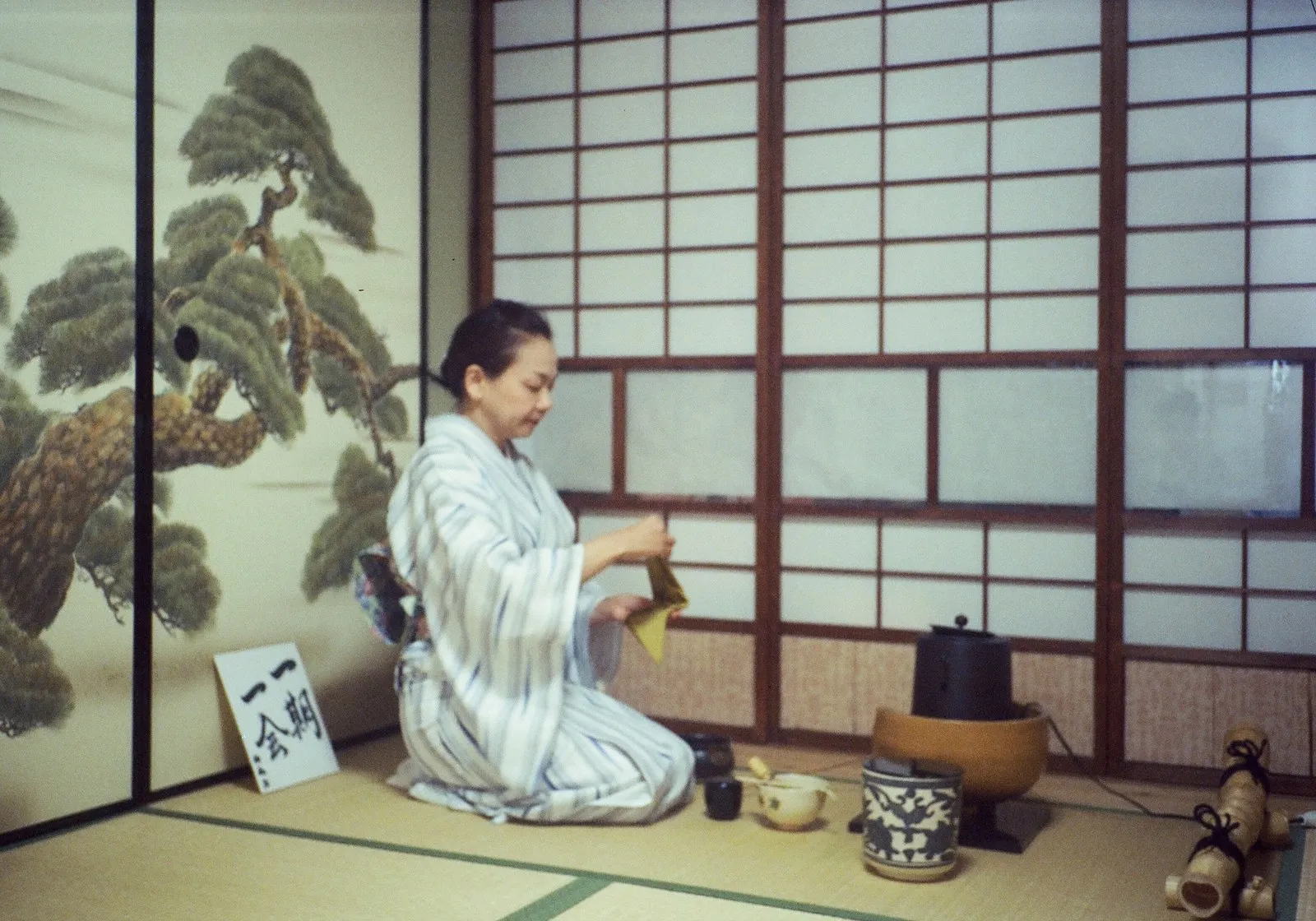
This photograph of a Kyoto tea gathering shows a host preparing tea indoors. The relationship between host, utensils and room leads into the discussion of tea spaces.
Tea-Room Space: From Sukiya to Sō-an
Form and Symbolism of the Chashitsu
The chashitsu (tea room) is the spatial vessel of tea-ceremony aesthetics. The sō-an hermitage established by Rikyū is typically only two mats (~3.3 m²) to four-and-a-half mats (~7.4 m²), built with earthen walls, thatched roofs, bamboo, and wood, deliberately kept low and humble. The tea room’s few small windows are covered with shoji (paper screens) that admit only soft natural light; the floor is covered with tatami, and the orientation of the tatami borders dictates the seating positions of guests and host[5].
The spiritual centre of the tea room is the tokonoma (alcove) — a slightly raised recessed space for displaying a kakejiku (hanging scroll) and a chabana (tea flower). The scroll’s calligraphy or ink painting often sets the theme of the gathering (season, Zen phrase, or poem), while the single seasonal wildflower in a simple vase embodies the aesthetic of fuei ryūkō (unchanging yet ever-changing)[5].
Nijiriguchi and Roji
Before entering the tea room, guests pass through the roji (dewy path) — a garden path paved with moss, stone lanterns, and a tsukubai (stone water basin). The roji symbolises the transition from the mundane world to the spiritual realm: guests here lay aside their social identity, remove their swords, and wash away worldly thoughts.
At the end of the roji stands the nijiriguchi — a square door approximately 66 cm high and 63 cm wide, through which guests must crouch to enter. This act carries profound symbolic meaning: whether samurai, noble, or merchant, all must bow their heads to enter the tea room, signifying equality before the Way of Tea[5].
Three thresholds of the tearoom
Basin, crawl-in door, alcove.
Rinse hands and mouth
- A low stone water basin
- A bamboo ladle
Guests crouch to rinse, leaving the everyday world behind on the roji path.
About this sketch
The crawl-in door is about 66 × 63 cm, as described in this article; layouts vary between tearooms and schools.
Schematic, not a complete temae lesson.
The Beauty of Utensils: From Karamono to Wamono
Core Tea Utensils
The utensil system of Japanese tea ceremony is extremely refined; a single usucha temae involves at least a dozen implements:
| Utensil | Japanese | Function | Material & Aesthetic |
|---|---|---|---|
| Tea bowl | Chawan | Holds and receives tea | Raku, Shino, Oribe; hand-moulded stoneware celebrating irregularity |
| Tea whisk | Chasen | Whisks matcha to create foam | A single node of bamboo split into 80–120 fine tines, hand-carved |
| Tea scoop | Chashaku | Measures matcha powder | Bamboo or ivory, curved like a rainbow, often inscribed with a poetic name |
| Tea caddy | Chaire / Natsume | Holds matcha powder | Chaire is ceramic; natsume is lacquerware shaped like a jujube fruit |
| Water container | Mizusashi | Holds cold water for replenishment | Ceramic or bamboo, often taking natural forms |
| Waste-water jar | Kensui | Receives waste water | Ceramic or metal, kept beside the host |
| Brazier / Hearth | Furo / Ro | Heats water | Furo is a portable brazier for summer; ro is a sunken hearth for winter |
| Water ladle | Hishaku | Ladles hot or cold water | Bamboo, long-handled, using naturally curved bamboo |
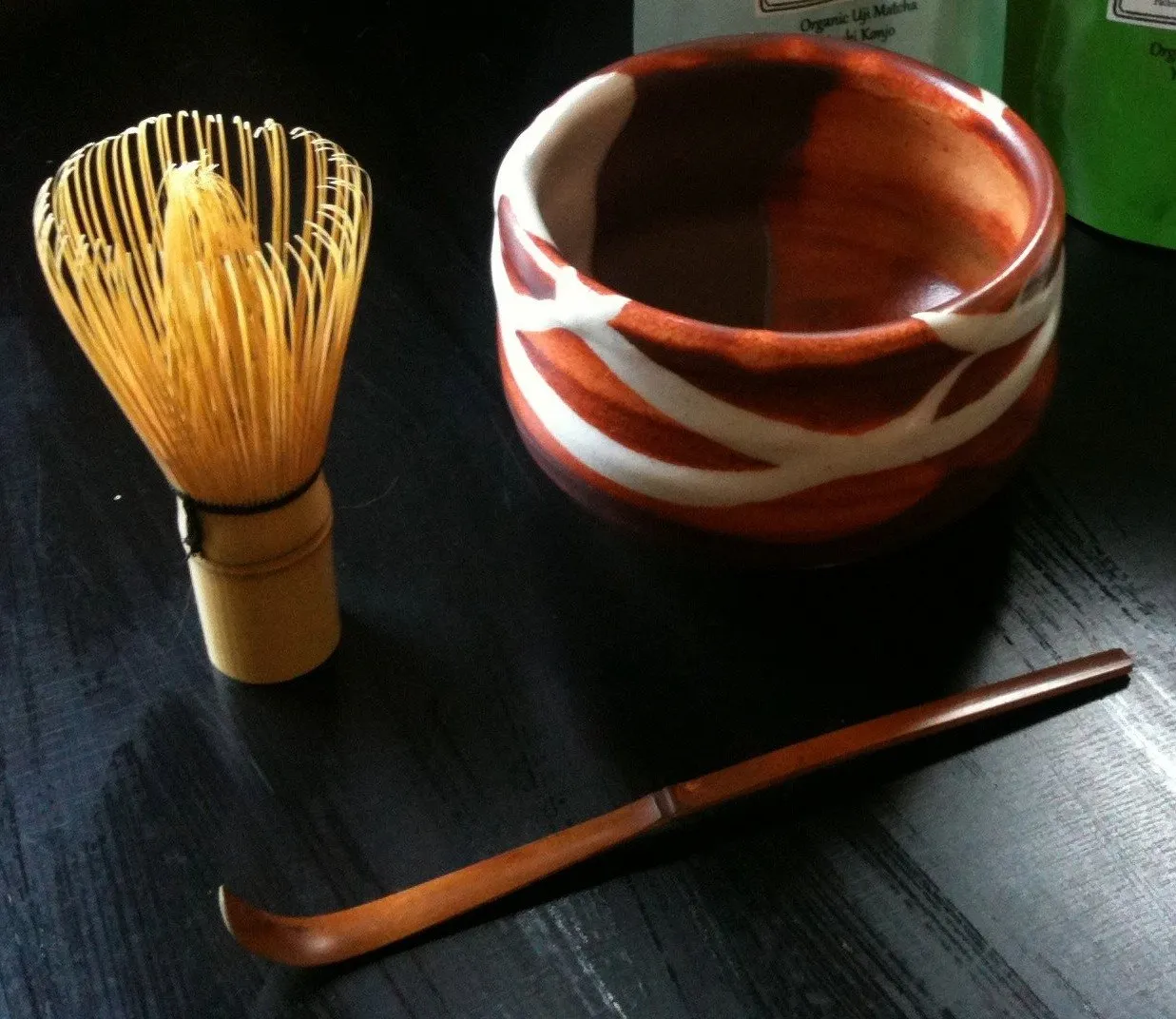
Parameters are representative ranges. Utensils vary by school, season, and formality of the gathering[5][7].
Raku Ware: The Collaboration of Rikyū and Chōjirō
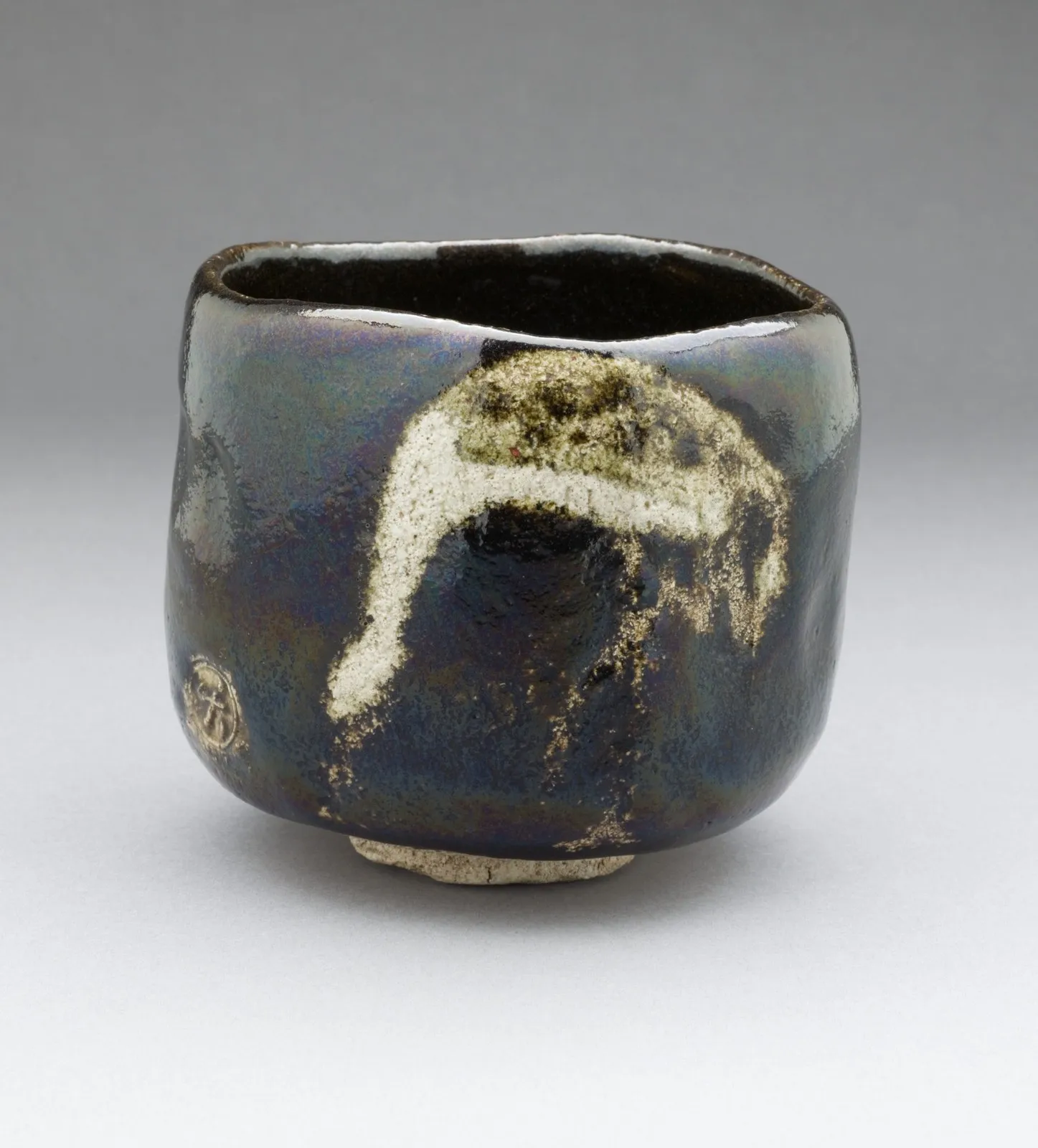
The Raku chawan is one of the most iconic utensils of Japanese tea ceremony. In the Tenshō era (1573–1592), Rikyū collaborated with the potter Tanaka Chōjirō to create tea bowls by hand-moulding rather than wheel-throwing, deliberately preserving fingerprints and irregular deformations, fired in red and black glazes. This “imperfection” is the materialisation of wabi-sabi aesthetics: Raku bowls have no ornate decoration; their beauty lies in the subtle variations of glaze, the warmth of touch, and the patina developed through years of use[5].
Toyotomi Hideyoshi later granted Chōjirō’s son a seal bearing the character “raku” (enjoyment), and Raku became a hereditary craft tradition continuing to the present day. The foot of a Raku bowl is often left unglazed, directly touching the tatami — another expression of Rikyū’s ideal that “utensils should merge into daily life.”
Temae Procedure: The Birth of a Bowl of Usucha
Koicha vs. Usucha
Four moves of a usucha temae
Watch the cloth, whisk and bowl.
Wipe caddy and scoop
- The folded silk fukusa
- The tea caddy (natsume)
- The bamboo scoop
Set folds and strokes clean the utensils and calm the room.
About this sketch
A simplified usucha sequence; schools such as Omotesenke and Urasenke differ in details.
Schematic, not a complete temae lesson.
The interactive diagram above shows the main steps of a typical usucha (thin tea) temae: cleansing utensils, whisking matcha into jade foam, serving and rotating the bowl, and viewing the utensils.
Tea ceremony temae is divided into koicha (thick tea) and usucha (thin tea). Koicha is the most formal: about 3–4 g of tea powder with ~30–40 ml of water, slowly kneaded with the chasen into a thick, syrupy liquor without foam, shared among guests from a single bowl. Usucha is more everyday: about 1.5–2 g of powder, ~60–80 ml of water, rapidly whisked into a frothy foam, served individually[7].
The following outlines a typical usucha temae in the Urasenke school:
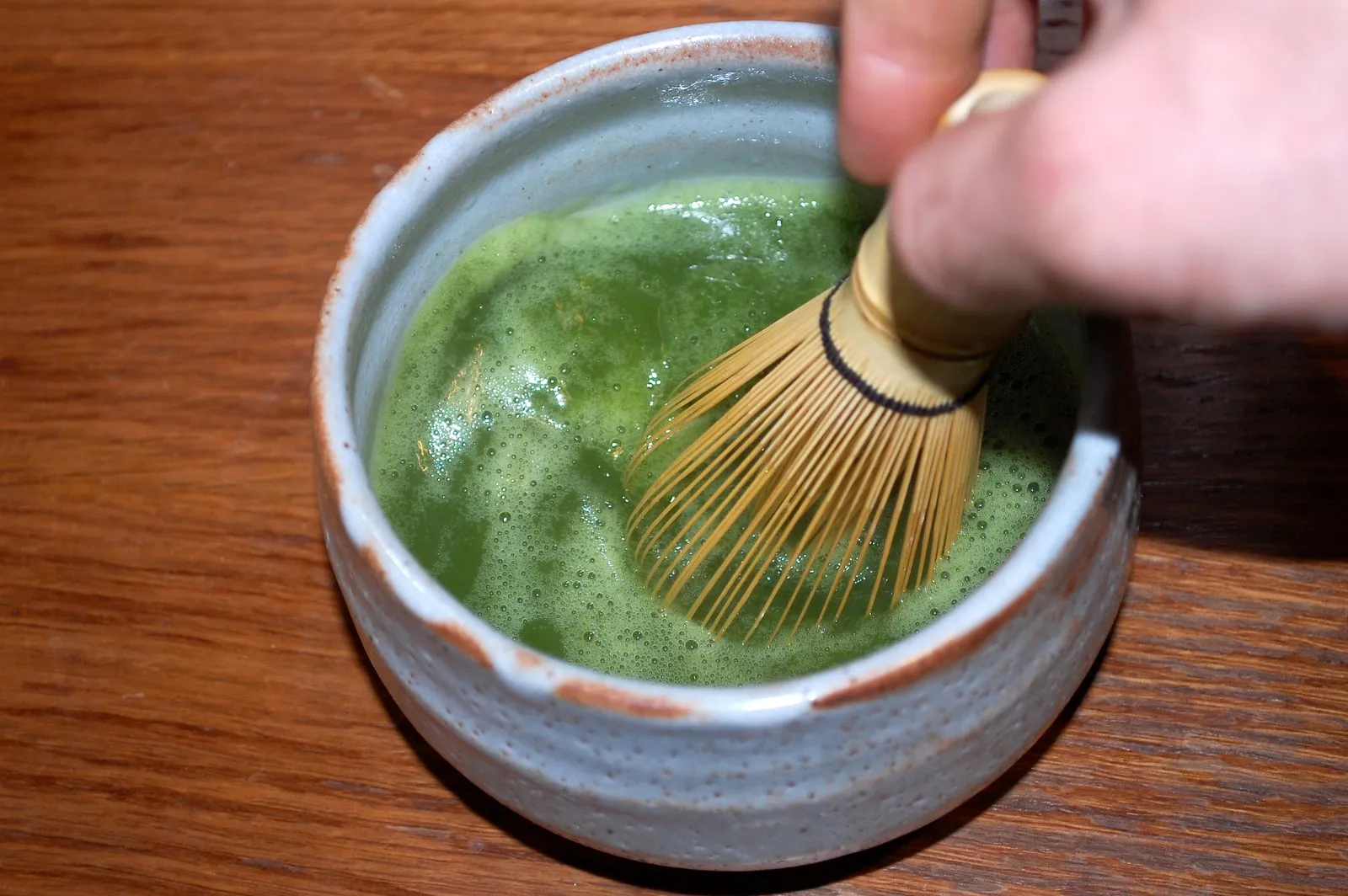
This photograph shows a bamboo whisk being used to prepare matcha. The source does not identify a particular tea school or gathering.
The Physics and Aesthetics of Whisking
During temae, the chasen traces rapid “W” or “M” patterns through the tea, generating shear forces that entrain air into the liquid, forming bubbles. Tea saponins in the matcha act as natural surfactants, lowering the air–liquid surface tension and enabling bubble formation while resisting coalescence; tea-powder particles and proteins form a viscous film on bubble surfaces, enhancing mechanical strength and longevity[8].
The ideal usucha foam should be “white, fine, even, and long-lasting.” Urasenke particularly values a rich, full foam layer, while Omotesenke prefers a more restrained, delicate froth. This difference reflects the subtle aesthetic divergence between the two schools: Urasenke emphasises “wa” (inclusiveness and warmth), while Omotesenke emphasises “jaku” (restraint and quietude)[6][7].
Water temperature is also critical. Around 70–80 °C is generally considered suitable for usucha: water that is too hot brings out bitterness, while water that is too cool makes fine foam harder to raise.
Guest Etiquette: From Entrance to Exit
The Complete Guest Experience
In a formal usucha gathering (chaji), the guest (kyaku) experiences the following:
- Nyūtei (entering the pavilion): Guests arrive at the appointed time, wait in the machiai (waiting room), and appreciate the garden and scroll;
- Tsukubai: In the roji, crouch at the stone basin to wash hands and rinse mouth, symbolising cleansing of the mundane;
- Nijiriguchi: Crawl through the low entrance, and first bow to the scroll and flower in the tokonoma;
- Seating: Take seats in order, with the shōkyaku (chief guest) closest to the tokonoma;
- Utensil appreciation: The host displays the chaire and chashaku; guests examine them in turn and offer thanks;
- Receiving tea: The host serves tea; the guest receives the bowl with the right hand, places it in the left palm, and thanks the host;
- Drinking: Supporting the bowl with the right hand, rotate it clockwise twice (to avoid the front), drink in three sips, and emit a soft sui on the last sip to express appreciation;
- Admiring the bowl: After drinking, wipe the rim with thumb and forefinger, turn the bowl to face the front, and admire the glaze and form;
- Exit: The host gathers utensils; guests bow again to the scroll and leave in order[7][3].
Ichi-go Ichi-e
Ichi-go ichi-e (one time, one meeting) is one of the most central spiritual concepts of tea ceremony. Rooted in the Zen view of impermanence, it teaches that every gathering is a unique convergence of time and space — host and guest, utensils and season, light and atmosphere — never to be repeated. Therefore, the host must prepare with omotenashi (wholehearted hospitality), and the guest must receive with kansha (appreciation)[4][3].
Modern Heritage and Global Influence
Domestic Transmission in Japan
Today, tea ceremony remains an important part of traditional cultural education in Japan. Many schools include tea ceremony in club activities or integrated studies; many universities have sadō-bu (tea ceremony clubs), predominantly of the Urasenke school. Domestic learners are numerous, with Urasenke, Omotesenke, Mushakōjisenke, and other schools (such as Enshū-ryū and Oribe-ryū) forming a diverse ecosystem[6].
International Dissemination
Urasenke has been a pioneer in the internationalisation of tea ceremony. The 15th-generation iemoto Sen Sōshitsu has travelled extensively to Europe, the Americas, and Asia since the 1960s, promoting tea ceremony and establishing the Urasenke Gakuen in Kyoto and dozens of overseas chadō circles. Urasenke’s ryūrei temae is especially popular internationally because it allows guests to sit in chairs or on sofas, lowering the physical barrier to entry[6].
In recent years, tea ceremony has resonated with global cultural movements such as “mindfulness” and “slow living.” Many tea rooms, yoga studios, and meditation centres in Western cities have begun incorporating elements of tea ceremony as a form of stress relief and spiritual cultivation. However, this “decontextualised” dissemination has also sparked controversy: some Japanese tea-ceremony guardians argue that “tea-ceremony experiences” detached from Zen and seasonal context risk becoming mere cultural consumption, diluting the spiritual core of the practice[3].
Common Myths & Scientific Clarifications
Myth 1: “Is the Japanese tea ceremony (chanoyu) simply the Song Dynasty whisked tea method preserved intact?”
Scientific Clarification: A historical oversight ignoring six centuries of aesthetic reconstruction. While chanoyu traced its origins to Song Zen monastery whisked tea brought back by Eisai, Japanese masters Murata Jukō, Takeno Jōō, and Sen no Rikyū fundamentally re-architected it into Wabi-cha[2][3]. Agronomically, Song compressed tea cakes evolved into shade-grown steamed tencha; thermal mechanics reduced water temperature from Song near-boiling (90–95 °C) to 70–80 °C to curb bitterness and highlight theanine umami; aesthetically, the lavish imperial pursuit of white froth and Jian ware shifted decisively toward the rustic wabi austerity of thatched huts, wa-kei-sei-jaku, and hand-molded black Raku bowls[2][4].
Myth 2: “Has the Japanese tea ceremony always been a leisure pursuit for women practicing refined manners?”
Scientific Clarification: A historical inversion born from modern gender demographics. From the Muromachi through Sengoku, Azuchi-Momoyama, and Edo periods, the tea ceremony was an exclusive socio-political realm and spiritual crucible for Zen abbots, samurai warriors, and daimyō lords[3][4]. Warriors removed their swords before entering the crawling entrance (nijiriguchi) to confront mortality and foster mental equanimity. It was only during the Meiji period that tea was incorporated into female secondary education as deportment training, swelling female participation; yet the pinnacle Grand Master (Iemoto) lineages of the San-Senke remain strictly male-hereditary to this day[3][6].
Myth 3: “Can any commercially available green tea powder be whisked into authentic ceremonial matcha?”
Scientific Clarification: Ordinary green tea powder and ceremonial matcha are technologically divergent. True matcha requires at least 20 days of deliberate shade cultivation (honzu or kabuse) prior to plucking, suppressing bitter catechins while maximizing umami-rich theanine and vibrant chlorophyll[1][8]. The leaves are flash-steamed without rolling to preserve cell walls, dried into tencha, and micro-pulverized using traditional granite stone mills at low RPM into 5–15 μm particles[1][8]. Ordinary pan-fired green tea powder has a coarse particle distribution (40–80 μm) and high tannin degradation, failing to generate the stable, micro-foaming suspension characteristic of ceremonial grade[1][8].
Myth 4: “Does attending a Japanese tea gathering require kneeling in rigid seiza for hours without moving?”
Scientific Clarification: A dogmatic perception of tea etiquette. While classical tatami seiza remains standard, chanoyu prioritizes hospitality, mutual consideration, and spiritual composure over physical ordeal[6][7]. As early as the 1872 Kyoto Exhibition, the 11th Urasenke Grandmaster Gengen-sai created the Ryūrei table-and-chair style to welcome foreign guests without requiring floor seating, which is now an official presentation across schools[6]. In contemporary tea gatherings, guests are entirely welcome to politely excuse themselves and shift posture or use discrete wooden meditation stools (seiza benches) between formal greetings[6][7].
Related Entries
- Song Whisked Tea — The direct technical predecessor of Japanese matcha tea ceremony
- Origin and Global Spread of Tea — The historical thread from medicinal use to beverage
- Tang Boiled Tea — China’s first systematic tea-making method
- Flavor Wheel & Six Tea Categories — Comparison of matcha flavour with green-tea flavour profiles
References
- R-148 — UNESCO. (2013). Washoku, traditional dietary cultures of the Japanese, notably for the celebration of New Year. Inscribed in 2013 on the Representative List of the Intangible Cultural Heritage of Humanity (8.COM 8.17). https://ich.unesco.org/en/RL/washoku-traditional-dietary-cultures-of-the-japanese-notably-for-the-celebration-of-new-year-00869
- R-133 — 荣西 (日本建历元年 1211年).《吃茶养生记》(Kissa Yōjōki). 日本第一部茶学著作. 论茶为养生之仙药与五脏五味调和.
- R-118 — 桑田忠亲 (1979).《日本茶道史》. 河出书房新社. ISBN: 978-4309220970.
- R-135 — Sen Sōshitsu XV. (1998). The Japanese Way of Tea: From Its Origins in China to Sen Rikyū. University of Hawaii Press. ISBN: 978-0824819903.
- R-142 — 林屋辰三郎 (1978).《数寄屋と茶室:日本建築の美と歴史》. 平凡社.
- R-144 — Urasenke Foundation. (2020). Chado: The Way of Tea and the Philosophy of Harmony, Respect, Purity and Tranquility. Kyoto, Japan. https://www.urasenke.or.jp/
- R-145 — Omotesenke Fushin’an. (2020). The Tradition of Chanoyu and the Spirit of Wabi. Kyoto, Japan. https://www.omotesenke.jp/
- R-122 — Böttcher, S., & Drusch, S. (2016). Interfacial Properties of Saponin Extracts and Their Impact on Foam Characteristics. Food Biophysics, 11(1), 91–100. https://doi.org/10.1007/s11483-015-9420-5
Article Knowledge Network
Explore the connections between the teas, processes and flavours in this article.