
Start with the essentials
Gongfu tea connects small vessels, repeated infusions and shared liquor with brewing and hospitality. Warming, pouring and distributing affect both the cup and the gathering’s rhythm. This use of gongfu differs from Gongfu black-tea manufacture.
The article explains tools, preparation and host–guest relationships, then compares regional practices. Understanding each action’s purpose makes terminology and etiquette easier to use in daily life.
Three key points
- Ratio works with rhythmLeaf, water and timing coordinate repeated small infusions.
- Tools serve operationsHeating, pouring, draining and sharing have practical roles.
- Hospitality belongs to the practiceCleanliness, distribution and conversation vary across communities and households.
Try it in everyday brewing
Use an easily controlled gaiwan or small pot, observe successive infusions and share the liquor evenly. Learn safe practical purposes before adopting named gestures or high pouring.
Name: gongfu tea, not “kung fu tea”
In the Min and Yue dialects, gongfu means time, effort and care. Reliable records of “gongfu tea” as the name of a brewing practice date from Qing texts (such as Yu Jiao’s Mengchang zazhu), where it refers to the small-pot, small-cup, repeated-infusion method of southern Fujian, Chaozhou and Taiwan[3].
Modern marketing often writes it as “kung fu tea”, borrowing the martial-arts connotation of “kung fu” to suggest skill. Strictly speaking, “gongfu tea” is the historically and academically correct form; “kung fu tea” is a phonetic folk variant that has become widespread but is not the standard term in scholarly or ICH contexts[1][3].
Core vessels: the four treasures and the tea array
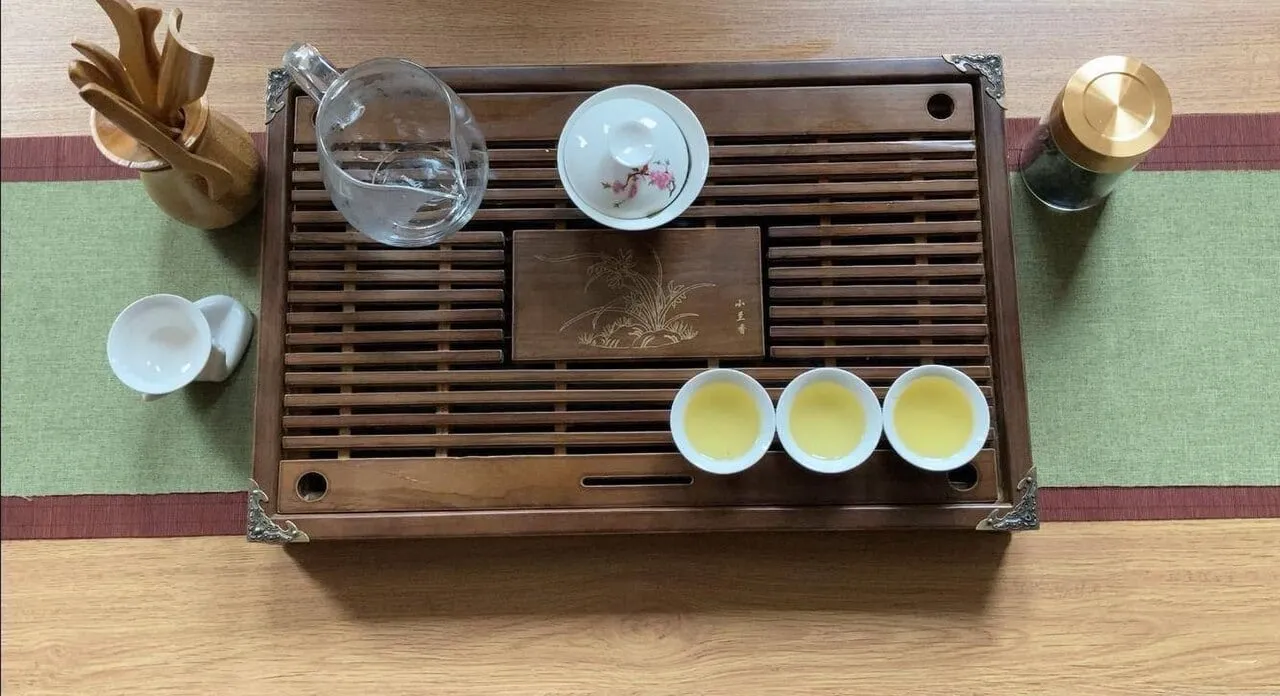
Traditional gongfu tea revolves around four core vessels, often called the “four treasures”:
| Vessel | Name | Function and aesthetics |
|---|---|---|
| Teapot | Mengchen pot | A small Yixing zisha pot, often 80–150 ml, dedicated to one tea type and “raised” over years. |
| Cups | Ruochen cups | Small, thin white porcelain cups from Jingdezhen; three cups to a set, finished in three sips. |
| Kettle | Yushu kettle / brazier kettle | A small clay or sand kettle whose boiling sound helps judge the water’s heat. |
| Stove | Hongni stove | A red-clay brazier burning olive pits or alcohol, giving gentle, steady heat. |
The whole set is small by design: small pot, small cups, small stove. This matches the brewing logic of high leaf-to-water ratio, short infusion times and many infusions.
The “four treasures” of gongfu tea
Switch to light up each vessel.
A small red-clay pot
- A small pot: quick to pour off
- A snug lid keeps the heat in
A small pot and a high leaf ratio let each infusion pour off in seconds.
Sources & reading
The four treasures follow the Chaozhou gongfu tea tradition described in this article [5]; real sets vary by household and region.
Schematic; practice differs by region, school and teaware.
Brewing logic: high ratio, short times, many infusions
Gongfu tea uses little water and a lot of leaf, often reaching 1:15 or even 1:10, with each infusion lasting from a few seconds to around a minute. The logic is:
- High concentration at the start: the first few infusions are poured out quickly to capture fragrance and freshness.
- Gradually lengthen: as the leaf is depleted, each infusion is extended slightly to maintain concentration.
- Many infusions for change: a single tea may yield 5–10 or more infusions, with aroma, taste and body shifting each time.
This method suits semi-oxidised oolong teas especially well — Tieguanyin, Fenghuang Dancong, Wuyi rock tea and Dongding oolong — because their aromatic layers only fully unfold over multiple infusions.
Step by step: from warming the vessel to tasting
The following sequence is based on the Chaozhou 21-form gongfu tea, a nationally recognised intangible cultural heritage item[2][3]:
Five moves of Chaozhou gongfu tea
Watch the kettle, pot and cups.
Rinse and warm the set
- Boiling water from the kettle
- Into the empty pot
- Then over the cups
A warm pot and warm cups do not steal heat from the first brew.
Sources & reading
Five moves condensed from the Chaozhou “21 forms” [5]; leaf ratio is often 1:15 to 1:10, with steeps from seconds to a minute.
Schematic; practice differs by region, school and teaware.
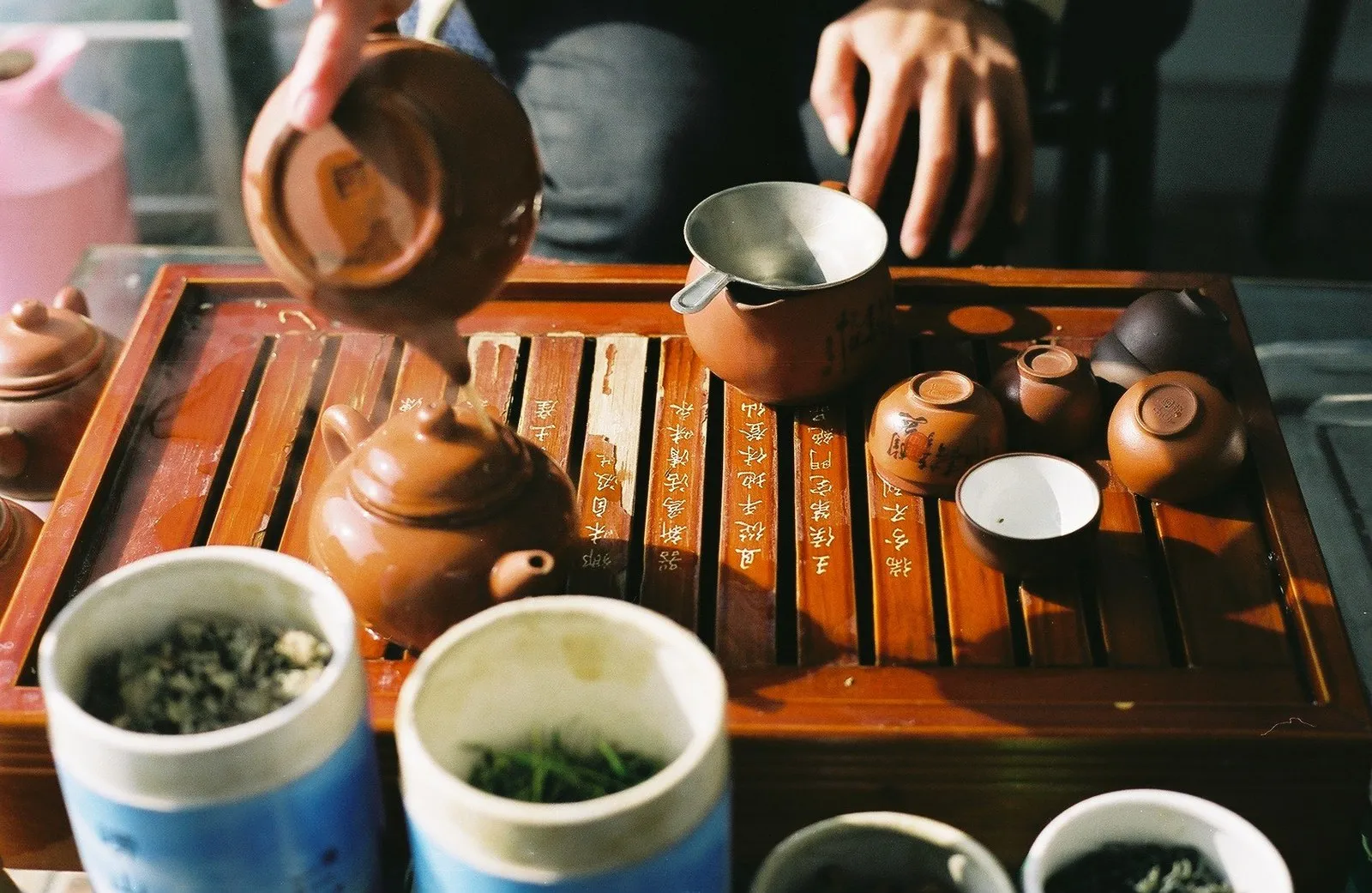
1. Warm the vessel
Rinse the pot and cups with boiling water to clean and pre-heat them. A warm pot does not steal heat from the first infusion.
In this tea setting, water is poured from one pot onto another. The photographer documented a green-tea service near Laoshan; it illustrates handling the vessels, not the complete Chaozhou sequence.
2. Load the leaves
Fill the pot with leaves to roughly one-half to two-thirds of its volume. Gongfu tea is “more leaf, less water”; the act is called “na cha” (receiving tea) rather than simply “putting tea”.
3. Heat the water
Listen to the water as it approaches the boil: “shrimp eyes”, “crab eyes”, “fish eyes” and linked pearls describe different stages of heat. Oolong and rock tea can start near boiling; very tender green teas begin slightly cooler.
4. Rinse the leaves
A quick first pour, immediately discarded, is called “washing tea” or “awakening tea”. Its purpose is not detoxification but to wake the leaves, open the twisted leaf and pre-heat the cups.
5. Pour high
Lift the kettle and pour from above so the stream agitates the leaves, promoting even heat and quick extraction. The high pour also carries a performative element.
6. Skim and cap
Skim the foam with the lid, then pour water over the lid to keep the pot uniformly hot. This is called “lin hu” (showering the pot) or “scraping the foam and capping”.
7. Warm the cups
Cups are rinsed with hot liquor or water so the tea does not cool when served, and so the warmed cup walls help release aroma.
8. Serve low and even
Pour close to the cup rims, rotating between the three cups so each has similar concentration and warmth — this is “Guan Gong patrolling the city”. The last few drops are divided drop by drop — “Han Xin drilling the troops”. Cups are never filled to the brim; leaving space is part of the etiquette of “yielding tea”.
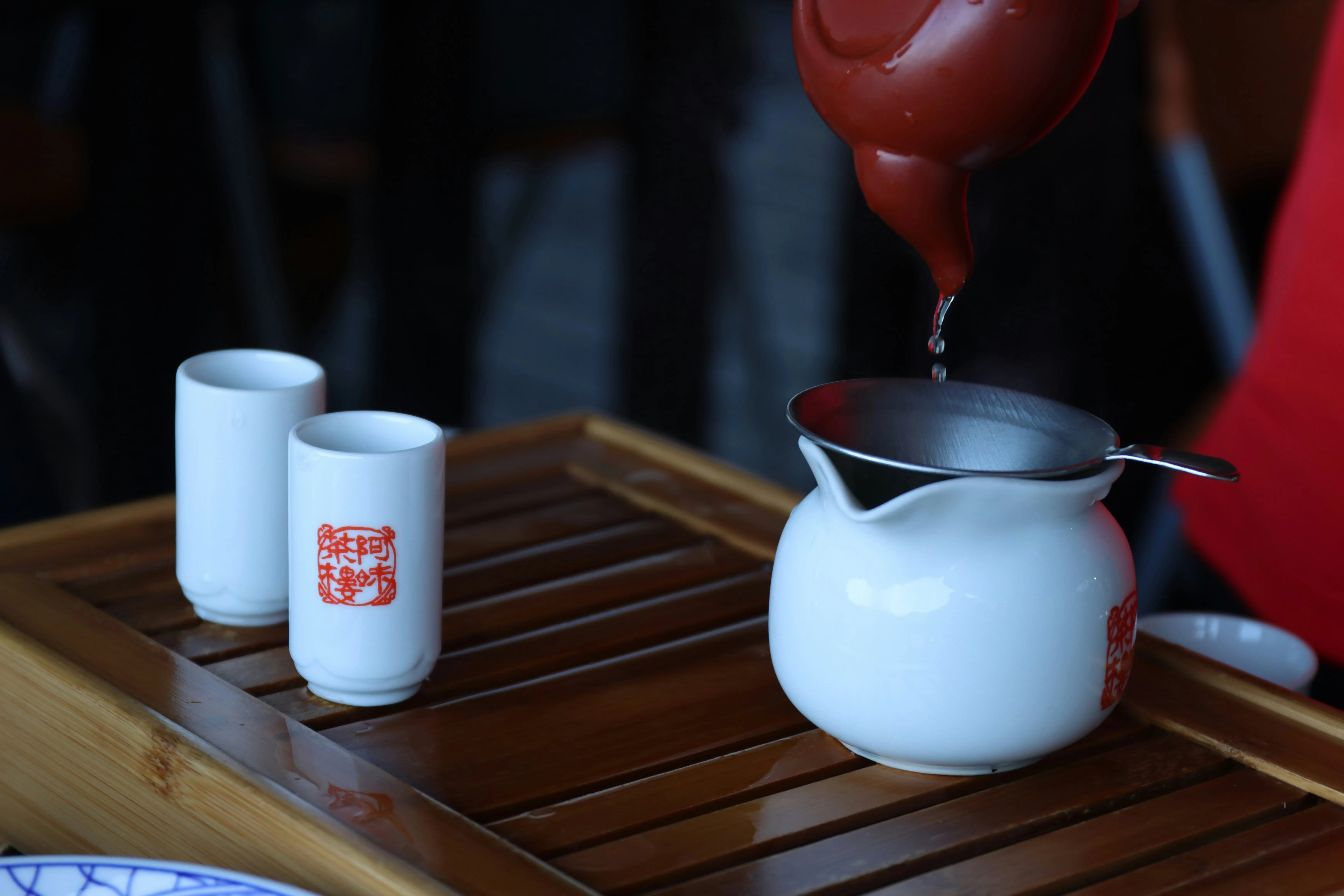
Tea may also be poured through a strainer into a serving pitcher before it is divided among cups. The photograph below documents one tea-house setting in Jiufen; arrangements and gestures vary by occasion.
9. Taste and appreciate
Smell the cup aroma first, then sip in three mouthfuls to sense fragrance, taste, sweetness and throat finish. Emptying the cup in three sips echoes the three “mouths” of the character 品 (to savour); holding the cup with thumb and forefinger on the rim and middle finger under the base is called “three dragons guarding the tripod”.
Etiquette and social rhythm: the tea table as relationship
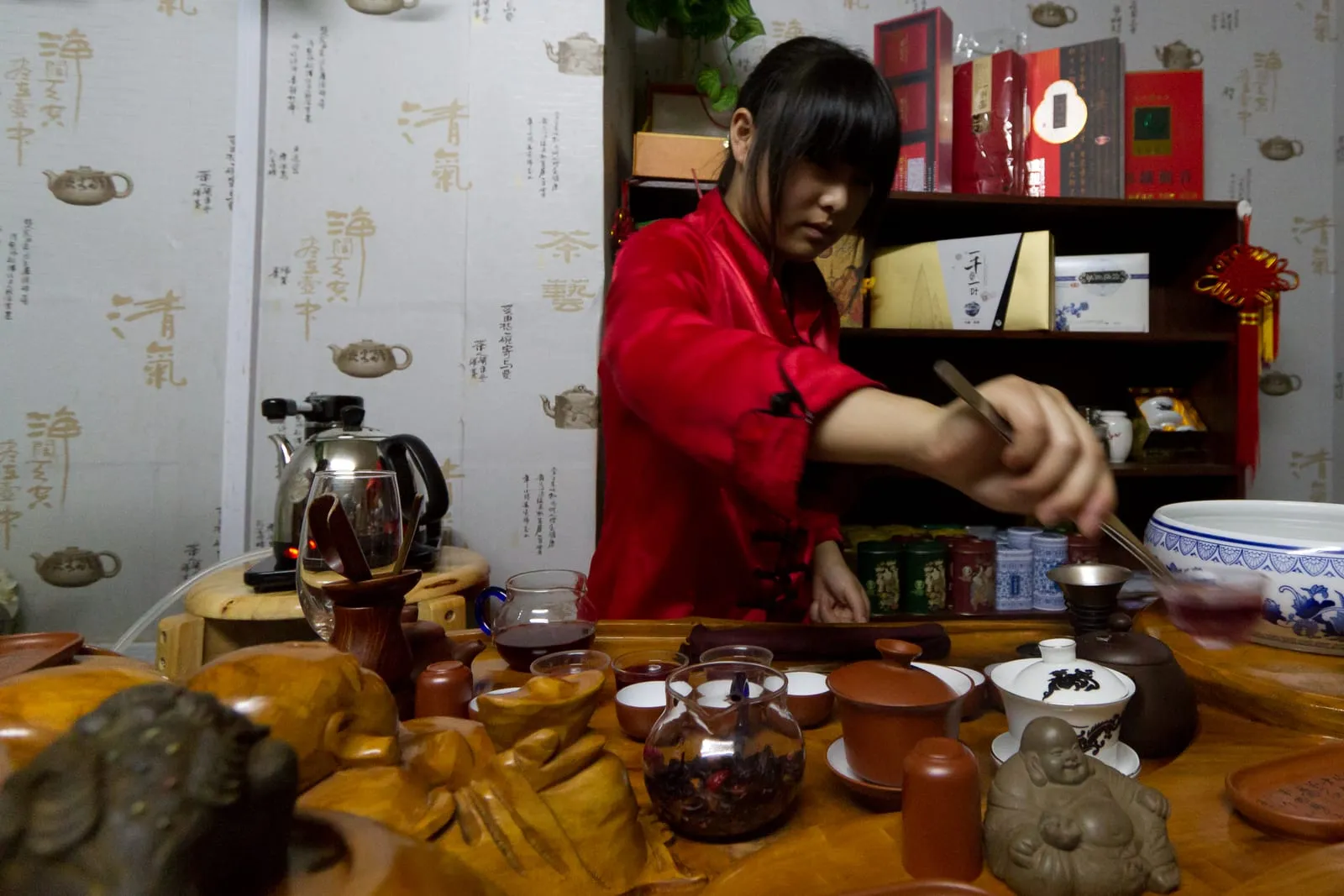
The most compelling feature of gongfu tea is the social rhythm it creates. The host keeps pouring, passing and offering; the guests keep receiving, tasting and thanking. In this constant exchange, tea acts as both buffer and bond:
- Elders first: the first cup is normally offered to the oldest or most honoured guest; if the guest declines, the host may say, “The tea is thin, but the feeling is deep.”
- Three sips as respect: finishing a cup in one gulp seems rushed; three sips show appreciation and attention.
- Finger-tapping thanks: a younger person taps fingers on the table to mimic a kowtow, thanking an elder for pouring tea.
- Refilling and stopping: continuous refilling means welcome; a guest who wants no more leaves the cup on the table instead of lifting it again.
Chaozhou gongfu tea was listed as national intangible cultural heritage in 2008 and inscribed by UNESCO in 2022 as part of “Traditional tea processing techniques and associated social practices in China”. The focus of protection is not “revival” but maintaining this living practice of gathering people and expressing hospitality through tea[2][4][5].
Regional variations
Chaozhou gongfu tea
The most systematic and codified form. The Chaozhou 21-form was compiled by inheritors such as Chen Xiangbai and stresses “harmony, respect, refinement and enjoyment”[2][3].
Southern Fujian gongfu tea
Quanzhou, Zhangzhou and Xiamen practice a method close to Chaozhou, but household practice often substitutes a gaiwan for the small pot. Tieguanyin’s golden age in the 1990s and 2000s made southern Fujian gongfu tea the model copied nationwide.
Taiwanese gongfu tea / tea-brewing method
Descended from Fujian immigrants, but from the 1970s it developed a “tea-art house” culture that places greater weight on tea-table aesthetics, space and standardised brewing education. Taiwanese tea masters such as Fan Zengping influenced modern tea-art teaching.
Overseas gongfu tea
Chinese tea houses in Southeast Asia (Singapore, Malaysia, Thailand) retain many Chaozhou traditions, coexisting with local coffee culture and Nyonya culture to create a distinctive Nanyang tea-space.
Comparing the Four Regional Gongfu Tea Traditions
| Regional Branch | Signature Teas | Core Brewing Vessels | Brewing & Aesthetic Focus |
|---|---|---|---|
| Chaozhou Gongfu Tea | Fenghuang Dancong, medium/heavy-roast oolongs | Small Zhuni Yixing pot (Mengchen) + three small porcelain cups arranged in a triangle (no fairness pitcher) | High leaf-to-water ratio, high pour, lid-skimming, and direct rotational pouring (Guan Gong / Han Xin) for concentrated body and lingering throat finish[2][3] |
| Southern Fujian (Minnan) Gongfu Tea | Anxi Tieguanyin, Wuyi Rock Tea | White porcelain gaiwan + fairness pitcher (gongdaobei) + tasting cups | Fast, clean decanting from a glazed gaiwan preserves high floral and mineral-roast aromatics; the fairness pitcher equalises strength for guests and side-by-side comparison |
| Taiwanese Tea-Art (Chayi) | Dongding Oolong, High-Mountain Oolong, Oriental Beauty | Small clay pot or gaiwan + fairness pitcher + paired aroma cup (wenxiangbei) and tasting cup | Introduces the tall narrow aroma cup to capture evolving warm and cooled bottom-of-cup aromatics, paired with dry-table aesthetics and contemplative staging |
| Southeast Asian (Nanyang) Gongfu Tea | Roasted Tieguanyin, Shuixian, Liubao, aged Pu-erh | Traditional Zhuni pot on a deep tea boat + three small cups | Favours roasted, aged, or full-bodied teas suited to tropical humidity, woven into clan associations, shophouse commerce, and neighbourhood gathering |
Common Myths & Scientific Clarifications
Myth 1: “Must Gongfu tea be brewed strictly in Yixing zisha teapots, making porcelain gaiwan unauthentic?”
Scientific Clarification: A misconception regarding Gongfu tea material culture. Throughout Minnan and Chaoshan, both Yixing clay pots (Mengchen jars) and glazed porcelain gaiwans (Sancai cups) are traditional core vessels[2][3]. Porous purple clay retains heat and softens astringency, excelling with heavy-roast Wuyi rock oolongs and aged teas; conversely, vitrified white porcelain absorbs no volatile aromas and drains instantaneously, making it the gold standard for appraising delicate floral Dancong and fragrant Tieguanyin[2][3]. Gongfu tea authenticity resides in fluid dynamic mastery rather than rigid vessel dogmatism[2][3].
Myth 2: “Is the initial ‘rinsing steep’ (wen run pao) intended to wash off pesticide residues and dust?”
Scientific Clarification: Rinsing tea is fundamentally not a toxicological decontamination method. Modern compliant agricultural inputs are overwhelmingly lipophilic and insoluble in brief aqueous flushes; safety relies on farm governance and laboratory testing[1][2]. The true thermodynamic purpose of the rapid initial rinse is to elevate leaf core temperature and break surface tension, allowing tightly rolled semi-spherical or strip-style dry leaves to gently unfurl. This thermal wake-up enables balanced, consistent diffusion of polyphenols and amino acids from the subsequent infusions onwards[2][3].
Myth 3: “Is the Gongfu brewing methodology strictly limited to oolong teas like Tieguanyin, Dancong, and Rock Tea?”
Scientific Clarification: A narrow view of sensory extraction principles. The Gongfu method embodies an analytical extraction framework characterized by high leaf-to-water ratios (1:15–1:22), small vessels, flash pouring, and progressive second-by-second infusion curves[2][3]. Far from being restricted to oolongs, this hydrodynamic approach is widely employed across high-end tea appreciation—including raw and ripe pu-erh, aged Fuding white tea, and orthodox Keemun black tea—because it captures transient top notes and maps extraction persistence across successive infusions[1][2].
Myth 4: “Does a more expensive teapot with thick ‘seasoned patina’ (chashan) guarantee superior tea flavour?”
Scientific Clarification: Conflating antique valuation with brewing functionality. Master-craftsman teapot valuations reflect artisanal scarcity and aesthetic collectibility rather than physical extraction physics. What dictates infusion quality is thermal stability, clay purity, lid seal precision, and smooth laminar pouring[2][3]. Crucially, neglecting pot hygiene to build up thick “tea cake residue” is a hazard: oxidized polyphenol build-ups harbor rancid organic fats and mold spores, spoiling delicate tea profiles with stale taints[1][2]. Utensil cleanliness remains the paramount foundation of fine tea preparation.
Related entries
- Traditional Chinese tea craft techniques and social practices — the UNESCO ICH framework encompassing Chinese tea making and social customs
- Teaware Thermodynamics — how Yixing clay pots and glazed porcelain gaiwans differ in heat retention, wall thickness, and decanting flow
- Brewing basics & quick reference — the temperature, leaf-to-water ratio, and timing variables behind gongfu brewing
- Anxi Tieguanyin, Wuyi Rock Tea, & Dongding Oolong — benchmark oolongs whose layered aromatics unfold across repeated gongfu infusions
- Song Dynasty Tea Culture — trace the historical shift from Tang boiling and Song whisked powdered tea to Ming–Qing loose-leaf steeping
- Japanese tea ceremony · Chadō — another East Asian tea ritual, contrasting powdered-tea temae with oolong gongfu hospitality
References
- R-030 — 陈宗懋 主编 (2000).《中国茶叶大辞典》. 中国轻工业出版社. ISBN: 978-7501925094.
- R-248 — 潮州市文化广电旅游体育局. 潮州工夫茶冲泡技艺(国家级非物质文化遗产代表性项目资料). 2008.
- R-305 — 陈香白. (1998). 中国茶文化. 太原: 山西人民出版社. ISBN: 978-7203037279.
- R-245 — 中华人民共和国文化和旅游部. 中国传统制茶技艺及其相关习俗列入人类非物质文化遗产代表作名录. 2022-11-29. https://www.mct.gov.cn/
- R-146 — UNESCO. (2022). Traditional tea processing techniques and associated social practices in China. Inscribed in 2022 on the Representative List of the Intangible Cultural Heritage of Humanity (17.COM 7.b.6). https://ich.unesco.org/en/RL/traditional-tea-processing-techniques-and-associated-social-practices-in-china-01884
Article Knowledge Network
Explore the connections between the teas, processes and flavours in this article.