
Start with the essentials
Traditional tea craft includes decisions as well as steps: when to turn leaves, how aroma has changed, and what warmth or elasticity indicates. Seeing, smelling, touching and handling form practical knowledge alongside tools, local life and teaching.
This article explores sensory judgement, representative crafts and the relationship between heritage, customs, hand work and machinery. Understanding how people decide and pass on experience gives the heritage more meaning than a list alone.
Three key points
- Actions require timely judgementMaterial and weather can call for different handling.
- Teaching connects observation with decisionsDemonstration, explanation and practice carry experience forward.
- Protection involves people and settingsTools, customs and modern production affect continuity; listings do not certify every product.
Notice how a craft is passed on
Watch where a maker pauses to judge conditions and changes the next action. Connect those observations with explanation and learning to recognise the experience within the craft.
Why “Techniques + Practices” Were Nominated Together
UNESCO’s nomination dossier highlights this heritage as “knowledge, skills and practices concerning the management of tea plantations, tea-leaf picking, manual processing, drinking and sharing”[1]. Pairing technical craft with cultural custom reflects how tea functions in China not merely as an agricultural commodity or industrial beverage, but as an indispensable cultural medium:
- Agrarian Philosophy on the Production Side: Harmonized with the 24 solar terms—sprouting at the Spring Equinox, plucking tender buds before Qingming, harvesting abundant flushes during Grain Rain. Millennia of ecological wisdom unite cultivar breeding with soil and microclimate management.
- Empirical Science on the Artisanal Side: Tea masters continuously monitor temperature, moisture, and mechanical pressure through sensory perception—touch, vision, hearing, and olfaction—converting raw green shoots into dry leaves of profound aromatic complexity.
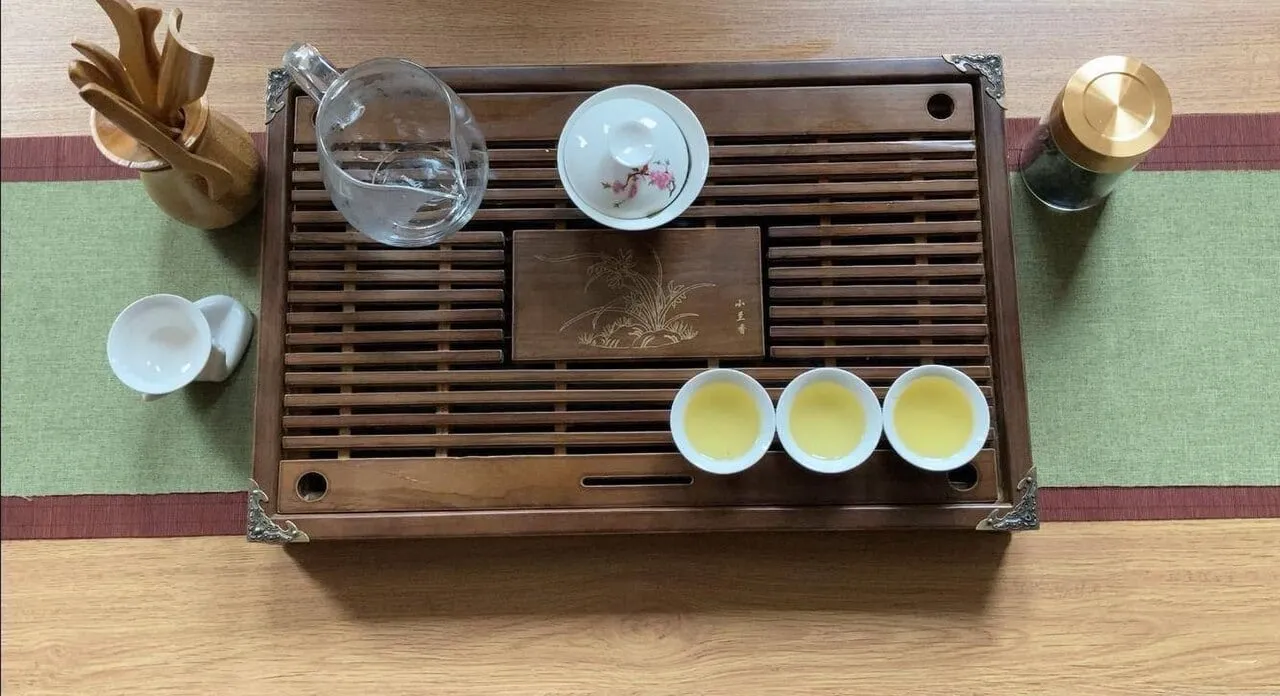
- Social Cohesion on the Living Side: From seasonal spring plucking rites, Dragon Boat and Mid-Autumn tea sharing, to wedding tea ceremonies where newlyweds honor elders and memorial tea offerings, tea is the universal language of social etiquette and mutual respect[2][3]. In southeastern regions like Chaoshan and Fujian, the Gongfu tea table functions as an indispensable social hearth for daily hospitality and commercial negotiations—where an ancient saying goes: “There are no strangers across a tea table; a warm infusion dissolves all distance.”
This tripartite synthesis—Technique, Practice, and Society—distinguishes Chinese tea heritage from purely automated food manufacturing and from rigid single-school ceremonial formats. Tangible agro-processing techniques and the living spirit of interpersonal hospitality coalesce into an enduring intangible cultural legacy.
The “Sensory Physics” and Tacit Knowledge of Handcrafting
Long before industrial sensors existed, master tea makers developed a refined system of Sensory Physics to govern biochemical transformations in real time. This tacit knowledge (隐性知识), transmitted through generations of mentorship, remains the defining soul of premier artisan teas:
1. Visual Cues (Kan Qing / Watching the Leaf)
In Oolong leaf-bruising (zuoqing) and White tea withering, “watching the leaf” governs the entire cycle. The master inspects the evaporation rate, leaf turgidity, and the exact boundary of marginal red oxidation (“green leaf with red borders”) to determine shake speed, resting duration, and moisture redistribution (zoushui).
2. Tactile Feedback & Elasticity
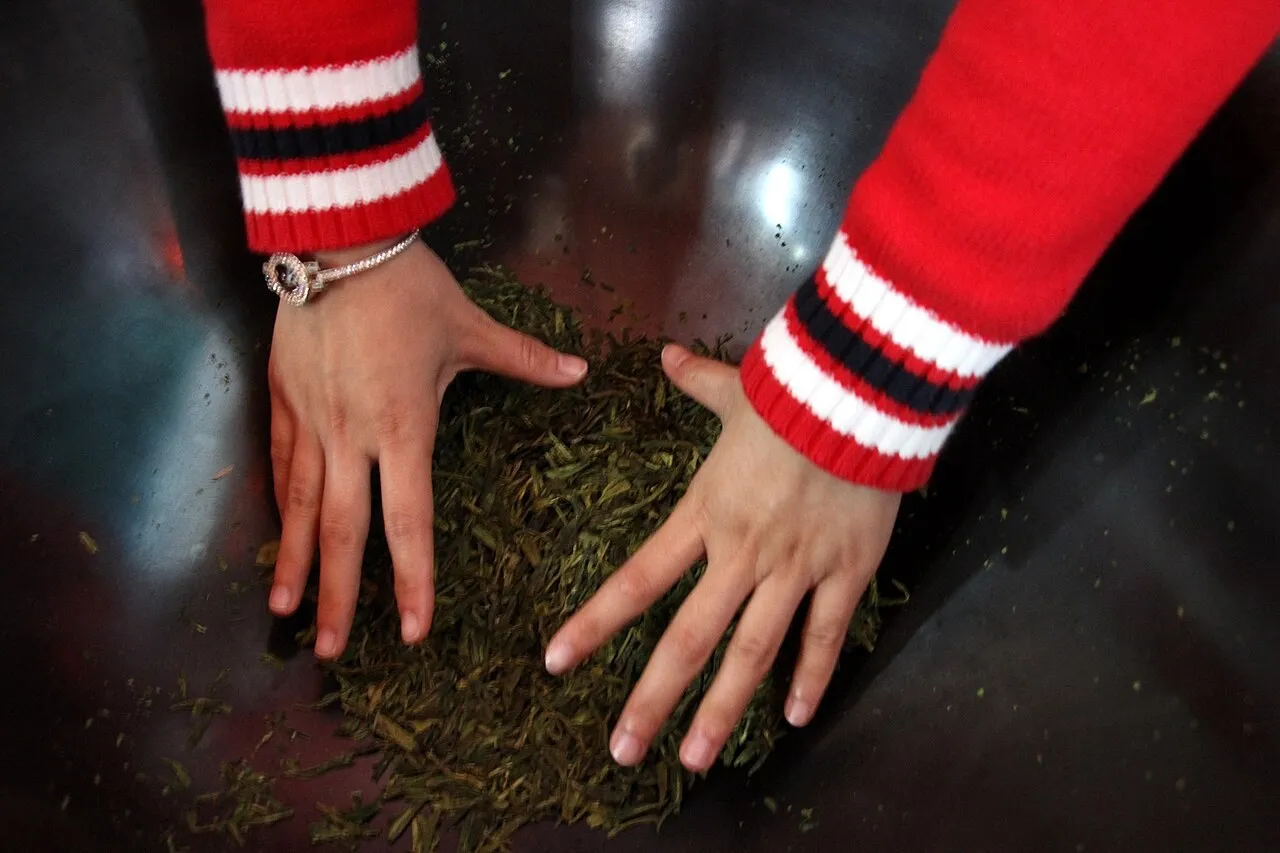
- Wok Temperature & Fixation Degree: During Longjing manual pan-firing, the artisan judges wok heat and leaf condition by hand, feeling for leaf softness, ensuring elasticity is lost without stem breakage.
- Rolling Pressure: Applying calibrated palm force to rupture leaf cell walls and express viscous juices, avoiding leaf shredding while achieving tightly twisted cords.
- Pile Temperature (Wodui): In ripe Pu-erh pile-fermentation, the elder master plunges his bare arm deep into the pile, feeling the 55–65 °C core heat and moisture tackiness to time turning and aeration.
This photograph records hand work in a pan at a Hangzhou tea plantation. It shows the contact between hands, leaves and pan; the photographer does not specify the particular firing stage.
3. Auditory Feedback (Ting Sheng / Listening to the Crackles)
During iron-wok pan-firing, raw moisture violently vaporizes against hot metal, generating dense crackling pops. As enzymes denature and moisture drops, the crackles thin out into crisp, intermittent snaps—signaling the exact second to empty the wok.
4. Olfactory Turning Points (Xiu Xiang)
Volatile aromatic compounds undergo rapid reconfiguration. The artisan continuously smells the rising vapor, capturing the precise transition when low-boiling grassy aldehydes (e.g., (Z)-3-hexenol) dissipate and high-boiling floral monoterpenes (linalool, geraniol) emerge, instantly initiating high-heat fixation.
5. Thermal Intuition & Charcoal Roasting Physics (Tanpei)
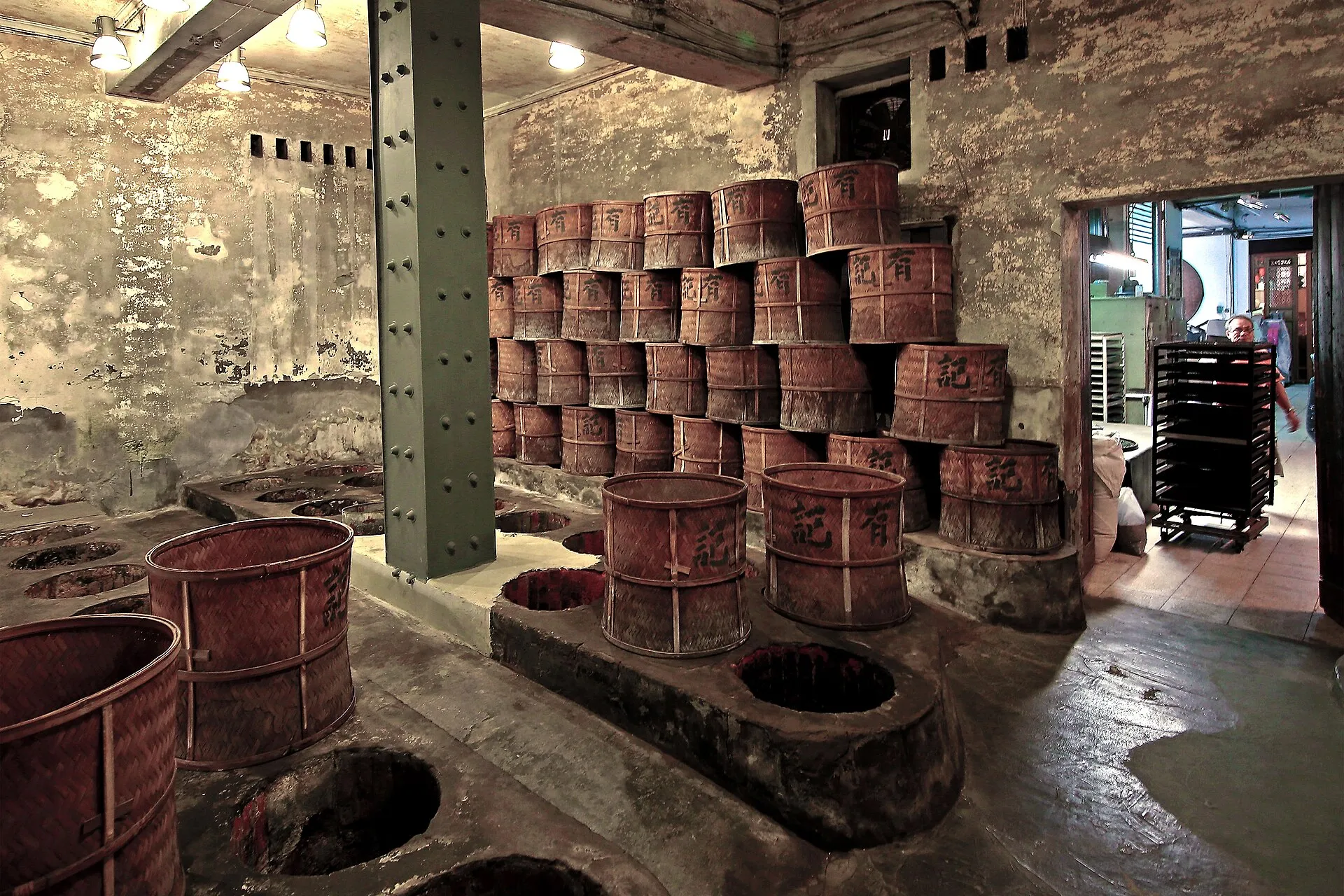
In the refining of Wuyi rock tea, Phoenix Dancong, and traditional Oolong, slow charcoal roasting (炭火慢焙) is the defining soul of enduring depth and stability[5][6]. Traditional bakehouses rely on zero electrical sensors; the roastmaster operates entirely through sight, touch, and radiant thermal intuition:
- Hardwood Charcoal & Smokeless Embers: Pure lychee-wood or dense white charcoal is combusted until glowing red without trace of smoke before being packed into floor pits;
- Ash Blanket Temperature Regulation: Depending on atmospheric humidity and barometric pressure, the master blankets glowing coals with a 1–3 cm layer of fine rice-husk or bamboo-wood ash. Adjusting ash thickness and ventilation holes modulates radiant pit temperature within 60–120 °C;
- Far-Infrared Penetration & Maillard Dynamics: Far-infrared radiation gently penetrates leaf cells without scorching surfaces, driving catechin condensation and Maillard reactions between reducing sugars and free amino acids. This eliminates lingering grassy harshness and develops roasted nutty, pyrazine, and caramelized aromas, forging long-lived “rock bone” complexity.
How a maker judges oolong by the senses
Eye, hand, ear, nose: one leaf.
Watch the edge redden
- Red edge, green centre
- Roughly three red, seven green
The red rim shows how far shaking has bruised and oxidised the edge.
Sources & reading
Oolong shaking (zuoqing) as the example; every class of tea relies on similar judgement by eye, hand, ear and nose. Descriptions follow this article’s craft profiles [5][6].
Schematic; judgement differs with leaf, weather and maker.
Representative Traditions Across the 44 ICH Items
The 44 inscribed items constitute a grand map of Chinese regional tea mastership across the primary categories[2]:
44 national heritage items
Open a tea class to see its items.
Green tea14
- Green Tea Craft (West Lake Longjing)Zhejiang · Hangzhou
- Green Tea Craft (Wuzhou Juyan)Zhejiang · Jinhua
- Green Tea Craft (Zisun Tea)Zhejiang · Changxing, Huzhou
- Green Tea Craft (Anji White Tea)Zhejiang · Anji, Huzhou
- Green Tea Craft (Dongting Biluochun)Jiangsu · Taihu, Suzhou
- Green Tea Craft (Yuhua Tea)Jiangsu · Nanjing
- Green Tea Craft (Wuyuan Green Tea)Jiangxi · Wuyuan, Shangrao
- Green Tea Craft (Huangshan Maofeng)Anhui · Huangshan
- Green Tea Craft (Taiping Houkui)Anhui · Huangshan District
- Green Tea Craft (Lu'an Guapian)Anhui · Jinzhai, Lu'an
- Green Tea Craft (Enshi Yulu)Hubei · Enshi
- Green Tea Craft (Xinyang Maojian)Henan · Xinyang
- Green Tea Craft (Duyun Maojian)Guizhou · Duyun, Qiannan
- Green Tea Craft (Mengshan Tea)Sichuan · Mount Mengding, Ya'an
White tea1
- White Tea Craft (Fuding White Tea)Fujian · Fuding, Ningde
Yellow tea1
- Yellow Tea Craft (Junshan Yinzhen)Hunan · Junshan Island, Yueyang
Oolong3
- Wuyi Rock Tea (Da Hong Pao) CraftFujian · Wuyishan, Nanping
- Oolong Tea Craft (Tieguanyin)Fujian · Anxi, Quanzhou
- Oolong Tea Craft (Zhangping Shuixian)Fujian · Zhangping, Longyan
Black tea4
- Black Tea Craft (Tanyang Gongfu)Fujian · Fu'an, Ningde
- Black Tea Craft (Ninghong Tea)Jiangxi · Xiushui, Jiujiang
- Black Tea Craft (Keemun Black Tea)Anhui · Qimen, Huangshan
- Black Tea Craft (Dianhong Tea)Yunnan · Fengqing, Lincang
Dark tea11
- Dark Tea Craft (Anhua Qianliang Tea)Hunan · Anhua, Yiyang
- Dark Tea Craft (Anhua Fuzhuan Tea)Hunan · Anhua, Yiyang
- Dark Tea Craft (Zhaoliqiao Brick Tea)Hubei · Chibi, Xianning
- Dark Tea Craft (Changshengchuan Brick Tea)Hubei · Yichang
- Dark Tea Craft (Xianyang Fu Tea)Shaanxi · Xianyang
- Pu-erh Tea Craft (Tribute Tea Craft)Yunnan · Ning'er, Pu'er
- Pu-erh Tea Craft (Dayi Tea Craft)Yunnan · Menghai, Xishuangbanna
- Traditional Craft (De'ang Sour Tea)Yunnan · Mangshi, Dehong
- Dark Tea Craft (Xiaguan Tuocha)Yunnan · Xiaguan, Dali
- Dark Tea Craft (Nanlu Border Tea)Sichuan · Ya'an
- Dark Tea Craft (Liubao Tea)Guangxi · Cangwu, Wuzhou
Scented tea3
- Flower Tea Craft (Fuzhou Jasmine Scenting)Fujian · Fuzhou
- Flower Tea Craft (Wuyutai Jasmine)Beijing · Dongcheng District
- Flower Tea Craft (Zhangyiyuan Jasmine)Beijing · Xicheng District
Tea customs7
- Temple Fair (Pan'an Tea Market Fair)Zhejiang · Pan'an, Jinhua
- Tea Art (Jingshan Tea Banquet)Zhejiang · Yuhang, Hangzhou
- Tea Refreshment (Fuchun Tea Refreshment)Jiangsu · Yangzhou
- Green Tea Craft (Gannan Hakka Pounded Tea)Jiangxi · Ganzhou
- Tea Custom (Bai Three-Course Tea)Yunnan · Dali
- Tea Art (Chaozhou Gongfu Tea)Guangdong · Chaozhou
- Tea Custom (Yao Oil Tea Custom)Guangxi · Gongcheng, Guilin
From the UNESCO listing “Traditional tea processing techniques and associated social practices in China” (2022) [2].
Green Tea: Pan-Fired and Steamed Traditions
- West Lake Longjing (Zhejiang): The benchmark of flat pan-firing, employing ten distinct manual hand movements (shake, press, push, rub,扣, etc.) to achieve flat sword-like shape and chestnut sweetness.
- Anji Baicha (Zhejiang): Harvested from a temperature-sensitive albino cultivar during early spring, capturing extraordinarily high amino acid levels (6–9%) and umami richness.
- Enshi Yulu: Preserving steam-fixation techniques, maintaining “three greens” (dry leaf, liquor, infused leaf) and savory nori aroma.
- Huangshan Maofeng, Taiping Houkui, Lu’an Guapian: Anhui green tea icons featuring sparrow-tongue buds, hand-pinched oversized leaves, and single-leaf high-charcoal roasting.
White Tea: The Art of Natural Withering
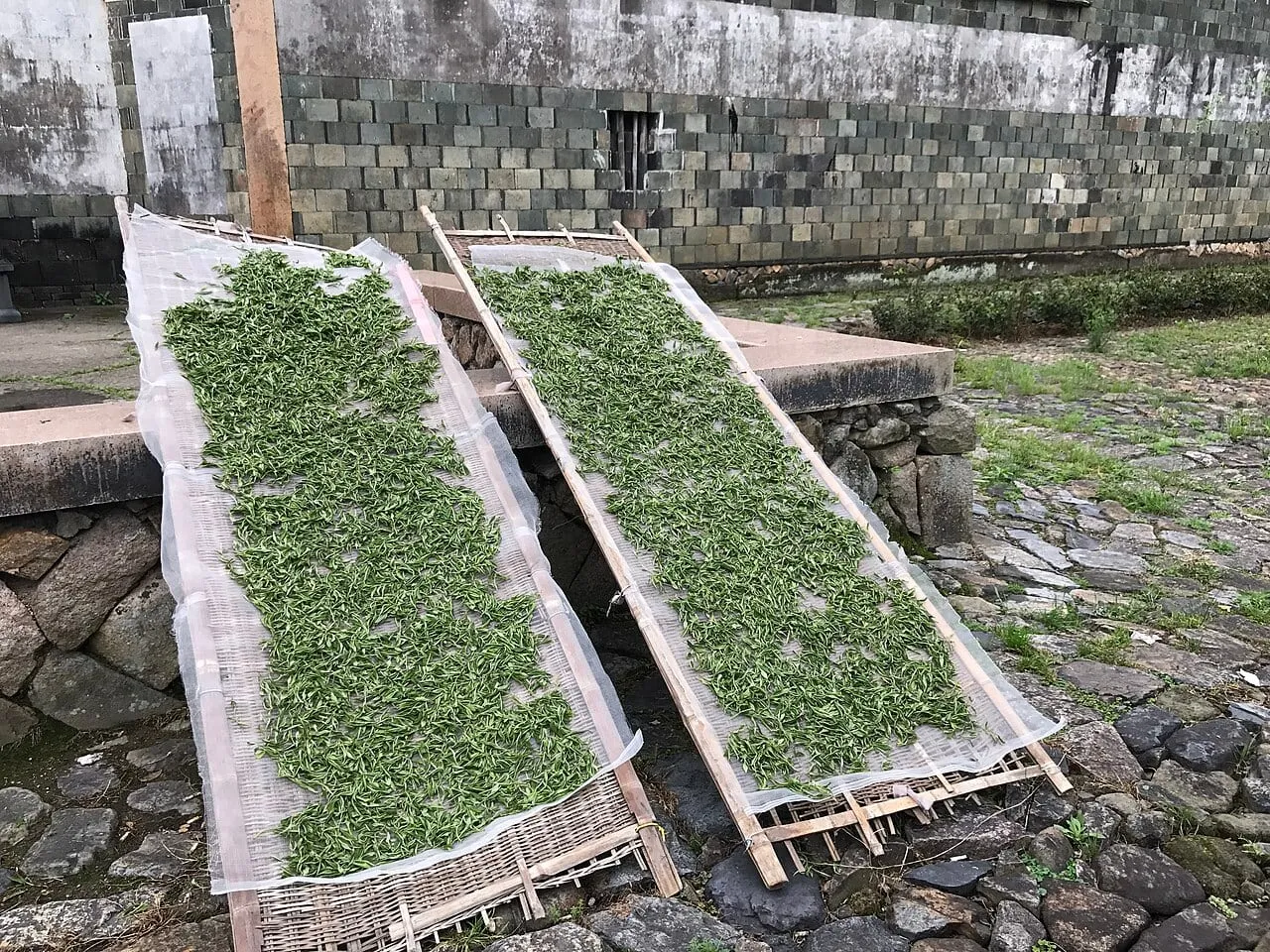
- Fuding White Tea (Fujian): Celebrated for sun-withering, avoiding rolling and pan-firing, allowing gentle, slow enzymatic oxidation to yield pekoe aroma and sweet liquor across Silver Needle, White Peony, and Shou Mei grades.
- Zhenghe White Tea (Fujian): Relying primarily on shaded, indoor natural ventilation withering, producing silver-gray down and deep, mellow body.
During white-tea withering, leaves can be spread out. The photograph shows one example; its precise location and processing conditions are not specified by the source.
Yellow Tea: The “Wet-Heat Yellowing” Craft
- Junshan Yinzhen (Hunan): Plump single buds undergoing repeated Kraft paper wrapping and smothering (menhuang), creating the legendary “gold-inlaid jade” appearance and corn-silk sweetness.
- Mengding Huangya (Sichuan): High-temperature fixation followed by warm heap-yellowing, setting the historic benchmark of yellow tea.
Oolong Tea: Bruising and Roasting Mastery
- Anxi Tieguanyin (Fujian): Invented cloth-bag wrapping and compression (baorou), forming compact dragonfly-head pearls with frosty green sheen and orchid fragrance.
- Wuyi Rock Tea (Da Hong Pao) (Fujian): Pinnacle of weather-dependent leaf bruising and slow charcoal roasting (wenhuo manpei), forging the iconic “rock bone and floral fragrance” (yan gu hua xiang).
- Fenghuang Dancong (Guangdong): Harvesting single ancient trees independently to craft ten distinct natural floral and fruity aroma archetypes.
Black Tea: From Ancient Pine Smoke to Modern Congou
- Lapsang Souchong (Tongmu, Fujian): The world’s original black tea, withered and roasted over horsetail pine woodsmoke in three-story Qinglou smokehouses, yielding resinous pine and dried longan notes.
- Keemun Black Tea (Anhui): Master of congou refinement (sifting, winnowing, sorting, firing), world-renowned for the complex “Keemun aroma” (honey, orchid, and dried fruit).
- Dianhong, Chuanhong, Yihong: High-elevation black teas from Yunnan large-leaf, Sichuan, and Hubei valleys.
Dark Tea and Reprocessed Specialty
- Pu-erh Tea Craft (Yunnan): Sun-dried green tea (shangqing) and the 1973 standardized artificial wet-piling (wodui) post-fermentation.
- Anhua Qianliang Tea (Hunan): Wrapped in palm bark and bamboo leaves, hand-treaded and leveraged into massive solid cylinders, naturally aged outdoors under sun and dew to bloom with golden Eurotium cristatum spores.
- Fuzhou Jasmine Scenting (Fujian): Repeatedly blending high-grade green tea with night-blooming fresh summer jasmine buds over multiple rounds, achieving pure floral aroma without flower dregs.
Modern Safeguarding: Coexistence of Machinery and Handcraft
Following UNESCO recognition, Chinese tea heritage addresses the dual mandate of industrial modernization and living cultural preservation:
- Synergy, Not Opposition:
- Mass Market Production: Continuous automated lines (rotary fixers, multi-tier rollers, conveyor driers) reduce grueling physical labor, ensuring hygiene, food safety, and uniform quality for daily consumption.
- Core Artisanal Nodes: For top-tier specialty lots (e.g., Longjing final polishing, Wuyi rock tea charcoal roasting, Dancong single-tree oxidation), the master’s tactile adjustments cannot be replaced by rigid algorithms.
- Geographical Indication (GI) & Micro-Terroir Protection:
- Integrating ICH safeguarding with national GI regulations preserves native landraces and prevents indiscriminate monoculture.
- Living Transmission to the Next Generation:
- Through China’s Five-Year Safeguarding Plan (2021–2025), master studios, community training, and university tea science programs ensure that traditional craftsmanship actively thrives in contemporary tea rooms rather than becoming a fossil in a museum[4].
See also
- Japanese Tea Ceremony · Chadō — the Zen ritualized evolution of Song whisked tea in Japan
- Chinese Gongfu Tea Culture — the living tea table art of hospitality and sensory appreciation
- Origin and Global Spread of Tea — the macro-historical journey of tea
- The Six Tea Categories — processing chemistry and oxidation spectrum
References
- R-146 — UNESCO. (2022). Traditional tea processing techniques and associated social practices in China. Inscribed in 2022 on the Representative List of the Intangible Cultural Heritage of Humanity (17.COM 7.b.6). https://ich.unesco.org/en/RL/traditional-tea-processing-techniques-and-associated-social-practices-in-china-01884
- R-245 — 中华人民共和国文化和旅游部. 中国传统制茶技艺及其相关习俗列入人类非物质文化遗产代表作名录. 2022-11-29. https://www.mct.gov.cn/
- R-030 — 陈宗懋 主编 (2000).《中国茶叶大辞典》. 中国轻工业出版社. ISBN: 978-7501925094.
- R-246 — 国务院. 中国传统制茶技艺及其相关习俗五年保护计划(2021—2025). 2022.
- R-029 — 宛晓春 主编 (2003).《茶叶生物化学》(第3版). 中国农业出版社. ISBN: 978-7109066274.
- R-031 — 施兆鹏, 夏涛 主编 (2016).《茶叶加工学》(第3版). 中国农业出版社. ISBN: 978-7109214347.
Article Knowledge Network
Explore the connections between the teas, processes and flavours in this article.