
Start with the essentials
Anhua Fuzhuan is a dark tea whose stems, brick structure and familiar “golden flowers” connect with material, pressing and managed fungal development. What does the internal structure contribute, and under which conditions does this growth occur?
This article links moisture, heat, ventilation and microbes with manufacturing, then considers flavour, preparation and quality control. Understanding a controlled process also clarifies the limits of identifying suspicious mould at home.
Three key points
- Structure contributes to manufactureLeaves, stems and pressing affect internal space and airflow.
- Fungal development is managedMoisture, heat and production control distinguish it from accidental dampness.
- Sensory and production information work togetherTasting describes style, while provenance and testing address condition.
What to notice when tasting
Check the package and production account before inspecting structure and liquor. Stop using suspiciously damp or mouldy tea; colour cannot identify microbes, and home cultivation is not an appropriate substitute for controlled production.
1. Origin and raw material
Fu brick tea (Fuzhuan) is a dark tea. It is made from raw dark tea (heimaocha) that is blended, steamed, pressed, “bloomed” and dried[1][2]. Anhua County in Hunan (part of Yiyang, with the Zi River running through it) is an important producer of raw dark tea and Fu bricks. The area is hilly, rainy and humid, and local tea plants include the Anhua population variety and Yuntaishan large-leaf variety[7].
For reading the origin, it is enough to know where the tea comes from and what material it uses; flavour still depends on the actual sample.
2. Why Fu bricks contain stems
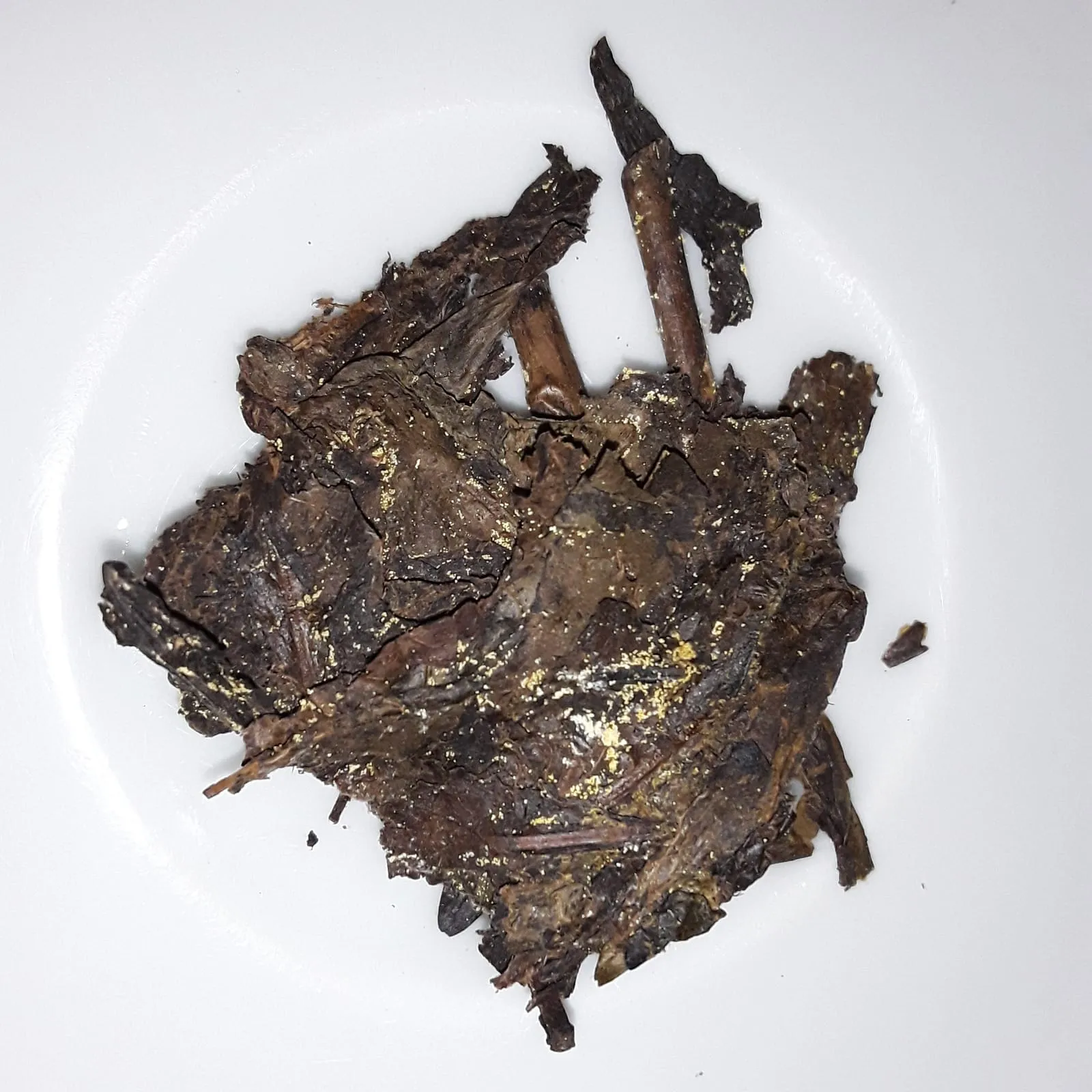
Fu brick material usually contains a share of tea stems; “no stems, no Fu brick” is a widely repeated saying. Stems are stiff and do not compact easily, so they help the brick keep its air spaces. Aspergillus cristatus needs oxygen to grow well, and those spaces let air and moisture reach the inside of the brick[1][2].
Two caveats:
- Stem content follows the standard, not one universal number. The applicable product standard limits stem content, and products and grades differ[1]. A percentage seen online is not a recipe every Fu brick must meet.
- Stems are only one condition. Successful blooming also depends on how tightly the brick is pressed, its moisture, temperature and humidity, and the state of the fungus. Stems do not mean poor quality, and no single stem ratio guarantees good blooming.
It is sometimes said that stems are rich in sugars and make the liquor sweeter. The sources cited here contain no measurement that can be checked for this, so it is not treated as a conclusion.
Why leave spaces in compressed tea?
Follow stems, steam and pores in section.
Leaves and stems: the base
- Tea flakes: pieces of leaf
- Stems: part of the brick structure
- A mixed heap; icon counts are not stem %
Stems help the brick hold together; they do not mean poor work.
What to notice, why & sources
What to notice: Short dark bars are stems and flat shapes are leaves. Counts do not show stem percentage.
Raw material, blending and pressing interact. Icon counts cannot determine fermentation success.
Sources:
Simplified cross section; no universal stem ratio or porosity. Not to time scale.
3. From raw dark tea to Fu brick
Fu brick is made in two stages: fresh leaves are first made into raw dark tea in the growing area, and a factory then sorts and blends it, steams and presses it, blooms it and dries it[1][2]. This section covers the second stage.
3.1 Sorting and blending
Raw dark tea is sieved, winnowed and hand-picked to remove debris, then lots are blended to the product specification, adjusting the leaf-to-stem balance and overall quality[1][2].
3.2 Steaming
The material is steamed briefly so that leaves and stems take up some water and become pliable enough to press[1][2]. Steam pressure, time and batch size vary with the equipment; the sources cited here do not give one standard setting.
3.3 Pressing
The softened tea is packed into moulds and pressed into bricks. Traditionally this was done by hand; today it is mostly done by machine. A common rule of thumb is “firm but not dead”: the brick must hold its shape but must not be pressed so hard that air cannot get in, or blooming will be uneven[2].
3.4 Blooming
The pressed bricks go into a blooming room and stay for a long period in warm, humid conditions with some ventilation. Aspergillus cristatus grows inside the brick, first as hyphae and then as golden-yellow cleistothecia, the “golden flowers”[2][4].
Exact room temperature, humidity and number of days vary between factories and are usually counted in weeks. A common pattern is to keep the room warm and humid early on so the hyphae can grow, then increase ventilation and lower humidity later. A 2016 culture experiment found that fungi isolated from Fu bricks grew differently at different temperatures, humidities and on different media, and that samples from different seasons also differed[8]. One temperature and humidity curve should not be treated as a fixed recipe for every factory.
3.5 Drying
After blooming, the bricks are dried slowly while the temperature is raised step by step rather than all at once. Drying brings moisture below the limit set by the product standard, slows microbial activity and makes the tea easier to store[1][2].
Moisture content and water activity are different measurements. Drying to a given moisture content does not guarantee that no microorganism remains active; whether a product is acceptable still depends on the standard, testing and storage[1][2].
How do golden flowers appear?
Hyphae, golden flowers, then drying.
Fungal hyphae spread inside
- Tea material inside the brick
- Loupe: hyphae spread between tea pieces
- Temperature, humidity and air are controlled
Blooming involves growth, not just adding yellow particles to a brick.
What to notice, why & sources
What to notice: The line network represents enlarged hyphae. This differs from black-tea leaf-enzyme oxidation.
Strain, culture conditions and season affect growth and reproduction. One humidity curve cannot replace production control.
Sources: ;
Enlarged schematic; colours cannot identify organisms. Not to time scale.
4. What happens in the tea during blooming
4.1 Aspergillus cristatus
The golden flowers in Fu brick are usually the cleistothecia of Aspergillus cristatus (formerly Eurotium cristatum): small golden spheres formed when the fungus reproduces sexually[2][4]. A 2016 study sequenced the genome and transcriptome of this fungus and compared gene expression as it developed under different osmotic conditions, which helps explain how it can grow in a relatively dry environment such as a tea brick[4]. A genome study describes what the fungus can do; it cannot be used to estimate how much of it is in a given brick.
4.2 Changes in composition
Metabolomic studies that followed Fu brick processing found that catechins, especially the galloylated (ester-type) catechins, decrease markedly during blooming, while various oxidation, polymerisation and other conversion products appear. These changes were associated with reduced bitterness and astringency and a mellower taste[3][5].
An in-vitro solid-state fermentation study used molecular networking to follow what fungi turn EGCG into and proposed several possible conversion pathways[6]. The “fuzhuanin” compounds reported from Fu brick belong to this group of catechin conversion products. These studies were done in experimental systems and do not show that drinking Fu brick lowers blood lipids or has any other treatment effect[2][6].
Fungal enzymes break down part of the cell walls and proteins, but the fungus also uses up sugars and amino acids. A 2024 experiment fermented raw dark tea with the LJSC.2006 strain and compared it with the resulting loose golden-flower tea: total polyphenols, soluble sugars and free amino acids all fell, the relative share of some aroma compounds rose, and the tea tasted mellower with a clearer fungal-floral note[9]. So it is not accurate to say that blooming simply “increases sugars and amino acids”. That study used one strain and loose tea, so its figures cannot be applied directly to every commercial Fu brick.
4.3 Aroma
Fu brick aroma is often described as “fungal-floral”, with some aged and woody notes. Studies have detected many alcohols, aldehydes, ketones and esters in Fu brick, and the profile differs clearly before and after blooming[2][9]. Which compounds matter most for the fungal-floral note varies with the samples and methods, and the studies do not agree, so this article does not list specific compounds.
Anhua Fuzhuan Brick Tea
Dark · "Golden Flower" Fungal Blooming5. Reading grades and the standard
The national standard for Fu brick is GB/T 9833.3-2013 Compressed tea — Part 3: Fuzhuan tea. It has two grades, special-grade Fu brick and ordinary Fu brick, with separate requirements for appearance, infusion quality (liquor colour, aroma, taste, infused leaf) and physical and chemical indicators[1].
| Grade | General appearance | Liquor impression | Items to check in the standard[1] |
|---|---|---|---|
| Special grade | Flat surface, sharp edges; golden flowers abundant and evenly spread | Orange-yellow to orange-red; clean aroma with fungal-floral note; mellow taste | Moisture, ash, stems, water extract, A. cristatus count and others |
| Ordinary | Fairly flat surface; golden flowers visible | Orange-yellow; clean aroma; mellow and fairly full taste | Same items, with limits different from the special grade |
For exact figures, use the text of the standard and the product’s test report. Toxin limits and test methods cannot be judged by looking at how many golden flowers there are[1].
6. Brewing and boiling
Fu brick is tightly pressed and often contains stems, so it is usually brewed with boiling water, and many people like to boil it. The settings below are common practice; adjust them to taste.
6.1 Prising off tea
Insert a tea knife or pick into the side of the brick along its layers and lever off a piece gently. Peel along the layers where possible rather than chopping; lots of fine fragments make the liquor cloudy.
6.2 Common ways to prepare it
| Method | Vessel | Typical amount | How | What to notice |
|---|---|---|---|---|
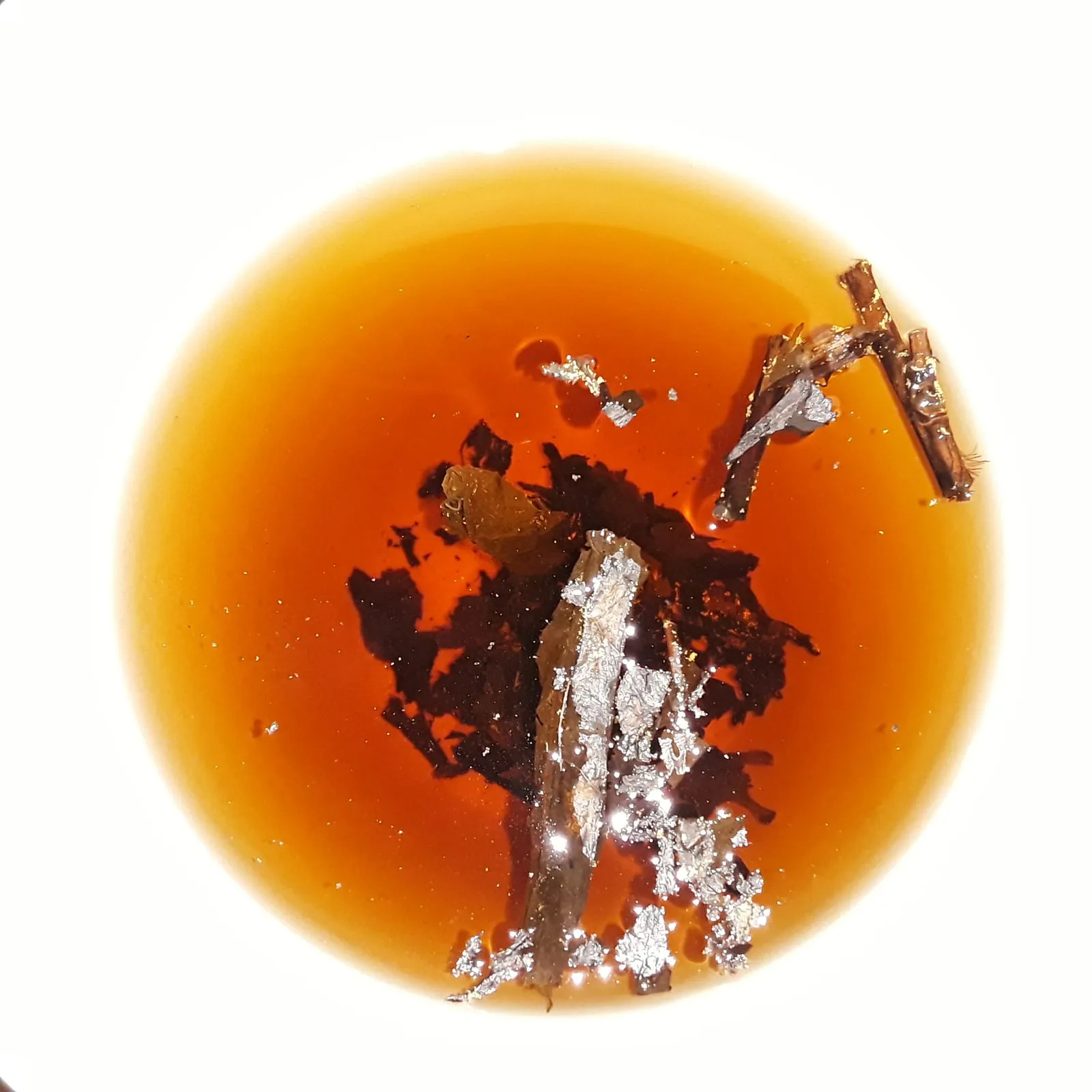
| Gaiwan or teapot | Gaiwan, clay teapot | 5–7 g with about 150 ml boiling water | Rinse once with boiling water and discard; pour the first few infusions quickly, then lengthen them | Liquor moving from orange-yellow to orange-red; fungal-floral and aged notes |
| Boiling | Kettle, clay pot | About 8–10 g per litre | Rinse first, bring to the boil in the pot, then simmer for a few minutes | Longer boiling makes it stronger and can add bitterness; adjust to taste |
| Milk tea | Pot | To taste | Boil a strong tea, strain, add milk and a little salt and bring back to the boil | One traditional way of drinking it in northwest China and Inner Mongolia |
The first rinse mainly loosens the compressed tea and washes off surface dust; whether to drink it is a matter of habit.
7. Common questions
Are golden flowers the aflatoxin mould? Is the tea poisonous?
They are not the same fungus. Golden flowers are usually Aspergillus cristatus; Aspergillus flavus is a different species, some strains of which produce aflatoxins[2][4]. Colour alone cannot identify a fungus, however. Whether a given tea is safe depends on production control, product testing and storage; the review also discusses possible risks in Fu brick that are managed by testing[1][2]. Buy from a proper source with standard and test information, and stop drinking tea that is unusually damp, smells mouldy or shows patches that do not look like golden flowers.
Lots of stems in the tea: is that cutting corners?
Not necessarily. Fu brick material normally contains some stems, which help keep air spaces in the brick for blooming[1][2]. Whether there are too many should be judged against the product’s standard[1].
Is older Fu brick always better? Do golden flowers keep multiplying?
They do not keep increasing. After drying, the golden flowers no longer grow as they did during blooming. In long storage their colour may darken, and aroma and taste keep changing, often described as a stronger aged note[2][7]. Age alone does not guarantee a better tea, and damp storage can cause spoilage.
8. Related Articles
- Ripe Pu-erh: another microbially processed dark tea, made by pile fermentation rather than blooming
- Raw Pu-erh: sun-dried tea pressed into cakes and changing slowly in storage
- The six tea categories: where dark tea sits among the six categories
- Dark tea pile fermentation: basics of microbial and polyphenol changes in dark tea
- Teaware and water temperature: how kettles, clay pots and other vessels affect temperature
References
- R-316 — Standardization Administration of the People’s Republic of China, & General Administration of Quality Supervision, Inspection and Quarantine of the People’s Republic of China. (2013). Compressed tea—Part 3: Fuzhuan tea (GB/T 9833.3-2013). Standards Press of China.
- R-317 — Xiao, Y., Huang, Y., Chen, Y., et al., Liu, Z. (2023). A critical review of Fuzhuan brick tea: processing, chemical constituents, health benefits and potential risk. Critical Reviews in Food Science and Nutrition, 63(28), 9400–9421. https://doi.org/10.1080/10408398.2021.2020718
- R-318 — Xiao, Y., Li, M., Liu, Y., et al., Liu, Z. (2021). Dynamic changes in the metabolite profile and taste characteristics of Fu brick tea during the manufacturing process. Food Chemistry, 344, 128576. https://doi.org/10.1016/j.foodchem.2020.128576
- R-319 — Ge, Y., Wang, Y., Liu, Y., et al., Liu, Z. (2016). Comparative genomic and transcriptomic analyses of the Fuzhuan brick tea-fermentation fungus Aspergillus cristatus. BMC Genomics, 17, 428. https://doi.org/10.1186/s12864-016-2637-y
- R-320 — Zheng, P. C., Liu, P. P., Song, C. X., et al., Liu, Z. (2015). Investigation on biochemical compositional changes during the microbial fermentation process of Fu brick tea by LC–MS based metabolomics. Food Chemistry, 186, 176–184. https://doi.org/10.1016/j.foodchem.2014.12.045
- R-321 — Xie, H. F., Kong, Y. S., Li, R. Z., Wan, X. C., Ling, T. J., et al. (2020). Feature-Based Molecular Networking Analysis of the Metabolites Produced by In Vitro Solid-State Fermentation Reveals Pathways for the Bioconversion of Epigallocatechin Gallate. Journal of Agricultural and Food Chemistry, 68(40), 11315–11326. https://doi.org/10.1021/acs.jafc.0c02983
- R-322 — Liu, Z. (2022). Chemical Quality and Health Benefits of Anhua Dark Tea. Hunan Science and Technology Press. ISBN: 978-7-5710-1495-7.
- R-353 — Zhao Renliang, Tan Jihui, Lu Qinhua, Wu Dan, Zhu Qi (2016). Biological Characterization of Fungi Involved in Fu Brick Tea Fermentation. Journal of Tea Science, 36(2), 160–168. https://doi.org/10.13305/j.cnki.jts.2016.02.006
- R-358 — Xiao Juanjuan, Cheng Ying, Liu Yan, Liu Qiaofang, Jiang Ating, Huang Jian’an, Wang Kunbo, Liu Zhonghua, Wang Zhenhong, Yu Lijun (2024). Isolation and Identification of Aspergillus cristatus LJSC.2006 and Its Effect on Fu Tea’s Quality. Journal of Tea Science, 44(4), 639–654. https://doi.org/10.13305/j.cnki.jts.2024.04.009
Article Knowledge Network
Explore the connections between the teas, processes and flavours in this article.