
Start with the essentials
Born in Tongmuguan Pass around 2005 out of traditional Lapsang Souchong lineage, Jin Jun Mei trades mature smoked leaves for fragile wild-adapted small-leaf single buds. Excluding pinewood smoke completely and relying on clean temperature-controlled oxidation turns attention toward intrinsic bud honey, sweet-potato, and floral aromatics.
This monograph explores fragile bud-only moisture balance, GI standard classification (DB35/T 1228-2015), multi-compound aroma interactions behind honey sweetness, and why authentic buds dry gold-and-black rather than neon all-yellow.
Three key points
- Jin Jun Mei splits cleanly from pine-smoked Lapsang Souchongcontrolled oxidation and clean odorless heat eliminate guaiacol wood-smoke in favor of clear floral-honey fruitiness.
- Sweet honey notes arise from compound interactions, not one magic moleculelinalool, phenylacetaldehyde, beta-damascenone, and 2-amylfuran interact across masking and synergy thresholds.
- Genuine fermented Tongmuguan small buds display interwoven golden trichomes and dark mahogany strands—uniform bright-yellow shoots often come from larger-bud cultivars or lighter fermentation.
What to notice when tasting
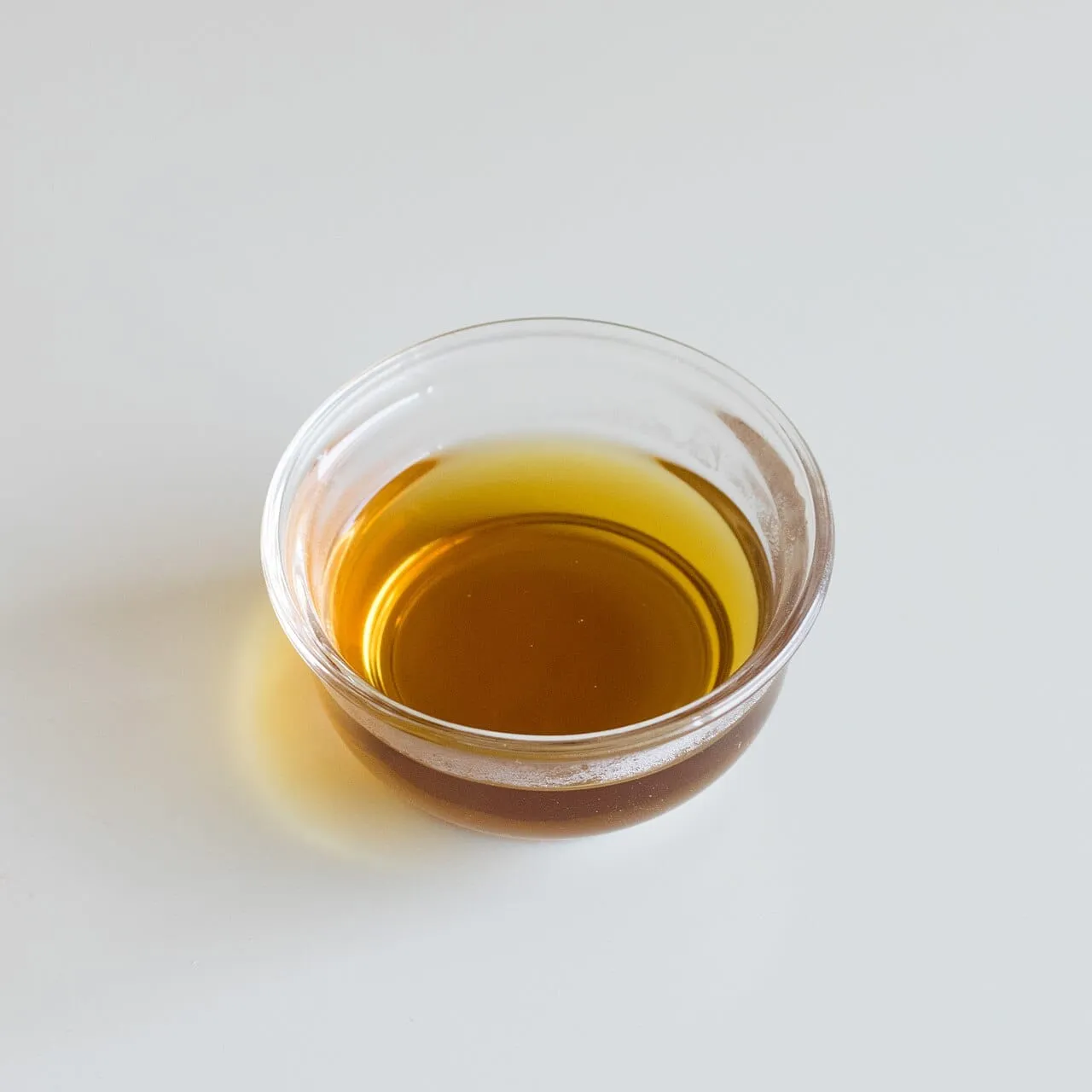
Start with a white porcelain gaiwan at ~88–92 °C and brisk initial pours. Look for a clear golden liquor rim and taste it alongside a traditional pine-smoked Lapsang Souchong to separate clean honey sweetness from smoke phenolics.
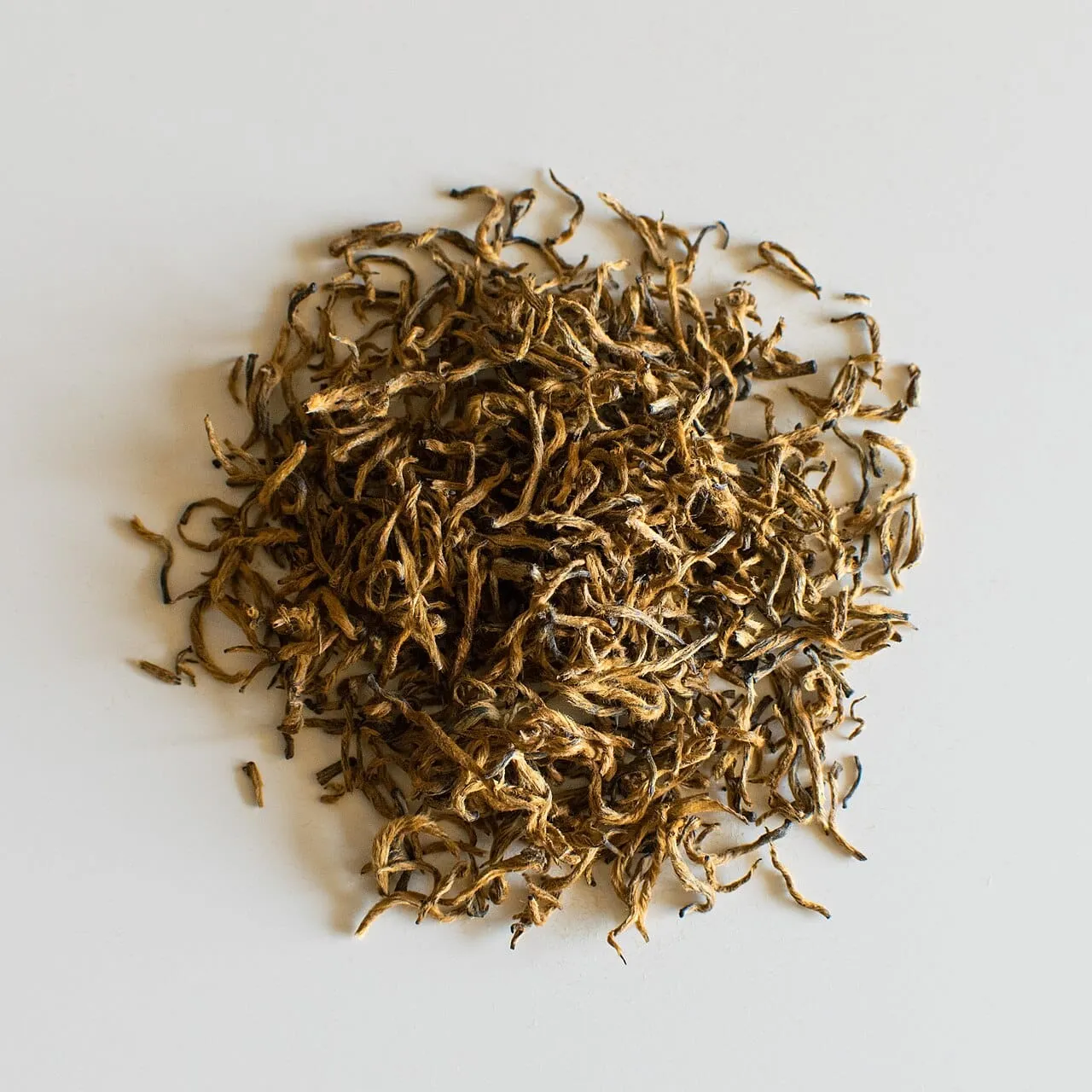
Inspect dry Jin Jun Mei crafted in the classic Tongmuguan mold before brewing and you encounter an instructive visual surprise: instead of gleaming uniform neon gold, the delicate, tightly rolled single buds display an interwoven blend of dark glossy black, warm amber, and golden-ochre trichomes[1]. Pour hot water and the liquor glows luminous pale gold, throwing a bright ring along porcelain walls while lifted scents of ripe floral honey and soft baked sweet potato rise free of wood-smoke resin[3][4]. Dropping mature foliage, narrowing down to pure small-leaf single buds, and closing the door on qinglou pine smoke fundamentally rewired both oxidation control and volatile chemistry.
1. Lineage & Taxonomy: Branching Out from Smoked Souchong
1.1 Standard Classification in Wuyi Black Tea
Far from sitting outside Fujian’s Souchong heritage, Jin Jun Mei emerged around 2005 inside Tongmuguan Pass as an unsmoked single-bud branch of Wuyi black tea[1]. Under Fujian geographical indication standard DB35/T 1228-2015 Product of Geographical Indication—Wuyi Black Tea, regional black teas are classified cleanly across Lapsang Souchong, Souchong black tea, smoked Souchong, and specialty creations (Qihong, explicitly anchoring Jin Jun Mei and kindred single-bud innovations) within protected Wuyi boundary lines, while national standard GB/T 13738.3-2012 codifies baseline Souchong black tea taxonomy[1][2]. Regional registration identifies provenance and subtype rather than crowning any single aromatic intensity automatically[1][2].
1.2 Single-Bud Physics Once Broad Leaf Blades Disappear
Conventional gongfu black teas (like Keemun or classic Lapsang Souchong) pair a bud with two or three open leaves. Those broader blades and slender petioles supply crucial surface-moisture buffering and structural cushioning inside rolling drums. Restricting raw input exclusively to hand-plucked highland small-leaf single buds—requiring tens of thousands of delicate tips per half-kilogram—rewrites processing physics:
- Zero Vascular Buffer During Withering: Compact downy buds present low surface-area-to-mass ratios while fine trichomes impede steady evaporation; stagnant rooms trap damp heat and sourness, whereas harsh blasts dry bud tips brittle before interior softening finishes;
- Fragile Rolling Mechanics: Without broad leaves to absorb mechanical shear, heavy rolling snaps shoots and strips fine down dark. Craft shifts toward very light pressure or delicate hand-rolling to pierce cell boundaries lightly without pulverizing fragile tips[7].
Single-Bud Withering & Clean Unsmoked Oxidation
Stage 01: fragile bud withering; Stage 02: controlled smoke-free oxidation.
Thin uniform spreading for fragile single buds lacking leaf water buffers
- Ventilated bamboo sieve holds thin layer of single buds
- No large leafy stems to slowly feed bud hydration
- Tender moisture rises evenly under mild cool breeze
- Stopped once buds flex cleanly without snapping
Uniform bud-only moisture loss keeps later rolling & oxidation synchronized.
Conditions, chemistry & GI standards
- Environment
- Cool Tongmuguan mountain breeze or gentle temperature-controlled room
- Timing
- Tiny single buds lose moisture faster than large whole leaves, requiring tighter pacing
- Moisture
- Fresh ~75–78% down to supple unbreaking pliability
- Leaf state
- Slender single buds stay intact and supple without dried scorching
Unlike classic Lapsang Souchong using mature one-bud-two/three-leaf shoots, Jin Jun Mei uses delicate small-leaf single buds from Tongmuguan. Without leafy moisture buffers, uniform bud withering is decisive.
Thin, gentle spreading without mechanical leaf tearing; no coarse stem moisture buffer
Standard taxonomy: Fujian GI standard DB35/T 1228-2015 (Wuyi Black Tea — classifying Jin Jun Mei under "Qihong") and national GB/T 13738.3-2012 (Souchong Black Tea).
All honey, fruity, and sweet-potato notes in unsmoked Wuyi buds reflect multi-compound sensory synergy rather than one single aromatic molecule or fixed recipe.
2. Clean Thermal Finishing & Why Authentic Buds Aren’t Pure Yellow
The smoke-free single-bud chain follows: high-mountain tender bud plucking → mild ventilated withering → delicate light rolling → controlled warm-humid aerobic fermentation → odorless clean heat drying (smokeless charcoal/ash-moderated or clean warm air)[1][7]. Each phase aims to drive complete enzymatic oxidation cleanly without wood-smoke masking or bud-tip scorching.
2.1 Separating Guaiacol Wood-Smoke from Clean Baked Clarity
Classic smoked Lapsang Souchong rises over burning Pinus massoniana firewood inside multi-story wooden qinglou smokehouses, saturating leaves with combustion phenolics and wood resins[3]. Comparing five pine-smoke treatments (including TS and DS) against unsmoked Souchong control chemistry, Tian et al. (2025) tracked 69 volatile compounds and demonstrated that β-caryophyllene, nerolidol, guaiacol, and α-terpineol dominate authentic smoky/woody character[3].
Omitting wood smoke completely and drying with clean ash-tempered charcoal heat or filtered warm air keeps exogenous guaiacol phenolics near zero, letting endogenous terpenoid florals and gentle heat-formed sweets command the nose[3][4]. Throughout drying, chamber or dryer thermostat readings never equal internal bud temperature: overheated air singes fragile golden hairs and dulls cup clarity, whereas sluggish low heat fails to arrest PPO promptly and clouds sweet lift[7].
2.2 Optical Truth Behind the “Gold, Amber, and Black” Strand Rule
First-time buyers often expect top-tier Jin Jun Mei to glow solid canary gold and distrust dark black strands in the tin. Tissue chemistry explains why classic oxidized Tongmuguan buds look banded instead:
- Oxidized Bud Epidermis Naturally Turns Dark: Single bud cores pack rich polyphenols and active PPO; once lightly bruised and cleanly oxidized, polymerized thearubigins and dark surface pigments cure the bud body glossy mahogany-black;
- Trichomes Catch Golden-Ochre Pigments: Epidermal hairs carry minimal dark phenolic juice, staining warm golden-yellow from surface sap oxidation—weaving together the classic “interwoven gold, yellow, and black” appearance[1];
- Why Some Teas Look Monotone Bright Gold: Uniformly bright yellow lots across markets often stem not from dye, but from substituting heavily pubescent, large-bud early cultivars (such as early white-downy clones) or holding oxidation lighter to maximize golden shine. Judging authenticity by pure yellow proportion alone easily misleads without checking clean honey depth and small-leaf texture.
3. Decoding Honey & Baked-Sweet-Potato Aroma: Synergy Over Single Molecules
Free of pinewood smoke, top smoke-free Wuyi bud teas are frequently praised for crisp floral honey layered over faint roasted sweet-potato sweetness. Three quantitative studies unpack how multiple volatiles cooperate to produce that sensory signature:
Gold-and-Black Contrast & Golden-Ring Cup Tasting
Stage 03: dry-bud myths vs. structure; Stage 04: golden-ring liquor cues.
Authentic slender gold-and-black strands vs. solid-yellow myths
- Genuine Tongmuguan style: dark oxidized tips interwoven with golden down
- Notice compact small-leaf bud curvature & dense trichomes
- Right loupe shows bright uniformly yellow lookalikes
- All-gold buds often signal larger early-bud cultivars or light ferment
Interwoven gold trichomes and dark oxidized skins—not uniform bright yellow—define the traditional look.
Conditions, chemistry & GI standards
- Environment
- Airtight, dry, dark storage of finished slim buds
- Timing
- Dry-leaf assessment balancing golden down against dark-oxidized shoot skin
- Moisture
- Dry black-tea stability threshold
- Leaf state
- Interwoven golden-downy tips and dark mahogany-black slender strands—not solid yellow
When genuine Tongmuguan small-leaf buds undergo thorough controlled oxidation, dense trichomes dry gold while exposed epidermis turns deep dark mahogany—contrasting all-gold lookalikes often derived from under-oxidized big-bud cultivars.
Distinguishing authentic gold-and-black contrast from flashy all-yellow lookalikes made elsewhere
Standard taxonomy: Fujian GI standard DB35/T 1228-2015 (Wuyi Black Tea — classifying Jin Jun Mei under "Qihong") and national GB/T 13738.3-2012 (Souchong Black Tea).
All honey, fruity, and sweet-potato notes in unsmoked Wuyi buds reflect multi-compound sensory synergy rather than one single aromatic molecule or fixed recipe.
- Key Odorants Behind Honey & Sweet-Potato Wuyi Black Tea (Lin et al., 2026): Examining Wuyi black teas exhibiting honey and sweet-potato notes, investigators screened 19 key aroma-active compounds and validated five pivotal contributors via aroma recombination and omission tests alongside olfactory receptor docking/molecular dynamics: 2-amylfuran, α-ionone, β-cyclocitral, β-damascenone, and benzeneacetaldehyde (phenylacetaldehyde)[4].
- Feller Binary Interactions Across 70 Odorants (Niu et al., 2022): Analyzing Jin Jun Mei (JJM), Keemun, and Dianhong via HS-SPME, SAFE, and GC-MS-O revealed 70 odorants, with 39 primary contributors anchored by linalool and geraniol[5]. Pairing methyl salicylate separately with 10 floral odorants under Feller’s perceptual model revealed 5 masking, 1 additive, and 4 synergistic binary effects—with binary ratio R following Stevens’ power law exponent n[5].
- Cross-Varietal Signature Benchmarks (Zhang et al., 2025): Profiling five Chinese black tea cultivars including Zhengshan (ZS) via high-resolution GC × GC-QTOFMS and UPLC revealed 165 total volatiles and 51 key odorants (37 odor-active volatiles perceived specifically in ZS). Linalool, phenylethyl alcohol, linalool oxide I, and (E)-furan linalool oxide formed shared floral pillars across all five teas, while α-cubebene and trans-calamenene stood out as distinctive woody/spice markers in Zhengshan and partner groups[6].
Together, these papers establish cleanly that Jin Jun Mei’s floral-honey halo arises from perceptual synergy and balanced masking across dozens of volatiles rather than any isolated “honey molecule”[4][5][6].
Jin Jun Mei
Black · Single-Bud Clean Wuyi Oxidation4. Adjustable Brewing Starting Points & Smoked-vs-Clean Exercise
Tender single buds carry thin epidermal walls and high soluble extract per gram; protracted high-heat stewing accelerates astringent release while muting high floral top notes. Treat these parameters strictly as flexible dialing baselines, adjusting freely to leaf age and personal richness goals:
- Thin Porcelain Gaiwan Brisk Steeps (Recommended Baseline):
- Measure
3–4 gbuds into a100–120 mLthin white porcelain gaiwan (~1:25–1:30ratio); - Begin near
88–92 °C, pouring smoothly down the vessel wall rather than pounding directly onto bud tips; - Decant promptly after
5–8 son the first pour, holding8–12 son infusions two and three, then stepping up5–10 sgradually. If buds have rested several months and seem tight-lipped at 90 °C, push comfortably to95–98 °Cusing fast flash pours—never treat 90 °C as an absolute heat taboo.
- Measure
- Smoked-vs-Clean Side-by-Side Tasting:
- Place a white gaiwan of smoke-free Jin Jun Mei beside an identical gaiwan of traditional pine-smoked Lapsang Souchong (or a golden Dianhong / Keemun) at matched ratio and timing;
- Contrast lid aromatics right after pouring: separate resinous guaiacol/β-caryophyllene wood-smoke from clean
β-damascenonehoney-fruit and faint warm sweet-potato clarity, alongside visual inspection of infused bud uniformity versus multi-leaf Souchong structures.
5. Common Myths & Scientific Clarifications
Myth 1: “Only Jin Jun Mei made of 100% glowing yellow buds is authentic—black strands prove adulteration.”
Scientific Clarification: High-mountain Wuyi small-leaf buds packed with active PPO naturally oxidize dark glossy mahogany across leaf cores while fine epidermal hairs tint amber-gold, generating an interwoven gold, yellow, and black profile[1]. All-yellow batches frequently rely on downy broad-bud cultivars or deliberately under-oxidized craft rather than superior mountain provenance.
Myth 2: “Jin Jun Mei is just overpriced bud-only Lapsang Souchong made with the exact same factory recipe.”
Scientific Clarification: Although sharing Tongmuguan lineage under
DB35/T 1228-2015[1][2], removing broad blades removes natural moisture buffering during withering and rolling, while cutting qinglou pine smoke redirects oxidation/drying chemistry from exogenous guaiacol toward balanced internal honey-fruit esters and furan ketones[3][4].
Myth 3: “Genuine Jin Jun Mei lasts 15+ steeps effortlessly because fine trichomes seal slow-release pectin inside the bud.”
Scientific Clarification: Infusion longevity depends on tea-to-water ratio, bud density, and cell damage during rolling—not mystical hair-sealed pectin vaults. Tender buds front-load intense honey-floral volatiles over initial steeps before shifting toward gentle broth; adjusting leaf mass and pour speed manages pacing cleanly.
Myth 4: “Water over 90 °C scalds delicate Jin Jun Mei buds and turns the cup bitter and sour.”
Scientific Clarification: Fully oxidized, heat-dried single buds tolerate high heat far better than unoxidized delicate spring green teas. Starting at
88–92 °Csimply gives beginners wider timing margin to capture subtle floral-honey highs without over-steeping; brief flash pours at95 °C+often unlock deeper sweet-potato richness cleanly.
6. Related Articles
- Lapsang Souchong: Must It Taste Smoky? Qinglou Smoking vs. Smoke-Free Split
- Qimen (Keemun) Black Tea: Small-Leaf Gongfu Oxidation & Glycoside Hydrolysis
- Dianhong Black Tea: Large-Leaf Polyphenols & Golden Tips
- Black Tea Enzymatic Oxidation & Theaflavins
- Composition and Flavour Science
References
- R-421 Fujian Provincial Bureau of Quality and Technical Supervision. DB35/T 1228-2015 Product of Geographical Indication—Wuyi Black Tea. Fuzhou: Fujian Local Standards, 2015.
- R-082 Standardization Technical Committee on Tea (SAC/TC339). GB/T 13738.3-2012 Black tea—Part 3: Souchong black tea. Beijing: Standards Press of China, 2012.
- R-434 Tian W, Feng J, Wang J, et al. Different smoking processes with the special fuel rods: Impart a smoky aroma to Souchong black tea. Food Chemistry: X, 2025, 25: 102142. https://doi.org/10.1016/j.fochx.2024.102142
- R-433 Lin Z, Xia M, Niu L, et al. Elucidation of the key odorants contributing to the distinctive honey and sweet potato-like aroma in Wuyi black tea. Food Chemistry: X, 2026, 36: 104022. https://doi.org/10.1016/j.fochx.2026.104022
- R-432 Niu Y, Ma Y, Xiao Z, et al. Characterization of the Key Aroma Compounds of Three Kinds of Chinese Representative Black Tea and Elucidation of the Perceptual Interactions of Methyl Salicylate and Floral Odorants. Molecules, 2022, 27(5): 1631. https://doi.org/10.3390/molecules27051631
- R-435 Zhang M, Lu X, Zhang P, et al. Reveal the differences in flavor of five varieties of black teas via sensory evaluation, UPLC, and GC × GC-QTOFMS approaches. Food Chemistry: X, 2025, 31: 103083. https://doi.org/10.1016/j.fochx.2025.103083
- R-031 Shi ZP, Xia T (eds.). Tea Processing Science (3rd ed.). Beijing: China Agriculture Press, 2016.
Article Knowledge Network
Explore the connections between the teas, processes and flavours in this article.