
Start with the essentials
Sensory evaluation brings samples, vessels, water and timing into comparable conditions, then examines dry leaf, liquor colour, aroma, taste and infused leaf separately. A preference can otherwise reflect price expectations, preparation or strength as much as the tea.
This article explains equipment, category-specific procedures, the five factors and common defects. Professional evaluation follows defined standards; home practice can begin with controlled variables and clear descriptions.
Three key points
- Establish comparable conditionsConsistent vessels, water and handling reduce preparation differences.
- Separate five factorsIndividual notes help locate strengths and problems.
- State purpose and procedureCategory and standard determine operation; home conclusions initially concern the samples tested.
Try it while tasting
Number two teas, hide brands and prices, then prepare and describe them consistently before revealing the labels. Compare specific notes to explore both sensory differences and expectations.
1. Laboratory Environment & Standardized Equipment
Objectivity and reproducibility in sensory evaluation require rigorous environmental control and precise equipment standards[1][2]:
1.1 Environmental Requirements
- Lighting Conditions: The evaluation room should ideally face north to utilize diffuse natural daylight without direct glare or shadows, maintaining a benchtop illuminance of 1000–1200 Lux (room conditions follow GB/T 18797, Basic conditions of tea sensory evaluation rooms). When artificial lighting is used, D65 standard daylight lamps (colour temperature ~6500 K, Ra ≥ 90) are required;
- Temperature & Humidity: Ambient room temperature is maintained at 20–25 °C, relative humidity at 50%–70%, with good ventilation and complete freedom from foreign odors;
- Neutral Background: Walls and testing benches should be painted in matte, non-reflective neutral white or light neutral gray to eliminate chromatic reflections on liquor appraisal[1][3].
1.2 Standard Tasting Sets (GB/T 23776 / ISO 3103)
Tasting sets are manufactured from high-density, non-porous white glazed porcelain[1]:
- Cylindrical Tasting Cup (150 ml): Inner diameter ~65 mm, height ~68 mm, featuring sawtooth drainage serrations at the rim and a small steam vent on the lid;
- Hemispherical Tasting Bowl (200 ml): Rim diameter ~95 mm, height ~55 mm, with a smooth, bright white interior for examining liquor clarity, hue, and brightness;
- Sample Trays: White, odorless, non-reflective trays (~230 × 230 × 30 mm) used for swirling and inspecting dry leaf structure.
150ml Cylindrical Cup
Uniform volume promotes consistent thermal convection; rim teeth allow smooth and complete drainage within 15 seconds without residual liquid.
200ml Hemispherical Bowl
Smooth, white concave surface provides uniform light reflection, clearly showcasing liquor clarity, hue, and sparkle.
Analytical Balance & Pure Water
Weighs precisely to 3.0 g (or 5.0 g for oolong/dark teas); testing water requires low mineralization (TDS < 50 mg/L) to prevent mineral interference.
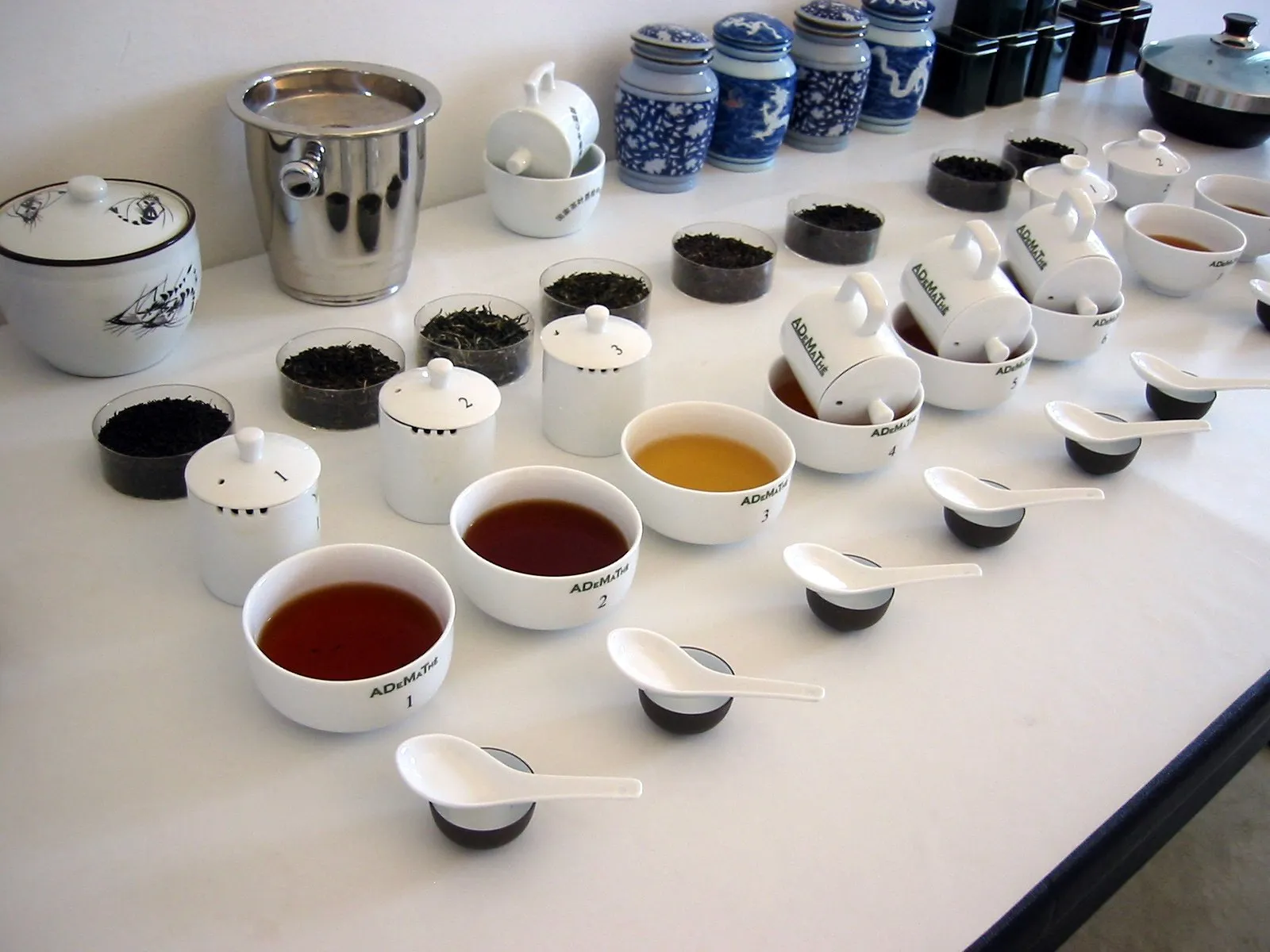
Start with a real tasting table where dry samples, cups, bowls and liquor are arranged separately. The photograph identifies the equipment but does not establish a particular standard or parameter set.
2. Six Tea Categories: Evaluation Steeping Matrix
Because leaf maturity, rolling tightness, and extraction rates vary across categories, standards specify targeted steeping parameters[1][2]:
| Tea Category | Leaf Dose | Vessel Size | Water Temp | Steep Time | Rounds | Primary Evaluation Focus |
|---|---|---|---|---|---|---|
| Commodity Green / Black | 3.0 g | 150 ml Cup | 100 °C | 5 min | 1 round | Freshness, balance of briskness vs astringency, purity |
| Tender Fine Green Tea | 3.0 g | 150 ml Cup | 100 °C | 4 min | 1 round | Delicate aroma, downy pekoe, sweetness, leaf tenderness |
| Gongfu Oolong Tea | 5.0 g | 110 ml Cup | 100 °C | 2 ➔ 3 ➔ 5 min | 3 rounds | Floral-fruity profile & persistence, rock/orchid rhyme, endurance |
| White Tea (Silver Needle/Peony) | 3.0 g | 150 ml Cup | 100 °C | 5 min | 1 round | Downy pekoe aroma, delicate sweetness, liquor clarity |
| Yellow Tea (Yellow Sprout) | 3.0 g | 150 ml Cup | 100 °C | 5 min | 1 round | Sweet toasty notes, yellow leaf / yellow liquor character |
| Dark Tea / Loose Pu-erh | 3.0 g or 5.0 g | Cylindrical cup, 1:50 ratio | 100 °C | 2 min ➔ 5 min | 2 rounds | Aged aroma purity, liquor smoothness, fermentation uniformity |
| Compressed Tea (Brick/Cake) | 3.0 g or 5.0 g | Cylindrical cup, 1:50 ratio | 100 °C | 2 min ➔ 5 min | 2 rounds | Cleanliness, absence of storage taints, leaf unfolding |
Note: While 80–85 °C is common for daily green tea enjoyment, professional sensory evaluation strictly uses 100 °C boiling water for prolonged steeping as a standardized stress test to expose hidden craft defects[1][3].
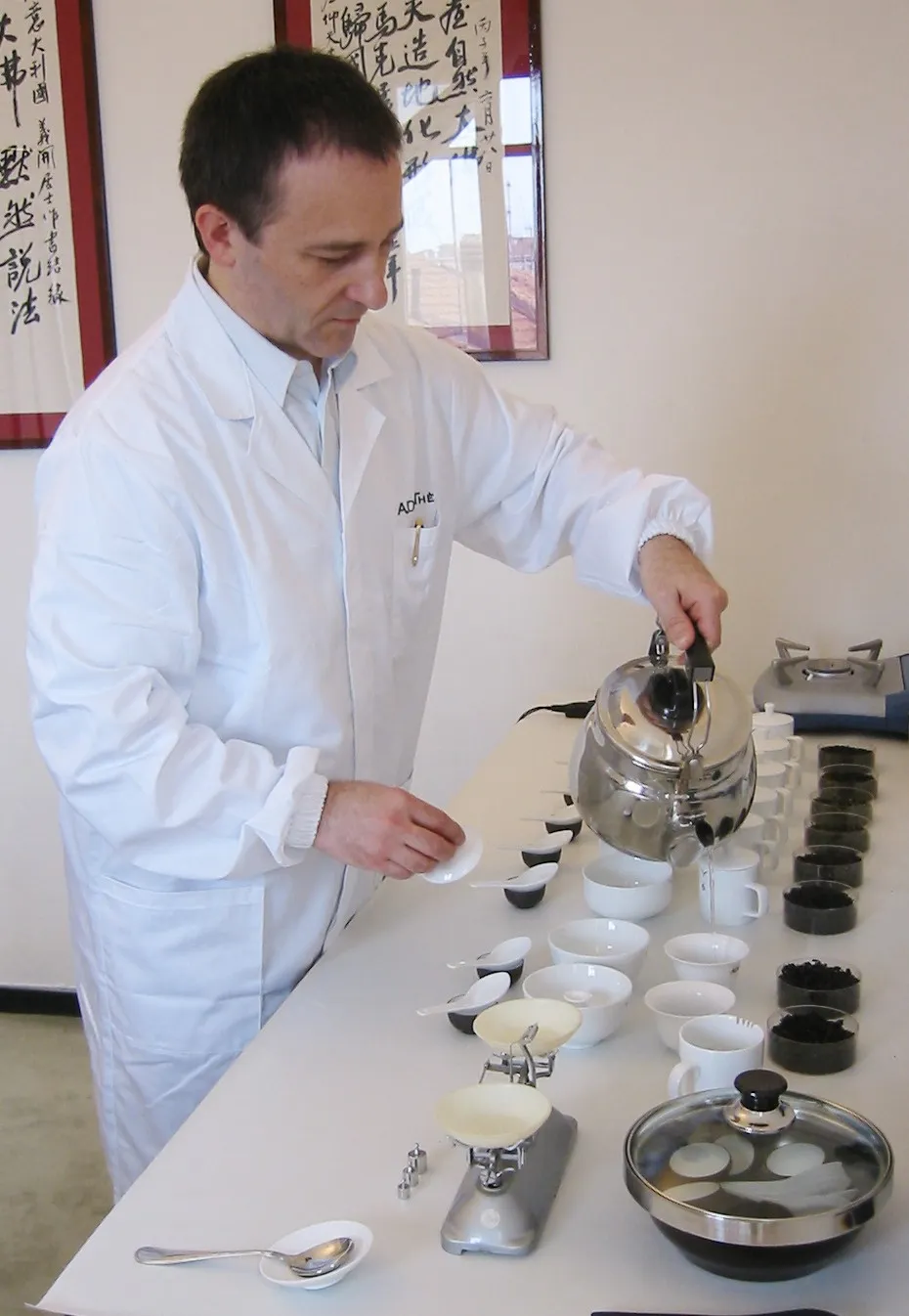
During preparation, pouring and timing both matter for comparability. This image shows water being poured into tasting vessels; temperature, leaf mass and timing are not visible.
3. Five-Factor Appraisal Methodology
Six steps of a standard cupping
Step through; watch hands and tools.
Swirl the tray; leaves sort by size
- Shape: tightness and curl
- Colour and sheen
- Evenness: share of broken bits
- Cleanliness: stems, seeds, debris
Swirl with both hands; never dig into the sample with your fingers.
Procedure details & sources
Weigh a representative sample (100–150g) into a white appraisal tray. Gently rotate the tray in circular sweeps to naturally stratify leaves by mass. Inspect shape, colour, uniformity and cleanliness under standard light.
Technique rule: Never dig fingers directly into the sample tray; swirl the tray with both hands to stratify particles by weight.
Standard: Based on GB/T 23776-2018 (Methodology of tea sensory evaluation) and ISO 3103:2019. Testing conducted under controlled north light or standard 6500K illuminant.
A learning sketch of GB/T 23776; formal cupping follows the full standard.
The interactive simulator above breaks down the 6 procedural steps of standard sensory evaluation. Evaluation centres around five core dimensions: Appearance, Liquor Colour, Aroma, Taste, and Infused Leaf. Below, we examine the appraisal techniques for each factor and the weighted scoring mechanism.
3.1 Dry Leaf Appearance
Holding the sample tray with both hands, gently swirl the leaves in a circular motion so they naturally stratify by weight and size:
- Shape & Tightness: Tightness, straightness, flatness, curl, and density;
- Colour & Lustre: Emerald green, sand green, glossy black, or coppery brown hues;
- Uniformity: Proportion of broken leaves, fragments, and dust;
- Purity: Freedom from yellow stems, seeds, hairs, or non-tea debris[1][2].
3.2 Liquor Colour
Evaluate within 1–2 minutes of pouring to avoid non-enzymatic darkening or cooling haze:
- Hue (Chroma): Tender green, golden-yellow, amber, bright red, or deep ruby;
- Brightness: Clear, sparkling luminosity vs dull opacity;
- Clarity: Translucent clarity (suspended downy pekoe hairs from tender silver needle buds represent normal “downy haze”, distinct from muddy sediment)[2].
3.3 Aroma Evaluation
Follow the Hot, Warm, and Cold Sniff protocol[1][2]:
- Hot Sniff (50–55 °C): Inhale shortly after opening the lid to screen for smoky, sour, stale, or moldy taints;
- Warm Sniff (35–45 °C): Identify specific aromatic profiles (floral, fruity, chestnut, honey, aged) and assess purity;
- Cold Sniff (Ambient): Inhale residual bouquet on the lid and exhausted leaves to evaluate aromatic longevity.
3.4 Taste & Mouthfeel
Take 3–5 ml of liquor on a professional cupping spoon and slurp vigorously with incoming air[2][3]:
- Aerosolization: Air intake disperses the liquor into fine droplets across the tongue;
- Taste and mouthfeel: Record sweetness, umami, bitterness, acidity and sensations such as astringency and body separately;
- Finish (Huigan & Shengjin): Observe the onset and persistence of lingering sweetness and mouth-watering salivation[1][2].
3.5 Infused Leaf Inspection
Tip the wet leaves onto the lid or white inspection tray to examine tactile feel and morphology[1]:
- Tactile Tenderness: Gently press with fingers; soft, fleshy elasticity indicates tender plucking, while stiff toughness indicates coarse leaf material;
- Color Uniformity: Inspect evenness of color, checking for un-fixed red stems in green tea or scorched margins from uneven roasting[2][4].
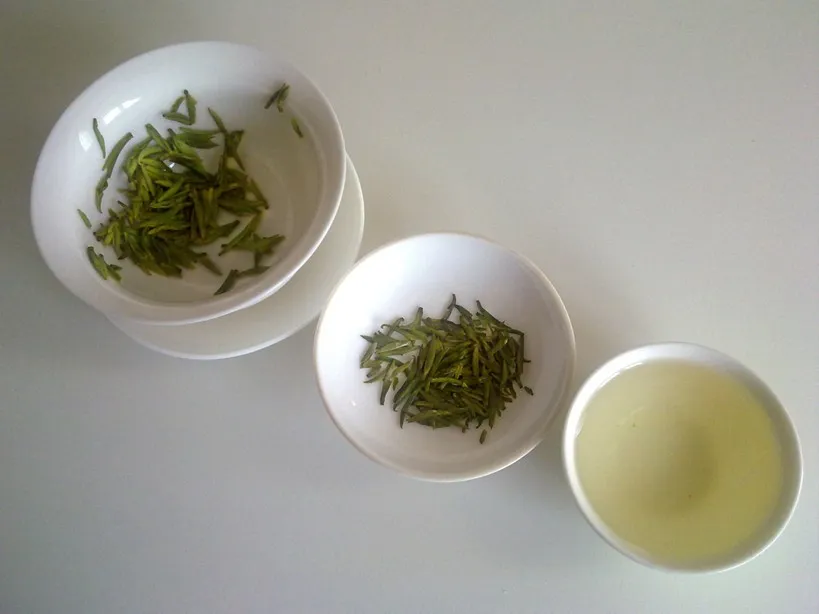
When observing one sample, describe dry leaves, infused leaves and liquor together. This photograph documents one green tea sample; colour alone cannot establish its chemistry or sensory score.
4. Five-Factor Weighting & Score Calculation
National standards assign category-specific percentage weights across the five factors, allowing evaluators to compute weighted composite scores[1]:
How the weighted score adds up
Pick a tea, then move the five scores.
Weighted total
How the total is calculated
Total = Σ (factor score × category weight). Weights follow the category table in the article, based on GB/T 23776-2018; each factor is scored on a 100-point scale.
The procedure supports learning; weights, grade feedback and exercise results are not national-standard grading or professional certification.
A practice calculator; panels score independently and reconcile results.
The weightings below follow a commonly cited version; a few categories may differ from the standard text, so consult GB/T 23776-2018 itself.
| Tea Category | Appearance | Liquor | Aroma | Taste | Infused Leaf | Weighting Rationale |
|---|---|---|---|---|---|---|
| Green Tea (General) | 25% | 10% | 25% | 30% | 10% | Emphasizes fresh brisk taste and delicate aroma, with 25% on leaf shape |
| Gongfu Oolong Tea | 20% | 5% | 30% | 35% | 10% | Strongly prioritizes aroma and palate character (65% combined) |
| Gongfu Black Tea | 20% | 10% | 25% | 35% | 10% | Emphasizes rich, sweet taste and bright liquor |
| White Tea (Silver Needle) | 30% | 10% | 25% | 25% | 10% | Highlights silver bud plumpness, downy pekoe, and delicate sweetness |
| Yellow Tea (Yellow Sprout) | 20% | 15% | 25% | 30% | 10% | Raises liquor weight to 15% to evaluate hallmark yellow liquor character |
| Dark Tea / Pu-erh | 20% | 10% | 25% | 35% | 10% | Prioritizes aged smooth mouthfeel, cleanliness, and steeping endurance |
Composite Scoring Formula:
Final Score = ∑(Individual Factor Score × Category Weight)Each factor is usually scored in bands — A (90–99), B (80–89), C (70–79) — then multiplied by its weighting coefficient; how a total maps to a product grade is set by each product standard[1][2].
5. Common Quality Defects & Process Troubleshooting
Smoky / Scorched Notes
Sensory Profile: Dark charred specks, dry smoky odor, bitter and rasping taste.
Root Cause: Dryer smoke leaks; excessive fixation pan temperature or uncleaned pan residue.
Raw / Grassy / Harsh Notes
Sensory Profile: Sharp grassy odor, heavy astringency that fails to dissipate.
Root Cause: Insufficient fresh-leaf withering; under-fixation failing to deactivate enzymes; or inadequate zuoqing.
Stale Stewed Notes
Sensory Profile: Dull yellowish liquor, flat boiled-vegetable aroma, lacking briskness.
Root Cause: Wet-leaf fixation without proper ventilation; failure to rapidly cool leaves after fixation.
Musty / Sour Notes
Sensory Profile: Dull grayish appearance, sour or damp mouldy odor, cloudy liquor.
Root Cause: Packaging before reaching safe moisture levels (<7%); storage in high relative humidity (>75%).
6. Common Myths & Scientific Clarifications
Myth 1: “Is human sensory evaluation purely subjective, and inherently inferior to GC-MS instrumentation?”
Scientific Clarification: A misconception regarding sensory science. Standardized evaluation protocols (GB/T 23776 / ISO 3103) strictly calibrate lighting, water chemistry, vessel geometry, and blind tastings to eliminate subjective bias[1][3]. While chromatography quantifies isolated compound concentrations, it cannot replicate the complex neural integration, receptor antagonism, or synergistic umami-sweetness interactions occurring in the human olfactory-gustatory cortex[2][5]. Calibrated sensory panels remain indispensable for detecting subtle off-notes and evaluating holistic balance[1][2].
Myth 2: “Does brewing delicate green tea with 100 °C boiling water for 5 minutes during evaluation scorch the tea?”
Scientific Clarification: Daily pleasurable brewing and sensory evaluation pursue opposing objectives. Daily drinking employs 80–85 °C water to curb catechins and caffeine, highlighting fresh umami; conversely, GB/T 23776 mandates 100 °C boiling water for 5 minutes as a deliberate “destructive stress test”[1][2]. Extreme hydrothermal extraction breaks through surface barriers, exhausting leaf soluble solids to ruthlessly expose raw coarse material, uneven fixation, internal fermentation, or scorching defects that remain masked in casual brewing[1][5].
Myth 3: “Does any noticeable bitterness or astringency during sensory evaluation signal a defective tea?”
Scientific Clarification: No. Ester catechins and caffeine provide the structural foundation and lively briskness indispensable to high-grade teas[5][6]. Professional sensory grading evaluates the dynamic resolution of astringency: premium teas present brisk astringency that transforms within seconds into refreshing salivation and lingering hui gan[2]. In contrast, true sensory defects are defined by persistent, throat-gripping harshness, or irreversible processing flaws such as sour-fermentation, stale moldiness, or acrid scorch notes[1][4].
Myth 4: “Can a single 5-minute infusion during standard evaluation accurately assess brewing endurance?”
Scientific Clarification: Extraction kinetics make single-infusion evaluation highly representative. For green, black, and dark teas, a 1:50 ratio steeped in boiling water for the time set by tea type extracts a substantial share of the soluble solids, laying bare the leaf’s cellular integrity and biochemical reserves in one shot[1][2]. Furthermore, GB/T 23776 mandates a specialized sequential-steep protocol for oolong teas (5 g in 110 mL, steeped across 2 min, 3 min, and 5 min intervals) to rigorously trace aroma persistence and liquor stamina across infusions[1][3].
7. See Also
- Quality Troubleshooter — Online diagnostic guide for tea processing defects
- Sensory Terms Glossary — Standardized terminology definitions based on GB/T 14487
- Composition & Flavor Balance — The biochemistry of the phenol-to-amino ratio
- Teaware Materials & Heat Retention — Comparing porcelain and clay vessels
References
- R-161 — GB/T 23776-2018.《茶叶感官审评方法》(Methodology for sensory evaluation of tea). 全国茶叶标准化技术委员会(SAC/TC339).
- R-295 — 施兆鹏 主编. (2018).《茶叶审评与检验》(第五版). 中国农业出版社.
- R-294 — ISO 3103:2019. Tea — Preparation of liquor for use in sensory tests. International Organization for Standardization. https://www.iso.org/standard/73224.html
- R-236 — GB/T 14487-2017.《茶叶感官审评术语》(Terminology of tea sensory evaluation). 全国茶叶标准化技术委员会(SAC/TC339). 2018-05-01 实施,代替 GB/T 14487-2008.
- R-029 — 宛晓春 主编 (2003).《茶叶生物化学》(第3版). 中国农业出版社. ISBN: 978-7109066274.
- R-253 — Xu, Y.-Q., et al. (2018). Quantitative analyses of the bitterness and astringency of catechins from green tea. Food Chemistry, 258, 16–24. https://doi.org/10.1016/j.foodchem.2018.03.042
Article Knowledge Network
Explore the connections between the teas, processes and flavours in this article.