
Start with the essentials
The Tea-Horse Road was a network linking tea-producing places, highland communities and market towns. Tea, horses and other goods moved through mountains, leaving histories of porters, caravans, regulation and everyday life. The name identifies only part of that world.
This article connects tea’s place in highland life with Sichuan–Tibet and Yunnan–Tibet routes, trading institutions and transport workers. Follow the goods, the people moving them and the rules governing exchange.
Three key points
- It is a networkRoutes connected different origins and markets and changed with trade and time.
- Terrain shapes transportPorters, pack animals and supply stops explain mountain travel and settlements.
- Exchange connects societyPolicy, diet, movement and local culture all form part of the history.
Follow the main thread
Locate a producing area, a mountain passage and a trading town. Imagine how goods moved between them, then place porters, caravan leaders and trading institutions within that route.
Why Did Tea Become Part of Highland Life and Trade?
Compressed tea was practical to transport and store and became part of highland food customs, hospitality and exchange[3][4]. Explain demand through diet, transport, institutions and markets together rather than presenting tea as a universally essential medicine.
- Transport and Supply: Compression supported long-distance distribution; routes, seasons and trading arrangements shaped access.
- Diet and Custom: Tea combined with butter, salt and other ingredients in distinctive local drinks. Calories and salts in the finished drink do not come entirely from the tea itself.
- Narrative and Evidence: Historical sayings about needing tea express its perceived value; they are not clinical evidence that tea treats scurvy, bowel obstruction or low oxygen. See tea and health for modern evidence boundaries.
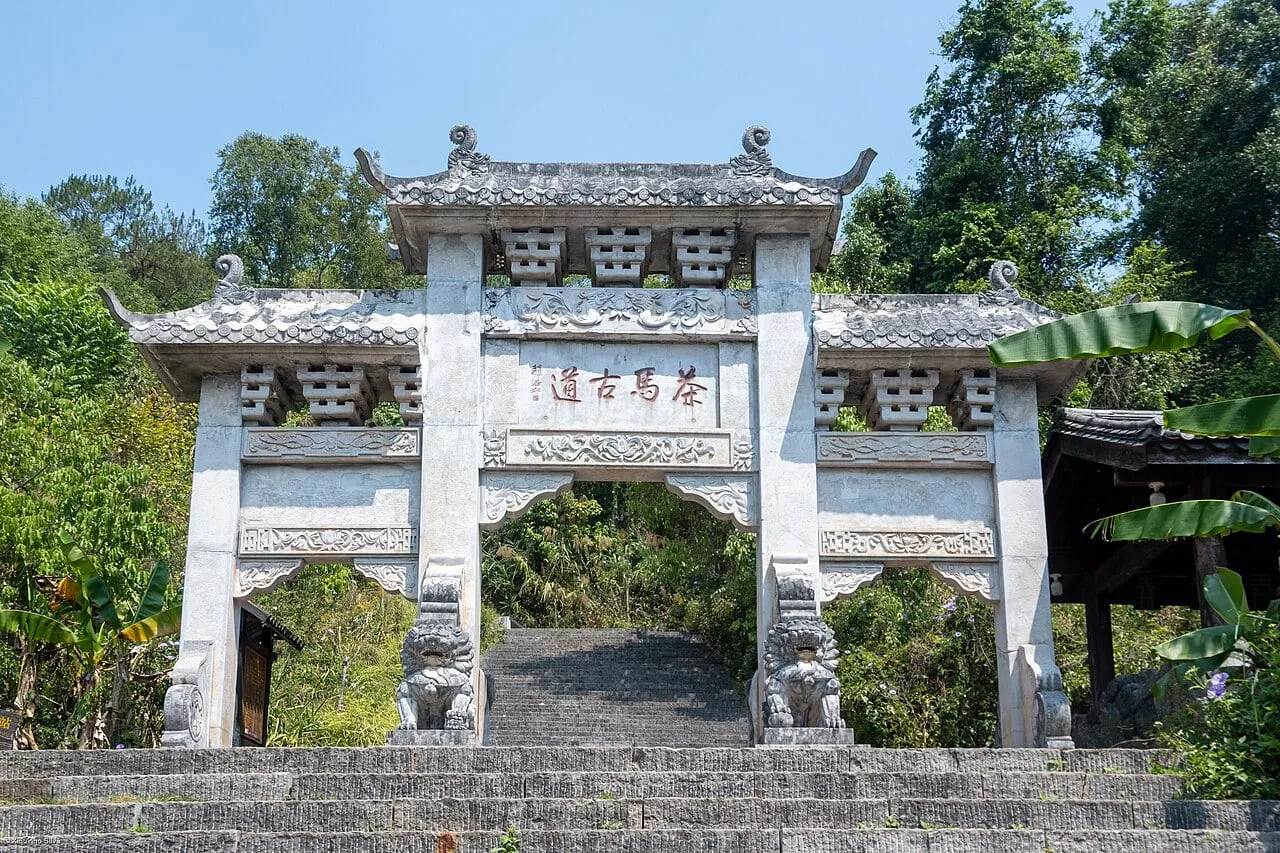
Political Evolution of Imperial Tea-Horse Statecraft
From the Tang dynasty through the Ming and Qing, the tea-horse trade was a paramount strategic pillar of frontier defense and imperial diplomacy:
1. Tang Dynasty (618–907): Border Markets & the Tang–Tubo Corridor
In the 8th century, the Tang court and the Tibetan Empire established official border markets at Chiling (modern Riyue Mountain, Qinghai), where silk was the main currency for horses; records of tea-for-horse exchange multiply from the mid-Tang onward. Following the An Lushan Rebellion, the Tang lost control of northern pasturelands and relied intensely on southern tea-horse corridors. Tradition credits Princesses Wencheng and Jincheng with bringing tea to Tibet; a more reliable record in the Tang Guoshi Bu notes that when the envoy Chang Lu visited the Tibetan king, several famous Chinese teas were already in the royal tent[8][9].
2. Song Dynasty (960–1279): The Tea and Horse Bureau Monopoly
Faced with formidable cavalry forces from the Liao, Jin, and Western Xia, the Song dynasty experienced unprecedented horse deficits. In 1074, the court established a tea-market superintendency, later merged with the horse-purchasing office into the Tea and Horse Bureau (都大提举茶马司), monopolizing Sichuan tea production and border horse markets. Private tea commerce was outlawed, and ten to twenty thousand horses were procured in good years using fixed tea rations from Ya’an, Hanyuan, and Leshan[3][9].
3. Ming Dynasty (1368–1644): The Imperial Tally System (Jinpai Xinfu)
The Ming dynasty elevated tea statecraft to its administrative peak. In 1393, Emperor Zhu Yuanzhang instituted the Imperial Bronze Tally System (Jinpai Xinfu)[9]:
- Matching Tallies: Bronze tallies inscribed with imperial seals (“Imperial decree: fulfill tribute duty; violators shall be executed”) were split in two—one half held by the imperial bureau, the other distributed to Tibetan chieftains. Every three years, officials verified the tallies before allowing tea-for-horse transactions;
- Strict Monopoly Enforcement: Ming statutes imposed capital punishment for illicit tea smuggling across mountain passes, maintaining complete geopolitical leverage. Sichuan teas were codified into “Southern Route Border Tea” (Ya’an to Kangding) and “Western Route Border Tea” (Guanxian to Songpan).
Three Grand Trunk Routes: Geography & Extremes
The interactive map below illustrates the three primary trunk routes: the Sichuan–Tibet, Yunnan–Tibet, and Qinghai–Tibet highways. Click any node to inspect starting points, passes, elevation, distance, and historical cargoes:
Three trunk routes of the Tea Horse Road
Switch routes: start, hub, hard stretch.
Pu-erh through the gorges
- Pu’er, Yiwu: compressed tea sets out
- Dali, Lijiang: caravans gather
- Three Rivers: deep gorges
- Lhasa: the end point
One way took months; gorges and snow passes were the hazards.
Distance, altitude & cargo
- One way
- ~4,000 km
- Altitude
- 1,300 → 4,300 m
- Cargo
- Pu-erh compressed tea ⇄ Tibetan horses, herbs
Distances and altitudes follow this article’s sources [9][10][11]; each route had several branches, and figures vary by source.
Schematic, not to scale; routes shifted over the centuries.
1. The Sichuan–Tibet Route: The Human Porter Epic
Originating in Ya’an, Sichuan, traversing Luding and Kangding (formerly Dajianlu), crossing the formidable Daxueshan range into Chamdo, and terminating in Lhasa[3].
- The Treacherous Ya’an–Kangding Section: This 200 km stretch through misty gorge passes was too narrow and precipitous for pack mules; it was conquered entirely by human porters (beizi).
- Porters negotiated sub-zero blizzards over the 3,000-meter Daxiangling and Erlangshan passes. A local adage captured the horror: “Months 1 to 3, snow seals the peaks; 4 to 6, rain makes you weep; 7 to 9, trails briefly open; winter months, crawl on hands and knees.”
2. The Yunnan–Tibet Route: Pu-erh’s Mountain Journey
Beginning in the ancient tea forests of Yiwu, Pu’er, and Xishuangbanna, cutting across the Hengduan “Three Parallel Rivers” gorges (Jinsha, Lancang, and Nu rivers), climbing past Jade Dragon and Meili Snow Mountains to join the southern route at Markam[1].
- Under the Mu chieftains of Lijiang, Naxi and Tibetan mule caravans (mabang) operated journeys taking up to six months one way.
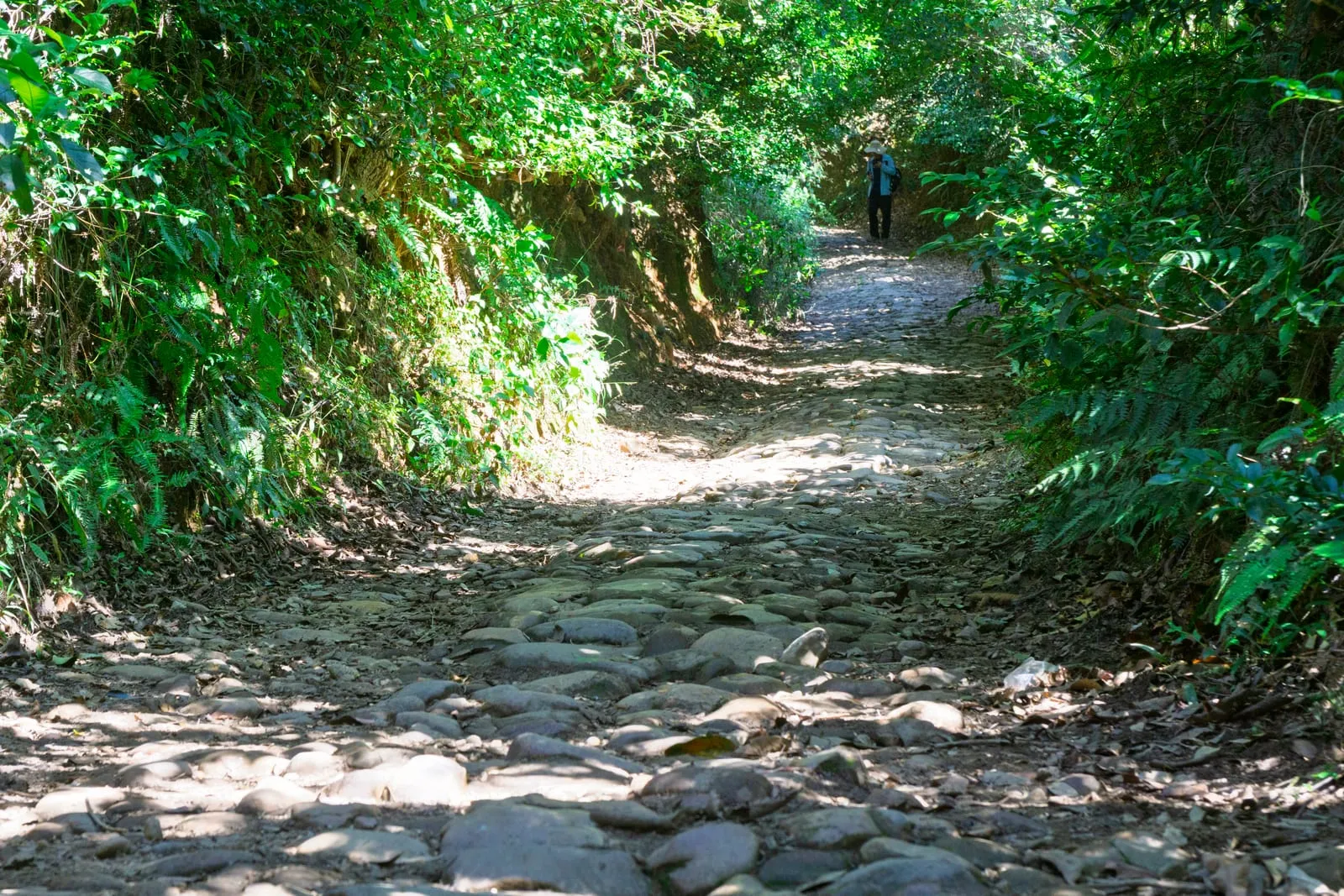
3. The Qinghai–Tibet Route: The Imperial Diplomatic Highway
Departing historical Chang’an or Xining, crossing the source of the Yellow and Yangtze rivers via Yushu into the northern Changtang grasslands to Lhasa[9].
Living Material Heritage: Porters, Caravans, and “Staff Impressions”
The Tea Horse Road forged an extraordinary chapter of human resilience:
How did tea reach the plateau?
Caravans, porters and markets.
Mules carry tea over passes
- A tea bundle on each side
- The lead mule wears a bell
- Snow passes above 4,000 m
Naxi and Tibetan caravans carried the Yunnan trade; one way took months.
About these figures
Porter loads follow the historical accounts cited in this article; a single brick weighed about 8–10 kg, and loads varied with the person and the season.
Figures and gear are schematic, not a reconstruction.
1. Porters and the Beibengzi
On the Sichuan trails, impoverished men, women, and teenagers hauled wooden pack frames (beibengzi) stacked with 8–12 brick tea packs. Adult porters routinely carried 100 to 150 kg (220–330 lbs)—often double their body weight—shod only in straw sandals and carrying a single iron-tipped T-shaped wooden crutch (dading / tingzigua).
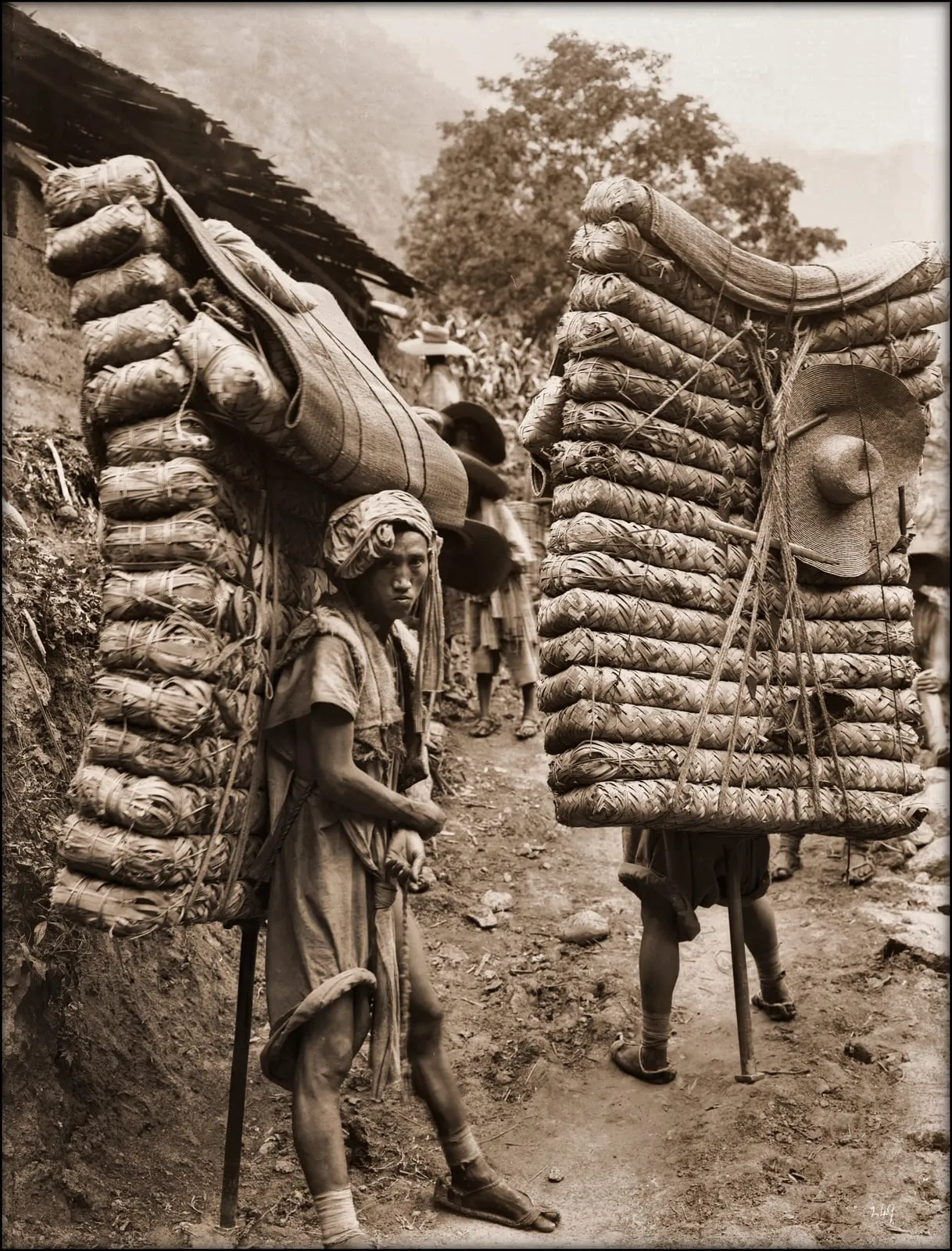
2. The Haunting “Staff Impression Pits” (Dachuwowo)
Because pack weights were crushing, porters could not take off their burdens to sit during rest stops. Instead, they rested by propping the bottom crossbeam of their wooden backpack onto the top crossbar of their iron-tipped crutch while standing. Over centuries, millions of porters rested at the exact same intervals along granite cliff trails, drilling dense indentations 5–10 cm (2–4 inches) deep into solid granite stone slabs—the famous Dachuwowo, one of the most poignant testaments to human toil on earth.
3. Mule Caravans (Mabang) and Frontier Harmony
On animal-accessible segments, horse caravans led by head muleteers (guotou) navigated cliffs, bandits, and avalanches. Brass bells tied to pack animals chimed through river gorges to coordinate passage on single-file ledges, fostering a culture of profound mutual trust, honor, and multi-ethnic coexistence between Han, Tibetan, Naxi, Bai, and Yi communities.
Frontier Compressed Tea Lineages and Caravan Transformation
The cargoes moving along the Tea Horse Road were not fragile loose green teas, but tightly compressed frontier teas (bianxiao cha) engineered to withstand months of abrasion, rain, and altitude swings. Each trunk route carried distinctive regional compressed forms[4][8]:
| Compressed Tea Lineage | Trunk Route & Core Origin | Raw Material & Pressed Form | Caravan Transport & Craft Evolution |
|---|---|---|---|
| Sichuan Southern-Route Border Tea (Kangzhuan / Jinjian) | Sichuan–Tibet Route (Ya’an, Tianquan, Yingjing) | Mature shoots and stems, enzyme-deactivated, pile-fermented multiple times, and steam-pressed into rounded rectangular bricks (Kangzhuan) or woven bamboo packs (Jinjian) | Multi-stage pile fermentation creates a mellow, low-astringency liquor; split-bamboo casing withstands human porter frames and yak packs |
| Sichuan Western-Route Border Tea (Fangbao) | Sichuan–Qinghai / Songpan Route (Dujiangyan, Shifang) | Mature leaves and twigs pan-fired, lightly pile-fermented, and rammed into large square bamboo-woven bales | Bright amber liquor with roasted warmth, supplying pastoral communities across northwestern Sichuan, Qinghai, and southern Gansu |
| Yunnan Compressed Tea (Round Cake / Jincha / Tuocha) | Yunnan–Tibet Route (Yiwu, Pu’er, Simao, Xiaguan) | Yunnan large-leaf sun-dried maocha steamed and pressed into disc cakes, stemmed heart-shaped “mushroom bricks” (Jincha), or bowl-shaped Tuocha | The heart-shaped Jincha with a necked stem left airflow channels between packed bricks, preventing heat buildup and mould while crossing humid river gorges[8] |
| Shaanxi–Hunan Official Brick Tea (Fuzhuan) | Qinghai–Tibet / Tang–Tubo Route (Hunan dark maocha pressed in Jingyang/Anhua) | Dark maocha pile-fermented, pressed into bricks, and conditioned in warm humid rooms to cultivate golden Eurotium cristatum (“golden flowers”) | Calibrated brick density allows aerobic fungal growth inside the core; see Anhua Fuzhuan Tea and Dark Tea Wodui Science |
Notably, mule caravans travelling from Xishuangbanna or Simao to Lhasa spent six months or more crossing sweltering 1,000 m river valleys and freezing 4,500 m mountain passes. Exposed to alternating river mist, monsoon rain, sunshine, and pack-mule warmth, sun-dried Yunnan cakes underwent slow hydrothermal non-enzymatic auto-oxidation and microbial post-fermentation en route—arriving on the plateau noticeably darker, smoother, and sweeter. This “ageing on horseback” is often cited as background to later pile fermentation; the 1970s wodui process for ripe Pu-erh drew directly on wet-piling methods from Guangdong and elsewhere[4][8].
Modern Heritage and Cultural Rebirth
By the mid-20th century, paved alpine highways and railways replaced foot trails and horse bells. In the 1990s, Chinese scholars Mu Jihong, Chen Baoya, and Li Xu conducted extensive field expeditions, officially naming and theorizing the “Tea Horse Road” in global academic discourse[1][2].
Today, the Tea Horse Road is preserved as a Major Historical and Cultural Site Protected at the National Level, representing an enduring monument of multi-ethnic integration, ecological diversity, and cultural exchange across the roof of the world.
See also
- Chinese Tea History & Botanical Origins — the macro-historical journey of tea from southwestern forests to imperial institutions
- Global Tea Trade History — compare overland caravan networks with maritime East India Company and clipper-ship trade
- The Science of Dark Tea: Wodui — biochemistry of microbial and hydrothermal post-fermentation in border brick teas and ripe Pu-erh
- Raw Pu-erh & Ripe Pu-erh — how Yunnan–Tibet caravan cakes evolved into modern sun-dried and pile-fermented Pu-erh styles
- Anhua Fuzhuan Tea — how frontier horse-market brick tea gave rise to the “golden flower” (Eurotium cristatum) craft
- China’s Four Great Tea Regions — alpine river-gorge geography and the southwestern tea gene pool
References
- R-035 — 木霁弘、李旭等.《滇藏川“大三角”文化探秘》. 云南大学出版社,1992.
- R-036 — 格勒.《茶马古道的历史作用与当代意义》. 《中国藏学》,2002.
- R-037 — 石硕.《茶马古道及其历史文化价值》. 《西藏研究》,2002.
- R-029 — 宛晓春 主编 (2003).《茶叶生物化学》(第3版). 中国农业出版社. ISBN: 978-7109066274.
- R-038 — Yang Fuquan(杨福泉). Research on the Tea Horse Road and socio-economic development of ethnic areas in southwest China. Yunnan Social Sciences.
- R-039 — T. Matthew Ciolek. Tea and horse trade routes in Tibet, Sichuan and Yunnan c. 680–1950 CE. OWTRAD GIS-ready datasets. Australian National University. http://www.ciolek.com/OWTRAD/DATA/tmcCNm0680a.html
- R-040 — Tea Horse Road. Wikipedia. https://en.wikipedia.org/wiki/Tea_Horse_Road
- R-030 — 陈宗懋 主编 (2000).《中国茶叶大辞典》. 中国轻工业出版社. ISBN: 978-7501925094.
- R-113 — 朱自振.《中国茶叶历史资料选辑》. 农业出版社, 1981.
Article Knowledge Network
Explore the connections between the teas, processes and flavours in this article.